

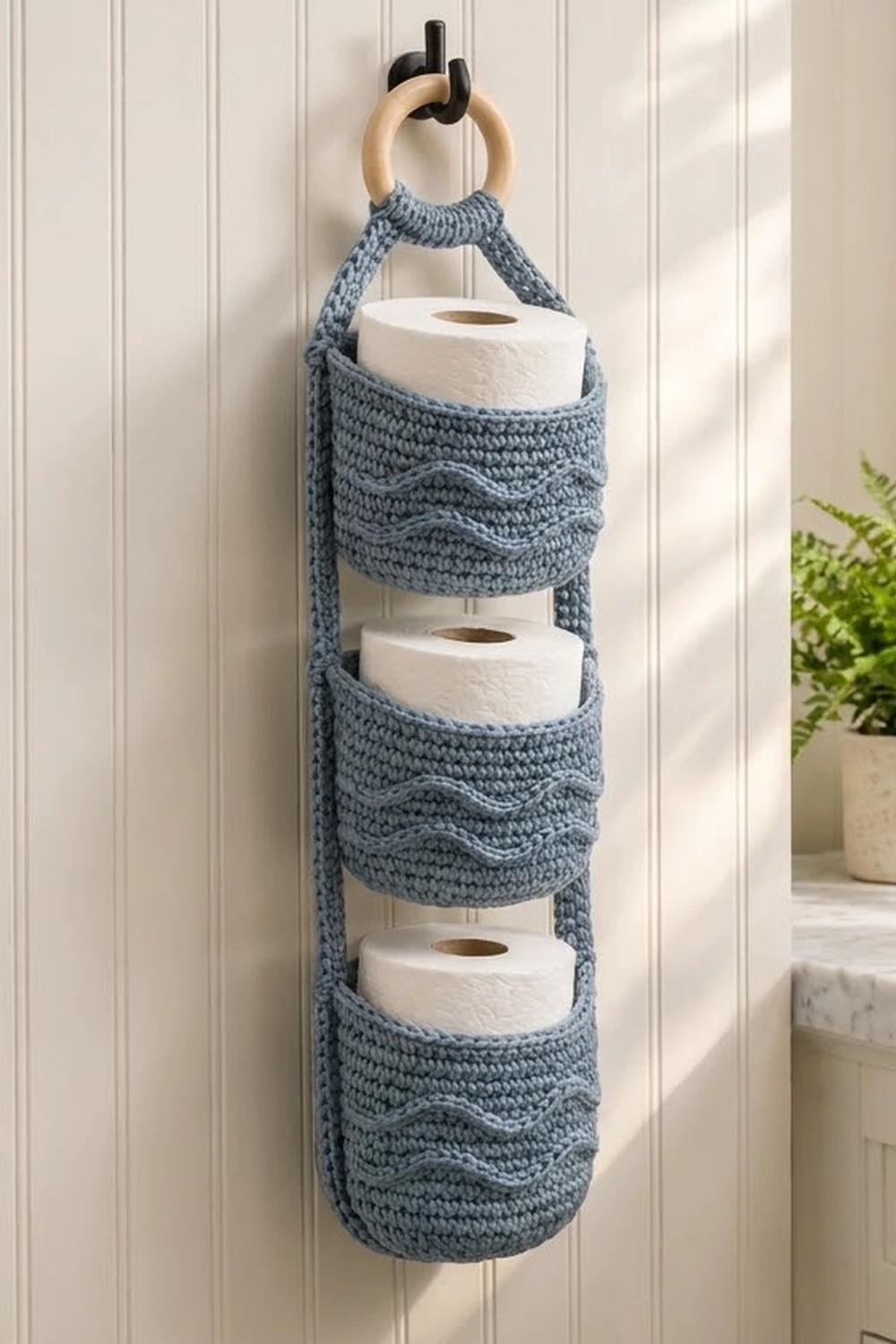
The Blue Tide Hanging Toilet Paper Holder has three soft, rounded pockets stacked one above the other on two crocheted side straps. The straps meet at a natural wooden ring, so the whole piece hangs from a single wall hook. Each pocket holds one standard roll.
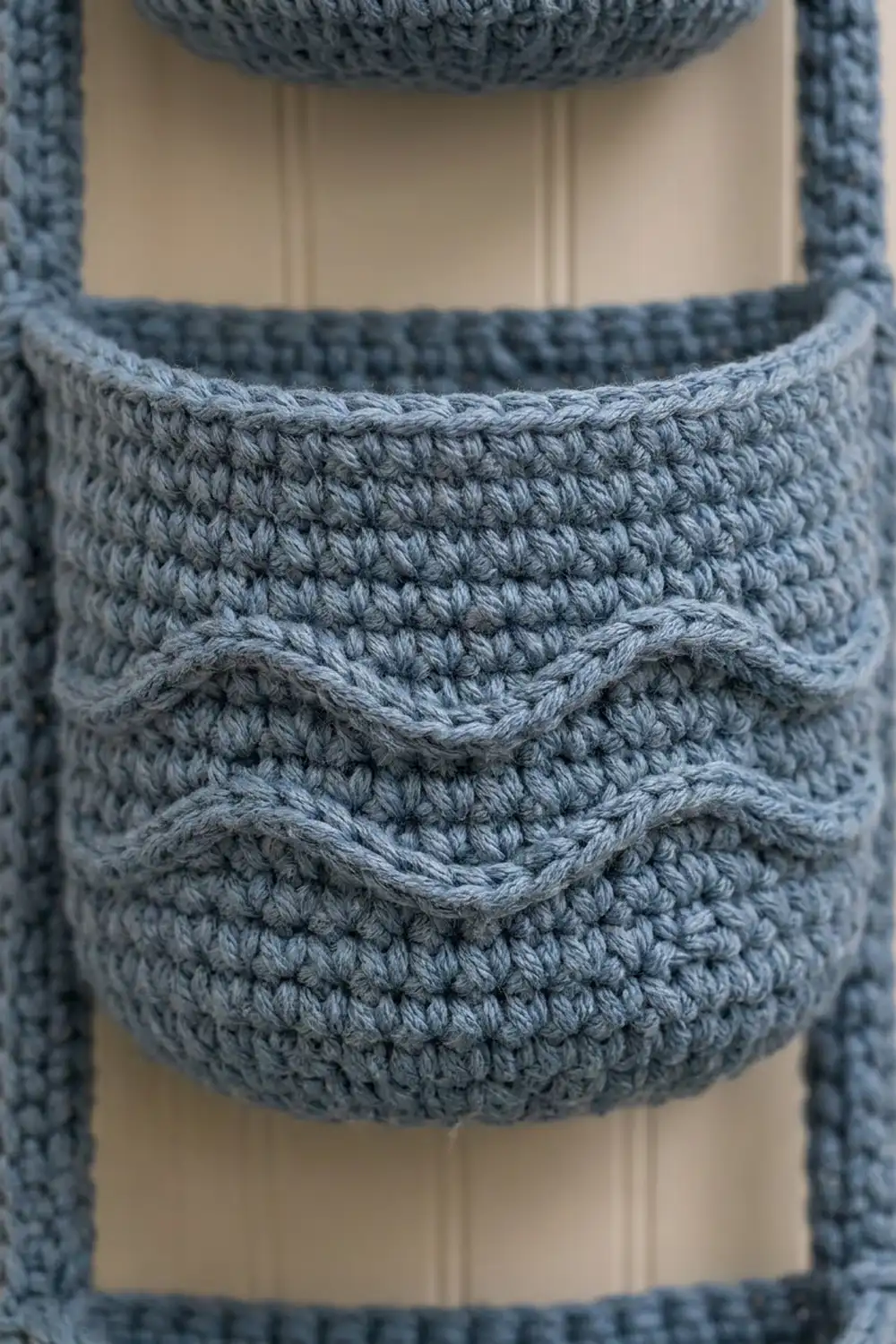
The holder uses a single dusty blue cotton, and all the texture comes from the stitches. The pockets are dense single crochet. Two raised, wavy cords run across the front of each pocket and look like gentle ripples on water. The style is calm, coastal, and practical.
This pattern uses US crochet terms. Laid flat, the finished holder measures about 8.75 in (22.2 cm) wide including the straps. It is about 24 in (61.0 cm) long from the top of the ring to the bottom of the lowest pocket.
Construction is simple:
- Make three identical pockets with oval bases, working in joined rounds.
- Add the waves in surface slip stitch.
- Crochet two flat straps.
- Cover the lower part of the wooden ring.
- Sew the pockets to the straps, one strap stitch per round.
Finished Size and Construction
- Finished size: about 8.75 in (22.2 cm) wide flat × 24 in (61.0 cm) long
- Skill level: Easy+ (basic stitches plus surface slip stitch)
- Terminology: US
- Yarn weight: worsted (#4) cotton
- Hook: 5.0 mm (H-8)
- Number of pieces: 6 crocheted pieces (3 pockets, 2 straps, 1 ring band) plus 1 wooden ring
- Layout: 3 pockets stacked vertically in 1 column
- Piece size: each pocket about 7.7 in (19.6 cm) wide × 6 in (15.2 cm) tall when flattened
- Size before border: each strap 22 in (55.9 cm) long × 0.6 in (1.5 cm) wide
- Border depth: a single slip-stitch round, which adds no measurable width
Materials
Choose a smooth, firmly twisted worsted-weight cotton or cotton blend of about 170 m per 100 g. Cotton holds the pocket shape and survives a humid bathroom. Avoid very soft acrylic, which sags under the weight of a roll.
- Dusty Blue: 200 g, about 340 m
Tools:
- 5.0 mm (H-8) crochet hook
- 1 wooden ring, 3 in (7.6 cm) outer diameter
- 4 stitch markers
- Tapestry needle
- Scissors
- Measuring tape
- Pins
These quantities are about 15 percent more than the measured total, so you won’t run short if your gauge is a little loose.
Abbreviations (US Terms)
- ch – chain
- sc – single crochet
- sl st – slip stitch
- st(s) – stitch(es)
- BLO – back loop only
- rnd(s) – round(s)
- rep – repeat
Special stitch – surface slip stitch (surf sl st): Hold the working yarn behind the fabric. Insert the hook from front to back through the center of the indicated sc, yarn over, and pull a loop through the fabric and through the loop on the hook. Each surf sl st makes one raised V on the front, like a chain stitch.
Gauge and Checkpoints
Gauge: 14 sc and 14 rnds = 4 in (10.2 cm) in joined rounds, worked firmly.
The gauge is square on purpose. When you join the pieces, one strap stitch must match one pocket round, so stitch width and round height need to be the same.
Test one piece first. Work Rnds 1–8 of one pocket and check these points:
- After Rnd 7: the oval base measures about 5.75 in (14.6 cm) long × 4 in (10.2 cm) wide.
- After Rnd 8: the perimeter measures 15.4 in (39.1 cm).
- After Rnd 21: the sides measure 4 in (10.2 cm) from Rnd 8 to the top of Rnd 21.
If the base is too big, use a hook 0.5 mm smaller. If it is too small, use a hook 0.5 mm larger. If the stitch count per inch is right but the rounds are too short, pull each loop up slightly taller. If the rounds are too tall, keep the loops snug on the hook.
Pocket (Make 3)
The pocket starts with an oval base. One BLO round turns it upward, and joined rounds continue straight up from there. Join every round with a sl st to the first sc, and ch 1 at the start of each round (the ch 1 does not count). Joined rounds keep the stitches stacked in straight columns, which matters for the waves and the joining.
Base
Ch 9.
Rnd 1: 3 sc in 2nd ch from hook, sc in next 6 ch, 3 sc in last ch. Rotate and work along the other side of the foundation chain: sc in next 6 ch. Join. (18 sts)
The first 3 sts form end A, the next 6 form side 1, the next 3 form end B, and the last 6 form side 2.
Rnd 2: Ch 1, 2 sc in each of next 3 sts, sc in next 6 sts; rep from * once. Join. (24 sts)*
Rnd 3: Ch 1, (sc in next st, 2 sc in next st) 3 times, sc in next 6 sts; rep from * once. Join. (30 sts)*
Rnd 4: Ch 1, (sc in next 2 sts, 2 sc in next st) 3 times, sc in next 6 sts; rep from * once. Join. (36 sts)*
Rnd 5: Ch 1, (sc in next 3 sts, 2 sc in next st) 3 times, sc in next 6 sts; rep from * once. Join. (42 sts)*
Rnd 6: Ch 1, (sc in next 4 sts, 2 sc in next st) 3 times, sc in next 6 sts; rep from * once. Join. (48 sts)*
Rnd 7: Ch 1, (sc in next 5 sts, 2 sc in next st) 3 times, sc in next 6 sts; rep from * once. Join. (54 sts)*
Each end group now has 21 sts and each side has 6 sts: 21 + 6 + 21 + 6 = 54.
Mark the fold lines. Place a marker in st 11 (the center of end A) and another in st 38 (the center of end B). These are the left and right fold stitches, where the straps attach.
- Front panel: sts 12–37 (26 sts)
- Back panel: sts 39–54 and 1–10 (26 sts)
Check: 26 + 26 + 2 fold sts = 54.
Sides
Rnd 8: Ch 1, sc in BLO of each st around. Join. (54 sts)
The unused front loops make a neat ridge where the base turns upward.
Rnds 9–21: Ch 1, sc in each st around. Join. (54 sts)
Move the fold markers up every few rounds so they stay in sts 11 and 38. You now have 14 side rounds (Rnds 8–21), or 4 in (10.2 cm).
Rnd 22 (rim): Work the rim round given in the Border section. Then fasten off and weave in the tail on the back panel.
Waves
Each pocket gets two waves, on the front panel only. Cut two strands of yarn, each 60 in (152.4 cm) long, and hold them together. The doubled yarn makes a plump, cord-like ridge.
Each wave climbs across three levels of rounds: low (L), middle (M), and high (H). Work 1 surf sl st into each listed stitch, on the listed round:
- Sts 12–13 on L
- Sts 14–15 on M
- Sts 16–17 on H
- Sts 18–19 on M
- Sts 20–21 on L
- Sts 22–23 on M
- Sts 24–25 on H
- Sts 26–27 on M
- Sts 28–29 on L
- Sts 30–31 on M
- Sts 32–33 on H
- Sts 34–35 on M
- Sts 36–37 on L
That is 26 surf sl sts per wave, with three crests. The middle crest (sts 24–25) sits exactly at the center of the front panel, so the wave is symmetrical and you can start from either fold line.
To change levels, insert the hook straight into the next listed stitch on its new round. That short diagonal step makes the curve.
- Wave 1: L = Rnd 11, M = Rnd 12, H = Rnd 13
- Wave 2: L = Rnd 16, M = Rnd 17, H = Rnd 18
To start, pull a loop of the doubled yarn up from the back at st 12 of the low round. To finish, pull the tails through to the inside after st 37 and weave them in behind the sc. Keep the surface stitches as loose as the sc beneath them, because tight waves pucker the front.
Rnds 8–10, 14–15, and 19–21 stay plain, giving calm bands below, between, and above the waves.
Straps (Make 2)
Ch 78.
Row 1: Sc in 2nd ch from hook and in each ch across. (77 sts)
Row 2: Ch 1, turn, sc in each st across. (77 sts)
Don’t fasten off. Go straight on to the strap edging in the Border section.
Each strap is 77 sts = 22 in (55.9 cm) long and 0.6 in (1.5 cm) wide. Stitch 1 is the bottom end.
Ring Band (Make 1)
Hold the wooden ring. Join the yarn with a sc worked over the ring, then work 17 more sc over the ring. (18 sts)
Push the stitches together so they cover the lower arc snugly. Fasten off, leaving a 12 in (30.5 cm) tail for sewing.
Make All Pieces
All pieces are Dusty Blue:
- 3 pockets, about 50 g / 85 m each, waves included
- 2 straps, about 10 g / 17 m each
- 1 ring band, about 3 g / 5 m
These pieces use about 173 g in total. The 200 g in Materials adds the spare margin.
Layout:
            [ Ring + Band ]
             /           \
      Strap L             Strap R
      (sts 64–77 free)    (sts 64–77 free)
      |  [ Pocket 3, top    ]  |   sts 43–63
      |  [ Pocket 2, middle ]  |   sts 22–42
      |  [ Pocket 1, bottom ]  |   sts 1–21
Joining
Each pocket uses exactly 21 strap stitches: 7 for the base (Rnds 1–7) and 14 for the sides (Rnds 8–21). That is one strap stitch per pocket round.
- Pocket 1 (bottom): strap sts 1–21
- Pocket 2 (middle): strap sts 22–42
- Pocket 3 (top): strap sts 43–63
- Free section to the ring: strap sts 64–77 (14 sts, 4 in / 10.2 cm)
Check: 21 × 3 + 14 = 77 sts.
Method: Whipstitch with a long tail of Dusty Blue and the tapestry needle.
- Lay Pocket 1 face down. Place the left strap beside the left fold line (the st 11 column), with strap st 1 at Rnd 1 of the base.
- Working up the base curve, sew one strap st to the fold st of each base round: strap sts 1–7 to Rnds 1–7.
- Continue up the side, sewing strap sts 8–21 to Rnds 8–21 of the st 11 column.
- Repeat on the right fold line (the st 38 column) with the right strap.
- Attach Pocket 2 to strap sts 22–42 and Pocket 3 to strap sts 43–63 in the same way.
The rim round of each pocket sits just above strap st 21, 42, or 63 and stays free.
Tension: Pull each whipstitch just enough to close the gap. If you pull hard, the strap shortens and gathers the side of the pocket.
Ring: Lay the last 2 sts (76–77) of the left strap behind ring band sts 5–9. Lay the last 2 sts of the right strap behind ring band sts 10–14. Sew through both layers several times, because this joint carries all the weight.
Size checkpoint: Laid flat, the three pockets together measure 18 in (45.7 cm) from the bottom of Pocket 1 to the rim of Pocket 3. Each pocket should touch the next one at its base but not overlap it.
Border
The border is a slip-stitch edging. It firms the pocket rims and gives the straps a smooth edge that looks like cord.
Border gauge: 1 sl st per stitch or row end, keeping the 14 sts = 4 in (10.2 cm) gauge.
Pocket Rim
Rnd 22: Ch 1, sl st in each st around. Join. (54 sl sts = 54 existing sts + 0 added)
Strap Edging
Rnd 3 (worked around the strap): Ch 1, do not turn.
- Long side 1: sl st in each st of Row 2. (77 sl sts)
- Short end: sl st in each row end. (2 sl sts)
- Long side 2: sl st in each st along the foundation chain. (77 sl sts)
- Short end: sl st in each row end. (2 sl sts)
Join to the first sl st. (158 sl sts)
The 77 on each long side already includes the corner stitches, so nothing is counted twice. Check: 77 + 2 + 77 + 2 = 158.
Why the math works: Each edging round puts exactly 1 sl st into each existing stitch or row end, with no extras at the corners. Because the edging is the same length as the edge, the rim doesn’t flare and the strap stays exactly 77 sts = 22 in (55.9 cm). That keeps the one-strap-stitch-per-round joining accurate.
Final Blocking
- Weave in all ends before blocking.
- Mist the whole holder lightly with cool water. Don’t soak it, because wet cotton stretches under its own weight.
- Lay it flat on a towel, front up.
- Pin each strap straight to 22 in (55.9 cm).
- Fill each pocket with a dry hand towel, or with a toilet roll inside a plastic bag, to set the round shape.
- Smooth each wave with a fingertip so the crests line up.
- Let it dry completely flat, then hang it.
Final Quality-Control Checklist
- Each pocket has 54 sts in every round from Rnd 7 to Rnd 22.
- Each base measures about 5.75 × 4 in (14.6 × 10.2 cm).
- Every pocket has sides 4 in (10.2 cm) tall.
- Each wave has 26 surf sl sts and three crests, centered on the front panel.
- Each strap has 77 sts and 158 edging sl sts.
- Each pocket is sewn to exactly 21 strap sts on each side.
- Both free strap sections are 14 sts, so the holder hangs level.
- The ring joint is sewn securely through both layers.
- Overall length is about 24 in (61.0 cm).
Troubleshooting
Base curls into a bowl: Your increases are too tight. Go up a hook size for Rnds 1–7 only.
Base ruffles: Check your stitch counts, because an extra increase in each round adds up fast.
Waves look flat: Use doubled yarn, and work one surf sl st into every listed stitch, not every other one.
Front puckers behind the waves: Loosen the surface stitches until they lie as wide as the sc beneath them.
Pockets overlap or leave gaps: Your rounds are taller or shorter than your stitches are wide. Ease the strap to fit, keeping one strap st per round.
Holder hangs crooked: Count the free strap stitches on each strap. Both must be 14.
Roll doesn’t fit: A standard roll is about 4.5 in (11.4 cm) across and needs the full 15.4 in (39.1 cm) perimeter. If your rolls are larger, add one more base round (60 sts).
Care
Hand wash in cool water with mild soap, press the water out in a towel, and dry flat. Reshape the pockets while they are damp.
Final Notes
Each measurement leads to the next:
- The gauge is 14 sts and 14 rnds = 4 in (10.2 cm).
- The base grows to 54 sts, a 15.4 in (39.1 cm) perimeter.
- Fourteen side rounds give 4 in (10.2 cm) walls.
- Each pocket is 21 rounds, or 6 in (15.2 cm).
- The three pockets use 63 strap stitches, and 14 more reach the ring, for a 77-st strap 22 in (55.9 cm) long.
If you keep each of those numbers accurate, the holder will hang straight and hold every roll neatly.
Happy crocheting!