

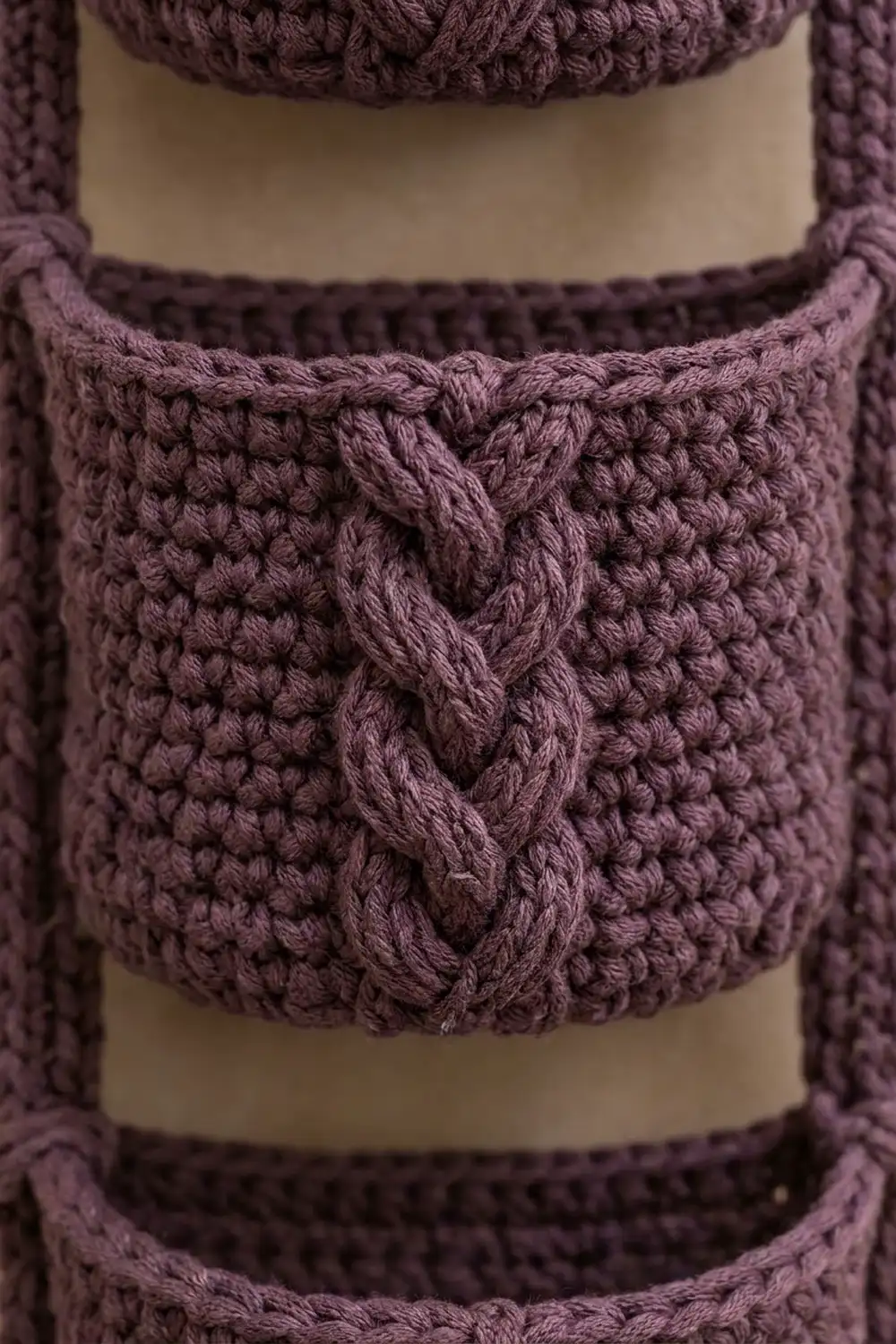
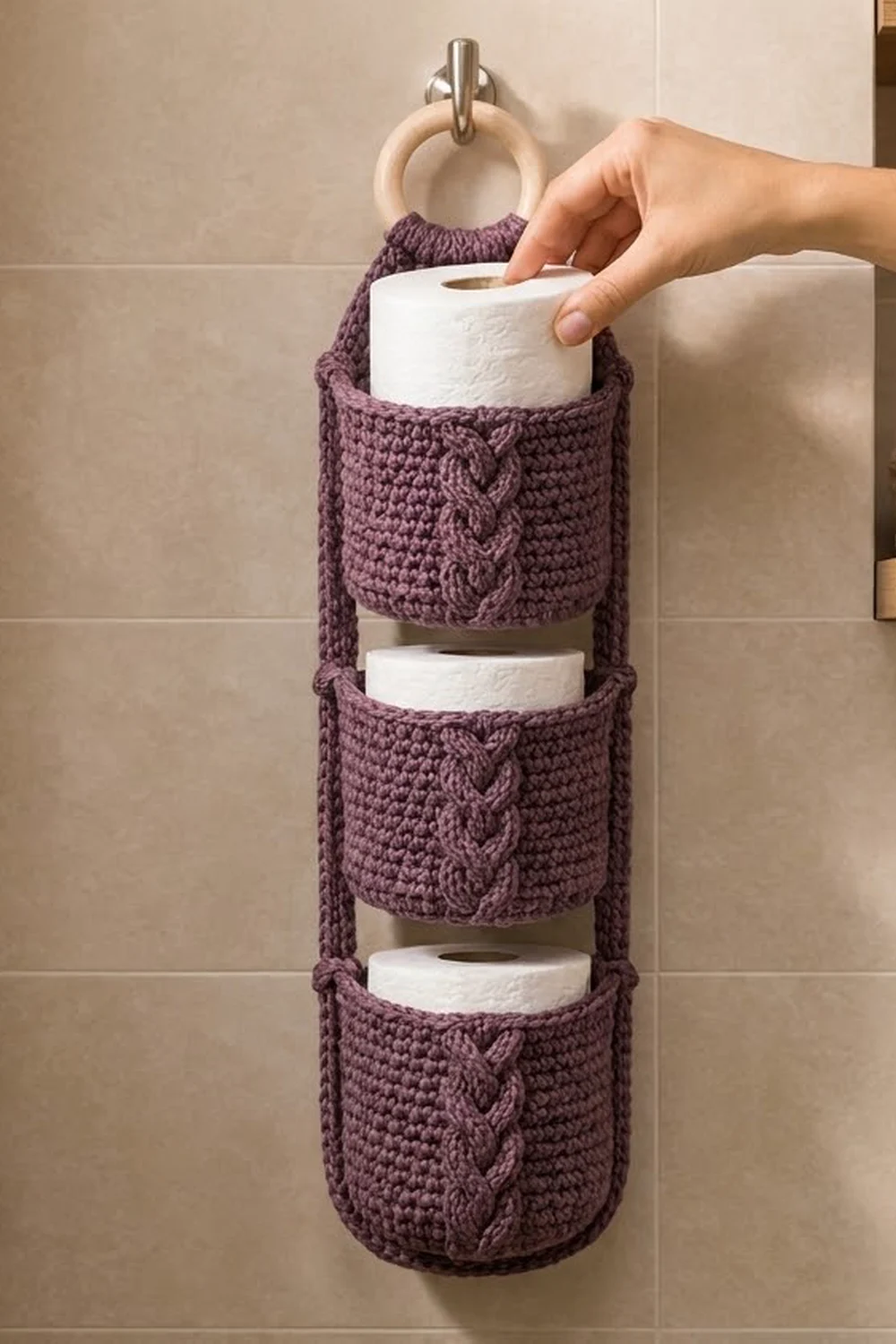
This hanging toilet paper holder keeps three spare rolls tidy and within reach. Three round pockets are stacked in a neat vertical column, each one decorated with a raised three-strand braid cable down the front. Two sturdy side cords run the full length, gather at the top, and hang from a natural wooden ring.
The sample is worked in a single shade of deep plum, a muted purple that looks calm against beige tile, white towels and brushed-metal fixtures. The style is simple and modern: dense single crochet texture, one bold cable per pocket, and a clean rolled rim.
This pattern uses US crochet terms. The finished holder measures about 20½ in (52.1 cm) long from the top of the ring to the bottom of the lowest pocket and about 6 in (15.2 cm) wide including the cords. Each pocket is 5¼ in (13.3 cm) across and 3½ in (8.9 cm) tall, sized for a standard roll about 4½ in (11.4 cm) wide.
Construction is straightforward. Each pocket starts as a flat single crochet circle, turns upward with a back-loop round, and builds its walls in rounds while the braid is worked with front post treble crochet. A two-round rim finishes each pocket. You then make two Romanian cords, wrap the bottom of a wooden ring with single crochet, and sew the pockets to the cords.
Finished Size and Construction
- Finished size: 20½ in (52.1 cm) long × 6 in (15.2 cm) wide
- Skill level: Intermediate (post stitches and cable crosses)
- Terminology: US crochet terms
- Yarn weight: Medium / worsted (#4)
- Hook: 4.5 mm (US 7)
- Number of pieces: 3 pockets, 2 cords, 1 ring wrap worked directly onto the ring
- Layout: 1 column of 3 pockets, hung from 1 ring
- Pocket size: 5¼ in (13.3 cm) diameter × 3½ in (8.9 cm) tall
- Pocket size before rim (border): 5¼ in (13.3 cm) diameter × 3 in (7.6 cm) tall
- Rim (border) depth: 2 rounds, about ½ in (1.3 cm)
Materials
Choose a smooth worsted-weight cotton or cotton blend. Cotton holds its shape, shows cable definition well, and copes with bathroom humidity. Avoid fuzzy or very splitty yarns, which blur the braid.
- Plum (only color): 300 g, about 540 m (590 yd). Each pocket uses about 65 g, the two cords about 20 g together, and the ring wrap about 5 g.
Tools:
- 4.5 mm (US 7) crochet hook
- Wooden ring, 3 in (7.6 cm) outer diameter
- 4 locking stitch markers
- Tapestry needle
- Scissors
- Measuring tape
- One toilet roll for fitting
Yarn quantities include a margin of roughly 30% for gauge swatching and differences in tension.
Abbreviations (US Terms)
- BLO – back loop only
- ch – chain
- FPtr – front post treble crochet
- inc – 2 sc in the same stitch
- rnd(s) – round(s)
- sc – single crochet
- sl st – slip stitch
- st(s) – stitch(es)
- rev sc – reverse single crochet (crab stitch)
FPtr (front post treble crochet): Yo twice, insert hook from front to back to front around the post of the indicated stitch two rounds below, yo and pull up a loop, (yo and pull through 2 loops) 3 times. Always skip the sc directly behind each FPtr so the count stays the same.
Romanian cord: Ch 2, sc in 2nd ch from hook. Turn the work clockwise so the side faces you, insert hook under the single vertical loop at the left, sc. *Turn clockwise again, insert hook under the 2 loops now at the left, sc. Repeat from * for the length required. It produces a square, rope-like cord about ⅜ in (1.0 cm) wide.
Gauge and Checkpoints
Gauge: 16 sc and 18 rnds = 4 in (10.2 cm) in sc worked in the round.
Make one complete pocket first and check it against a toilet roll before starting the others. Use these checkpoints:
- After Rnd 6 (36 sts): base about 2¾ in (7.0 cm) across.
- After Rnd 11 (66 sts): base 5 to 5¼ in (12.7 to 13.3 cm) across, lying flat.
- After Rnd 19: wall about 1¾ in (4.4 cm) tall measured from the BLO ridge.
- After Rnd 25 (before rim): wall about 3 in (7.6 cm) tall.
- After Rnd 27 (finished): wall 3½ in (8.9 cm) tall; circumference 16½ in (41.9 cm).
Too big: if the base passes 5½ in (14.0 cm), go down to a 4 mm (US G-6) hook. A loose pocket lets the roll lean.
Too small: if the base is under 4¾ in (12.1 cm), go up to a 5 mm (US H-8) hook. A roll should slide in with gentle ease, not be forced.
Pocket (Make 3)
Work in continuous rounds. Do not join or turn. Mark the first stitch of each round and move the marker up as you go.
Base
Rnd 1: Make a magic ring, 6 sc in ring. (6 sts)
Rnd 2: Inc in each st around. (12 sts)
Rnd 3: (Sc 1, inc) 6 times. (18 sts)
Rnd 4: (Sc 2, inc) 6 times. (24 sts)
Rnd 5: (Sc 3, inc) 6 times. (30 sts)
Rnd 6: (Sc 4, inc) 6 times. (36 sts)
Rnd 7: (Sc 5, inc) 6 times. (42 sts)
Rnd 8: (Sc 6, inc) 6 times. (48 sts)
Rnd 9: (Sc 7, inc) 6 times. (54 sts)
Rnd 10: (Sc 8, inc) 6 times. (60 sts)
Rnd 11: (Sc 9, inc) 6 times. (66 sts)
The base should lie flat. Stagger the increases slightly if it starts to look hexagonal.
Walls and Braid
Rnd 12 (turning round): Sc in BLO of each st around. (66 sts = 66 worked 1-per-stitch + 0 added)
This round forms a crisp ridge, and the walls now rise upward.
Rnd 13: Sc in each st around. (66 sts)
Rnd 14 (cable set-up): Sc 30, FPtr around each of the next 6 sts of Rnd 12, skipping the 6 sts behind them, sc 30. (66 sts = 60 sc + 6 FPtr)
Stitches 31 to 36 are the cable panel. Number the 6 FPtr as strands 1–2, 3–4 and 5–6 in working order.
Rnd 15 and all odd rnds through Rnd 25: Sc in each st around, including the tops of the FPtr. (66 sts)
Rnd 16 (Cross A): Sc 30, skip the first 2 FPtr of the round below, FPtr around the next 2 FPtr (3–4), then working in front of the sts just made, FPtr around the 2 skipped FPtr (1–2), FPtr around the last 2 FPtr (5–6), sc 30. (66 sts = 60 sc + 6 FPtr)
Rnd 18 (Cross B): Sc 30, FPtr around the first 2 FPtr, skip the next 2 FPtr, FPtr around the following 2 FPtr, then working behind the sts just made, FPtr around the 2 skipped FPtr, sc 30. (66 sts = 60 sc + 6 FPtr)
In both crosses, the strand that moves into the center lies on top. Alternating them is what creates the three-strand braid.
Rnd 20: Repeat Cross A. (66 sts)
Rnd 22: Repeat Cross B. (66 sts)
Rnd 24 (finish braid): Sc 30, FPtr around each of the 6 FPtr, sc 30. (66 sts = 60 sc + 6 FPtr)
Rnd 25: Sc in each st around. (66 sts)
This gives four crosses and a braid about 2½ in (6.4 cm) long, centered on the front of the wall.
Rim (Border)
The rim is the border for each pocket.
Border gauge: 4½ rnds = 1 in (2.5 cm); 4 sts = 1 in (2.5 cm).
Before working the rim, place markers on the two side stitches: st 17 and st 50. This divides the round into:
- Front: sts 18–49 = 32 sts (the braid sits in the middle at sts 31–36)
- Back: sts 51–66 and 1–16 = 32 sts
- Side stitches: 2
Rnd 26: Sc in each st around. (66 sts = 32 front + 32 back + 2 side sts; 66 worked 1-per-stitch + 0 added)
Rnd 27: Rev sc in each st around. (66 sts = 66 worked 1-per-stitch + 0 added) Sl st to first st, fasten off, and weave in the end.
Why the math works: The rim keeps exactly 66 sts, so it neither flares nor pulls in. At 16 sts per 4 in (10.2 cm), 66 sts give a 16½ in (41.9 cm) circumference and a 5¼ in (13.3 cm) diameter. A standard roll 4½ in (11.4 cm) wide has a circumference of about 14¼ in (36.2 cm), so you have just over 2 in (5.1 cm) of ease. The 2 rim rounds add about ½ in (1.3 cm), bringing the wall from 3 in (7.6 cm) to 3½ in (8.9 cm). Leave the side markers in place for joining.
Make All Pieces
- Pockets: 3 in plum, about 65 g each
- Cords: 2 in plum, about 10 g each
- Ring wrap: 1, worked directly on the wooden ring, about 5 g
Cords (Make 2)
Work a Romanian cord to 19½ in (49.5 cm). Fasten off, leaving a 12 in (30.5 cm) tail for sewing.
This length is the 18 in (45.7 cm) that runs below the ring plus 1½ in (3.8 cm) to fold over the ring.
Ring Wrap
Join yarn around the wooden ring with a sl st. Work 14 sc over the ring, covering the lower third of the ring, about 2¾ in (7.0 cm) of arc. Fasten off and weave in the ends.
Layout (front view):
          ( RING )
          /      \
   cord  /  4 in  \  cord
        |[POCKET 1]|   3½ in
        |   gap    |   1½ in
        |[POCKET 2]|   3½ in
        |   gap    |   1½ in
        |[POCKET 3]|   3½ in
         \_tucked_/    ½ in under base
Joining
Method: Whipstitch with the cord tails or a matching length of yarn.
1. Cords to ring: Fold the top 1½ in (3.8 cm) of one cord over the ring at one end of the ring wrap, and sew the fold securely to the cord. Repeat with the second cord at the other end of the wrap. The cords now hang in a V.
2. Top pocket: Measure 4 in (10.2 cm) down each cord from the ring. Align that point with the top of the rim at a side stitch (st 17 on one side, st 50 on the other). Whipstitch the cord to the pocket’s side stitch column, one stitch per round, from Rnd 27 down to Rnd 12. That is 16 stitches on each side, matching the 3½ in (8.9 cm) wall.
3. Gap: Leave 1½ in (3.8 cm) of cord free below the top pocket.
4. Middle and bottom pockets: Join them in the same way, 16 rounds per side, with the braid facing front each time.
5. Cord ends: Tuck the last ½ in (1.3 cm) of each cord under the bottom pocket and sew it to Rnd 11 of the base.
Tension: Sew firmly but don’t pull. If the stitching is too tight, the walls pucker and the cords shorten. Keep the cord flat, not twisted, along each side.
Size checkpoint: Hang the holder. It should measure 20½ in (52.1 cm) from the top of the ring to the bottom of the lowest pocket, and 6 in (15.2 cm) across the widest pocket including the cords.
Final Blocking
- Lightly mist each pocket with water, or wet-block it if you’re using cotton.
- Slide a toilet roll into each pocket to shape it into a cylinder.
- Gently push the base flat from inside and straighten the braid so it runs vertically through the center front.
- Lay the holder flat with the cords straight and parallel, and check that each gap measures 1½ in (3.8 cm).
- Let it dry completely, at least 24 hours, before hanging it in a damp bathroom.
Final Quality-Control Checklist
- Each base has 66 sts and lies flat.
- Each wall is 3½ in (8.9 cm) tall, with 66 sts in every round.
- Each braid shows four crosses and sits centered between the side stitches.
- The rim is level with no flare.
- Both cords are 19½ in (49.5 cm) long and untwisted.
- The pockets are evenly spaced, with 1½ in (3.8 cm) gaps.
- All ends are woven in and the cord-to-ring folds are secure.
Troubleshooting
Base ruffles: You’re crocheting loosely. Go down a hook size or check the increase counts.
Base cups before Rnd 12: Your tension is too tight. Go up a hook size for the base only.
Stitch count drifts in cable rounds: You forgot to skip the sc behind an FPtr. Recount 30 + 6 + 30.
Braid looks flat or tangled: Make sure Cross A goes in front and Cross B goes behind, and that crosses happen only on even rounds 16–22.
Holes beside the cable: Pull the first sc after each FPtr snug.
Pocket tilts forward: The cords are joined off-center. Re-sew them to sts 17 and 50 exactly.
Roll won’t fit: Rework the pocket with a larger hook. Don’t add stitches, as that misaligns the panel.
Care
Hand wash in cool water with mild soap, press out the water, and dry flat with a roll inside each pocket to keep the shape. Avoid the dryer, which can distort the cords.
Final Notes
The measurement chain is simple: 16 sts to 4 in (10.2 cm) gives a 66-stitch base of 5¼ in (13.3 cm). Sixteen wall rounds give 3½ in (8.9 cm), and two 19½ in (49.5 cm) cords carry the three pockets with 1½ in (3.8 cm) gaps for a finished length of 20½ in (52.1 cm). Check each link of that chain as you work, and your holder will hang straight and hold every roll securely.
Happy crocheting!