

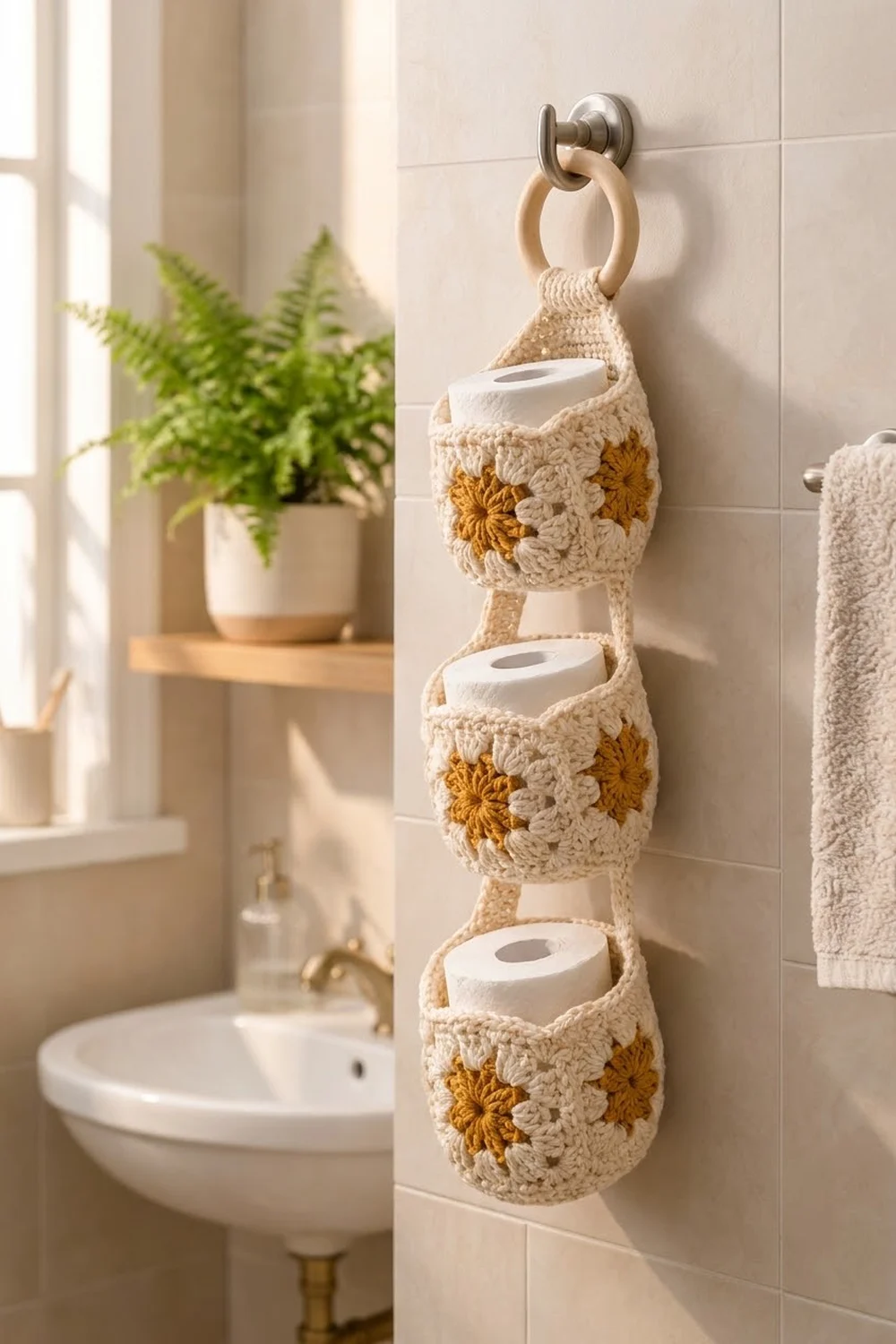
This hanging toilet paper holder has three deep pockets stacked in a column, joined by slim straps and hung from a wooden ring. Each pocket front has a granny motif with a bright mustard flower in the middle and soft cream clusters around it. The result is calm and cottage-style, and it frees up shelf space in a small bathroom.
The palette is just two colors: cream for the pockets, straps, and tab, and mustard for the eight pointed flower petals. Worsted-weight cotton keeps the pockets firm enough to hold their shape when a roll is inside. The pattern uses US crochet terms throughout.
The finished holder is 5.5 in (14.0 cm) wide and 27.25 in (69.2 cm) long, measured from the bottom of the lowest pocket to the top of the ring. Each pocket is 6.25 in (15.9 cm) tall and 2.5 in (6.4 cm) deep.
Each pocket is built from three pieces: a flower motif for the front, a solid cream motif for the back, and a sc gusset that runs down one side, across the bottom, and up the other side. You join the pieces with sc seams, work a three-round rim around the opening, and then link the pockets with straps and a ring tab.
Finished Size and Construction
- Finished size: 5.5 in (14.0 cm) wide x 27.25 in (69.2 cm) long, including the ring
- Skill level: Intermediate
- Terminology: US crochet terms
- Yarn weight: Worsted (#4) cotton
- Hook: 5.0 mm (H-8)
- Number of pieces: 14 crocheted pieces (3 front motifs, 3 back motifs, 3 gussets, 4 straps, 1 tab) plus 1 wooden ring
- Layout: 3 pockets stacked vertically, 2 in (5.1 cm) apart
- Piece size: each motif is 5.5 in (14.0 cm) square; each gusset is 2.5 in (6.4 cm) x about 15 in (38.1 cm)
- Pocket size before border: 5.5 in (14.0 cm) tall
- Border (rim) depth: 0.75 in (1.9 cm), 3 rounds
Materials
Choose a smooth, firm worsted-weight cotton or cotton blend. Acrylic stretches under the weight of a roll, and a soft blend will sag. A cotton at about 170 m per 100 g is ideal.
- Cream: 260 g (442 m)
- Mustard: 20 g (34 m)
These quantities include a margin of about 10% for gauge swatching and small differences in tension.
Tools
- 5.0 mm (H-8) crochet hook
- One 3 in (7.6 cm) wooden ring
- Tapestry needle
- 6 locking stitch markers
- Rust-proof pins and a blocking mat
- Measuring tape
Abbreviations (US Terms)
- ch: chain
- sl st: slip stitch
- sc: single crochet
- dc: double crochet
- tr: treble crochet
- MR: magic ring
- sp: space
- st(s): stitch(es)
- RS / WS: right side / wrong side
Special stitch: Petal. Work [sl st, ch 2, dc, tr, dc, ch 2, sl st] all in the same stitch. The tr is the petal tip.
Corner: (3 dc, ch 2, 3 dc) in the same corner sp.
Gauge and Checkpoints
The gauge is 14 sc and 16 rows = 4 in (10.2 cm). Before you start the full set, make one front motif and one gusset and check them.
Motif checkpoints:
- After Round 2 (the flower): about 2.5 in (6.4 cm) across
- After Round 4: 3.5 in (8.9 cm) square
- After Round 5: 4.25 in (10.8 cm) square
- After Round 6: 5 in (12.7 cm) square
- After Round 7: 5.5 in (14.0 cm) square
Gusset checkpoint: after 10 rows, the strip should be 2.5 in (6.4 cm) wide.
If your motif is too big, go down 0.5 mm in hook size. If it is too small, go up 0.5 mm. Do not add or remove rounds, because every seam count depends on 19 stitches per side.
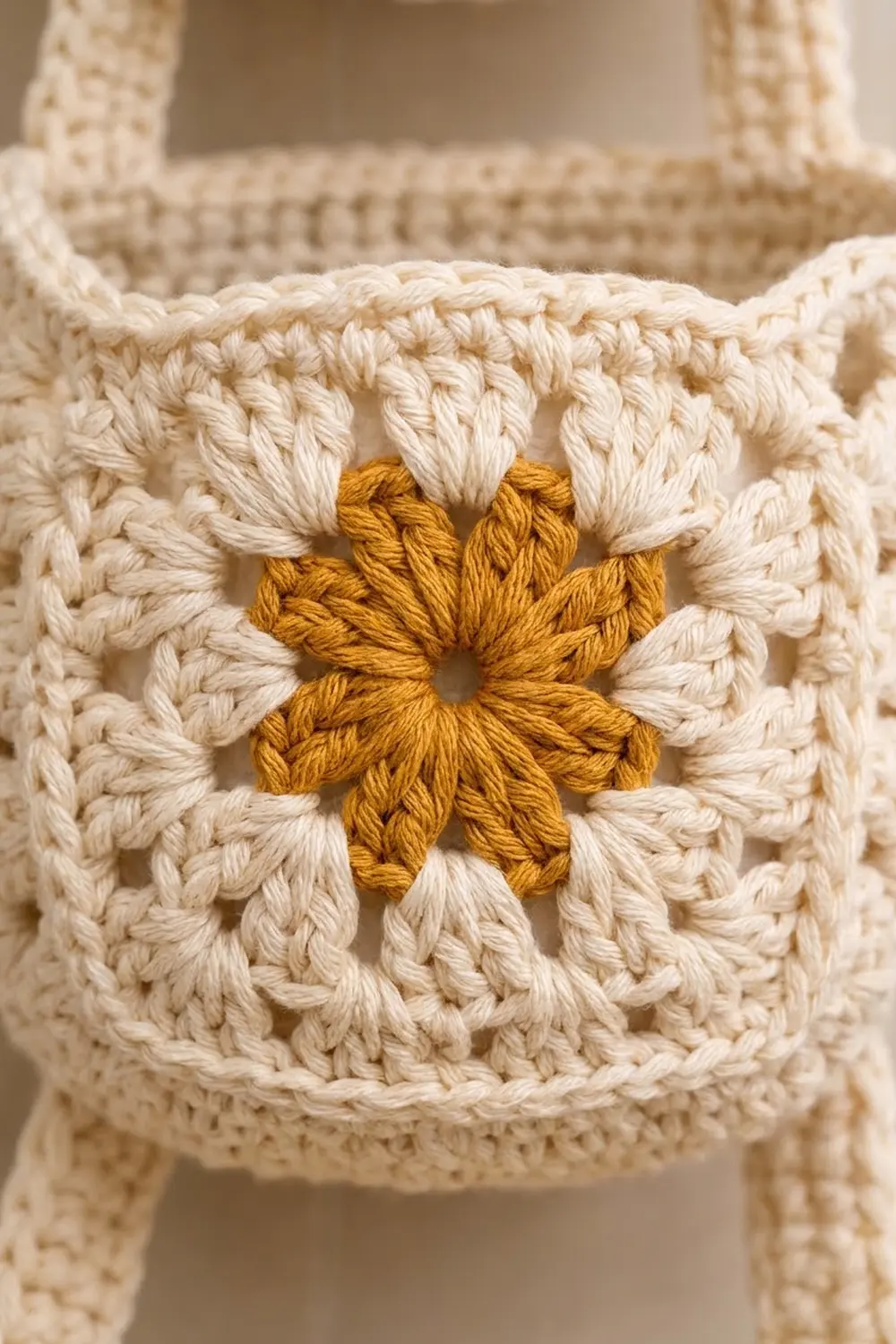
Front Motif (make 3)
Round 1 (mustard): Make a MR, ch 1, work 8 sc into the ring, then sl st to the first sc. Pull the ring tight. (8 sc)
Round 2 (mustard): Work a Petal in each sc around. (8 petals) Fasten off.
Round 3 (cream): Join with a sc in the tr tip of any petal, then ch 4. Sc in the tr tip of the next petal, ch 4. Repeat from * 6 more times, then sl st to the first sc. (8 sc, 8 ch-4 sps)
Round 4 (cream): Sl st into the first ch-4 sp. Ch 3 (counts as dc) and work (2 dc, ch 2, 3 dc) in the same sp. Work 3 dc in the next sp. Work a Corner in the next sp, then 3 dc in the next sp. Repeat from * 2 more times, then sl st to the top of the ch-3. (36 dc: 9 per side, plus 4 corner ch-2 sps)
Round 5 (cream): Sl st across to the corner sp and work a Corner there, counting the ch-3 as the first dc. Along each side, work 3 dc in each gap between 3-dc groups (2 gaps per side), then a Corner in each corner sp. Sl st to join. (48 dc: 12 per side)
Round 6 (cream): Work as for Round 5. There are now 3 gaps per side. (60 dc: 15 per side)
Round 7 (cream, conversion round): Ch 1. Work 1 sc in each dc and 3 sc in each corner ch-2 sp. Sl st to the first sc. (60 sc + 12 corner sc = 72 sc)
Counted from corner center to corner center, each side has 19 sts: 15 side sts, 2 corner side sts, and the 2 corner centers. Check: 4 x 19 = 76, and 76 − 4 shared corners = 72. Fasten off.
Back Motif (make 3)
Work exactly like the front motif, but use cream for all rounds. (Round 7: 72 sc, 19 per side)
Gusset (make 3)
Use cream throughout.
Row 1: Ch 54. Sc in the 2nd ch from the hook and in each ch across. (53 sc)
Rows 2–10: Ch 1 and turn. Sc in each st across. (53 sc)
The gusset should be 2.5 in (6.4 cm) wide and about 15 in (38.1 cm) long. Fasten off.
Straps (make 4)
Row 1: Ch 5. Sc in the 2nd ch from the hook and in each ch across. (4 sc)
Rows 2–16: Ch 1, turn, and sc across. (4 sc)
Each strap is about 1.1 in (2.8 cm) wide and 4 in (10.2 cm) long.
Hanging Tab (make 1)
Row 1: Ch 8. Sc in the 2nd ch from the hook and in each ch across. (7 sc)
Rows 2–24: Ch 1, turn, and sc across. (7 sc)
The tab is 2.0 in (5.1 cm) wide and 6 in (15.2 cm) long.
Make All Pieces
- Mustard: 3 flower centers (Rounds 1–2 of each front motif)
- Cream: Rounds 3–7 of 3 front motifs, plus 3 back motifs, 3 gussets, 4 straps, and 1 tab
Layout (front view, top to bottom):
        ( ring )
          |tab|
   [ POCKET 1: motif ]
     ||          ||     <- 2 straps
   [ POCKET 2: motif ]
     ||          ||     <- 2 straps
   [ POCKET 3: motif ]
Joining
Method: sc seams worked on the RS through both layers, using cream. This makes the raised ridge that outlines each pocket.
Step A: build each pocket.
- Lay the front motif RS up with its gusset behind it, WS together.
- On the front motif, place a marker in the first st below the top-right corner center. The seam path runs 18 sts down the right side (ending at the bottom-right corner center), then 17 sts across the bottom between the corners, then 18 sts up the left side (starting at the bottom-left corner center). That gives 18 + 17 + 18 = 53 sts.
- Join cream at the marker and work 1 sc through each front st and the matching foundation-ch st of the gusset. (53 sc) The two top corner centers stay free for the rim.
- Join the back motif to the gusset’s Row 10 edge in the same way. (53 sc)
Stitch-to-stitch logic: the gusset has 53 sts and the motif’s seam path has 53 sts. The count matches exactly, so do not skip or add stitches at the corners.
Tension: work the seam sc at your normal gauge. Tight seams pucker the corners, and loose seams let the pocket sag.
Size checkpoint: a joined pocket stands 5.5 in (14.0 cm) tall, is 5.5 in (14.0 cm) wide, and is 2.5 in (6.4 cm) deep.
Work the rim (see the Border section) on all three pockets before you continue with Steps B and C.
Step B: straps. Place markers in sts 2–5 and 15–18 along the top and bottom edges of each back motif. Whipstitch the top 1 in (2.5 cm) of two straps over the bottom of Pocket 1’s back at those markers. Whipstitch the bottom 1 in (2.5 cm) of each strap over the back of Pocket 2, covering its rim and ending 0.25 in (0.6 cm) into the motif. This leaves a 2 in (5.1 cm) gap between the pockets. Repeat between Pockets 2 and 3.
Step C: tab. Fold the tab around the ring. Stack both ends on the back of Pocket 1, centered over sts 7–13, overlapping 1 in (2.5 cm) down from the top of the rim. Whipstitch through all layers. About 1.5 in (3.8 cm) of tab shows above the rim.
Border (Pocket Rim)
Border gauge: 14 sc = 4 in (10.2 cm), worked in rounds on the RS without turning. The rim is cream.
Round 1: Join at the top-right corner of the front. Work:
- 19 sc across the front top
- 9 sc across the gusset’s 10 row ends (skip the 5th row end)
- 19 sc across the back top
- 9 sc across the other gusset end
Sl st to the first sc. (19 + 9 + 19 + 9 = 56 sc)
Round 2: Ch 1, then sc in each st around. (56 sc: 19 / 9 / 19 / 9)
Round 3: Ch 1, then sc in each st around. (56 sc) Fasten off.
Why the math works: the opening measures 5.5 + 2.5 + 5.5 + 2.5 = 16 in (40.6 cm), and 56 sc at 3.5 sts per inch is exactly 16 in (40.6 cm). The gusset’s 10 rows cover 2.5 in (6.4 cm), which is 8.75 sts at sc gauge, so working 9 sc keeps the end flat. Ten sc would flare, and 8 would pull the rim in.
Each pocket now stands 6.25 in (15.9 cm) tall. Three pockets plus two 2 in (5.1 cm) gaps give 22.75 in (57.8 cm). Adding the 1.5 in (3.8 cm) of visible tab and the 3 in (7.6 cm) ring gives 27.25 in (69.2 cm).
Final Blocking
- Weave in all ends along the seam ridges.
- Wet the whole holder in cool water and gently press out the excess.
- Lay it flat on a mat. Pin each front motif to 5.5 in (14.0 cm) square.
- Pin the straps straight so each gap measures 2 in (5.1 cm).
- Stuff each pocket with a folded towel or a toilet roll to set its 2.5 in (6.4 cm) depth.
- Let it dry completely, which takes 24–48 hours.
- Unpin it and hang it to check that the pockets sit level.
Final Quality-Control Checklist
- Each motif has 72 sc in Round 7, with 19 per side.
- Each gusset has 53 sc in all 10 rows.
- The seams have 53 sc each, with the top corners left free.
- The rims have 56 sc in each round.
- The petals are all the same size and point outward.
- The straps are evenly placed at sts 2–5 and 15–18.
- The tab is centered and secure through all layers.
- The overall length is 27.25 in (69.2 cm).
Troubleshooting
- Motif cups in the middle: your Round 3 chains are too short. Ch 5 instead of 4, but keep 8 spaces.
- Motif ruffles: go down a hook size for Rounds 4–6.
- Gusset is too short for the seam: recount Row 1. It must be 53 sc.
- Rim flares: check that you skipped one row end on each gusset end.
- Pocket leans forward: move the straps up slightly on the back of the upper pocket.
- Tab stretches: add a second line of whipstitching, or use a 4.5 mm (G-7) hook for the tab.
Care
Hand wash in cool water and lay flat to dry, reshaping the pockets while they are damp. Do not tumble dry, because cotton can shrink unevenly.
Final Notes
The whole design depends on one number: 19 stitches per motif side. That gives a 53-stitch seam path to match the 53-stitch gusset. The 56-stitch rim matches the 16 in (40.6 cm) opening. Three 6.25 in (15.9 cm) pockets, two 2 in (5.1 cm) gaps, the tab, and the ring add up to 27.25 in (69.2 cm). Check your gauge on the first motif, and everything after it will fit.
Happy crocheting!