

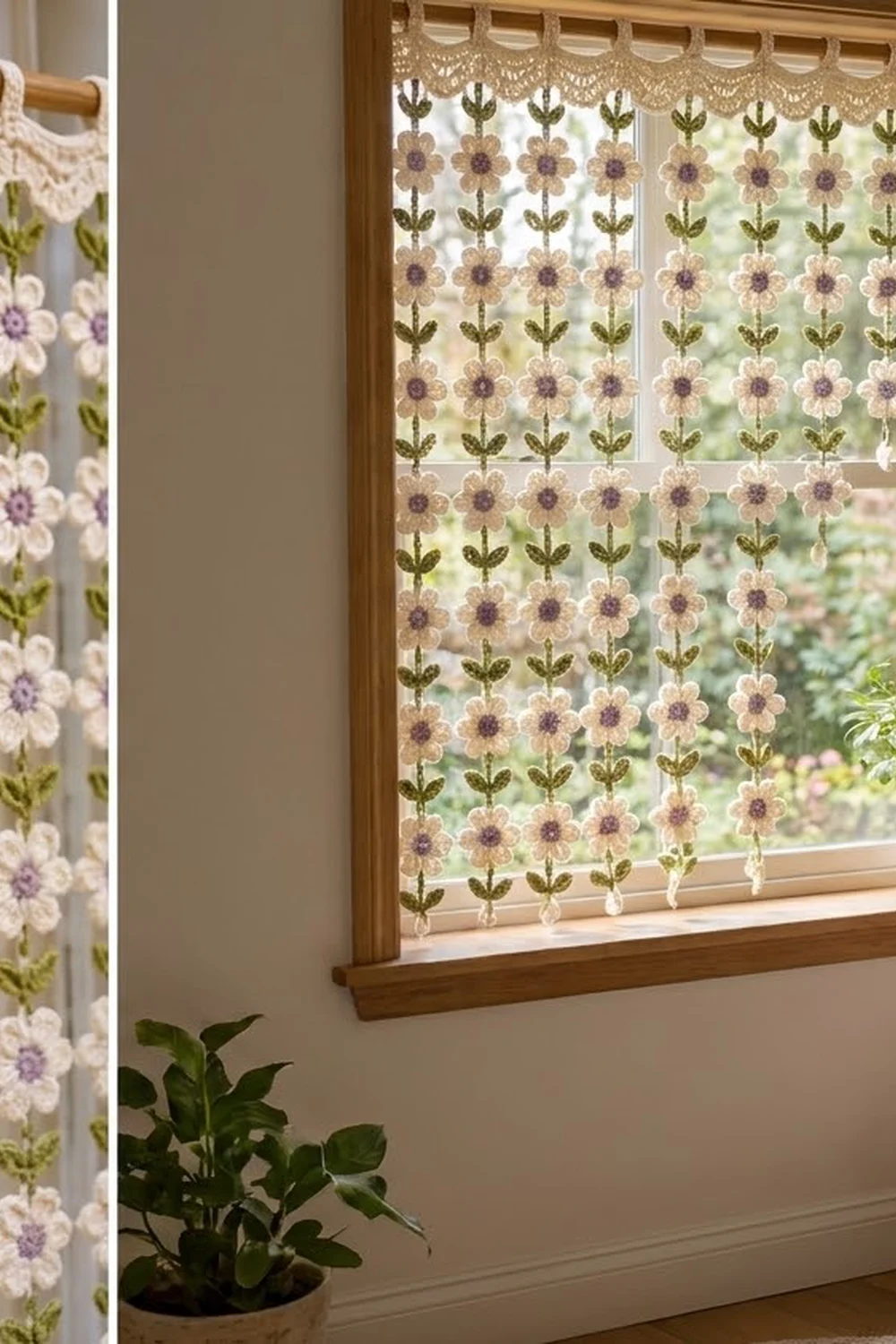
This curtain is a light, airy panel of hanging flower strands. A cream header band with a scalloped lower edge holds it up. From the lowest point of every scallop hangs a green stem lined with leaf pairs and cream six-petal flowers with lavender centers.
The colors are soft and cottage-style: cream for the header, tabs, and petals, lavender for the flower centers, and olive green for the stems and leaves. Light passes between the strands, so it works as a window panel, café curtain, or doorway screen.
This pattern uses US crochet terms. The finished curtain is 42.25 in (107.3 cm) wide and 47 in (119.4 cm) long, measured from the top edge of the header to the bottom flowers. The tab loops add about 2 in (5.1 cm) above that.
You make it in parts: 108 small flowers, 12 green strands with built-in leaves, and one header band. Then you sew the flowers onto the stems and the strands onto the scallop points.
Finished Size and Construction
- Finished size: 42.25 in (107.3 cm) wide x 47 in (119.4 cm) long, plus tabs
- Skill level: Easy-Intermediate (simple stitches, lots of repetition)
- Terminology: US crochet terms
- Yarn weight: Worsted (#4) cotton
- Hook: 4.0 mm (G-6)
- Number of pieces: 1 header band, 12 strands, 108 flowers
- Layout: 12 strands across, 9 flowers per strand
- Flower size: 3 in (7.6 cm) across
- Strand repeat: 5 in (12.7 cm) per leaf pair + flower
- Header size before the scallop rows (after Row 2): 42.25 in (107.3 cm) x 0.75 in (1.9 cm)
- Scallop depth (Rows 3-5): 1.25 in (3.2 cm) at the scallop centers, for a total header depth of 2 in (5.1 cm)
Materials
Use a smooth worsted-weight cotton of about 85 m per 50 g. Cotton holds the petal shape and hangs straight. Avoid acrylic, because long strands of it stretch over time.
- Cream: 450 g (765 m) for flowers, header, and tabs
- Lavender: 120 g (204 m) for flower centers
- Olive green: 180 g (306 m) for stems and leaves
These amounts include about 15-20 percent extra for swatching, weaving in ends, and differences in tension.
Tools:
- 4.0 mm (G-6) crochet hook
- Tapestry needle
- Stitch markers (at least 12)
- Scissors
- Measuring tape
- Blocking mats and rust-proof pins
- Spray bottle
Abbreviations (US Terms)
- ch – chain
- sl st – slip stitch
- sc – single crochet
- hdc – half double crochet
- dc – double crochet
- st(s) – stitch(es)
- sp – space
- RS – right side
Special stitch – Leaf: Ch 8. Work back along these chains: sl st in 2nd ch from hook, sc in next ch, hdc in next ch, dc in next ch, hdc in next ch, sc in next ch, sl st in last ch (the one at the stem). That makes 7 sts and a pointed leaf 1.75 in (4.4 cm) long.
Gauge and Checkpoints
Before starting the full project, make one flower, one strand repeat, and a small header swatch.
- Header gauge: 16 dc and 8 rows = 4 in (10.2 cm), which is 4 sts per inch.
- Flower checkpoint 1: After Round 1, the lavender center is 1.25 in (3.2 cm) across.
- Flower checkpoint 2: After Round 3, the flower is 3 in (7.6 cm) from petal tip to petal tip.
- Strand gauge: 4 stem chains = 1 in (2.5 cm), measured after the slip-stitch return pass. One full repeat (20 stem chains) = 5 in (12.7 cm).
If your pieces are too big, go down one hook size, to 3.75 mm. If they’re too small, go up one size, to 4.5 mm. Chain stems often come out loose, so if only the strand is off, change the hook size for the strands alone.
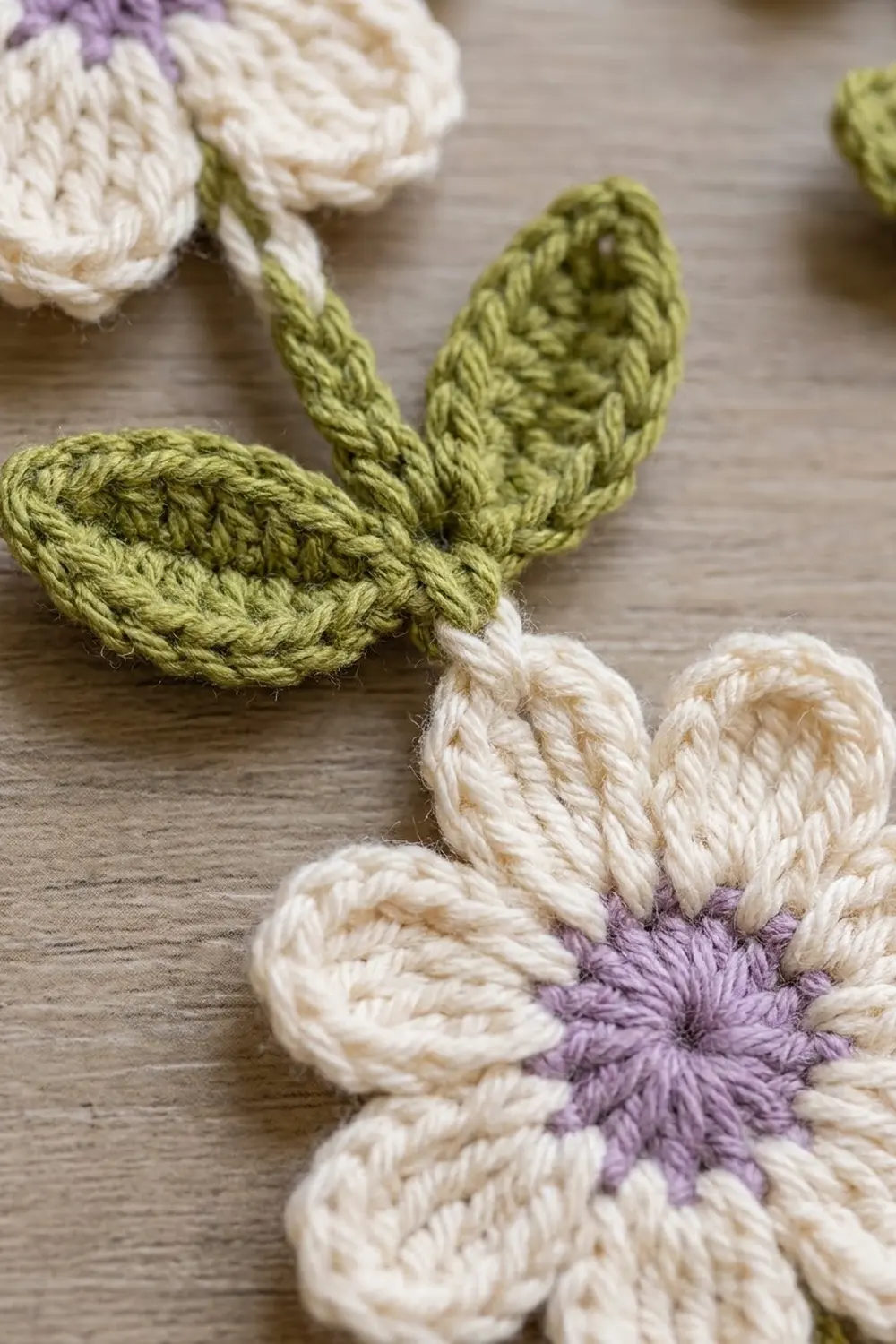
Flower (Make 108)
Round 1 (lavender): Make a magic ring. Ch 2 (does not count as a st), then work 12 hdc into the ring. Pull the ring closed and sl st to the first hdc. Fasten off. (12 sts)
Round 2 (cream): Join cream with a sl st in any hdc. Ch 1, sc in the same st, ch 3, skip next st, sc in next st, ch 3, skip next st; repeat from * 4 more times. Sl st to the first sc. (6 sc and 6 ch-3 sps)
Round 3 (cream): Sl st into the first ch-3 sp. Work (sc, hdc, 3 dc, hdc, sc) in each ch-3 sp around, then sl st to the first sc. Fasten off, leaving a 10 in (25.4 cm) tail for sewing. (6 petals, 7 sts each = 42 sts)
Each petal sits in its own ch-3 space, so you get six separate, rounded petals around the lavender center. Weave in the lavender tails, but keep the cream tail for sewing.
Stem Strand with Leaves (Make 12)
Each strand is one long chain with the leaf pairs built in. After that, you slip stitch back up the chain. This return pass makes the stem firm so it won’t stretch under the weight of the flowers.
Foundation (olive green): Leave a 10 in (25.4 cm) tail and ch 4. These 4 chains are the attachment section that will sit behind the header. (4 stem ch)
Repeat unit (work 9 times):
- Ch 6 (the stem above the leaves).
- Work 1 Leaf.
- Work 1 Leaf. Both leaves now come out of the same point on the stem.
- Ch 14 (the flower section, where you’ll sew on a flower later).
Stem chain total: 4 + (9 x 20) = 184 stem chains, plus 18 leaves.
Return pass: Ch 1. Work back up the stem with a sl st in the back bump of each stem chain, for 184 sl st. When you reach a leaf pair, push both leaves to the front and work only into the stem chains. At the top, fasten off and leave a 10 in (25.4 cm) tail.
Checkpoint: The strand is 46 in (116.8 cm) long: 1 in (2.5 cm) of attachment section plus 45 in (114.3 cm) of hanging stem. If it’s longer than 46.5 in (118.1 cm), make it again with a smaller hook.
Make All Pieces
- Cream + lavender: 108 flowers (Round 1 in lavender, Rounds 2-3 in cream)
- Olive green: 12 strands, each with 9 leaf pairs (216 leaves in total)
- Cream: 1 header band, made last (see the Border section)
Layout grid (12 strands across, 9 units down; each unit = leaf pair over flower, F):
Header:  [S1 S2 S3 S4 S5 S6 S7 S8 S9 S10 S11 S12]
Unit 1:   F--F--F--F--F--F--F--F--F--F--F--F
Unit 2:   F--F--F--F--F--F--F--F--F--F--F--F
Unit 3:   F--F--F--F--F--F--F--F--F--F--F--F
Unit 4:   F--F--F--F--F--F--F--F--F--F--F--F
Unit 5:   F--F--F--F--F--F--F--F--F--F--F--F
Unit 6:   F--F--F--F--F--F--F--F--F--F--F--F
Unit 7:   F--F--F--F--F--F--F--F--F--F--F--F
Unit 8:   F--F--F--F--F--F--F--F--F--F--F--F
Unit 9:   F--F--F--F--F--F--F--F--F--F--F--F
All the strands are the same, so the flowers line up in level horizontal rows.
Joining: Flowers to Stems
Method: Using the cream tail, whipstitch each flower to its stem from the back.
Placement: Lay the strand flat with the RS of the leaves facing up. In each 14-chain flower section, center the back of a flower over the 7th and 8th chains. Turn it so one petal points straight up the stem and the opposite petal points straight down. The stem runs behind the flower and shows above and below it. About 0.25 in (0.6 cm) of green should show between the top petal tip and the leaf pair above.
Stitch logic: Make 3 small stitches through the back loops of Round 2 and around the slip-stitch ridge of the stem: one at the center, one behind the top petal, and one behind the bottom petal. Don’t sew through to the front of the petals.
Tension: Keep the stitches snug, but not so tight that the stem puckers. Lay the strand flat after sewing on each flower and check that it’s still straight and hasn’t shortened.
Checkpoint: With all its flowers on, the strand still measures 46 in (116.8 cm). Flower centers are 5 in (12.7 cm) apart, and the last flower sits at the very end of the strand.
Border: Header Band with Scallops and Tabs
The header is this curtain’s border. You work it in rows across the full width, with the scallops at the bottom, then add the tabs along the top edge.
Border gauge: 4 sts per inch, matching your swatch. Each strand gets one 14-st section of the header, which is 3.5 in (8.9 cm). That means the strands are 3.5 in (8.9 cm) apart, center to center.
Why the math works: 12 strands x 14 sts = 168 sts. One more stitch lets you close the last scallop with a sc, so the header is 169 sts wide. At 4 sts per inch, 169 sts = 42.25 in (107.3 cm).
Foundation (cream): Ch 170.
Row 1 (RS, top edge): Sc in 2nd ch from hook and in each ch across, turn. (169 sc)
Row 2: Ch 3 (counts as dc), dc in each st across, turn. (169 dc)
Checkpoint: The band measures 42.25 in (107.3 cm) x 0.75 in (1.9 cm).
Row 3 (scallop base): Ch 1, sc in first st, skip 6 sts, 13 dc in next st, skip 6 sts, sc in next st; repeat from * 11 more times, turn. (12 fans of 13 dc + 13 sc = 169 sts)
Each repeat uses 14 sts (6 + 1 + 6 + 1). Add the first sc and you get 1 + (12 x 14) = 169.
Row 4 (lace fans): Ch 1, sc in first sc, (dc in next dc, ch 1) 12 times, dc in next dc, sc in next sc; repeat from * 11 more times, turn. (Each scallop: 13 dc + 12 ch-1 sps. Whole row: 156 dc + 144 ch-1 sps + 13 sc)
Row 5 (scallop edge): Ch 1, sc in first sc, sc in next dc, (2 sc in next ch-1 sp, sc in next dc) 12 times, sc in next sc; repeat from * 11 more times. Fasten off. (1 + 12 x 38 = 457 sc)
Each scallop gets 38 sc: 1 in the first dc, 36 from the 12 repeats, and 1 in the valley. The center of each scallop is its 19th sc, worked into the 7th dc, with 18 sc on either side. Mark these 12 center stitches. The strands will hang from them.
Checkpoint: The header is 2 in (5.1 cm) deep at the scallop centers and 1.5 in (3.8 cm) deep at the valleys.
Tab Row (top edge): With the RS facing, join cream in the first foundation chain at the top right corner. You’ll work into the 169 foundation chains on the top edge, along the other side of Row 1.
Ch 1, sc in first 7 sts, sc in next st, ch 16, sl st in top of the sc just made, work 24 sc into the ch-16 loop, sl st in top of the same sc, sc in next 13 sts; repeat from * 10 more times. For the last tab: sc in next st, ch 16, sl st in top of the sc just made, work 24 sc into the loop, and sl st in the same sc. Sc in the last 7 sts and fasten off.
(Count: 7 + 12 + (11 x 13) + 7 = 169 base sc, plus 12 tabs of 24 sc each)
The tabs sit on sts 8, 22, 36, and every 14th stitch after that, up to st 162. That puts each tab directly above a scallop center. Each tab hangs about 2 in (5.1 cm) and fits a rod up to 1.25 in (3.2 cm) across.
Attaching strands: Place the top 4 chains of a strand, 1 in (2.5 cm) long, against the back of the header with the stem pointing up. The 5th chain of the stem should line up with a marked center sc. With the green tails, whipstitch the 4 attachment chains to the back of Rows 4 and 5. Then make 2 small stitches through the center sc. Repeat for all 12 strands. The outer strands end up 1.75 in (4.4 cm) in from each side edge.
Final Blocking
- Weave in all remaining tails along the backs of the stems or inside the header stitches.
- Pin the header to 42.25 in (107.3 cm) wide, shaping each scallop into a smooth curve and pinning each tab flat.
- Spray the header until it’s damp and let it dry.
- Pin each flower to 3 in (7.6 cm), with one pin at each petal tip.
- Pin each leaf pair into a V that angles upward.
- Spray the flowers and leaves until damp. Let them dry completely before you take out the pins.
- Hang the curtain on its rod for 24 hours so the strands settle straight.
Final Quality-Control Checklist
- 12 strands with 9 flowers each, 108 flowers in total
- Each flower has 6 petals and measures 3 in (7.6 cm)
- Flower centers are 5 in (12.7 cm) apart on every strand
- The flowers form level horizontal rows
- The strands hang from scallop centers, 3.5 in (8.9 cm) apart
- The header is 42.25 in (107.3 cm) wide and 2 in (5.1 cm) deep at the scallop centers
- There are 12 tabs, each directly above a strand
- The total length is 47 in (119.4 cm)
- No sewing stitches show on the front of the petals
Troubleshooting
- The strands are different lengths: Your chain tension changed between strands. Measure each strand after its return pass and remake any that are more than 0.5 in (1.3 cm) off.
- The petals cup or ruffle: Check that Round 2 has exactly 3 chains per space, then steam-block the flower flat.
- The flowers flip forward: Add a fourth anchoring stitch behind the bottom petal.
- The scallops ripple: The Row 4 chains are too loose. Work Rows 4 and 5 with a smaller hook.
- The header is narrower than 42.25 in (107.3 cm): Your foundation chain is too tight. Make it again with a hook one size larger, keeping 170 chains.
- The leaves droop: Pin them into a V again and let them dry.
Care
Hand wash in cool water with mild soap and gently press out the water. Lay the curtain flat or hang it to dry, and reshape the flowers while they’re still damp.
Final Notes
Here’s how the measurements fit together. Each 3 in (7.6 cm) flower sits on a 5 in (12.7 cm) strand repeat, and 9 repeats make a 45 in (114.3 cm) hanging strand. Each strand gets a 14-st, 3.5 in (8.9 cm) section of the header. Twelve sections plus 1 closing stitch make 169 sts, which is 42.25 in (107.3 cm). Add the 2 in (5.1 cm) header to the strands, and the curtain is 47 in (119.4 cm) long.
If your first flower, first strand, and header foundation all match gauge, the rest of the curtain will line up.
Happy crocheting!