

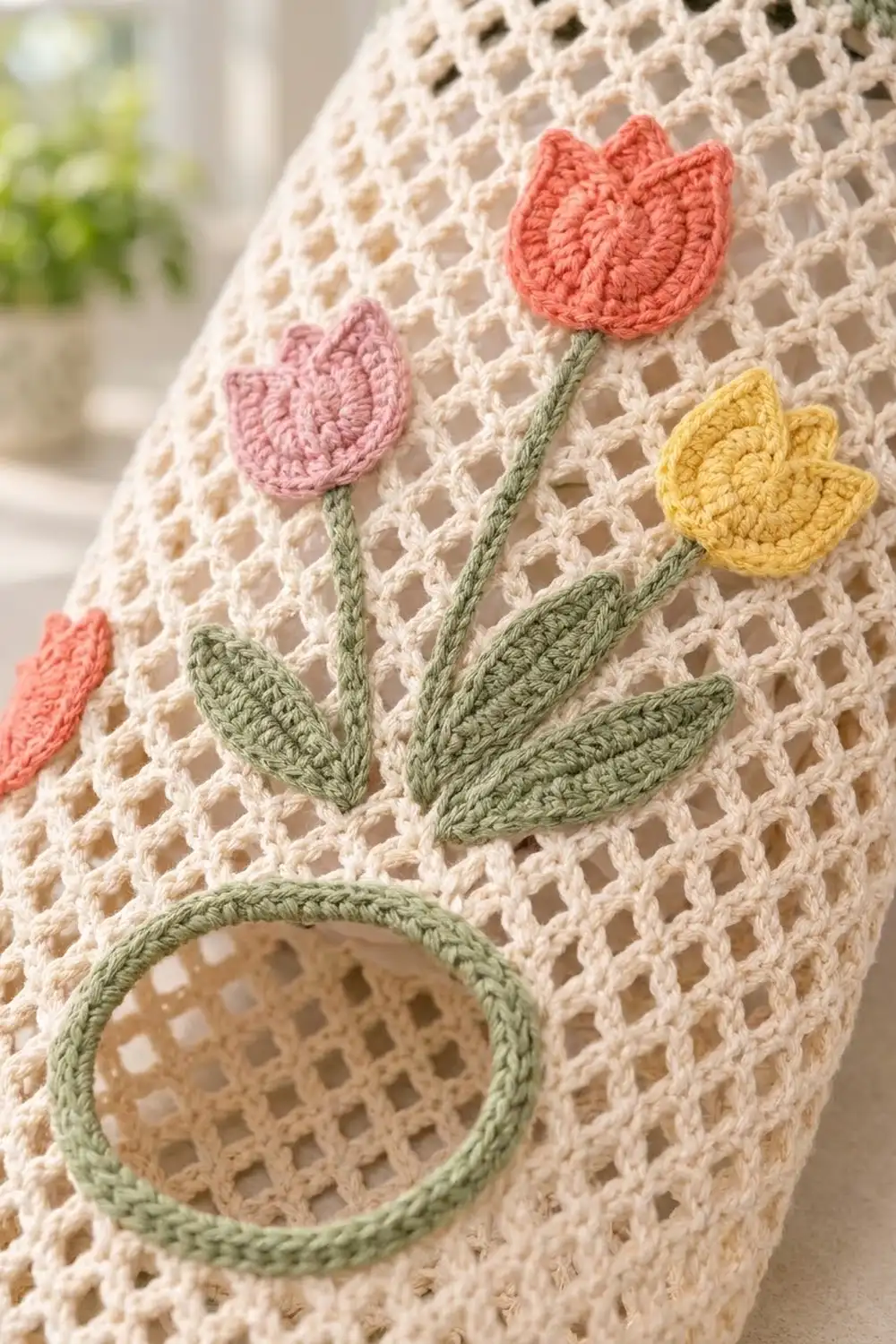
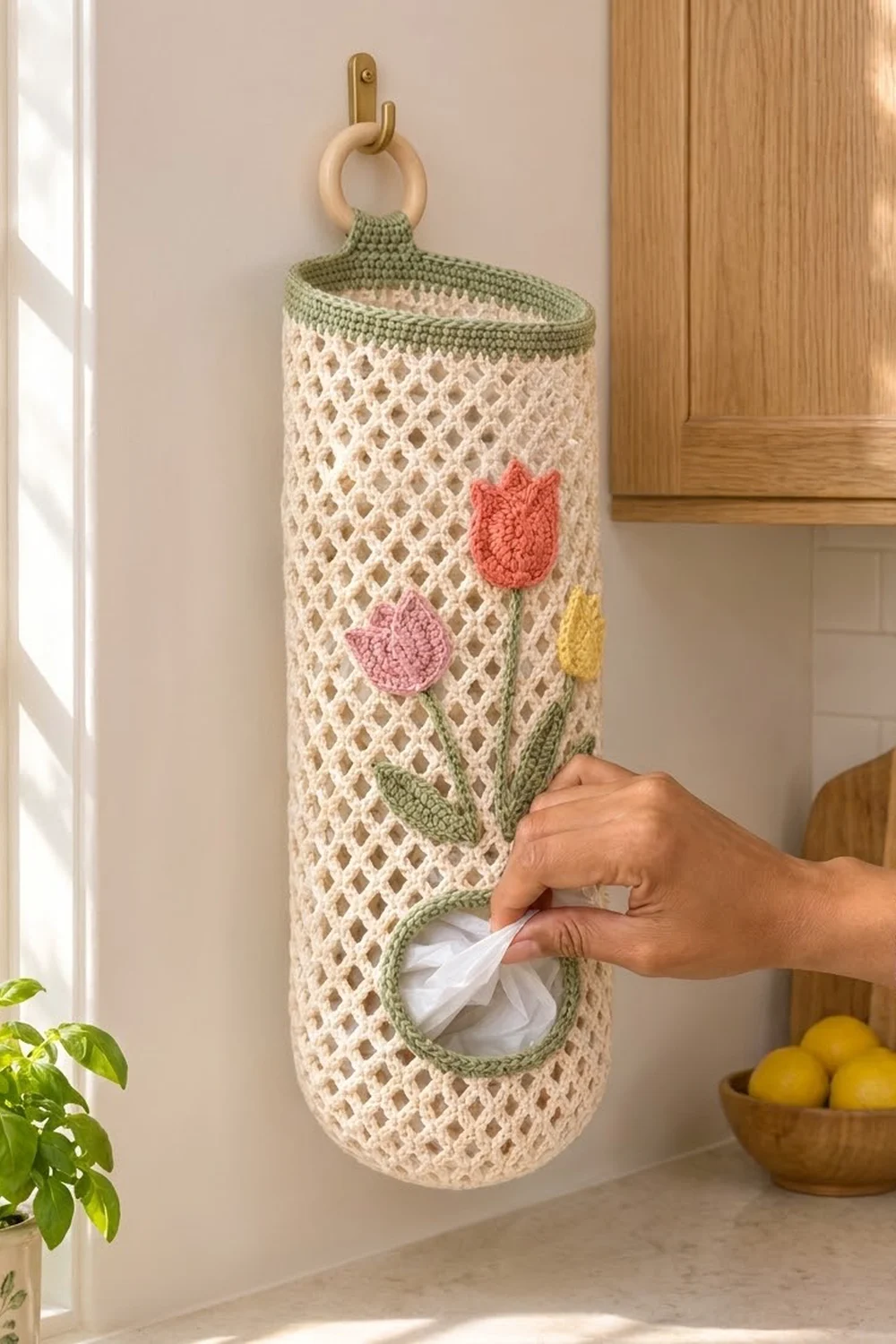
This hanging grocery bag holder is one long cream mesh tube with a rounded, closed bottom. It’s worked in an open diamond net. A sage green band trims the top, and a sage strap wraps around a wooden ring so you can hang it on a hook. Near the bottom on the front, a round opening edged in sage lets you pull out one bag at a time.
Three tulips decorate the front: coral in the center, pink on the left, and yellow on the right. Each one sits on a sage chain stem, and two sage leaves frame the stems where they meet just above the opening. The overall look is fresh and cottage-kitchen.
The pattern uses US terms. The finished holder is 7.5 in (19.1 cm) wide laid flat and 18 in (45.7 cm) long, not counting the strap. That makes the circumference 15 in (38.1 cm).
You crochet the body in joined rounds from the bottom up: a domed mesh base, a straight tube with the opening built in, then a sage band and strap. Then you edge the opening, make the tulips, stems, and leaves, and sew them on.
Finished Size and Construction
- Finished size: 7.5 in (19.1 cm) flat width × 18 in (45.7 cm) long, plus strap and ring
- Skill level: Intermediate
- Terminology: US
- Yarn weight: Worsted (#4) cotton
- Hooks: 5 mm (H-8) for the body, 4 mm (G-6) for the appliqués
- Number of pieces: 1 body, plus 8 appliqués (3 tulip heads, 3 stems, 2 leaves)
- Layout: Tulips centered on the front, above the opening
- Piece size: 20 mesh loops around = 15 in (38.1 cm) circumference
- Size before border: 16.4 in (41.7 cm) long, mesh only
- Border depth: Top band 1.6 in (4.1 cm); opening edging 2 rounds
Materials
Use smooth worsted cotton. It holds its shape when the holder is full, while acrylic tends to sag.
- Cream (main): 150 g, about 255 m
- Sage green (band, strap, opening, stems, leaves): 50 g, about 85 m
- Coral: 10 g, about 17 m
- Pink: 10 g, about 17 m
- Yellow: 10 g, about 17 m
Tools:
- 5 mm (H-8) and 4 mm (G-6) hooks
- Wooden ring, 2 in (5.1 cm) across
- Stitch markers
- Tapestry needle
- Rustproof pins
- Cardboard, 7 in (17.8 cm) wide, for sewing
All quantities include a margin of about 15 percent.
Abbreviations (US Terms)
- ch = chain
- sl st = slip stitch
- sc = single crochet
- hdc = half double crochet
- dc = double crochet
- tr = treble crochet
- sc2tog = single crochet 2 together
- sp(s) = space(s)
- st(s) = stitch(es)
- RS / WS = right side / wrong side
Special stitches:
- Join loop: Ch 2, then dc in the first sc. Together these count as a ch-5 loop, and they leave your hook at the center of that loop. In the base, ch 1 + hdc stands in for a ch-3 loop, and ch 1 + dc stands in for a ch-4 loop.
- Point: (dc, ch 2, sl st in 2nd ch from hook, dc) all in the same st.
Gauge and Checkpoints
- Mesh, 5 mm hook: 4 loops = 3 in (7.6 cm) wide, and 5 rounds = 3 in (7.6 cm) tall. That’s about 0.6 in (1.5 cm) per round.
- Sc, 5 mm hook: 16 sc and 18 rows = 4 in (10.2 cm).
Make a 4 in (10.2 cm) sc swatch. Then work Rounds 1–6 as your mesh test, and check:
- After Round 4: The base is about 2 in (5.1 cm) deep and about 7.5 in (19.1 cm) wide when flattened.
- After Round 12: About 6.8 in (17.3 cm) from the bottom.
- After Round 28: 16.4 in (41.7 cm) long.
- After the band: 18 in (45.7 cm) long.
If the tube is wider than 7.5 in (19.1 cm) when flat, go down half a hook size. If it’s narrower, go up half a size. Always keep 20 loops.
Body
Use cream and the 5 mm hook.
Round 1: Make a magic ring. Ch 1, then work 10 sc into the ring. Sl st to the first sc. (10 sc)
Round 2: Ch 1, sc in the first sc. (Ch 3, sc in next sc) 9 times. Ch 1, hdc in the first sc. (10 ch-3 loops)
Round 3: Ch 1, sc in the joining sp, ch 4, sc in the same sp. Ch 4, sc in next sp. Ch 4, sc in next sp, ch 4, sc in same sp, ch 4, sc in next sp; repeat from * 3 more times. Ch 1, dc in the first sc. (15 ch-4 loops)*
Round 4: Ch 1, sc in the joining sp, ch 5, sc in the same sp. (Ch 5, sc in next sp) 2 times. Ch 5, sc in next sp, ch 5, sc in same sp, (ch 5, sc in next sp) 2 times; repeat from * 3 more times. Ch 2, dc in the first sc. (20 ch-5 loops)*
The loops get longer each round, so the base curves into a dome instead of lying flat.
Rounds 5–6: Ch 1, sc in the joining sp. (Ch 5, sc in next sp) 19 times. Ch 2, dc in the first sc. (20 loops)
Dispensing Opening
Number the Round 6 loops 1–20. Loop 20 is the joining loop your hook is in. Loops 16–19 stay unworked; they form the bottom of the opening and mark the front of the holder.
Row 7 (RS): Ch 1, sc in the joining sp (loop 20). (Ch 5, sc in next sp) 15 times, ending in loop 15. Turn. (16 sc, 15 loops)
Row 8 (WS): Ch 5 (counts as dc + ch 2), sc in the first loop. (Ch 5, sc in next loop) 14 times. Ch 2, dc in the last sc. Turn. (15 sc, 14 loops, plus a half loop at each edge)
Row 9: Ch 1, sc in the dc. (Ch 5, sc in next loop) 14 times. Ch 5, sc in the 3rd ch of the beginning ch-5. Turn. (16 sc, 15 loops)
Rows 10–11: Repeat Rows 8 and 9. Don’t turn after Row 11.
The opening is now about 3.75 in (9.5 cm) wide and 3 in (7.6 cm) tall.
Round 12 (closing): Ch 19 across the gap, then sl st into the first sc of Row 11. Ch 1, sc in the first loop of Row 11. (Ch 5, sc in next loop) 14 times. To cross the bridge chain: ch 5, sc in the 2nd bridge ch, then (ch 5, sc in the 4th ch from the last sc) 4 times. That places sc in chains 2, 6, 10, 14, and 18. Ch 2, dc in the first sc. (15 sc on the mesh + 5 sc on the bridge = 20 sc, 20 loops)
Upper Mesh
Rounds 13–28: Repeat Round 5. (20 loops) Fasten off cream.
Checkpoint: 16.4 in (41.7 cm) long. That’s 2 in (5.1 cm) of base plus 24 mesh rounds at 0.6 in (1.5 cm) each.
Border
The border has two parts: a solid sc band and strap at the top, and a two-round edging around the opening. Border gauge is 16 sc = 4 in (10.2 cm), or 4 sc per inch.
Top Band
Round 29 (conversion): Join sage in the joining sp. Ch 1, then work 3 sc in each of the 20 ch-5 sps, counting the join loop. Sl st to the first sc. (20 sc, one per loop, + 40 extra sc, two more per loop = 60 sc)
Rounds 30–35: Ch 1, sc in each st around. Sl st to the first sc. (60 sc) Fasten off.
Why the math works: 60 sc ÷ 4 per inch = 15 in (38.1 cm). That exactly matches the mesh circumference, so the band neither flares nor pulls in. Flattened, each side has 30 sc, or 7.5 in (19.1 cm). The 7 rounds come to about 1.6 in (4.1 cm).
Hanging Strap
Flatten the holder with the opening centered on the front. Mark the 6 center sts on the back of Round 35.
Row 1: Join sage in the first marked st. Ch 1, sc in the same st and the next 5 sts. Turn. (6 sc)
Rows 2–16: Ch 1, sc across. Turn. (6 sc)
The strap is 1.5 in (3.8 cm) wide and about 3.6 in (9.1 cm) long. Slip it through the ring, fold the end 1.5 in (3.8 cm) down inside the band, and whipstitch it firmly.
Opening Edging
With RS facing and the 5 mm hook, join sage at the bottom right corner of the opening.
Round 1: Ch 1. Work 3 sc in each of the 4 unworked Round 6 loops (12 sc). Work 2 sc in each row end up the side (10 sc). Work 12 sc evenly across the underside of the bridge chain (12 sc). Work 2 sc in each row end down the other side (10 sc). Sl st to the first sc. (12 + 10 + 12 + 10 = 44 sc)
Round 2 (trim): Ch 1. Sc around, working sc2tog at each of the 4 corners over the last st of one edge and the first st of the next. Sl st to the first sc. (36 sc worked 1-per-st + 4 sc2tog = 40 sts)
The decreases round off the corners. 40 sts at 4 per inch make a 10 in (25.4 cm) ring, so the opening is about 3.25 in (8.3 cm) across. Fasten off.
Tulip Appliqués
Use the 4 mm hook. Make 1 tulip head each in coral, pink, and yellow.
Tulip head:
- Row 1: Ch 5. Sc in the 2nd ch from the hook and in the next 3 ch. Turn. (4 sc)
- Row 2: Ch 1. 2 sc in the first st, sc in the next 2 sts, 2 sc in the last st. Turn. (6 sc)
- Row 3: Ch 1, sc across. Turn. (6 sc)
- Row 4: Ch 1. 2 sc in the first st, sc in the next 4 sts, 2 sc in the last st. Turn. (8 sc)
- Row 5: Ch 1, sc across. Turn. (8 sc)
- Row 6 (petals): Ch 1, sc in st 1, point in st 2, sl st in st 3. Work (hdc, dc, tr) in st 4, ch 2, sl st in the 2nd ch from the hook, then (tr, dc, hdc) in st 5. Sl st in st 6, point in st 7, sc in st 8. (3 petal tips)
Fasten off. Each head is about 2 in (5.1 cm) wide and 2.25 in (5.7 cm) tall.
Stems (sage): Ch 26 for coral, about 5 in (12.7 cm). Ch 21 each for pink and yellow, about 4 in (10.2 cm). Sl st in the back bump of each ch.
Leaves (make 2, sage):
- Ch 11. Sc in the 2nd ch from the hook, hdc in next ch, dc in next 6 ch, hdc in next ch, 3 sc in the last ch.
- Work down the other side of the chain: hdc in next ch, dc in next 6 ch, hdc in next ch, sc in the last ch.
- Sl st to the first sc.
Each leaf is about 2.5 in (6.4 cm) long.
Placement
Slide the cardboard inside the tube so you don’t sew through to the back.
- The stems meet 0.75 in (1.9 cm) above the opening edging.
- The coral stem runs nearly straight up, just right of center.
- The pink stem curves left and the yellow stem curves right. Both end lower than the coral stem.
- Each tulip head sits on top of its stem, with the Row 1 edge at the stem.
- The leaves angle up and outward, one on each side near the base of the stems.
Pin everything, then whipstitch around all edges with matching yarn, catching the mesh strands.
Final Blocking
- Weave in ends through solid sc, not along open mesh chains.
- Soak in cool water for 10 minutes, then press the water out in a towel.
- Slide the holder over a 2-liter bottle or a rolled towel about 15 in (38.1 cm) around.
- Ease it to 18 in (45.7 cm) long and even out the diamonds.
- Pin the opening into a smooth 3.25 in (8.3 cm) circle.
- Flatten the appliqués, then let everything dry completely.
Final Quality-Control Checklist
- Every mesh round from Round 4 up has 20 loops.
- The opening is centered on the front, and the strap is centered on the back.
- Every band round has 60 sc and lies flat.
- The holder measures 7.5 in (19.1 cm) flat by 18 in (45.7 cm) long.
- The appliqués are secure on all edges, and no stitches show on the back.
Troubleshooting
- The base is flat, not domed: Your chains are too long. Tighten Rounds 2–4.
- The mesh twists: End every round with the join loop.
- The opening looks square: Check the Round 2 sc2tog corners, then block the opening over a round lid.
- The band ruffles or pulls in: Change hook size for Rounds 29–35, but keep 60 sc.
- The bridge sags: Chain it again more tightly, still using 19 ch.
Care
Hand wash in cool water, then dry flat or hanging. To restore the shape, reblock it over a bottle.
Final Notes
Here is how the measurements fit together. 4 loops = 3 in (7.6 cm), so 20 loops = 15 in (38.1 cm) around. The 60 band sc at 4 per inch also make 15 in (38.1 cm). For the length, 2 in (5.1 cm) of base + 14.4 in (36.6 cm) of mesh + 1.6 in (4.1 cm) of band = 18 in (45.7 cm). If your counts and checkpoints agree at each stage, the holder will hang neatly.
Happy crocheting!