

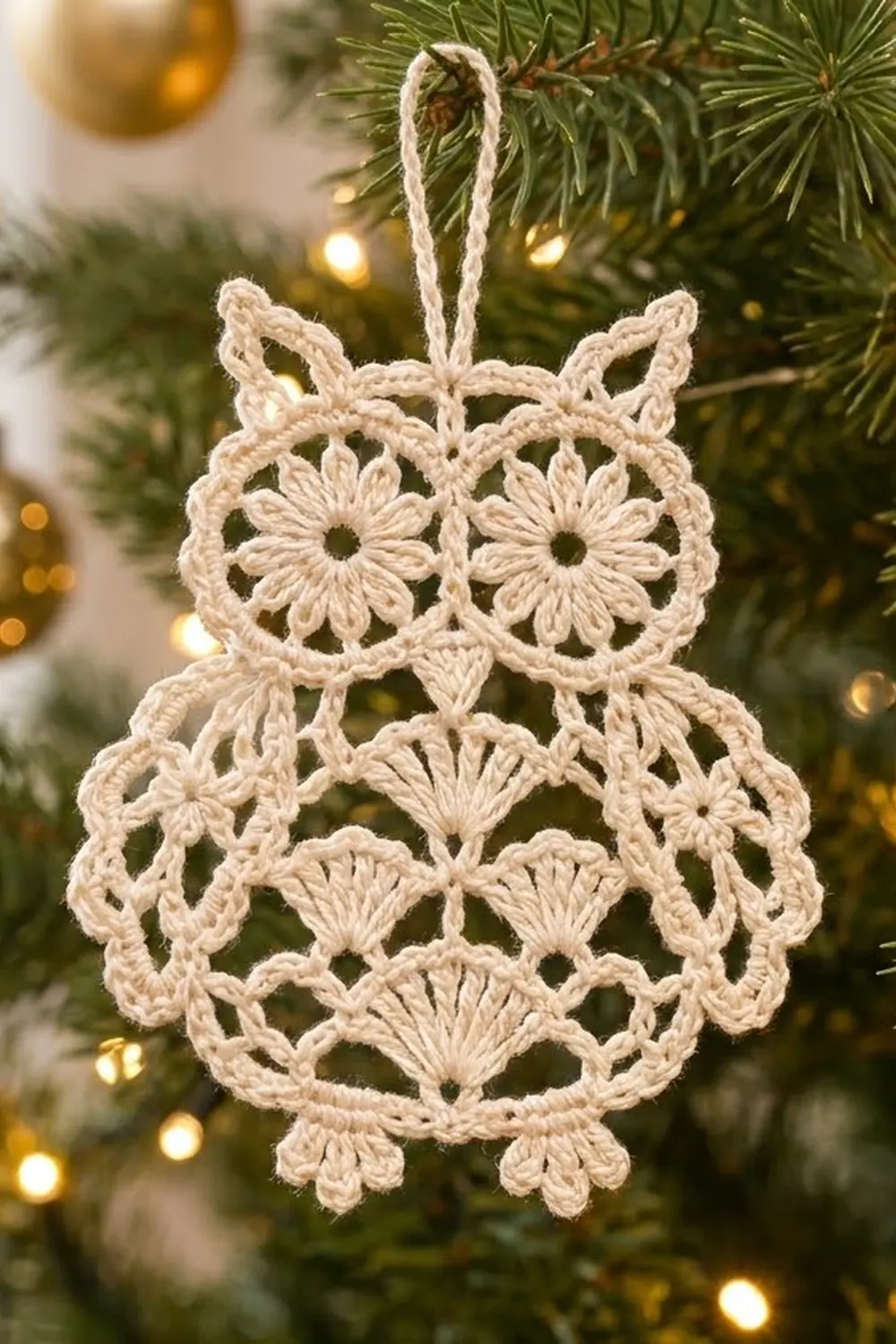
This little lace owl is made for the Christmas tree. It is worked in ivory cotton thread and has round daisy eyes, pointed ears, a tiny V-shaped beak, a body of stacked fan shells, and oval wings with a picot edge. In front of tree lights the open spaces glow, and it looks like vintage doily lace.
The finished owl is about 3.5 in (8.9 cm) wide and 4.25 in (10.8 cm) tall, plus a 1.25 in (3.2 cm) hanging loop. The pattern uses US crochet terms throughout.
You crochet five small motifs: two eyes, one body panel, and two wings. You join them as you go, so there is almost no sewing. The second eye joins to the first in its last round, and the top row of the body joins to the bottom of both eyes. Next comes a chain edge around the body, and the wings join to that edge in their last round. To finish, you add the ears, the feet, and the hanging loop.
Every motif has a size checkpoint, so you can catch gauge problems before they grow.
Finished Size and Construction
- Finished size: 3.5 in (8.9 cm) wide x 4.25 in (10.8 cm) tall, plus a 1.25 in (3.2 cm) loop
- Skill level: Intermediate (thread lace, join-as-you-go)
- Terminology: US crochet terms
- Yarn weight: Size 10 cotton crochet thread (lace weight, category 0)
- Hook: 1.65 mm (US steel size 7)
- Number of pieces: 5 motifs joined into 1 ornament
- Layout: two eyes side by side on top, the body centered below them, and one wing on each side of the body
- Piece sizes: eye 1.4 in (3.6 cm) across; body 2.2 in (5.6 cm) wide x 2.0 in (5.1 cm) tall before the edge round; wing 0.9 in (2.3 cm) x 2.0 in (5.1 cm)
- Size before border: 3.5 in (8.9 cm) wide x 3.5 in (8.9 cm) tall, without ears and feet
- Border depth: the ears add 0.35 in (0.9 cm) at the top, the feet add 0.35 in (0.9 cm) at the bottom, and the loop adds 1.25 in (3.2 cm)
Materials
Thread: Use mercerized size 10 cotton crochet thread. It holds a crisp shape and stiffens well. Cream, ivory, or natural all match the look shown, and so do white or metallic gold.
- Ivory (one color): 5 g, about 20 m (22 yd), per ornament
The quantity includes a margin for joining, weaving in ends, and a test swatch. A standard ball of size 10 thread will make many owls.
Tools:
- 1.65 mm (US steel 7) crochet hook
- Fine tapestry needle or thread needle
- Small sharp scissors
- Rustproof pins and a foam blocking board
- Fabric stiffener or starch spray
- Ruler marked in inches and cm
Abbreviations (US Terms)
- ch – chain
- sl st – slip stitch
- sc – single crochet
- hdc – half double crochet
- dc – double crochet
- tr – treble crochet
- sk – skip
- sp – space
- st(s) – stitch(es)
Special stitch – Join (JAYG join): Work the first half of the chain space, remove the hook from the loop, insert it from front to back into the stitch or space you are joining to, pick up the dropped loop, and pull it through. Then finish the second half of the chain space. For example, “ch 2, join, ch 2” takes the place of a ch-5.
Gauge and Checkpoints
Make one eye first and measure it. That is your gauge test.
- Eye after Round 1: 0.45 in (1.1 cm) across
- Eye after Round 2: 0.9 in (2.3 cm) across
- Eye after Round 4: 1.4 in (3.6 cm) across
- Body after Row 2: the bottom fan is 1.1 in (2.8 cm) wide
- Body after Row 5: 2.2 in (5.6 cm) wide
- Body after Row 9: 2.0 in (5.1 cm) tall
- Wing after Round 3: 0.9 in (2.3 cm) x 2.0 in (5.1 cm)
If your eye is bigger than 1.5 in (3.8 cm), go down to a 1.5 mm hook. If it is smaller than 1.3 in (3.3 cm), go up to a 1.75 mm hook. Measure lace lightly pressed flat, not stretched. Blocking opens it by only about 0.05 in (0.1 cm).
Eyes (Make 2)
Round 1: Ch 6 and sl st to the first ch to form a ring. Ch 3 (counts as dc), then work 11 dc in the ring. Join with a sl st to the top of the ch-3. (12 dc)
Round 2 (petals): Ch 1, sc in the same st, ch 5. Sc in the next dc, ch 5. Repeat from * to * 10 more times, then join to the first sc. (12 sc, 12 ch-5 petal loops)
Round 3: Sl st into the first 3 ch of the first loop. Ch 1, sc in the same loop, ch 4. Sc in the next ch-5 loop, ch 4. Repeat from * to * 10 more times, then join to the first sc. (12 sc, 12 ch-4 sps)
Round 4 (solid ring): Sl st into the first ch-4 sp, ch 1, and work 5 sc in each ch-4 sp around. Join to the first sc. (60 sc, in 12 groups of 5)
For the first eye, fasten off and leave a 4 in (10.2 cm) tail. Work the second eye through Round 3 only. Its Round 4 joins it to the first eye (see Joining).
For placement, treat each eye like a clock face, with each 5-sc group as one hour. The center sc of a group is its 3rd sc.
Body
The body is worked in rows from the bottom up, so every fan opens upward.
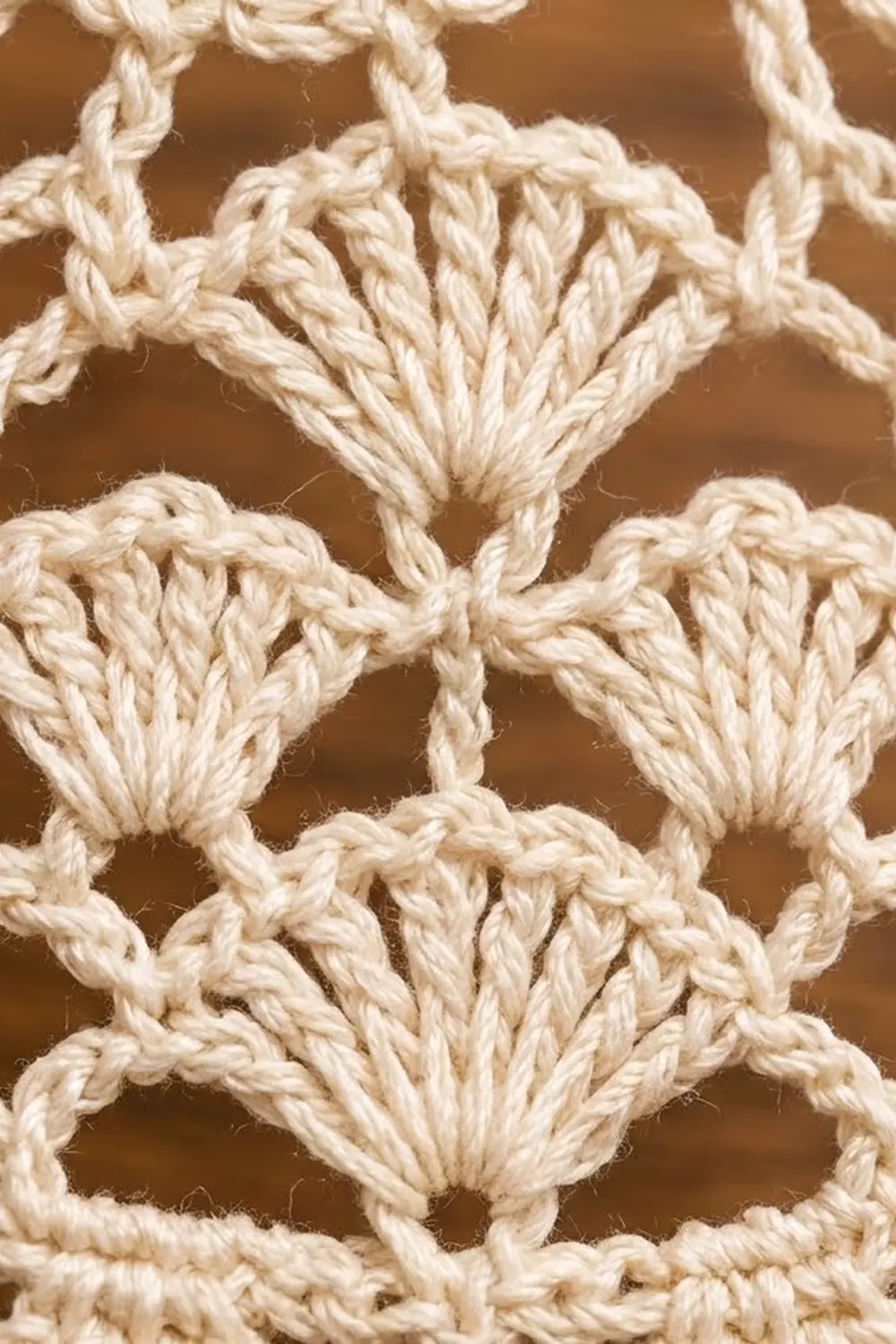
Row 1 (bottom fan): Ch 5 and sl st to the first ch to form a ring. Ch 3 (counts as dc), then work 12 dc in the ring. Turn. (13 dc)
Row 2: Ch 4 (counts as dc + ch 1). Dc in the next dc, ch 1. Repeat from * to * 10 more times, then dc in the top of the turning ch. Turn. (13 dc, 12 ch-1 sps)
Checkpoint: the fan is 1.1 in (2.8 cm) wide.
Row 3 (mesh): Ch 1, sc in the first dc. Ch 4, sk the next 2 dc, sc in the next dc. Repeat from * to * 3 more times. Turn. (5 sc, 4 ch-4 loops) You have worked into dc 1, 4, 7, 10, and 13.
Row 4 (two fans): Ch 1, sc in the first sc, ch 2, 9 dc in the next sc, ch 2, sc in the center sc, ch 2, 9 dc in the next sc, ch 2, sc in the last sc. Turn. (3 sc, 18 dc, 4 ch-2 sps)
Row 5: Ch 1, sc in the first sc, ch 2. Dc in the next dc, ch 1. Repeat from * to * 7 more times, then dc in the next dc, ch 2, and sc in the center sc. Ch 2 and repeat the fan section once more. Ch 2, sc in the last sc. Turn. (3 sc, 18 dc, 16 ch-1 sps, 4 ch-2 sps)
Checkpoint: the body is 2.2 in (5.6 cm) wide.
Row 6 (mesh): Ch 1, sc in the first sc, ch 5, sc in the 5th dc of the first fan, ch 5, sc in the center sc, ch 5, sc in the 5th dc of the second fan, ch 5, sc in the last sc. Turn. (5 sc, 4 ch-5 loops)
Row 7 (top fan): Ch 1, sc in the first sc, ch 3, sc in the next sc, ch 3, 7 dc in the center sc, ch 3, sc in the next sc, ch 3, sc in the last sc. Turn. (4 sc, 7 dc, 4 ch-3 sps)
Row 8: Ch 1, sc in the first sc, ch 3, sc in the next sc, ch 2. Dc in the next dc, ch 1. Repeat from * to * 5 more times, then dc in the next dc, ch 2, sc in the next sc, ch 3, sc in the last sc. Turn. (4 sc, 7 dc, 6 ch-1 sps, 2 ch-2 sps, 2 ch-3 sps)
Do not fasten off. Row 9 joins the body to the eyes (see Joining).
Wings (Make 2)
Round 1: Ch 15. Sc in the 2nd ch from the hook and in the next 12 ch (13 sc), then work 3 sc in the last ch. Rotate and work along the underside of the chain: sc in the next 12 ch, then 2 sc in the same ch as the first sc. Join to the first sc. (30 sc)
Round 2: Ch 1, sc in the same st. Ch 4, sk 2 sc, sc in the next sc. Repeat from * to * 8 more times, then ch 4, sk 2 sc, and join to the first sc. (10 sc, 10 ch-4 loops)
Round 3 is worked during joining. Unjoined, it reads: sl st into the first loop, ch 1, then work (2 sc, ch 3, 2 sc) in each loop around and join. (40 sc, 10 ch-3 picots)
Make All Pieces
All pieces are ivory:
- Eyes: 2 (Eye 1 complete, Eye 2 through Round 3)
- Body: 1 (through Row 8)
- Wings: 2 (through Round 2)
Layout:
        [ear]          [ear]
       [Eye 1]--+--[Eye 2]
  [Wing]   [  Body  ]   [Wing]
           [foot] [foot]
Joining
Every join is a JAYG join worked into the center sc of a 5-sc eye group or into a chain loop, one join per point. Keep each join at the same tension as the chains around it. A tight join puckers the lace, and a loose one leaves gaps.
Step 1 – Eye to eye: Work Round 4 of Eye 2. In the group that sits at 9 o’clock, work 2 sc, then for the center sc, insert the hook into the 3 o’clock center sc of Eye 1 and complete the sc through both pieces. Then work 2 sc. Finish the round. (Eye 2: 60 sc, 1 join)
Step 2 – Body Row 9: Hold the body under the eyes with the fan tops pointing up. Work: ch 1, sc in the first sc, ch 2, join to the outer bottom group of the eye above you (7 o’clock on the left eye or 5 o’clock on the right eye), ch 2, sc in the next sc. Ch 1, join to the inner bottom group of the same eye, ch 1. In the 4th (center) dc of the top fan, work (dc, ch 3, dc) to make the beak V. Ch 1, join to the inner bottom group of the second eye, ch 1, sc in the next sc. Ch 2, join to the outer bottom group, ch 2, sc in the last sc. (4 sc, 2 dc, 1 beak ch-3, 4 joins)
Step 3 – Body edge round: Do not turn. Ch 3, then sc in the end of Row 8. Ch 3, sc in the end of the next row. Repeat from * to * down to Row 1. Ch 3, sc around the ring at the bottom, ch 3. Sc in the end of Row 1 on the other side, then ch 3, sc in the end of the next row up to Row 8. Ch 3, sl st in the first sc of Row 9. Fasten off.
Per side: 8 sc, 8 ch-3 loops. Bottom: 1 sc, 2 ch-3 loops. Total: 17 sc, 18 ch-3 loops. Number each side’s loops L1–L8, starting from the top.
Step 4 – Wings: Work Round 3 of each wing, starting at the 3-sc tip. On the long side facing the body, the first five picots are A–E. For picot A, work ch 1, join to the outer middle group of the eye (8 o’clock left or 4 o’clock right), ch 1. Join picot C to L3 and picot E to L7 the same way. Work all other picots as ch 3. Each wing has 3 joins and 7 free picots.
Size checkpoint: the assembled owl measures 3.5 in (8.9 cm) wide x 3.5 in (8.9 cm) tall.
Border
The border is three small finishing details. Each ear and foot is about 0.35 in (0.9 cm) deep.
Ears (one per eye): Join thread in the 1st sc of the 11 o’clock group on the left eye. Ch 7. Working back along the chain: sc in the 2nd ch from the hook, hdc in the next ch, dc in each of the next 2 ch, and tr in each of the last 2 ch. Sk 3 sc, then sl st in the 5th sc of the group. Fasten off. Repeat on the 1 o’clock group of the right eye. (6 sts per ear; each ear base covers 5 sc)
Feet (one per side): Join thread in the sc at the end of Row 2 (between L7 and L8). Ch 5, sl st in the same sc. Repeat from * to * 2 more times and fasten off. Repeat on the other side. (3 ch-5 toes per foot)
Hanging loop: Join thread in the center sc of the left eye’s 1 o’clock group. Ch 4 and sl st in the center sc of the right eye’s 11 o’clock group. Turn, and work 5 sc in the ch-4 bridge. Ch 30 and sl st in the 3rd sc of the bridge. Work 36 sc over the chain loop, sl st, and fasten off.
Why the math works: Each ear covers exactly one 5-sc group, so the left and right ears are mirror images. The feet sit on matching row-end stitches 1.0 in (2.5 cm) apart. The loop bridge is anchored at mirrored groups, so the ornament hangs straight.
Final Blocking
- Weave in all ends along solid stitches, never through the open mesh.
- Wet the owl in fabric stiffener (or water, if you plan to use starch spray).
- Press out the extra liquid in a towel without wringing.
- Pin it to the board at 3.5 in (8.9 cm) wide x 4.25 in (10.8 cm) tall.
- Pin each eye round, pin through the center of every fan so it spreads evenly, and pin every wing picot outward.
- Pin the ear tips up and the toes down.
- Let it dry completely, about 6–8 hours.
Final Quality-Control Checklist
- Each eye has 60 sc and measures 1.4 in (3.6 cm).
- The fans count 13, 9, 9, and 7 ribs.
- The beak V is centered under the join between the eyes.
- Each wing has 3 joins and 7 free picots.
- The ears and feet are mirror images.
- The owl measures 3.5 in (8.9 cm) x 4.25 in (10.8 cm).
- The loop hangs straight.
Troubleshooting
- Fans cup: Your ch-1 spaces are too tight. Loosen them, or block flatter with extra pins.
- Eye ruffles: You worked more than 5 sc per space. Recount Round 4.
- Body pulls between the eyes: The Row 9 chains are too short. Keep them loose.
- Owl tilts: The hanging loop is off center. Re-anchor the bridge on mirrored groups.
- Wings flop: Re-stiffen them and dry them pinned flat.
Care
Hand wash gently in cool water, reshape, and dry flat. Re-stiffen if needed. Store flat between tissue paper.
Final Notes
Measure at each stage: the 1.4 in (3.6 cm) eye sets the 2.8 in (7.1 cm) top width, and the 2.2 in (5.6 cm) body becomes 2.4 in (6.1 cm) after its edge. The wings bring the width to 3.5 in (8.9 cm), and the ears and feet bring the height to 4.25 in (10.8 cm). If each checkpoint matches, the owl will too.
Happy crocheting!