

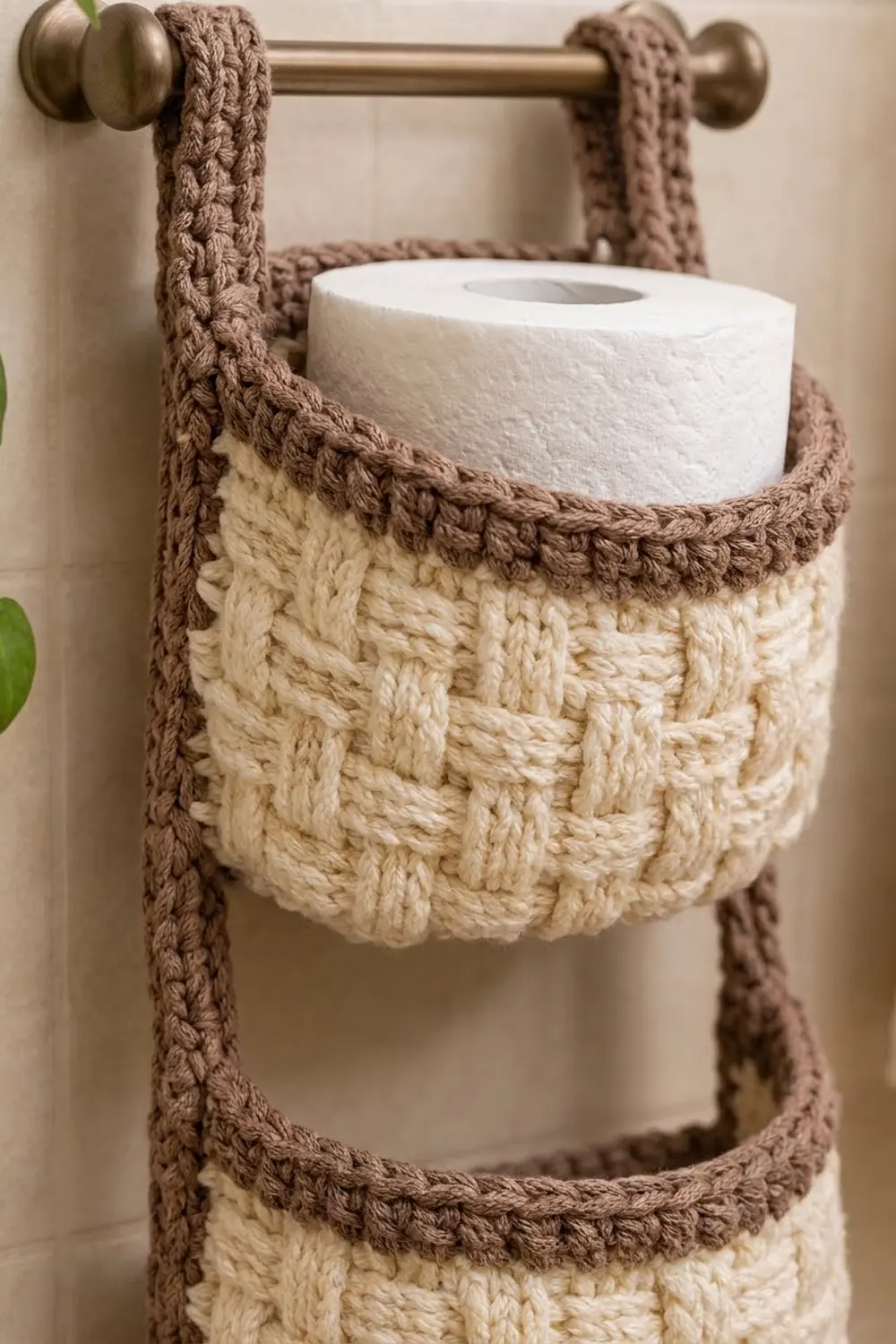
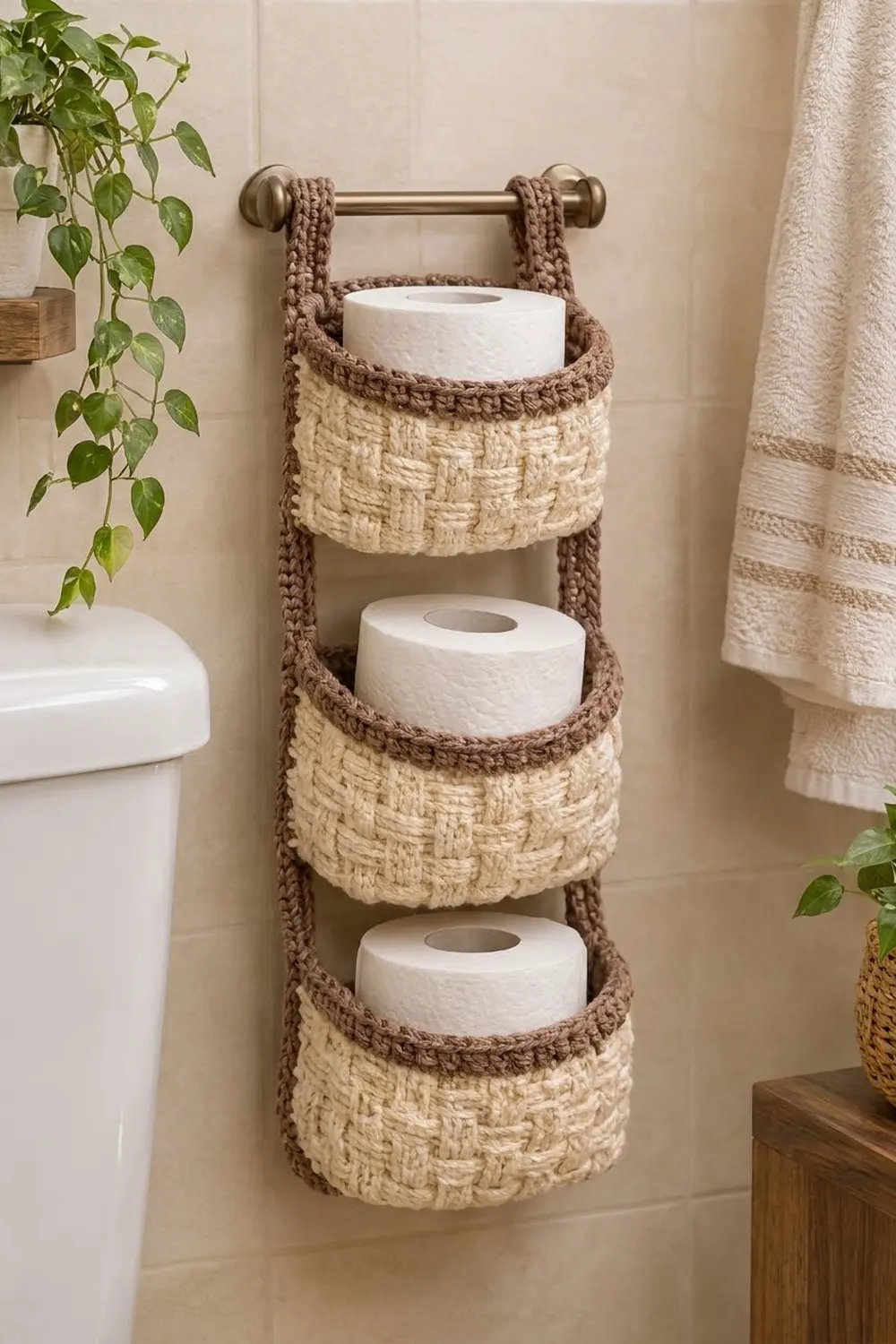
This hanging toilet paper holder has three oval pockets stacked one above the other, joined by two chocolate-brown side straps. The straps end in loops at the top that slip over a towel bar. Each pocket has a cream basketweave body with a smooth cream base and a rolled brown rim. It looks like a woven basket but stays soft and flexible.
The palette is warm and simple: natural cream for the pocket bodies and a medium brown for the rims and straps. It fits a farmhouse, boho or spa-style bathroom and holds one standard roll per pocket.
This pattern uses US crochet terms. The finished holder measures about 7.8 in (19.8 cm) wide and 18 in (45.7 cm) long from the top of the loops to the bottom of the lowest pocket. Each pocket is 6.5 in (16.5 cm) long, 5 in (12.7 cm) deep and 4 in (10.2 cm) tall.
You will make three identical pockets in the round, starting with a flat oval base. Basketweave walls in front and back post double crochet come next, then a brown rim. Then you make two long brown straps in rows, edge them, and sew them to the sides of the pockets.
Finished Size and Construction
- Finished size: about 7.8 in (19.8 cm) wide x 18 in (45.7 cm) long
- Skill level: Intermediate (post stitches, working in the round, sewing)
- Terminology: US
- Yarn weight: Worsted (#4) cotton or cotton blend
- Hook: 5.0 mm (H-8)
- Number of pieces: 5 (3 pockets, 2 straps)
- Layout: 3 pockets stacked vertically, 1 in (2.5 cm) apart, between 2 side straps
- Pocket size: 6.5 in (16.5 cm) long x 5 in (12.7 cm) deep x 4 in (10.2 cm) tall
- Strap size before edging: 0.8 in (2.0 cm) x 22.5 in (57.2 cm)
- Border (strap edging) depth: 0.25 in (0.6 cm) on each edge, for a finished strap of about 1.3 in (3.3 cm) x 23 in (58.4 cm)
Materials
Pick a firm, smooth cotton. It holds the pocket shape, shows the basketweave texture clearly and stands up to bathroom humidity. Acrylic works too, but the pockets will be softer and may sag.
- Color A (Cream): 200 g / about 340 m (372 yd)
- Color B (Brown): 100 g / about 170 m (186 yd)
Tools:
- 5.0 mm (H-8) crochet hook
- Tapestry needle
- 8 locking stitch markers
- Scissors
- Measuring tape
- Pins or clips for assembly
These quantities include roughly a 20% margin for your gauge swatch, tension differences and sewing.
Abbreviations (US Terms)
- ch – chain
- sl st – slip stitch
- sc – single crochet
- inc – 2 sc in the same stitch
- dc – double crochet
- BLO – back loop only
- FPdc – front post double crochet
- BPdc – back post double crochet
- rev sc – reverse single crochet (crab stitch)
- st(s) – stitch(es)
- rnd(s) – round(s)
Special stitch – rev sc: Work from left to right (right-handed). Insert the hook into the next stitch to the right, yarn over, pull up a loop, then yarn over and draw through both loops. This makes a twisted, rope-like edge.
Gauge and Checkpoints
- Sc in rounds: 15 sts and 16 rnds = 4 in (10.2 cm), so each sc rnd is about 0.25 in (0.6 cm) tall.
- Basketweave: 15 sts and 8 rnds = 4 in (10.2 cm), so each post rnd is about 0.5 in (1.3 cm) tall.
Make one complete pocket before you start the others. It serves as your real gauge test.
Checkpoints:
- After Rnd 5 (42 sts): the base is about 4 in (10.2 cm) x 2.5 in (6.4 cm).
- After Rnd 10 (72 sts): the base is about 6.5 in (16.5 cm) x 5 in (12.7 cm), and the outer edge measures about 19.2 in (48.8 cm).
- After Rnd 17: the wall is about 3.25 in (8.3 cm) tall, measured up from the base edge.
- Finished pocket: 4 in (10.2 cm) tall. A standard roll sits inside it, standing upright.
If the base is too big, go down a hook size (4.5 mm). If it is too small or the roll won’t fit, go up to 5.5 mm. If the base cups or ruffles, check that you are working exactly 6 increases per round.
Pocket (Make 3)
Work in continuous joined rounds. Join each round with a sl st to the first st. The starting ch 1 or ch 2 never counts as a stitch.
Oval Base
With Color A, ch 9.
Rnd 1: 3 sc in 2nd ch from hook, sc in next 6 ch, 3 sc in last ch. Rotate and work along the free loops of the foundation chain: sc in next 6 ch. Join. (18 sts)
The base now has two 3-st ends and two 6-st straight sides.
Rnd 2: Ch 1, [inc in each of next 3 sts, sc in next 6] twice. Join. (24 sts)
Rnd 3: Ch 1, [(sc in next st, inc) 3 times, sc in next 6] twice. Join. (30 sts)
Rnd 4: Ch 1, [(sc in next 2 sts, inc) 3 times, sc in next 6] twice. Join. (36 sts)
Rnd 5: Ch 1, [(sc in next 3 sts, inc) 3 times, sc in next 6] twice. Join. (42 sts)
Rnd 6: Ch 1, [(sc in next 4 sts, inc) 3 times, sc in next 6] twice. Join. (48 sts)
Rnd 7: Ch 1, [(sc in next 5 sts, inc) 3 times, sc in next 6] twice. Join. (54 sts)
Rnd 8: Ch 1, [(sc in next 6 sts, inc) 3 times, sc in next 6] twice. Join. (60 sts)
Rnd 9: Ch 1, [(sc in next 7 sts, inc) 3 times, sc in next 6] twice. Join. (66 sts)
Rnd 10: Ch 1, [(sc in next 8 sts, inc) 3 times, sc in next 6] twice. Join. (72 sts)
Each round adds exactly 6 stitches, 3 at each curved end, so the base stays flat. Check against Checkpoint 2.
Base Edge
Rnd 11: Ch 1, sc in BLO of each st around. Join. (72 sts)
The unworked front loops form a neat ridge, and the wall turns upward from here.
Basketweave Wall
72 is a multiple of 8, so the 4-and-4 weave repeats exactly 9 times per round.
Rnd 12: Ch 2, [FPdc around next 4 sts, BPdc around next 4 sts] 9 times. Join. (72 sts)
Rnd 13: Ch 2, [FPdc around next 4 FPdc, BPdc around next 4 BPdc] 9 times. Join. (72 sts)
Rnd 14: Ch 2, [BPdc around next 4 sts, FPdc around next 4 sts] 9 times. Join. (72 sts)
Rnd 15: Ch 2, [BPdc around next 4 BPdc, FPdc around next 4 FPdc] 9 times. Join. (72 sts)
Rnds 16–17: Repeat Rnds 12–13. (72 sts)
That gives three bands of blocks, two rounds each, offset so they look woven. The wall should measure about 3.25 in (8.3 cm), including the base edge round. Fasten off Color A.
Brown Rim
Join Color B in any st.
Rnd 18: Ch 1, sc in each st around. Join. (72 sts)
Rnd 19: Ch 1, sc in each st around. Join. (72 sts)
Rnd 20: Ch 1, rev sc in each st around. Join. (72 sts)
The rim adds about 0.75 in (1.9 cm), so the pocket is 4 in (10.2 cm) tall. Fasten off and weave in the ends.
Mark the Strap Lines
Flatten the pocket so the two 6-st straight sections sit at center front and center back. The folds then fall at the middle of each curved end. Place a marker at each fold on the rim. That gives you 2 markers per pocket, 6 in total. The straps will run along these lines.
Strap (Make 2)
With Color B, ch 4.
Row 1: Sc in 2nd ch from hook and in each ch across. (3 sts)
Rows 2–90: Ch 1, turn, sc in each st across. (3 sts)
Before edging, the strap measures 0.8 in (2.0 cm) x 22.5 in (57.2 cm), at 4 rows per inch. Do not fasten off; go straight into the edging.
Make All Pieces
- Color A + Color B: 3 pockets (cream base and walls, brown rim)
- Color B: 2 straps
Layout, front view:
 [loop]                 [loop]
   ||                     ||
   || [ Pocket 1 – top  ] ||
   ||        gap          ||
   || [ Pocket 2 – mid  ] ||
   ||        gap          ||
   || [ Pocket 3 – bot  ] ||
   ==== straps tuck under ===
Strap row map, counted from Row 1 (bottom) to Row 90 (top):
- Rows 1–10: tuck under Pocket 3, 2.5 in (6.4 cm)
- Rows 11–26: Pocket 3 side, 4 in (10.2 cm)
- Rows 27–30: gap, 1 in (2.5 cm)
- Rows 31–46: Pocket 2 side, 4 in (10.2 cm)
- Rows 47–50: gap, 1 in (2.5 cm)
- Rows 51–66: Pocket 1 side, 4 in (10.2 cm)
- Rows 67–90: loop section, 6 in (15.2 cm), folded in half
Border: Strap Edging
Border gauge: 1 sc per row-end along the long sides, which works out to 4 sts per inch. That matches the sc row gauge, so the edging lies flat and doesn’t flare or pull in.
Edging Rnd: After Row 90, ch 1. Do not turn. Work around the strap:
- Top short side: 3 sc in first st (corner), sc in next st, 3 sc in last st (corner).
- Long side: sc in the row-end of Rows 89 down to 2. (88 sts)
- Bottom short side: working into the free loops of the foundation chain, 3 sc in first ch (corner), sc in next ch, 3 sc in last ch (corner).
- Second long side: sc in the row-end of Rows 2 up to 89. (88 sts)
- Join to first sc. (190 sts)
The middle sc of each 3-sc group is the corner stitch. Counted corner to corner, including both corner stitches:
- Each long side: 1 + 1 + 88 + 1 + 1 = 92 sts
- Each short side: 1 + 1 + 1 + 1 + 1 = 5 sts
Why the math works: 2 x 92 + 2 x 5 = 194. The 4 corner stitches are each counted in two sides, so subtract 4: 194 − 4 = 190, which matches the round total. Rows 1 and 90 have no separate row-ends because their corners are already covered. That is why the long sides use only Rows 2–89.
The edging adds 0.25 in (0.6 cm) all around, so the finished strap is about 1.3 in (3.3 cm) x 23 in (58.4 cm). Fasten off and leave a 40 in (101.6 cm) tail for sewing.
Joining
Method: whipstitch with Color B on a tapestry needle.
- Make the loop. Fold the top 6 in (15.2 cm) of the strap (Rows 67–90) in half to the back. Sew the tip flat to the strap at Row 67 to make a 3 in (7.6 cm) doubled loop.
- Attach Pocket 1. Center Rows 51–66 over one pocket’s fold marker, with the top of Row 66 level with the top of the rim. Whipstitch both long edges of the strap to the pocket wall.
- Stitch-to-stitch logic: each pocket side is 16 strap rows tall, which is 16 edging sts per edge. Make 1 whipstitch per edging st and catch the pocket fabric every 0.25 in (0.6 cm). That is 16 catches per edge over the pocket’s 4 in (10.2 cm) height. Nothing is eased in or stretched.
- Continue down. Leave Rows 47–50 free as the gap. Attach Pocket 2 at Rows 31–46 and Pocket 3 at Rows 11–26 the same way.
- Tuck. Fold Rows 1–10 under the base of Pocket 3 and whipstitch them flat against the base.
- Repeat Steps 1–5 with the second strap on the other side of each pocket.
Tension advice: pull each stitch just snug. If it’s too tight, the strap will pucker the pocket wall. If it’s too loose, the pockets will tilt forward when they’re loaded.
Size checkpoint: lay the holder flat. It should measure about 18 in (45.7 cm) from loop tops to the bottom of Pocket 3, with 1 in (2.5 cm) gaps between pockets.
Final Blocking
- Spray the holder evenly with water until it is damp but not soaked.
- Stand a toilet roll, or a rolled hand towel, inside each pocket to set the oval shape.
- Lay it flat on a towel. Square the straps so they are parallel and 6.5 in (16.5 cm) apart at the pocket edges.
- Pin the loops flat and check that both are 3 in (7.6 cm) long.
- Let it dry completely, then take out the pins and the inserts.
Final Quality-Control Checklist
- Each base has 72 sts and lies flat.
- Each wall has 72 sts with 9 clean weave repeats.
- All three pockets are 4 in (10.2 cm) tall and the same size.
- Each strap edging round has 190 sts: 92 per long side and 5 per short side, including corners.
- The loops match in length and hang level on the bar.
- The gaps between pockets are all 1 in (2.5 cm).
- All ends are woven in securely.
Troubleshooting
- Base cups upward: you skipped increases or your tension is tight. Recount: every round should be 6 sts more than the last.
- Base ruffles: you added extra stitches. Recount from the last correct round.
- Weave blocks don’t line up: check that each post round starts at the same point and that there are exactly 72 sts.
- Roll doesn’t fit: remake the pocket with a 5.5 mm hook. Keep the 72-st count so the weave still repeats 9 times.
- Pockets lean forward: sew the straps higher on the pocket wall and use tighter whipstitches.
- Strap is wavy: you worked more or fewer than 1 sc per row-end. Redo the edging.
Care
Hand wash in cool water or machine wash on gentle in a laundry bag. Reshape while damp and dry flat.
Final Notes
The measurement chain is simple. A 72-st oval base, 6.5 in (16.5 cm) x 5 in (12.7 cm), supports a 72-st basketweave wall with 9 even repeats. The brown rim brings each pocket to 4 in (10.2 cm). A 90-row strap edged to 190 sts lines up row for row with three pockets, two 1 in (2.5 cm) gaps, a bottom tuck and a 3 in (7.6 cm) loop, for a finished holder 18 in (45.7 cm) long.
Happy crocheting!