

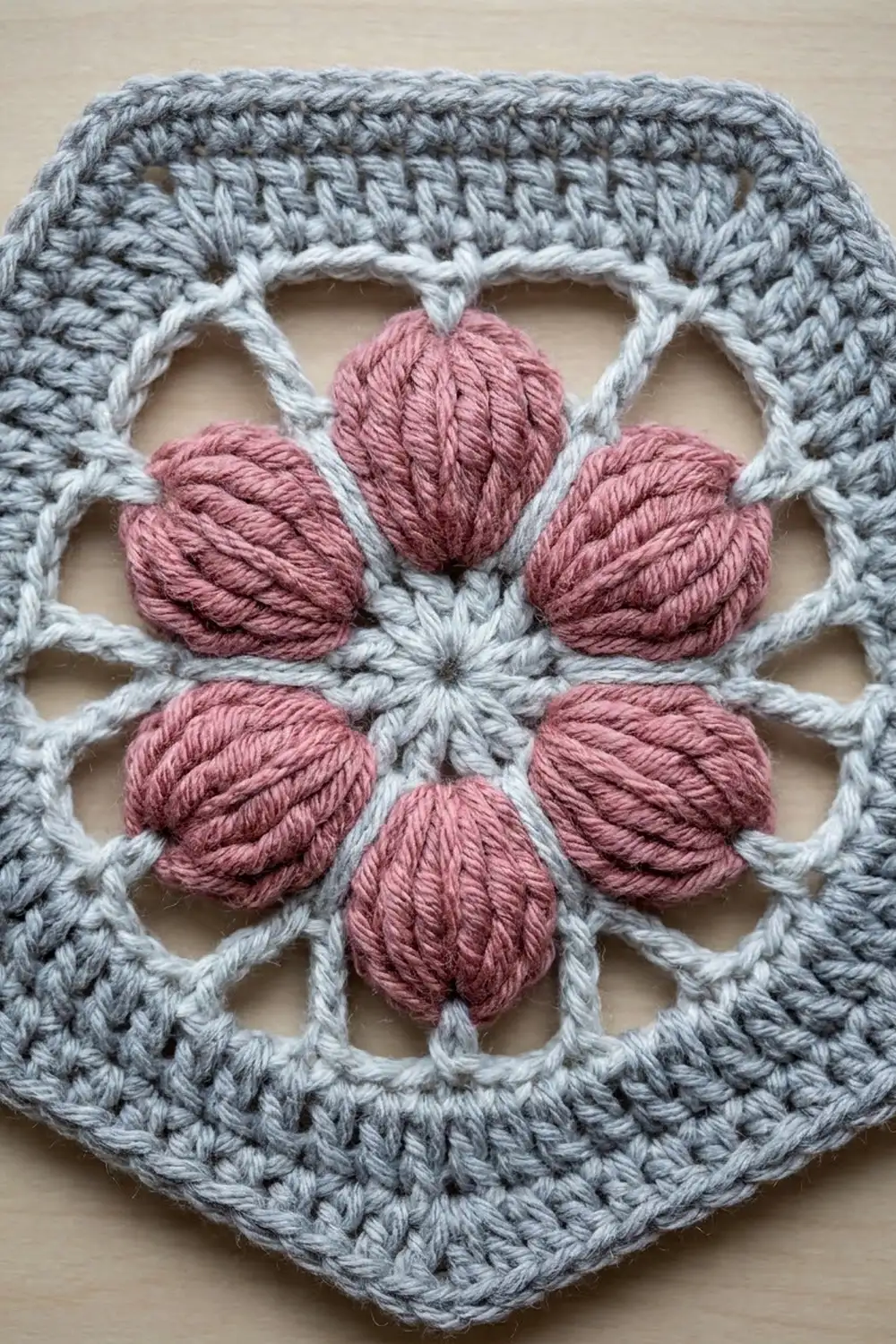
The Rosy Puff Blossom Hexagon is a single crochet motif with a plump six-petal flower in the middle and a clean gray hexagon frame around it. Each petal is made from two tall puff stitches that sit side by side, so it shows a soft center line and a rounded, raised surface.
The palette is just two colors: dusty rose for the flower and soft light gray for the frame. Thin gray spokes run out from between the petals to the six corners. Short chain arcs leave small open windows around the flower before the frame closes into two solid rounds and a single crochet edge. The style is cottage-soft but tidy, and the motif works well on its own as a coaster, a decorative mat, or a practice piece for puff stitches.
This pattern uses US crochet terms. The finished hexagon measures about 6.75 in (17.1 cm) from flat side to flat side and about 7.75 in (19.7 cm) from point to point.
You work the motif in the round from a magic ring. First comes a pink center ring, then the puff petals. Next you join gray for the spoke-and-arc round and work two double crochet rounds that set the hexagon corners. A single crochet border finishes it. This is one motif made as one single piece, with no joining.
Finished Size and Construction
- Finished size: 6.75 in (17.1 cm) flat side to flat side; 7.75 in (19.7 cm) point to point
- Side length: about 3.9 in (9.9 cm)
- Skill level: Easy-Intermediate (puff stitches, working into chain spaces)
- Terminology: US
- Yarn weight: Worsted (#4)
- Hook: 5 mm (H-8)
- Number of pieces: 1
- Layout: single hexagon motif, no assembly
- Piece size: 6.75 in (17.1 cm) flat to flat
- Size before border: 6.25 in (15.9 cm) flat to flat after Round 5
- Border depth: 0.25 in (0.6 cm), one round of single crochet
Materials
A smooth worsted-weight acrylic or cotton blend is best here. Puff stitches look fullest in a plied, non-fuzzy yarn, and the gray frame stays crisp and flat. Pick two colors with clear contrast so the petals stand out.
- Color A, dusty rose (flower): 12 g, about 24 m
- Color B, light gray (frame and border): 22 g, about 44 m
These amounts include a margin of about 20 percent. Puff stitches use more yarn than you might expect, and the extra covers a swatch, a frogged round, or tighter tension.
Tools:
- 5 mm (H-8) crochet hook
- Tapestry needle
- Scissors
- 2 stitch markers
- Ruler or tape measure
- Blocking mat and rust-proof pins
- Spray bottle with cool water
Abbreviations (US Terms)
- ch – chain
- sl st – slip stitch
- sc – single crochet
- dc – double crochet
- tr – treble crochet
- sp(s) – space(s)
- st(s) – stitch(es)
- beg – beginning
- rep – repeat
- PP – petal puff (special stitch)
Special stitch – Petal Puff (PP): (Yarn over, insert hook in the stitch named, yarn over and pull up a loop to about 0.75 in [1.9 cm]) 5 times in the same stitch, so you have 11 loops on the hook. Yarn over and draw through all 11 loops, then ch 1 to lock the puff. The locking chain is part of the PP and is never counted as a separate stitch.
Gauge and Checkpoints
Gauge: 9 dc = 2 in (5.1 cm) with Color B and the 5 mm hook.
Because this is a single motif, the motif itself is your gauge test. If you are unsure of your tension, make one test motif through Round 4 first, measure it, and adjust before starting your final piece. Measure at each checkpoint below and adjust before you move on:
- After Round 1: the dc ring is about 1.25 in (3.2 cm) across.
- After Round 2: the flower is about 3.25 in (8.3 cm) across, petal tip to petal tip.
- After Round 3: the spoke-and-arc round is about 4.25 in (10.8 cm) across.
- After Round 4: about 5.25 in (13.3 cm) flat to flat.
- After Round 5: about 6.25 in (15.9 cm) flat to flat.
- After Round 6 (border): about 6.75 in (17.1 cm) flat to flat.
If the piece is too big, go down to a 4.5 mm hook, or pull your puff loops slightly shorter. If it is too small, go up to a 5.5 mm hook. If only the flower is off but the frame is right, change the puff loop height rather than the hook.
Measure flat to flat on a flat, relaxed piece. Don’t stretch the motif while you measure.
Pattern
Before you start: The beginning chains count as stitches in every round. Join each round with a sl st, and don’t turn. The right side faces you the whole time.
Round 1 – Center Ring (Color A)
With Color A, make a magic ring.
Ch 3 (counts as first dc), work 11 dc into the ring. Pull the ring closed, leaving a small center hole about 0.25 in (0.6 cm) wide. Sl st to the top of beg ch-3.
Stitch count: 12 dc.
Round 2 – Puff Petals (Color A)
Ch 1, sc in the same st as the join. *(PP, ch 1, PP) all in the next dc, sc in the next dc; rep from * 4 more times, (PP, ch 1, PP) in the last dc. Sl st to the first sc.
Stitch count: 6 petals, made of 12 PP, 6 ch-1 sps, and 6 sc.
Each petal sits on one dc. The two puffs fan out from that dc, and the ch-1 between them makes the center line of the petal. The sc between petals anchors them and gives a narrow valley for the gray spokes. Fasten off Color A and weave in the tail.
Round 3 – Spokes and Arcs (Color B)
Join Color B with a sl st in any sc between two petals.
Ch 4 (counts as first tr), ch 4, sc in the ch-1 sp at the tip of the next petal, ch 4. *Tr in the next sc between petals, ch 4, sc in the next petal-tip ch-1 sp, ch 4; rep from * 4 more times. Sl st to the top of beg ch-4.
Stitch count: 6 tr, 6 sc, and 12 ch-4 sps.
Each tr is a spoke rising out of the valley between two petals. The sc tacks the frame to each petal tip, and the ch-4 arcs leave the open windows around the flower. Place a marker in any tr to help you find the corners in the next round.
Round 4 – Setting the Corners (Color B)
This is a conversion round: it turns the chain spaces into a solid double crochet frame.
Ch 3 (counts as dc), (dc, ch 2, 2 dc) in the same st as the join. This is the first corner. *4 dc in the next ch-4 sp, dc in the next sc, 4 dc in the next ch-4 sp, (2 dc, ch 2, 2 dc) in the next tr; rep from * 4 more times, 4 dc in the next ch-4 sp, dc in the next sc, 4 dc in the last ch-4 sp. Sl st to the top of beg ch-3.
Stitch count: 78 dc and 6 ch-2 corner sps.
Here is the count as a conversion: the dc worked into existing stitches are 6 tr × 4 dc plus 6 sc × 1 dc = 30 dc. The dc worked into chain spaces are 12 ch-4 sps × 4 dc = 48 dc. That gives 30 + 48 = 78 dc. Per side, between corner ch-2 sps, that is 2 + 4 + 1 + 4 + 2 = 13 dc.
The corners now sit at the tops of the spokes, so each spoke points straight into a hexagon corner.
Round 5 – Solid Frame (Color B)
This is a growth round. Sl st in the next dc and into the next ch-2 corner sp.
Ch 3 (counts as dc), (dc, ch 2, 2 dc) in the same corner sp. *Dc in each of the next 13 dc, (2 dc, ch 2, 2 dc) in the next ch-2 sp; rep from * 4 more times, dc in each of the last 13 dc. Sl st to the top of beg ch-3.
Stitch count: 102 dc and 6 ch-2 corner sps.
Each side now has 17 dc between corner ch-2 sps: 2 corner dc, 13 side dc, and 2 corner dc. Six sides × 17 dc = 102 dc. Check that the motif measures about 6.25 in (15.9 cm) flat to flat and lies flat without ruffling or cupping.
Border
Border gauge: 1 sc per dc along the sides, which matches the dc gauge of 9 sts = 2 in (5.1 cm). Three sc go into each corner.
Round 6 – Single Crochet Edge (Color B)
This is a trim round. Do not fasten off after Round 5.
Ch 1, sc in the same st as the join and in the next dc, 3 sc in the next ch-2 corner sp. *Sc in each of the next 17 dc, 3 sc in the next ch-2 corner sp; rep from * 4 more times, sc in each of the last 15 dc. Sl st to the first sc. Fasten off, leaving an 8 in (20.3 cm) tail.
Stitch count: 120 sc.
As a trim count: 102 sc are worked 1 per existing dc, and 6 corners × 3 sc = 18 extra sc are added. That gives 102 + 18 = 120 sc. Each side has 17 sc between corner groups, with a 3-sc group at each corner.
The 2 sc at the start plus the 15 sc at the end make up the 17 sc of the last side, because the round begins just before a corner.
Why the math works: One sc into each dc keeps each straight side exactly the same length as the round below, so the edges stay flat. At each point, a hexagon turns only 60 degrees. Three sc into the ch-2 sp give just enough extra length to round that turn without a peak or a dip. The single sc round adds about 0.25 in (0.6 cm) on every side, taking the motif from 6.25 in (15.9 cm) to 6.75 in (17.1 cm) flat to flat.
Weave in all ends along the back of the border so they don’t show through the open windows.
Final Blocking
- Weave in all tails before you block, but don’t trim them yet.
- Spray the motif lightly with cool water until it is damp, not soaked.
- Lay it face up on the blocking mat.
- Pin one corner, then pin the opposite corner so the motif measures 7.75 in (19.7 cm) point to point.
- Pin the other two pairs of opposite corners the same way.
- Check that every flat-to-flat distance is 6.75 in (17.1 cm). Adjust pins until all three match.
- Add a pin at the middle of each side to keep the edges straight.
- Use your fingertips to round each puff petal. Don’t press them flat.
- Let the piece dry completely, then unpin it and trim the tails.
Final Quality-Control Checklist
- Round 1 has 12 dc and a small, tidy center hole.
- There are 6 petals, and each one has 2 puffs and a ch-1 center line.
- The 6 gray spokes sit between the petals and point to the corners.
- Each arc is tacked to a petal tip with 1 sc.
- Round 4 has 78 dc, or 13 dc per side.
- Round 5 has 102 dc, or 17 dc per side.
- Round 6 has 120 sc, with 3 sc in every corner.
- The piece is 6.75 in (17.1 cm) flat to flat and 7.75 in (19.7 cm) point to point.
- All 6 sides are straight and the same length.
- No ends show on the front.
Troubleshooting
The puffs look thin or lopsided. Pull every loop up to the same height, about 0.75 in (1.9 cm), before you close the puff. Lock it firmly with the ch 1.
Puff loops snag or split when you close them. Use a hook with a smooth, rounded throat and draw through all 11 loops in one steady motion.
The flower cups upward. Your puff loops are too short or Round 1 is too tight. Pull the loops up a little higher, or rework Round 1 more loosely.
The spokes lean to one side. Make sure each tr goes into the sc between petals, not into a puff.
The frame ruffles. Check your Round 4 count. More than 4 dc in a ch-4 sp adds bulk, so recount each side to 13 dc.
The frame cups or pulls in. Your gray tension is tighter than your pink. Use a 5.5 mm hook for Rounds 3 to 6 only.
The corners look pointy or puckered. Make sure each corner is (2 dc, ch 2, 2 dc) and the border puts exactly 3 sc into each ch-2 sp.
The center hole is too big. Pull the magic ring tighter before weaving the tail, then weave the tail around the ring once to secure it.
Care
Hand wash in cool water with a mild soap, press out the water in a towel, and dry flat in shape. Don’t wring the motif, and don’t hang it to dry, or the puffs may stretch.
Final Notes
The size of this motif depends on one clear chain of measurements: a 1.25 in (3.2 cm) center ring, a 3.25 in (8.3 cm) flower, a 4.25 in (10.8 cm) spoke round, 5.25 in (13.3 cm) after Round 4, 6.25 in (15.9 cm) after Round 5, and 6.75 in (17.1 cm) after the border. The stitch counts follow it the whole way: 12 dc, 6 petals, 6 spokes, 78 dc, 102 dc, and 120 sc.
If you hit each checkpoint, the motif will come out the right size and lie flat, with full, rounded petals.
Happy crocheting!