

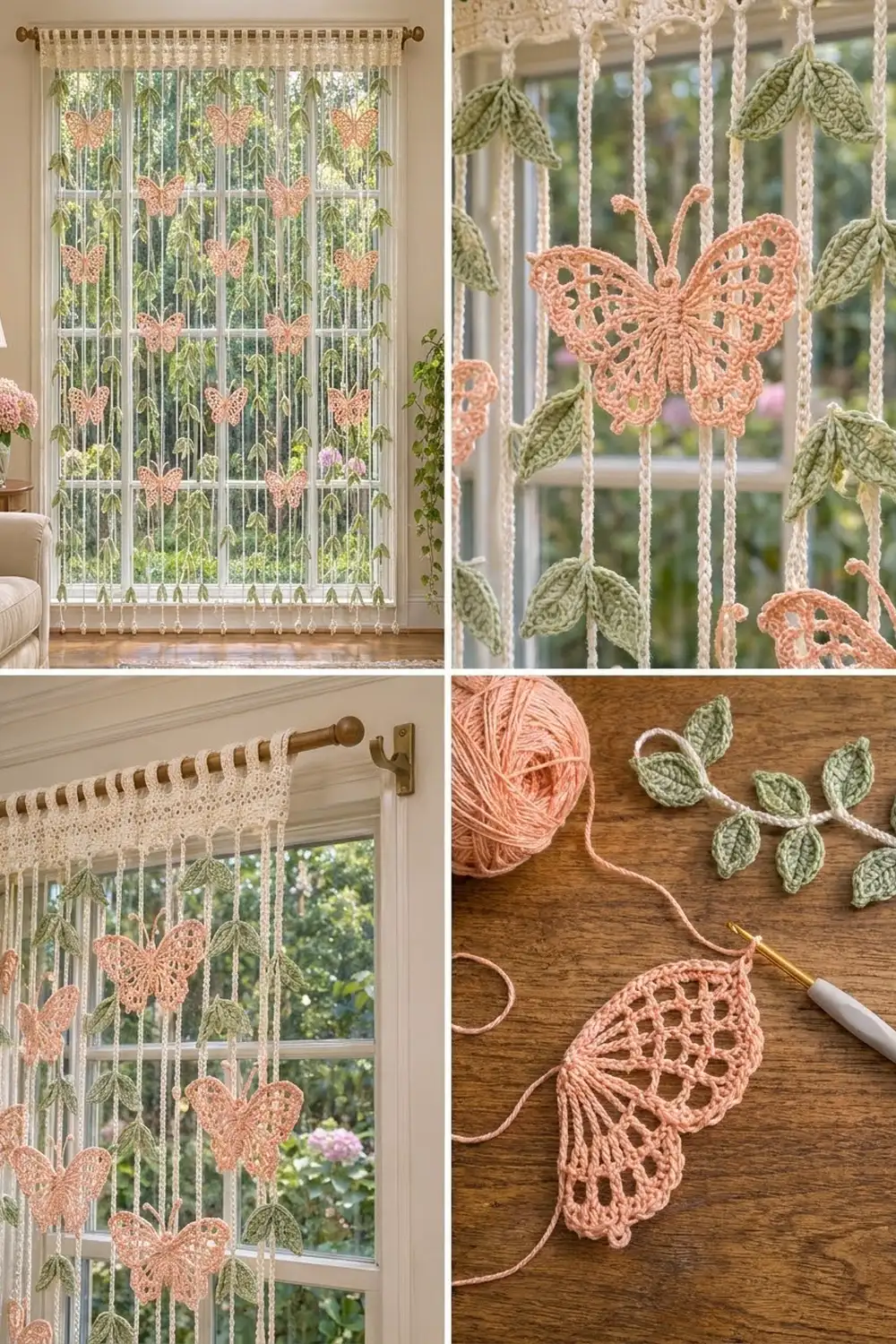
This curtain has a cream lace header that hangs from a rod on narrow tabs. Long cream cords drop from the header’s scalloped edge. Sage-green leaf pairs run up each cord, and openwork peach butterflies sit across the cords in staggered rows. With the window behind it, it reads as a garden trellis.
There are three colors: cream, sage green, and soft peach. The style is airy cottage lace that softens the view without blocking the light.
The pattern uses US terms. The finished curtain is 40.2 in (102.1 cm) wide and 72 in (182.9 cm) long, measured from the top of the header to the tip of the lowest leaf. The tabs sit above that edge.
You crochet the header flat in rows, then add the tabs and a scalloped border. After that you make 26 slip-stitch cords and hang them from the border. The leaves and butterflies are made separately and sewn on last.
Finished Size and Construction
- Finished size: 40.2 in x 72 in (102.1 cm x 182.9 cm)
- Skill level: Intermediate
- Terminology: US
- Yarn weight: DK / light (3) cotton
- Hook: 3.5 mm (E-4)
- Number of pieces: 1 header, 26 cords, 338 leaves, 18 butterflies (5 parts each)
- Layout: 26 cords spaced 1.6 in (4.1 cm) apart; butterflies in 5 staggered rows of 4-3-4-3-4
- Header before border: 40.2 in x 3.7 in (102.1 cm x 9.4 cm)
- Border depth: 0.5 in (1.3 cm), so the finished header is 4.2 in (10.7 cm) deep
- Cord length: 66 in (167.6 cm), plus a 1.8 in (4.6 cm) end leaf
- Butterfly size: 6.5 in (16.5 cm) wide x 5 in (12.7 cm) tall
Materials
Use mercerized cotton or a cotton blend. It shows lace clearly and sags less than acrylic, which stretches over long cords. The amounts below assume about 105 m per 50 g.
- Cream: 400 g / approx. 840 m (header, tabs, border, cords)
- Sage green: 150 g / approx. 315 m (leaves)
- Peach: 200 g / approx. 420 m (butterflies)
The quantities include a margin of about 15% for gauge differences and swatching.
Tools: 3.5 mm (E-4) hook, tapestry needle, rust-proof pins, blocking mats, measuring tape, locking stitch markers, spray bottle, scissors.
Abbreviations (US Terms)
- ch – chain
- sl st – slip stitch
- sc – single crochet
- hdc – half double crochet
- dc – double crochet
- sk – skip
- sp – space
- st(s) – stitch(es)
- RS / WS – right side / wrong side
V-st: (dc, ch 1, dc) in the same st.
Slip-stitch cord: Chain the stated number. Then sl st in the back bump of the 2nd ch from the hook and in each ch across. This makes a firm cord that stretches less than a plain chain.
Gauge and Checkpoints
- Sc gauge: 20 sc x 20 rows = 4 in (10.2 cm)
- Header: Rows 1–5 = 1.6 in (4.1 cm) deep
- Cord: 10 sl sts = 2 in (5.1 cm)
Make one leaf and one upper wing before you start the header. The leaf should be 1.8 in (4.6 cm) long. The wing should be 2.4 in (6.1 cm) from the ring to a scallop tip.
Next, make a header swatch: ch 22 and work Rows 1–5 over 21 sts. It should measure 4.2 in (10.7 cm) wide.
If your pieces come out too big, go down half a hook size. If they are too small, go up half a size. Never change the stitch counts, because the cord spacing depends on them.

Header
With cream, ch 202.
Row 1 (RS): Sc in 2nd ch from hook and in each ch across, turn. (201 sc)
Row 2: Ch 4 (counts as dc + ch 1), sk next st, dc in next st, ch 1, sk next st, dc in next st; rep from * across, turn. (101 dc + 100 ch-1 sps = 201 sts)
Row 3: Ch 1, sc in each dc and each ch-1 sp across, ending in the 3rd ch of the turning ch, turn. (201 sc)
Row 4: Ch 3 (counts as dc), sk 1, V-st in next st, sk 1, dc in next st; rep from * across, turn. (50 V-sts + 51 dc = 201 sts)
Row 5: Ch 1, sc in each dc and each ch-1 sp across, ending in the top of the turning ch, turn. (201 sc)
Checkpoint: 40.2 in (102.1 cm) wide x 1.6 in (4.1 cm) deep.
Rows 6–9: Repeat Rows 2–5.
Rows 10–11: Repeat Rows 2–3. (201 sc) Turn, but do not fasten off.
Checkpoint: 40.2 in x 3.7 in (102.1 cm x 9.4 cm).
Border
The border is worked along the bottom edge only, into Row 11. The side edges are left plain, and the tabs go on the top edge.
Border gauge: 1 scallop per 4 sts = 0.8 in (2.0 cm).
Border Row (WS): Ch 1, sc in first st, sk 1, 5 dc in next st, sk 1, sc in next st; rep from * across. (50 scallops, 51 sc) Fasten off.
Why the math works: Each repeat uses 4 sts, and 201 = (4 x 50) + 1. The extra st is the opening sc, so the 50th repeat ends exactly in st 201. Because no stitches are added or skipped, the edge stays 40.2 in (102.1 cm) wide and doesn’t ruffle.
Cord anchors: Mark the 1st, 3rd, 5th, … and 51st sc. That gives (51 + 1) / 2 = 26 anchors. Each anchor is 8 sts from the next, so they are 1.6 in (4.1 cm) apart. The two outer anchors are 25 x 1.6 = 40 in (101.6 cm) apart.
Tabs
With RS facing, work the tabs into the 201 free loops of the foundation chain. There are 29 tabs of 5 sts each, with 2-st gaps between them: 29 x 5 = 145, and 28 x 2 = 56, for 201 sts in total.
Each tab: Join cream and sc in the first 5 sts. Work 21 more rows of 5 sc, for 22 rows in total. Fasten off and leave a 10 in (25.4 cm) tail. Sk 2 sts and start the next tab.
Each tab is 1 in x 4.4 in (2.5 cm x 11.2 cm), and the gaps are 0.4 in (1.0 cm). Fold each tab to the WS and whipstitch it to the back of Row 3, which is 0.9 in (2.3 cm) below the top edge. Each loop is about 5.3 in (13.5 cm) around and fits a rod up to 1.5 in (3.8 cm) in diameter.
Cords
With cream, make 26 cords. For each one, ch 331 and work a slip-stitch cord. (330 sl sts = 66 in / 167.6 cm) Leave a 10 in (25.4 cm) tail at each end.
Leaves
With sage green, make 338 leaves: 312 with stems and 26 without.
Ch 9.
Rnd 1: Sc in 2nd ch from hook, hdc in next ch, dc in next 4 ch, hdc in next ch, (sc, ch 2, sc) in last ch. Working along the opposite side of the foundation, hdc in next ch, dc in next 4 ch, hdc in next ch, sc in same ch as first sc. Sl st to first sc. (16 sts + ch-2 tip)
The foundation chain forms the center vein. The dc in the middle give a pointed oval shape.
Stem (312 leaves only): Ch 4 and fasten off, leaving a 6 in (15.2 cm) tail. Hold 2 stems together and tie the tails once to make a pair. This gives 156 pairs.
Checkpoint: 1.8 in (4.6 cm) long x 0.8 in (2.0 cm) wide.
Butterflies
With peach, make 18 butterflies.
Upper Wing (make 2 per butterfly)
Row 1: Ch 4 and sl st to form a ring. Ch 3 (counts as dc), 9 dc in ring, turn. (10 dc)
Row 2: Ch 5 (counts as dc + ch 2), dc in next dc, ch 2, dc in next dc; rep from * across, turn. (10 dc, 9 ch-2 sps)
Row 3: Ch 6 (counts as dc + ch 3), dc in next dc, ch 3, dc in next dc; rep from * across, turn. (10 dc, 9 ch-3 sps)
Row 4: Ch 1, sc in first dc, 7 dc in next ch-3 sp, sc in next dc; rep from * across. (9 scallops, 10 sc) Fasten off.
Checkpoint: 2.4 in (6.1 cm) from ring to scallop tip.
Lower Wing (make 2 per butterfly)
Row 1: Ch 4 and sl st to form a ring. Ch 3, 7 dc in ring, turn. (8 dc)
Row 2: Ch 5, dc in next dc, ch 2, dc in next dc; rep from * across, turn. (8 dc, 7 ch-2 sps)
Row 3: Ch 1, sc in first dc, 5 dc in next ch-2 sp, sc in next dc; rep from * across. (7 scallops, 8 sc) Fasten off.
Checkpoint: 1.8 in (4.6 cm) from ring to scallop tip.
Body (make 1 per butterfly)
Ch 12. Sc in 2nd ch from hook and in next 9 ch, then 3 sc in last ch. Working along the opposite side of the foundation, sc in next 9 ch, then 2 sc in same ch as first sc. Sl st to first sc. (24 sc)
Checkpoint: 2.2 in (5.6 cm) long.
Antennae: At the head end, sl st in the center sc of the 3-sc group and ch 7. Sl st in the 4th ch from the hook to make the curl, then sl st in the remaining 3 ch. Sl st in the next sc and make the second antenna the same way. Fasten off. Each antenna is about 1.2 in (3.0 cm) long.
Assemble: Sew the rings of the upper wings to the top half of the body so the fans open up and out. Sew the lower wings to the bottom half so they open down and out.
Checkpoint: 6.5 in (16.5 cm) wide x 5 in (12.7 cm) tall.
Make All Pieces
- Cream: 1 header with border and 29 tabs, plus 26 cords
- Green: 156 leaf pairs and 26 end leaves
- Peach: 18 butterflies (36 upper wings, 36 lower wings, 18 bodies)
Butterfly layout: Cords are numbered 1–26 from left to right. “B 4|5” means a butterfly centered between cords 4 and 5. The depth for each row is measured from the scallop tips down to the butterfly centers.
Row A – 8 in (20.3 cm):    B 4|5    B 10|11   B 16|17   B 22|23
Row B – 20 in (50.8 cm):        B 7|8     B 13|14   B 19|20
Row C – 32 in (81.3 cm):   B 4|5    B 10|11   B 16|17   B 22|23
Row D – 44 in (111.8 cm):       B 7|8     B 13|14   B 19|20
Row E – 56 in (142.2 cm):  B 4|5    B 10|11   B 16|17   B 22|23
The butterfly centers are 9.6 in (24.4 cm) apart, which leaves 3.1 in (7.9 cm) between wingtips. Both row types are centered on the curtain’s midline.
Joining
Cords: Hang the header on the rod first. Thread a cord’s top tail through an anchor sc from front to back. Let the first sl st hang level with the scallop tips, 4.2 in (10.7 cm) below the top edge. The short bridge of tail stays hidden behind the scallops. Weave the tail down through the first 3 sl sts. Keep the tension the same on every cord so they all hang straight.
End leaves: Sew a stemless leaf to the bottom of each cord.
Leaf pairs: Each cord gets 6 pairs, measured below the scallop tips:
- Odd-numbered cords: 5, 15, 25, 35, 45, and 55 in (12.7, 38.1, 63.5, 88.9, 114.3, and 139.7 cm)
- Even-numbered cords: 10, 20, 30, 40, 50, and 60 in (25.4, 50.8, 76.2, 101.6, 127.0, and 152.4 cm)
Tack the knotted stems with 3 small stitches so the leaves point up in a V. If a pair would end up behind a butterfly, move it 2 in (5.1 cm) higher.
Butterflies: Center each body between its two cords. Tack each upper wing to the nearest cord at 2 points and each lower wing at 1 point. Sew loosely so the cords don’t pucker.
Size checkpoint: 40.2 in (102.1 cm) wide. The length is 4.2 in + 66 in + 1.8 in = 72 in (182.9 cm).
Final Blocking
- Wet-block the header to 40.2 in x 4.2 in (102.1 cm x 10.7 cm), pinning out every scallop.
- Spritz the butterflies and pin the wings so the mesh is open and the scallops are rounded. Shape the antenna curls with your fingers.
- Pin the leaves to points and let them dry.
- Dampen the cords, hang them with a clothespin clipped to the bottom of each one, and let them dry for 24 hours. This pre-stretches them.
- Hang the finished curtain, mist it lightly, and smooth the cords straight.
Final Quality-Control Checklist
- Every header sc row has 201 sts, and the border has 50 scallops
- 29 even tabs, all the same length
- 26 cords, each 66 in (167.6 cm)
- 156 leaf pairs and 26 end leaves, all secure
- 18 butterflies in the 4-3-4-3-4 layout
- 9 scallops on each upper wing, 7 on each lower wing
- All tails woven in at least 1.5 in (3.8 cm)
Troubleshooting
- Header ruffles: Recount to 201 sts. The most common mistake is a missed ch-1 sp in Row 3.
- Foundation edge pulls in: Redo the chain with a 4.0 mm hook.
- Uneven cords: Recount the sl sts and pre-stretch all the cords together.
- Wings curl: Wet-block them flat, and check for extra dc in the scallops.
- Curtain twists: Tack every butterfly to the same face of the cords.
- Loose tabs: Remove 2 rows from each tab before sewing it down.
Care
Hand wash in cool water with mild soap. Roll the curtain in a towel to remove the water, then re-hang it while it is slightly damp so the cords dry straight.
Final Notes
The sizes follow from each other. A gauge of 20 sts to 4 in gives a 201-st header that is 40.2 in (102.1 cm) wide. Its 4-st repeat makes 50 scallops and 26 anchors 1.6 in (4.1 cm) apart. A 4.2 in (10.7 cm) header, 66 in (167.6 cm) cords, and 1.8 in (4.6 cm) end leaves add up to 72 in (182.9 cm). Check each of these as you go and the curtain will hang the way it looks in the photos.
Happy crocheting!