

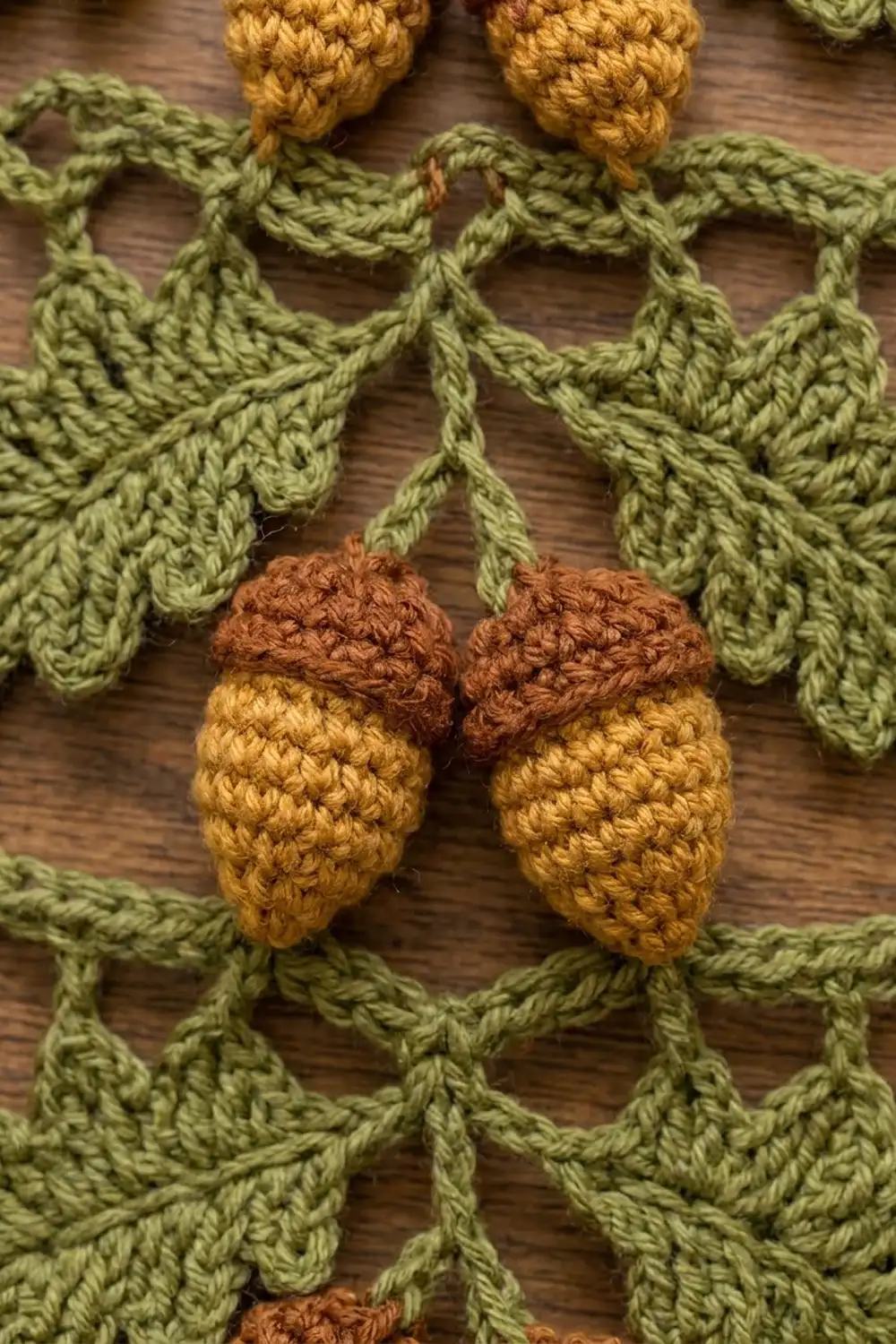
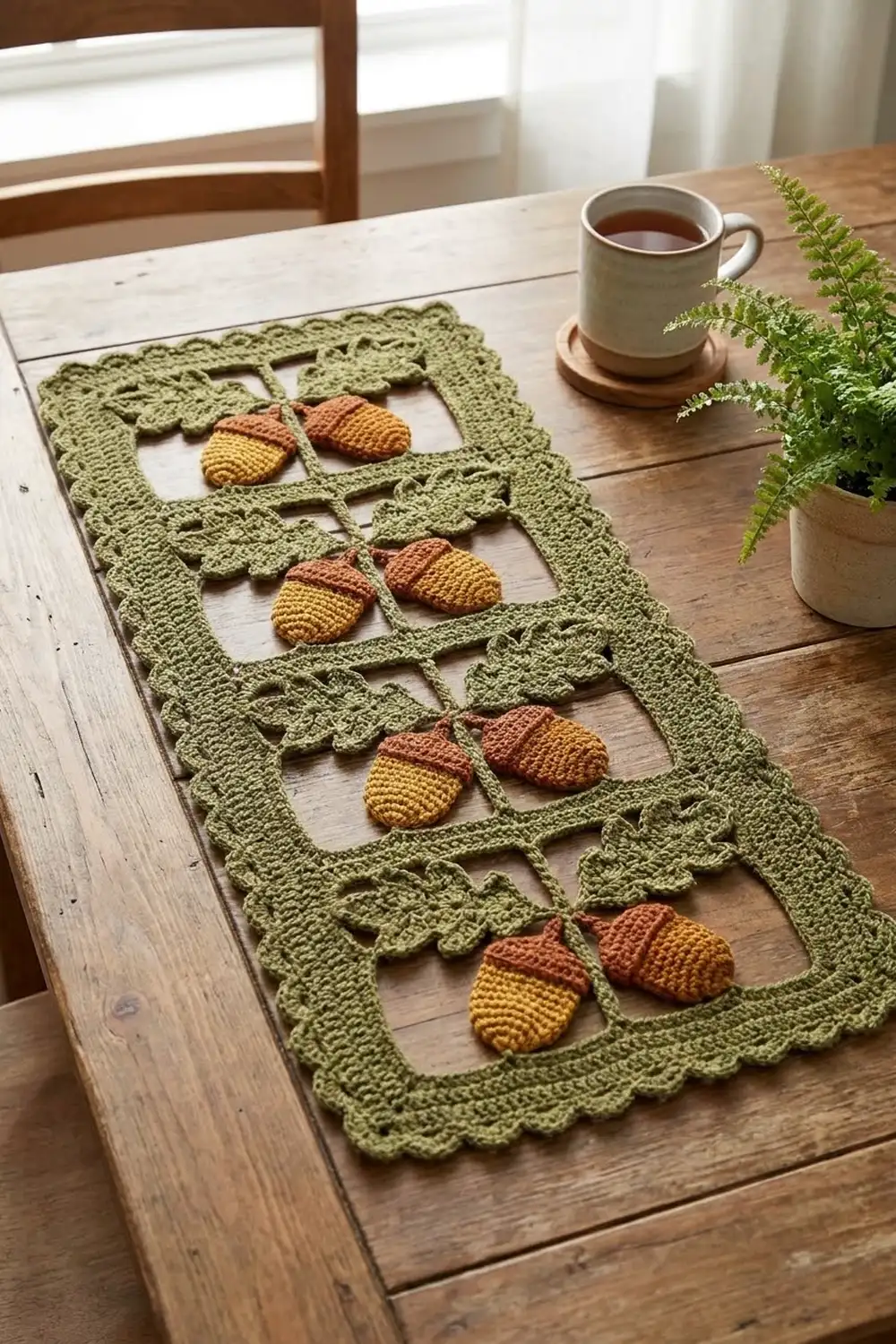
The Oak Hollow Acorn Lace Panel is a single rectangular strip of olive-green openwork with four autumn motifs stacked from top to bottom. In each motif, a short stem drops from a solid bar, two lobed oak leaves fan out from it, and two small 3D acorns hang side by side below.
The colors are warm and seasonal: olive green for the lace, leaves and stems, golden ochre for the acorn nuts, and rust brown for the textured caps. The open grid keeps the panel light, while the raised leaves and stuffed acorns add depth.
This pattern uses US crochet terms. The finished panel measures 8.25 in x 15.5 in (21.0 cm x 39.4 cm) after blocking.
You work the base panel in rows from bottom to top, alternating solid bars with open mesh windows, and then add a two-round border. You make the leaves, acorns and stems separately and sew them into each window.
Finished Size and Construction
- Finished size: 8.25 in x 15.5 in (21.0 cm x 39.4 cm)
- Skill level: Intermediate
- Terminology: US crochet terms
- Yarn weight: DK (light #3) cotton or cotton blend
- Hook: 4.0 mm (G-6)
- Number of pieces: 1 base panel (no joining), plus 8 leaves, 8 acorns and 4 stem chains sewn on as appliqué
- Layout: One vertical panel with 4 motif windows stacked in a single column
- Window size: 7.25 in x 3 in (18.4 cm x 7.6 cm), one motif per window
- Size before border: 7.25 in x 14.5 in (18.4 cm x 36.8 cm)
- Border depth: 0.5 in (1.3 cm) on every side
Materials
Use a smooth DK-weight cotton. It holds the shapes of the lobes and acorns crisply and blocks flat. Fuzzy yarns blur the open grid.
- Olive green: 75 g / 170 m (panel, border, leaves, stems)
- Golden ochre: 15 g / 34 m (acorn nuts)
- Rust brown: 10 g / 23 m (acorn caps)
These amounts include a margin of about 15 percent for your gauge sample and for differences in tension.
Tools:
- 4.0 mm (G-6) crochet hook
- Tapestry needle
- Small amount of polyester fiberfill
- Stitch markers
- Rust-proof pins and a blocking board
- Measuring tape and scissors
Abbreviations (US Terms)
- ch – chain
- sl st – slip stitch
- sc – single crochet
- hdc – half double crochet
- dc – double crochet
- sk – skip
- sp – space
- st(s) – stitch(es)
- MR – magic ring
- BLO – back loop only
- sc2tog – single crochet 2 together
- rnd – round
Special stitch – Lobe: (hdc, dc, hdc) all in the same chain. This makes one rounded oak-leaf lobe.
Gauge and Checkpoints
Gauge: 16 dc and 8 dc rows = 4 in (10.2 cm). That gives 4 sts per inch and 0.5 in (1.3 cm) per dc row.
Before you commit to the full panel, test one repeat by working Rows 1–8 below. This test piece is the start of the panel itself, so if it measures correctly, just keep going.
Checkpoints:
- After Row 1: width 7.25 in (18.4 cm)
- After Row 8: height 4 in (10.2 cm)
- After Row 22: height 11 in (27.9 cm)
- After Row 29: 7.25 in x 14.5 in (18.4 cm x 36.8 cm)
- After border: 8.25 in x 15.5 in (21.0 cm x 39.4 cm)
If your test piece is too big, go down 0.5 mm in hook size. If it is too small, go up 0.5 mm. Mesh rows tend to come out taller than solid rows, so keep the ch-3 spaces snug.
Base Panel
Work in olive green. Each mesh row has 8 dc posts with 7 ch-3 spaces between them, which fills the same 29-stitch width as a solid bar row.
Foundation: Ch 31.
Row 1 (bar): Dc in 4th ch from hook (the skipped 3 ch count as a dc) and in each ch across. Turn. (29 dc)
Row 2 (mesh): Ch 6 (counts as dc + ch 3), sk next 3 dc, dc in next dc, ch 3, sk 3 dc, dc in next dc; repeat from * 5 more times, placing the last dc in the top of the turning ch. Turn. (8 dc, 7 ch-3 sps)
Rows 3–7 (mesh): Ch 6 (counts as dc + ch 3), sk ch-3 sp, dc in next dc, ch 3, dc in next dc; repeat from * 5 more times, placing the last dc in the 3rd ch of the turning ch-6. Turn. (8 dc, 7 ch-3 sps per row)
Row 8 (bar): Ch 3 (counts as dc), 3 dc in next ch-3 sp, dc in next dc; repeat from * 6 more times, placing the last dc in the 3rd ch of the turning ch-6. Turn. (1 + 7 x 4 = 29 dc)
Checkpoint: the panel is now 4 in (10.2 cm) tall, and Window 1 (Rows 2–7) is 3 in (7.6 cm) tall.
Rows 9–14: Repeat Rows 2–7.
Row 15: Repeat Row 8. (29 dc)
Rows 16–21: Repeat Rows 2–7.
Row 22: Repeat Row 8. (29 dc) Checkpoint: 11 in (27.9 cm) tall.
Rows 23–28: Repeat Rows 2–7.
Row 29: Repeat Row 8. (29 dc) Do not fasten off.
This gives 5 bars and 4 windows. Each repeat (1 bar + 6 mesh rows) is 3.5 in (8.9 cm). With the closing bar, the total is 29 rows x 0.5 in = 14.5 in (36.8 cm).
Oak Leaves (make 8, olive green)
Each leaf has a 3-st stem and 4 lobes on each side, for 8 lobes in total.
Foundation: Ch 15.
Stem: Sl st in 2nd ch from hook and in the next 2 ch. (3 sl sts)
Side 1: Working toward the tip: sc in next ch, Lobe in next ch, sc in next ch; repeat from * 3 more times, hdc in next ch. (18 sts: 5 sc, 4 Lobes of 3 sts, 1 hdc)
Tip: (Hdc, ch 2, hdc) in the last ch.
Side 2: Rotate the leaf and work in the free loops of the same chains, heading back toward the stem: hdc in next ch, sc in next ch, Lobe in next ch; repeat from * 3 more times, sc in next ch. (18 sts)
Sl st in the base of the first stem sl st. Fasten off, leaving a 10 in (25.4 cm) tail for sewing. (Leaf total: 38 sts + ch-2 tip sp)
The leaf body is worked over 11 ch, so it measures about 2.75 in (7.0 cm) long and about 1.5 in (3.8 cm) wide across the lobes.
Acorns (make 8)
You work each acorn from the bottom tip up, so the cap ends up at the top.
Nut (golden ochre):
- Rnd 1: 6 sc in MR. (6)
- Rnd 2: Sc in next st, 2 sc in next st; repeat 3 times. (9)
- Rnd 3: 2 sc in next st, sc in next 2 sts; repeat 3 times. (12)
- Rnd 4: Sc in each st around, changing to rust brown on the last yarn over. (12)
Cap (rust brown):
- Rnd 5: Working in BLO, 2 sc in next st, sc in next 3 sts; repeat 3 times. (15) The unused front loops form a ridge at the cap rim, and the increases make the cap flare slightly past the nut.
- Stuff lightly with fiberfill.
- Rnd 6: Sc2tog, sc in next st; repeat 5 times. (10)
- Rnd 7: Sc2tog 5 times. (5)
Fasten off. Thread the tail through the front loops of the 5 sts, pull closed and secure.
Acorn stem: With olive green, join with a sl st at the top center of the cap, ch 3 and fasten off, leaving a 6 in (15.2 cm) tail. The finished acorn is about 1 in (2.5 cm) tall.
Center Stems (make 4, olive green)
Ch 5, sl st in 2nd ch from hook and in the remaining 3 ch. (4 sl sts) Fasten off, leaving both tails. Each stem is about 1 in (2.5 cm) long.
Border
Border gauge: 4 sc = 1 in (2.5 cm), which matches the dc gauge. Each dc row-end takes 2 sc because one dc row is 0.5 in (1.3 cm) tall.
Rnd 1 (olive green): Ch 1, turn. 3 sc in first st (corner), sc in next 27 sts, 3 sc in last st (corner). Rotate and work 2 sc in each of the next 27 row-ends, Rows 28 to 2. (54 sc) Along the free loops of the foundation chain: 3 sc in first ch (corner), sc in next 27 ch, 3 sc in last ch (corner). Work 2 sc in each of the 27 row-ends, Rows 2 to 28. (54 sc) Join with sl st to first sc.
Rnd 1 counts (the middle sc of each 3-sc group is the corner st):
- Short sides: 29 sts between corners, 31 including both corners
- Long sides: 56 sts between corners, 58 including both corners
- Total: 2 x 31 + 2 x 58 − 4 shared corners = 174 sc
Rnd 2 (olive green): Sl st into the next sc (corner). Ch 1, (sc, ch 5, sc) in the corner st.
- Short side: ch 4, sk 2 sts, sc in next st; repeat 9 times. Ch 4, sk 2 sts, (sc, ch 5, sc) in corner st. (10 ch-4 loops)
- Long side: ch 4, sk 2 sts, sc in next st; repeat 18 times. Ch 4, sk 2 sts, (sc, ch 5, sc) in corner st. (19 ch-4 loops)
Repeat the short side and long side once more. On the last long side, end with ch 4, sk 2, and join to the first sc instead of working a new corner.
Rnd 2 counts: 62 sc, 58 ch-4 loops, 4 ch-5 corner loops. Fasten off and weave in the ends.
Why the math works: Each side of Rnd 2 is a series of 3-st repeats (sk 2, sc 1) followed by 2 skipped sts. So the number of sts between corners must be a multiple of 3, plus 2. Short sides: 29 = 9 x 3 + 2. Long sides: 56 = 18 x 3 + 2. Both come out exactly, so nothing has to be fudged at the corners.
The size math works too. On the long sides, the 54 row-end sc cover Rows 2–28 at 4 sc per inch, which is 13.5 in (34.3 cm). The corner groups cover Rows 1 and 29, so the edge matches the 14.5 in (36.8 cm) body and won’t ruffle or pull in.
Placing the Appliqués
Work on one window at a time, with each motif hanging from the bar above it. Pin all the pieces for a window before you sew.
- Sew the top of a center stem to the 15th (center) st of the bar above the window, so it hangs straight down 1 in (2.5 cm).
- Place two leaves with their stems meeting at the bottom of the center stem. Angle them outward and slightly upward to make a shallow V, with the tips about 5 in (12.7 cm) apart. The lobes may overlap the bar a little.
- Hang two acorns just below the point where the leaves meet, side by side and about 0.25 in (0.6 cm) apart.
- Whipstitch the leaves around their edges, catching the dc posts and chains underneath. Tack each acorn at its stem and at one point on the cap.
Final Blocking
- Soak the finished panel in cool water. Roll it in a towel to press out the excess water, without wringing.
- Lay it right side up on a blocking board.
- Pin the corner loops to an 8.25 in x 15.5 in (21.0 cm x 39.4 cm) rectangle.
- Pin the windows so the dc posts stand straight up and the ch-3 spaces are square.
- Pin the border loops evenly along the long sides.
- Shape the leaf lobes with your fingers and plump up the acorns.
- Let it dry fully, then unpin it and measure again.
Final Quality-Control Checklist
- 29 rows: 5 bars and 4 windows of 6 mesh rows
- Every bar has 29 dc, and every mesh row has 8 dc and 7 ch-3 spaces
- Border Rnd 1 has 174 sc, and Rnd 2 has 58 ch-4 loops and 4 corner loops
- 8 leaves, each with 8 lobes and a ch-2 tip
- 8 acorns with gold nuts, brown caps and a ridge at the cap rim
- Each window has one stem, two leaves and two acorns, centered
- Blocked size: 8.25 in x 15.5 in (21.0 cm x 39.4 cm)
- All ends hidden behind the leaves
Troubleshooting
- Windows too tall: Your mesh dc are loose. Pull up a shorter first loop, or go down a hook size for the mesh rows.
- Bars wider than the mesh: Recount for 29 dc and work the 3 dc in each space snugly.
- Leaf curls: Work the Lobes a little looser, then block the leaf flat.
- Lumpy acorn: Use less stuffing, and roll the acorn between your palms before working Rnd 7.
- Border ruffles: Check that you worked 2 sc per row-end, not 3. If the edge is still wavy, shorten the loops to ch 3.
- Motifs off-center: The center stem should be 3.625 in (9.2 cm) from each long edge of the panel, not counting the border.
Care
Hand wash in cool water with a mild detergent and lay flat to dry. Reshape the acorns and lobes while the panel is damp.
Final Notes
The measurements build in a simple chain. 29 sts at 4 per inch makes a 7.25 in (18.4 cm) width, and 29 rows at 0.5 in makes 14.5 in (36.8 cm). A 0.5 in (1.3 cm) border on every side brings the panel to 8.25 in x 15.5 in (21.0 cm x 39.4 cm). Check each stage before moving on, and the leaves and acorns will fit neatly into every window.
Happy crocheting!