

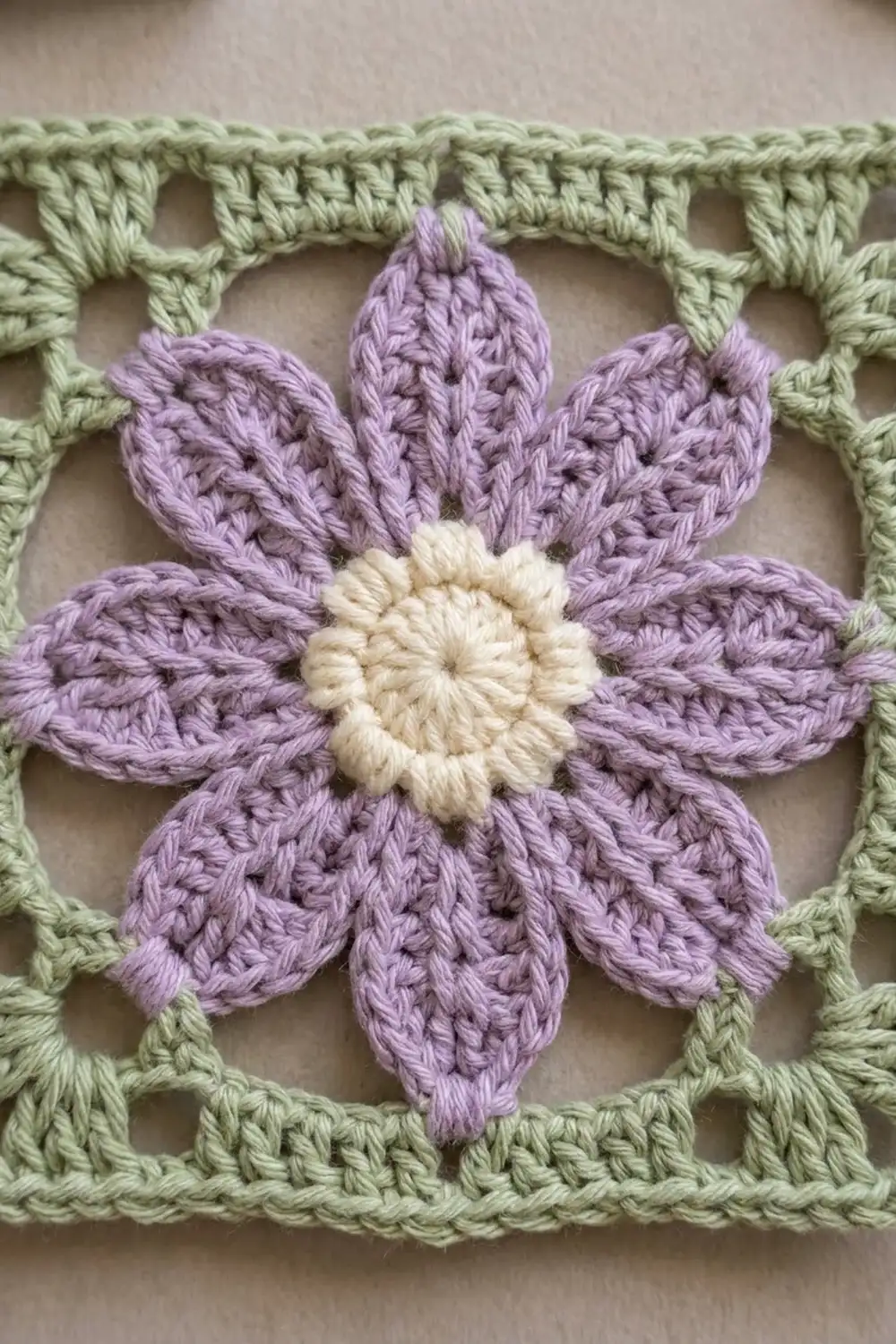
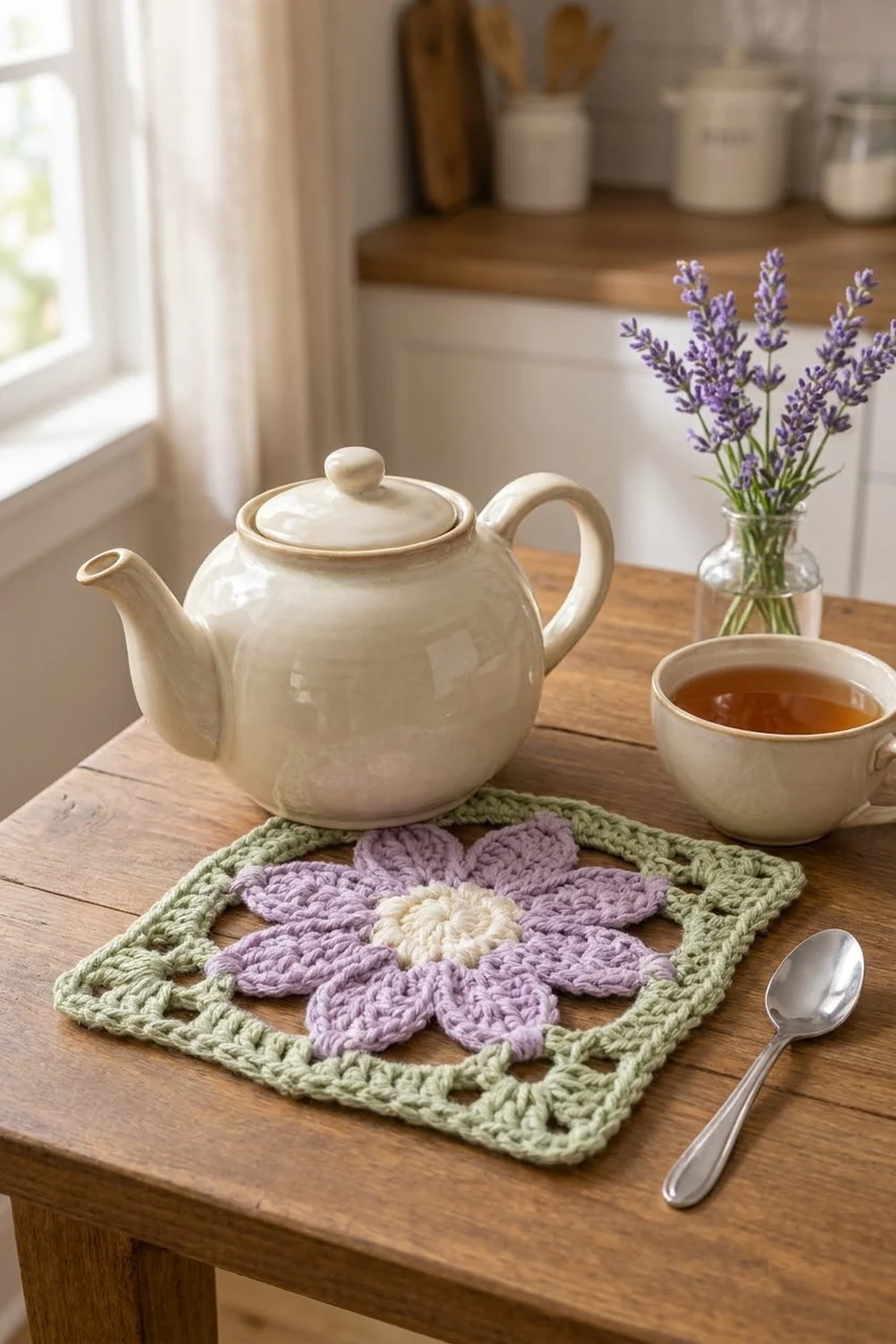
This square has one large eight-petal flower set in an airy sage green frame. Each lavender petal is long and pointed, with a raised vein down the middle, and the petals meet at a round cream center. In the green frame, a row of open mesh windows sits between two solid bands, so the flower looks like it’s sitting in a small lattice window.
The colors are soft cream, lavender, and sage green, which gives the square a fresh, slightly vintage, cottage-garden feel. The pattern uses US crochet terms.
When blocked, the square measures 9 x 9 in (22.9 x 22.9 cm). It is a single piece, and this pattern makes exactly one square.
You work from the center out. First comes a 2-round cream center. Next, you work 8 petals straight onto that center. Then 4 green frame rounds turn the round flower into a square. Last, a 2-round single crochet border finishes the edge.
Finished Size and Construction
- Finished size: 9 x 9 in (22.9 x 22.9 cm), blocked
- Skill level: Intermediate
- Terminology: US crochet terms
- Yarn weight: Worsted (#4), cotton or cotton blend
- Hook: 4.0 mm (US G-6)
- Number of pieces: 1
- Layout: single square, no joining
- Flower size: 5.5 in (14.0 cm) from petal tip to petal tip
- Size before border: 8.25 x 8.25 in (21.0 x 21.0 cm)
- Border depth: 0.375 in (1.0 cm) per side, 2 rounds of sc
Materials
Use a smooth worsted cotton or cotton blend. Cotton shows off the petal veins and the mesh windows, and it blocks flat and crisp. Fuzzy or very loosely plied yarns blur the texture, so avoid them.
- Color A, cream: 5 g, about 10 m
- Color B, lavender: 10 g, about 20 m
- Color C, sage green: 20 g, about 40 m
Tools:
- 4.0 mm (US G-6) crochet hook
- Tapestry needle
- Scissors
- 4 stitch markers
- Rust-proof pins and a blocking mat
- Spray bottle
- Tape measure or ruler
All quantities include a margin of roughly 25% to cover yarn tails and a possible redo of a round.
Abbreviations (US Terms)
- ch – chain
- sl st – slip stitch
- sc – single crochet
- hdc – half double crochet
- dc – double crochet
- tr – treble crochet
- dtr – double treble crochet
- sk – skip
- sp – space
- st(s) – stitch(es)
- rep – repeat
Special stitch – Half-Leaf (9 sts): Work back toward the center into the back bumps of a chain: sl st, sc, hdc, dc, tr, tr, dc, hdc, sc. This makes one half of a petal. It starts narrow at the tip, widens in the middle, and narrows again at the base.
Gauge and Checkpoints
Gauge: 15 dc and 9 rows = 4 in (10.2 cm) with the 4.0 mm hook.
The square works as its own gauge swatch. Make one square first and measure it at each checkpoint before going on:
- After Round 2 (cream center): 1.5 in (3.8 cm) across
- After Round 3 (petals): 5.5 in (14.0 cm) tip to tip
- After Round 5 (first solid green round): 6.5 in (16.5 cm) per side
- After Round 6 (mesh round): 7.25 in (18.4 cm) per side
- After Round 7 (second solid round): 8.25 in (21.0 cm) per side
- After Border Round 2: 9 in (22.9 cm) per side, blocked
If you’re more than 0.25 in (0.6 cm) too big at any checkpoint, switch to a 3.5 mm hook. If you’re more than 0.25 in (0.6 cm) too small, switch to a 4.5 mm hook. The stitch counts don’t change either way.
Pattern
Center (Color A, cream)
Round 1: Make a magic ring. Ch 3 (counts as dc), then work 11 dc into the ring. Pull the ring tight and sl st to the top of the ch-3. (12 dc)
Round 2: Ch 1, work 2 sc in each st around, and sl st to the first sc. (24 sc)
Fasten off. The center should measure 1.5 in (3.8 cm) across.
Petals (Color B, lavender)
Each petal is made of two Half-Leaves. Their two chain spines lie side by side down the middle of the petal, and that’s what creates the raised vein. Each petal uses 3 sc of Round 2: one to anchor the first spine, one to anchor the second spine, and one skipped stitch that keeps the petals apart.
Round 3: Join Color B with a sl st in any sc of Round 2. This is st A.
*Ch 10. Skip the first ch from the hook; this is the tip ch. Work a Half-Leaf in the next 9 ch, keeping the stitches to the right of the chain, away from the next sc. Sl st in the next sc of Round 2 (st B).
Ch 9, then sl st into the tip ch of the first half so the two halves meet in a point. Work a Half-Leaf back down this new ch-9, keeping the stitches to the left of the chain. The two chain spines should now lie side by side. Skip the next sc of Round 2 and sl st in the following sc (the new st A).*
Rep from * to * 7 more times. On the last rep, skip the last sc and sl st into the first sl st. (8 petals; 18 sts per petal, 144 petal sts total)
Fasten off. Each petal should measure about 2 in (5.1 cm) long, and the whole flower should be 5.5 in (14.0 cm) across.
Tension tip: Make the petal chains at an even, medium tension. If they’re tight, the Half-Leaf stitches crowd together and the petal curls. If they’re loose, the tip goes floppy and the vein gets lost.
Choose one petal to point toward a corner. From there the petals alternate: corner, side, corner, side.
Frame (Color C, sage green)
Round 4 (anchor round): Join Color C with a sc in the tip ch of any side petal. Work the sc through the point where both Half-Leaves meet so the tip stays closed. Ch 7, work (dtr, ch 4, dtr) in the tip of the next (corner) petal, ch 7, sc in the tip of the next (side) petal. Rep from * to * 3 more times, leaving out the final sc on the last rep. Sl st to the first sc. (4 sc, 8 dtr, 8 ch-7 sps, 4 ch-4 corner sps)
The corner petals sit farther from the corners of the square than the side petals sit from the edges. The tall dtr stitches make up that extra distance, so when you lay the piece flat it should already look slightly square.
Round 5 (first solid round): Ch 3 (counts as dc). Work 7 dc in the next ch-7 sp, dc in the next dtr, (3 dc, ch 2, 3 dc) in the ch-4 corner sp, dc in the next dtr, 7 dc in the next ch-7 sp, and dc in the next sc. Rep from * to * 3 more times, leaving out the final dc on the last rep. Sl st to the top of the ch-3.
Stitch count: 92 dc and 4 ch-2 corner sps. That’s 23 dc per side between corner sps (3 + 1 + 7 + 1 + 7 + 1 + 3). Put a marker in each corner sp. Checkpoint: 6.5 in (16.5 cm).
Round 6 (mesh round): Sl st in each of the next 11 dc, then sl st into the corner ch-2 sp. Ch 5 (counts as dc + ch 2) and work a dc in the same sp. [Ch 1, skip 1 dc, dc in the next dc] 11 times, then ch 1, skip 1 dc, and work (dc, ch 2, dc) in the next corner sp. Rep from * to * 3 more times. On the last rep, stop after the final ch 1 and sl st to the 3rd ch of the ch-5.
Stitch count: 52 dc, 48 ch-1 sps, and 4 ch-2 corner sps. Each side has 1 corner dc + 11 dc + 12 ch-1 sps + 1 corner dc = 25 sts between corner sps, which makes 12 open windows per side. Checkpoint: 7.25 in (18.4 cm).
Round 7 (second solid round): Sl st into the corner ch-2 sp. Ch 3 (counts as dc), then work (dc, ch 2, 2 dc) in the same sp. Dc in the next dc, [dc in the next ch-1 sp, dc in the next dc] 12 times, then (2 dc, ch 2, 2 dc) in the next corner sp. Rep from * to * 3 more times, leaving out the final corner group on the last rep. Sl st to the top of the ch-3.
Stitch count: 116 dc and 4 ch-2 corner sps. That’s 29 dc per side between corner sps (2 + 25 + 2). Checkpoint: 8.25 in (21.0 cm).
Don’t fasten off. Go straight on to the border.
Border
Border gauge: 4 sc and 5 sc rows = 1 in (2.5 cm). Two sc rounds add about 0.375 in (1.0 cm) to each side.
Border Round 1: Sl st in the next dc, then sl st into the corner ch-2 sp. Ch 1 and work 3 sc in the corner sp. Sc in each of the next 29 dc, then 3 sc in the next corner sp. Rep from * to * 3 more times, leaving out the final corner group on the last rep. Sl st to the first sc.
Stitch count: 128 sc. That’s 29 sc along each side plus a 3-sc group at each corner (4 x 29 + 4 x 3 = 128).
Border Round 2: Sl st in the next sc, which is the middle sc of the corner group. Ch 1 and work 3 sc in that same st. Sc in each of the next 31 sc, then 3 sc in the next sc (the corner middle). Rep from * to * 3 more times, leaving out the final corner group on the last rep. Sl st to the first sc.
Stitch count: 136 sc. That’s 31 sc along each side plus a 3-sc group at each corner (4 x 31 + 4 x 3 = 136). The 31 side sts are the 29 side sc from Border Round 1 plus the first and last sc of the corner groups on either side.
Fasten off and weave in all ends.
Why the math works: Along the sides, every border round puts exactly 1 sc into each stitch, so the sides stay the same length and the edges neither ruffle nor pull in. An sc round is short, so each corner needs only 2 extra stitches per round (3 sc in one spot) to turn and still lie flat. That means each round grows by exactly 8 stitches: 128 + 8 = 136.
Final Blocking
- Weave in every tail through stitches of the same color: cream tails into the center, lavender tails along the petal spines.
- Lay the square right side up on a blocking mat.
- Mist it evenly until it’s damp but not dripping.
- Pin the 4 corners first, so the square measures 9 x 9 in (22.9 x 22.9 cm).
- Pin the middle of each side, then add pins every 1 in (2.5 cm) to keep the edges straight.
- Pin each petal tip so it points straight outward, and gently smooth the petal edges.
- Use a fingertip to open each mesh window so all 48 look even.
- Leave the square until it’s completely dry, then take out the pins.
Final Quality-Control Checklist
- The center has 24 sc and lies flat.
- There are 8 petals, each about 2 in (5.1 cm) long with a visible center vein.
- 4 petals point to the corners and 4 point to the middle of each side.
- Round 5 has 23 dc per side and Round 7 has 29 dc per side.
- Each side has 12 mesh windows.
- Border Round 2 has 31 sc per side plus 3-sc corner groups, for 136 sc total.
- The square measures 9 x 9 in (22.9 x 22.9 cm), with all four sides equal.
- No yarn ends show on the front.
Troubleshooting
Petals curl or twist: The petal chain is too tight. Chain a little more loosely, or make the chain with a 4.5 mm hook and switch back to the 4.0 mm hook for the Half-Leaf.
No visible vein: Both Half-Leaves ended up on the same side of their chains. Keep the first half on the right and the second half on the left so the two spines touch.
Frame ruffles around the flower: The ch-7 sps are too long for your tension. Try ch 6 instead, and keep 7 dc per sp in Round 5.
Flower puckers or cups: The ch-7 sps are too short. Try ch 8, and keep 7 dc per sp.
Corners round off: Check that you worked the full (3 dc, ch 2, 3 dc) in Round 5 and the 3-sc corner groups in the border.
Sides wave in the border: Recount. Border Round 1 should have exactly 29 sc per side with no extra stitches.
Care
Hand wash in cool water with a mild detergent, then press the water out gently without wringing. Dry flat, and re-pin to 9 in (22.9 cm) if the square needs reshaping.
Final Notes
Here’s the measurement chain to check against:
- Center: 1.5 in (3.8 cm)
- Flower: 5.5 in (14.0 cm)
- Round 5: 6.5 in (16.5 cm)
- Mesh round: 7.25 in (18.4 cm)
- Round 7: 8.25 in (21.0 cm)
- Bordered, blocked square: 9 in (22.9 cm)
If your square matches each checkpoint, the stitch counts will line up and blocking will be quick. Every square finishes with the same 136 sc, so it works well as a standalone motif.
Happy crocheting!