

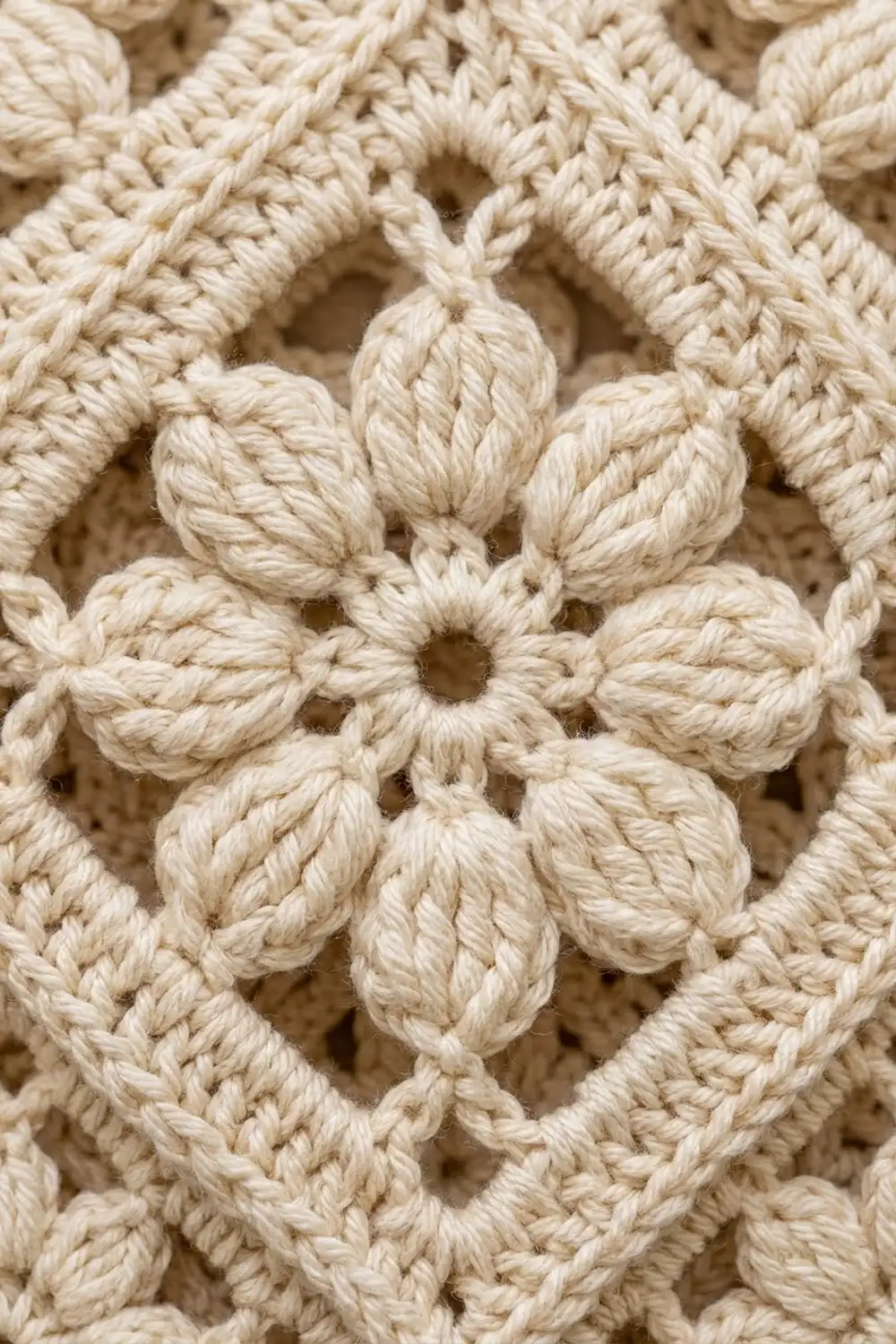
The Ivory Bloom Square is a single lacy motif with a big, soft flower at its heart. Eight plump puff-stitch petals circle a small open center. A ring of chain arcs leaves open windows between the flower and a solid frame of double crochet. A beaded crab-stitch edge with tiny picot tips at the corners finishes it neatly.
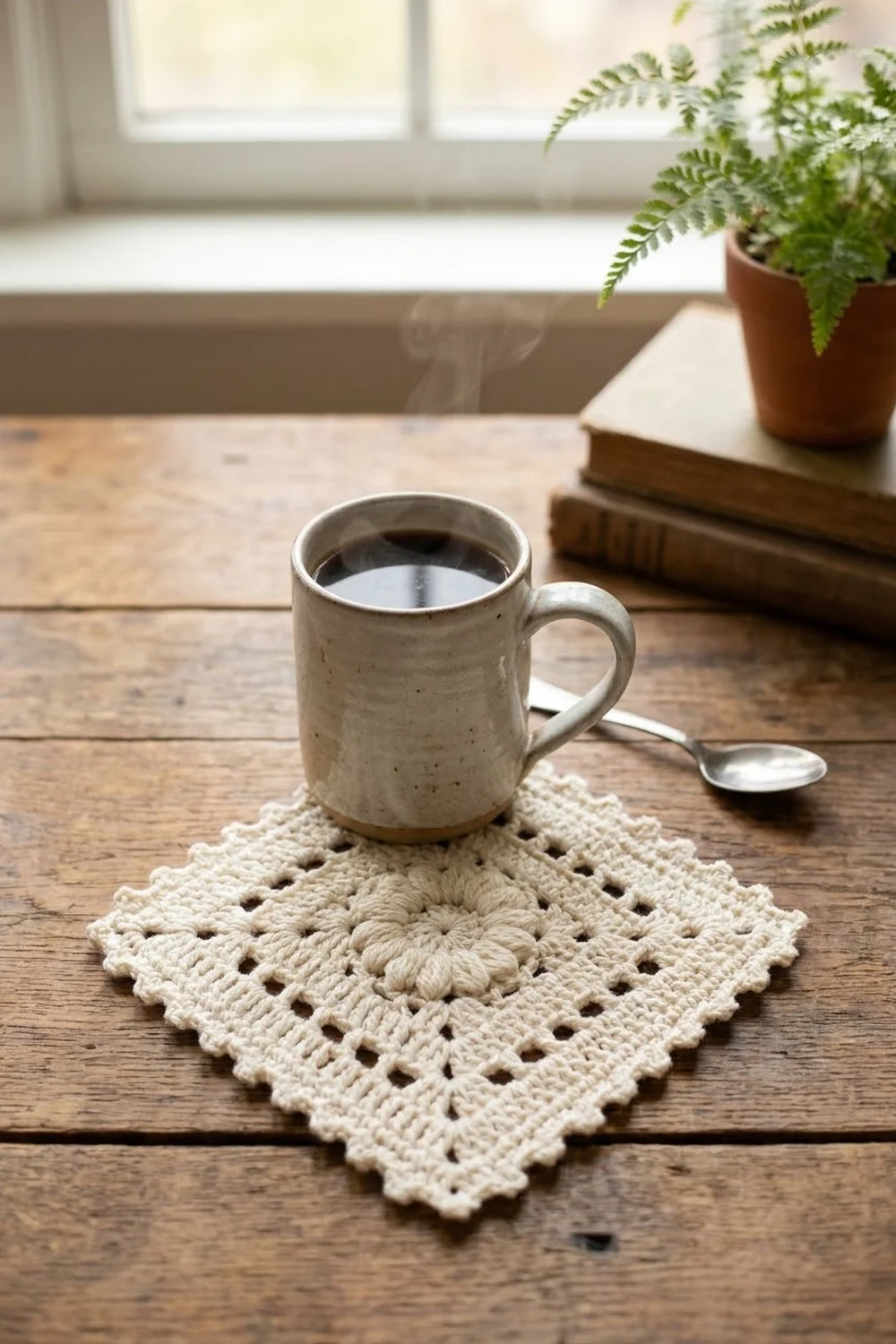
The sample uses just one color, a warm cream or ivory cotton. With a single shade, all the attention goes to texture: rounded petals, open lace and a firm, smooth frame. It looks especially pretty displayed on point as a diamond.
This pattern uses US crochet terms. The finished square measures 6.25 in (15.9 cm) per side, or about 8.75 in (22.2 cm) from tip to tip when displayed on point.
The whole square is worked in the round:
– Start with a magic ring and work the puff petals.
– Turn the 8 petals into a square with long and short chain arcs.
– Fill those arcs with double crochet.
– Add a three-round border.
There is no sewing and no joining. You make one piece only.
Finished Size and Construction
- Finished size: 6.25 in x 6.25 in (15.9 cm x 15.9 cm); about 8.75 in (22.2 cm) on the diagonal
- Skill level: Intermediate (puff stitches and reverse single crochet)
- Terminology: US crochet terms
- Yarn weight: Worsted (#4), cotton or cotton blend
- Hook: 5.0 mm (US H-8)
- Number of pieces: 1
- Layout: Single square motif, shown on point as a diamond
- Piece size before border (after Round 4): 4.5 in (11.4 cm) square
- Border: Rounds 5-7, about 0.875 in (2.2 cm) deep on each side
- Rounds: 7 total
Materials
Choose a smooth, light-colored worsted-weight cotton or cotton blend. Cotton makes crisp puff stitches and clean lace windows, and it blocks flat. A yarn that splits easily or is very fuzzy will hide the petal shaping and make the reverse single crochet hard to read.
- Cream / ivory (Color A): 25 g, about 45 m (49 yd)
The motif itself uses about 18 g. The amount above includes extra yarn for your gauge swatch, a practice puff stitch or two, and weaving in ends.
Tools:
- 5.0 mm (US H-8) crochet hook
- Tapestry needle
- Scissors
- Locking stitch markers (at least 4)
- Measuring tape or ruler
- Blocking mat and rust-proof pins
- Spray bottle with cool water
Abbreviations (US Terms)
- ch – chain
- sl st – slip stitch
- sc – single crochet
- dc – double crochet
- rev sc – reverse single crochet (crab stitch)
- sp / sps – space / spaces
- st / sts – stitch / stitches
- sk – skip
- yo – yarn over
- rep – repeat
Special stitches:
Petal puff: (Yo, insert hook in st, yo and pull up a loop to about 0.75 in / 1.9 cm tall) 5 times (11 loops on hook). Yo and pull through all 11 loops, then ch 1 to close. The closing ch 1 is the top of the petal. It counts as part of the puff, not as a separate stitch.
Reverse single crochet (rev sc): Working from left to right (if you are right-handed), insert hook in the next st to the right, yo and pull up a loop, yo and pull through both loops on hook.
Ch-3 picot (corner): Ch 3. It sits between two rev sc in the same corner space and does not count as a stitch.
Gauge and Checkpoints
Dc gauge: 14 dc and 8 rows = 4 in (10.2 cm), worked flat in worsted cotton with a 5.0 mm hook.
Since this is a single motif, the motif itself is your best test. Work Rounds 1-4 first and measure before you start the border.
Checkpoints (measured flat, unblocked, edge to edge through the middle):
- After Round 1: about 1.25 in (3.2 cm) across
- After Round 2: flower about 3 in (7.6 cm) across, petal tip to petal tip
- After Round 3: about 3.75 in (9.5 cm) across, measured straight across a side between corner arcs
- After Round 4: 4.5 in (11.4 cm) per side
- After Round 5: 5.5 in (14.0 cm) per side
- After Round 6: 6 in (15.2 cm) per side
- After Round 7: 6.25 in (15.9 cm) per side
If your square is too big at the Round 4 checkpoint, go down one hook size to 4.5 mm (US 7). If it is too small, go up to 5.5 mm (US I-9). You can fix a difference of 0.25 in (0.6 cm) or less during blocking.
If only the flower is off, with petals that are very tall or very squat, change the loop height of the petal puff instead of changing hooks.
Pattern
Round 1: Center Ring
Make a magic ring.
Ch 1, work 16 sc in ring. Pull the ring snug but leave a small open hole in the center. Sl st in first sc to join. (16 sc)
The small center hole is part of the look, so don’t close it completely.
Round 2: Puff Petals
Ch 2 (does not count as a st), petal puff in same st as join, ch 3, sk next sc, petal puff in next sc, ch 3, sk next sc; rep from * 6 more times, sl st in top (closing ch 1) of first petal puff to join. (8 petal puffs, 8 ch-3 sps)*
The puffs should stand up like long, rounded petals with visible strands. Pull every loop up to the same height so all 8 petals match.
Round 3: Squaring Arcs
This round turns the round flower into a square with 4 long corner arcs and 4 shorter side arcs. Work every sc into the closing ch 1 at the top of a petal. Leave the ch-3 sps of Round 2 unworked behind the arcs.
Ch 1, sc in top of same petal as join (petal 1), ch 7, sc in top of next petal, ch 5, sc in top of next petal; rep from * 2 more times, ch 7, sc in top of next petal (petal 8), ch 5, sl st in first sc to join. (8 sc, 4 ch-7 sps, 4 ch-5 sps)*
The ch-7 sps become the corners, and the ch-5 sps sit in the middle of each side. The gaps between the arcs and the petals form the open lace windows.
Put a marker in each ch-7 sp so the corners are easy to find.
Round 4: Solid Square
Sl st in first ch-7 sp. Ch 3 (counts as dc), 3 dc in same sp, ch 2, 4 dc in same sp (first corner made), *dc in next sc, 5 dc in next ch-5 sp, dc in next sc, (4 dc, ch 2, 4 dc) in next ch-7 sp; rep from * 2 more times, dc in next sc, 5 dc in next ch-5 sp, dc in next sc, sl st in top of beginning ch-3 to join.
Count per side: 4 + 1 + 5 + 1 + 4 = 15 dc between corner ch-2 sps.
Round total: 60 dc, 4 corner ch-2 sps.
Checkpoint: The square should measure 4.5 in (11.4 cm) per side and lie flat. This is your size before the border.
Border
The border is Rounds 5-7. It adds about 0.875 in (2.2 cm) on each side and takes the square from 4.5 in (11.4 cm) to 6.25 in (15.9 cm).
Border gauge: about 3.5 dc or sc per 1 in (2.5 cm) along each side. This matches the 14 dc = 4 in (10.2 cm) gauge.
Round 5: Double Crochet Band
Sl st in next 3 dc and into corner ch-2 sp. Ch 3 (counts as dc), (dc, ch 2, 2 dc) in same sp, *dc in each of next 15 dc, (2 dc, ch 2, 2 dc) in next corner sp; rep from * 2 more times, dc in each of next 15 dc, sl st in top of beginning ch-3 to join.
Count per side: 2 + 15 + 2 = 19 dc between corner ch-2 sps.
Round total: 76 dc, 4 corner ch-2 sps.
Checkpoint: 5.5 in (14.0 cm) per side.
Round 6: Single Crochet Round
Sl st in next dc and into corner ch-2 sp. Ch 1, (sc, ch 2, sc) in same sp, *sc in each of next 19 dc, (sc, ch 2, sc) in next corner sp; rep from * 2 more times, sc in each of next 19 dc, sl st in first sc to join.
Count per side: 21 sc (1 + 19 + 1). This includes the 1 corner sc at each end of the side.
Round total: 84 sc, 4 corner ch-2 sps.
Checkpoint: 6 in (15.2 cm) per side.
Round 7: Crab-Stitch Edge with Corner Picots
This is a trim round. Don’t turn your work. Work from left to right.
Ch 1, rev sc in each sc around, working (rev sc, ch-3 picot, rev sc) in each corner ch-2 sp. Sl st in first rev sc to join. Fasten off.
Count: 84 rev sc (1 in each existing sc) + 8 rev sc added in the corner sps = 92 rev sc, plus 4 ch-3 picots.
Per side: 21 rev sc over the side sts + 1 corner rev sc at each end = 23 rev sc.
Checkpoint: 6.25 in (15.9 cm) per side before blocking, or very close to it.
Why the Math Works
Every border increase happens only in the 4 corners, and each side grows by a fixed amount per round:
- Round 4: 15 dc per side
- Round 5: 15 + 2 + 2 = 19 dc per side
- Round 6: 19 + 1 + 1 = 21 sc per side (corner sc included)
- Round 7: 21 + 1 + 1 = 23 rev sc per side (corner rev sc included)
All 4 sides gain the same number of stitches in the same places, so the corners stay at 90 degrees and the sides stay straight. A tall dc round needs 2 extra stitches at each corner, while a shorter sc round needs only 1. The rev sc round adds 1 stitch plus a picot at each corner, so the tips lie flat and look crisp when the square is turned on point.
Final Blocking
- Weave in all ends before blocking. Run the tails through the back of the dc rounds, never through the lace windows.
- Mark a 6.25 in (15.9 cm) square on your blocking mat.
- Mist the motif with cool water until it is damp all the way through. With cotton, you can also soak it briefly and then press out the extra water in a towel.
- Lay the square face up. Pin the 4 corner picots first, on the marked corners.
- Pin the middle of each side. Then add pins about every 1 in (2.5 cm) along each edge to keep the sides straight.
- Use your fingers to gently push each puff petal into a rounded shape and open the lace windows evenly.
- Check that both diagonals measure about 8.75 in (22.2 cm). If they don’t, re-pin the corners.
- Let it dry completely before you remove the pins.
Final Quality-Control Checklist
- 16 sc in Round 1, with a small open hole in the center
- 8 petal puffs, all the same height and fullness
- 4 ch-7 corner arcs and 4 ch-5 side arcs in Round 3
- 15 dc per side in Round 4 (60 total)
- 19 dc per side in Round 5 (76 total)
- 21 sc per side in Round 6 (84 total, corner sc included)
- 92 rev sc and 4 picots in Round 7
- Square measures 6.25 in (15.9 cm) per side and 8.75 in (22.2 cm) on the diagonal
- Corners are sharp and all 4 sides are straight
- All ends are hidden in solid stitches
Troubleshooting
Petals look flat or thin. Pull each loop up taller, to the full 0.75 in (1.9 cm), and keep them all the same height before the final yo.
Petals lean or twist. Hold the loops on the hook gently with your index finger while you pull up the next loop. Close each puff with a firm ch 1.
Round 3 cups or ruffles. Cupping means your chains are too tight. Ruffling means they are too loose. Change your chain tension, not the number of chains.
Round 4 is wavy. This round is designed to sit flat, with 5 dc in each ch-5 sp and 4 dc on each side of a ch-7 corner. If it still waves, your dc are too loose. Try a smaller hook for Round 4 only.
Corners curl in the border. Check that you worked the full corner group in every round. Missing even one corner increase pulls that corner in.
Rev sc edge looks messy. Keep the loops short and work a little looser than a normal sc. Make sure you are moving to the right, not to the left.
Square is the wrong size. Check your gauge again at Round 4 and change hook size as described in the Gauge section.
Care
Hand wash in cool water with mild soap, press out the water in a towel, and dry flat, reshaping it to a 6.25 in (15.9 cm) square. Don’t wring or tumble dry, since that can crush the puff petals.
Final Notes
The measurement chain for this motif is short and easy to track:
– Round 1: about 1.25 in (3.2 cm)
– Round 2: flower about 3 in (7.6 cm)
– Round 3: arcs reach about 3.75 in (9.5 cm)
– Round 4: 4.5 in (11.4 cm) square
– Round 5: 5.5 in (14.0 cm)
– Round 6: 6 in (15.2 cm)
– Round 7: finished size of 6.25 in (15.9 cm), or about 8.75 in (22.2 cm) on point
Check your size after Round 4, keep the corner increases the same every round, and block gently. The result is a soft, lacy flower square that looks lovely on its own, laid flat as a diamond.
Happy crocheting!