
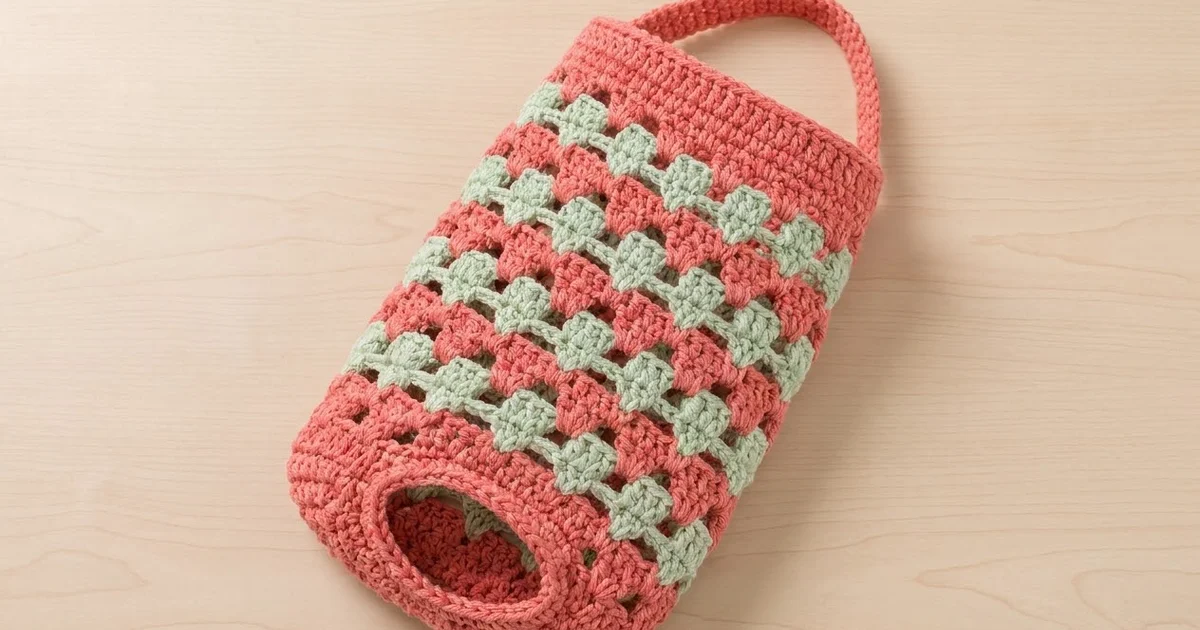
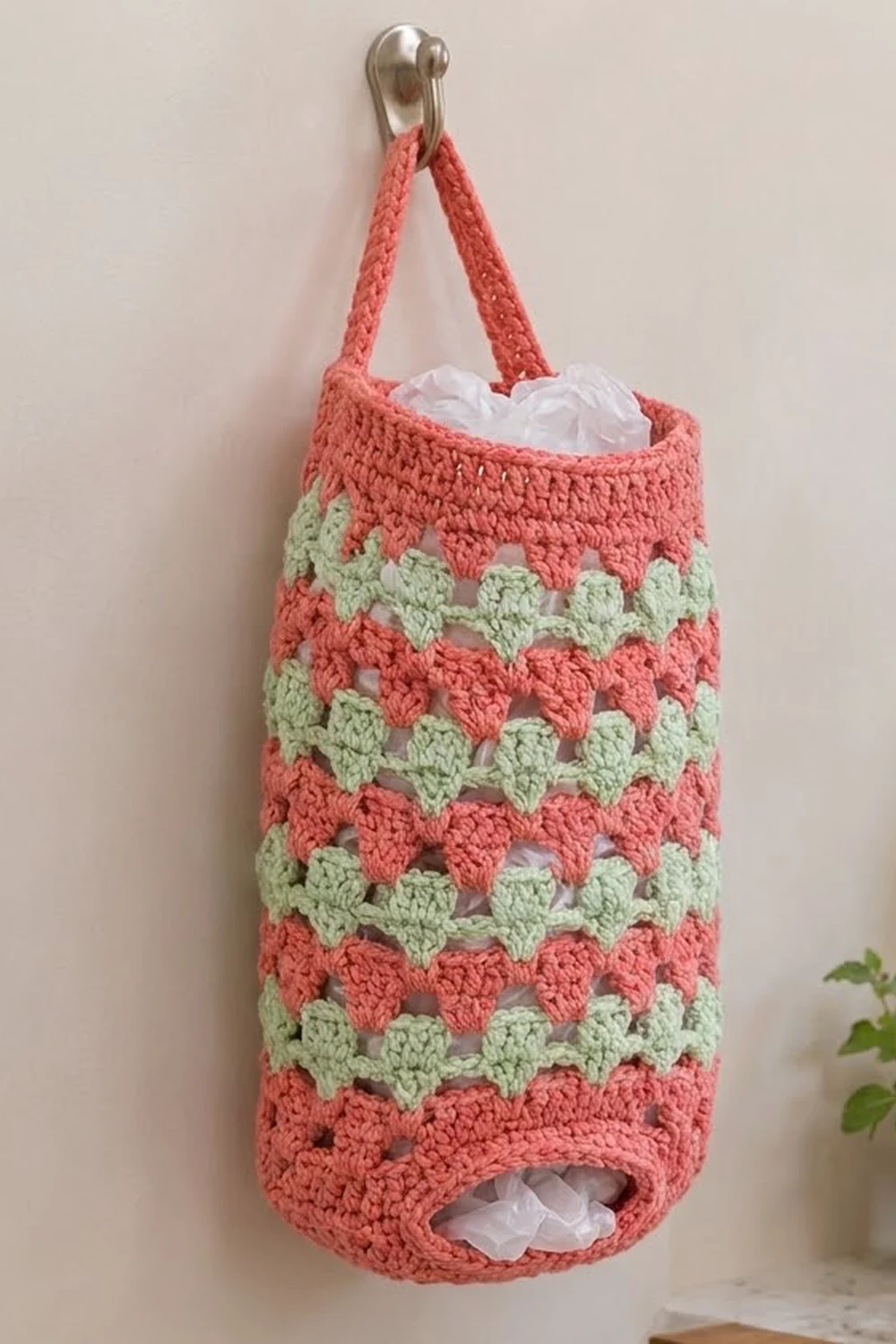
This bright bag keeper turns a drawer full of loose plastic bags into a tidy hanging tube. You stuff bags in through the top and pull them out one at a time through the round hole in the base.
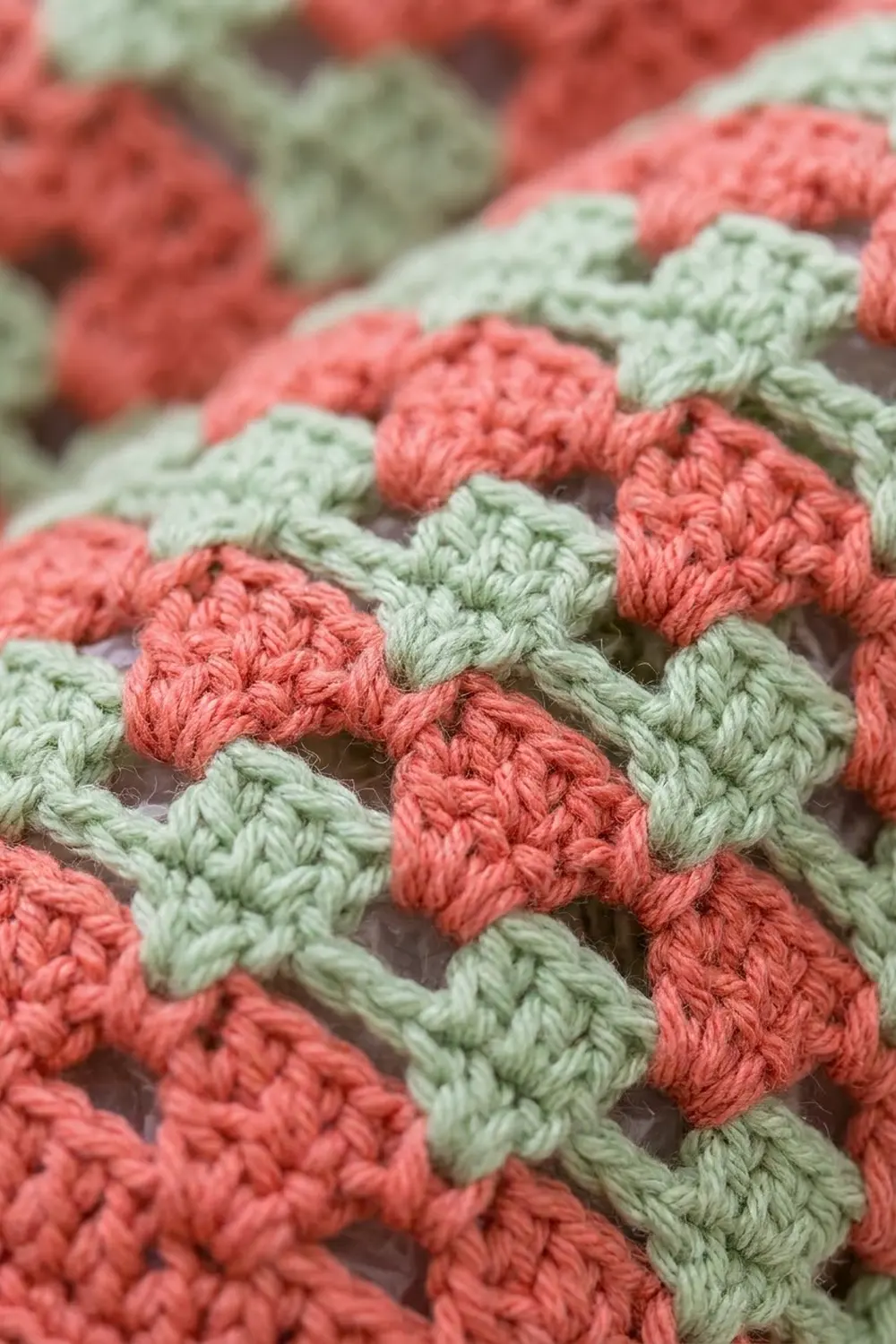
The body alternates coral and soft sage green bands of staggered granny-style shells. Each round of three-double-crochet groups sits in the gaps of the round below. The groups stack into small offset triangles, with gaps between them. Solid coral bands frame the bottom and top, and a sturdy coral strap crosses the opening so the holder hangs from a single hook.
All instructions use US crochet terms. The finished holder measures 18 in (45.7 cm) around, about 9 in (22.9 cm) wide laid flat, and about 12.5 in (31.8 cm) tall, plus a 12 in (30.5 cm) hanging strap.
The holder is worked in one piece from the bottom up. You start with a chain ring that becomes the dispensing hole and increase outward into a flat, ring-shaped base. A back-loop round turns the corner into the wall. Then you work the striped body in joined rounds and finish with a firm top band, the edgings, and the strap.
Finished Size and Construction
- Finished size: 18 in (45.7 cm) around; 9 in (22.9 cm) wide laid flat; about 12.5 in (31.8 cm) tall body; 12 in (30.5 cm) strap
- Skill level: Easy / advanced beginner
- Terminology: US crochet terms
- Yarn weight: Worsted weight (#4) cotton or cotton blend
- Hook: 5.0 mm (H-8)
- Number of pieces: 1 (the strap is worked directly off the rim)
- Layout: Single seamless cylinder; no assembly
- Piece size: base outer diameter about 5.75 to 6 in (14.6 to 15.2 cm); dispensing hole about 2.75 in (7.0 cm) across
- Size before border: body about 12.4 in (31.5 cm) tall
- Border depth: rim edging about 0.1 in (0.3 cm); hole edging about 0.3 in (0.8 cm)
Materials
Choose a smooth cotton or cotton-acrylic blend. Cotton holds the cylinder shape, resists stretching under a load of bags, and washes well. Avoid very fuzzy or very stretchy yarns, because the open shells will sag.
- Color A, Coral: 100 g / about 155 m (170 yd)
- Color B, Sage Green: 30 g / about 46 m (50 yd)
You can swap in any two colors you like. Pick a darker main color for Color A, because the base and rim get the most handling and show dirt first.
Tools:
- 5.0 mm (H-8) crochet hook
- Tapestry needle
- Stitch marker
- Scissors
- Measuring tape
- Rust-proof pins and a tall cylinder for blocking (a 2-liter bottle or rolled towel works)
The yarn amounts include a margin of about 30% to cover gauge differences and swatching.
Abbreviations (US Terms)
- ch – chain
- sl st – slip stitch
- sc – single crochet
- hdc – half double crochet
- dc – double crochet
- BLO – back loop only
- sp – space
- st(s) – stitch(es)
- rnd(s) – round(s)
- sk – skip
- beg – beginning
- rep – repeat
Special stitch – Shell: (3 dc, ch 1) worked into the same stitch or space. Each shell counts as 4 sts (3 dc + 1 ch).
Standing join: Fasten off the old color. Put a slip knot on your hook with the new color, insert the hook into the stated stitch or space, pull up a loop, and pull it through the loop on your hook.
Gauge and Checkpoints
- Single crochet: 16 sts and 18 rnds = 4 in (10.2 cm)
- Half double crochet: 16 sts and 12 rnds = 4 in (10.2 cm)
- Shell pattern: 4 shells (16 sts) and 8 rnds = 4 in (10.2 cm)
Test one piece first. The base (Rnds 1–7) is your gauge swatch. When it is done, it should lie flat and measure about 5.75 to 6 in (14.6 to 15.2 cm) across. The outer edge of 72 sts should measure 18 in (45.7 cm) around.
Checkpoints:
- After Rnd 7: the base lies flat, has 72 sts, and measures 18 in (45.7 cm) around the outer edge.
- After Rnd 11: the wall is about 1.25 in (3.2 cm) tall above the base edge.
- After Rnd 19: measure the shell gauge. 8 shell rounds should measure 4 in (10.2 cm) tall.
- After Rnd 31: the wall is about 11.25 in (28.6 cm) tall.
- After Rnd 36: the wall is about 12.4 in (31.5 cm) tall.
If too big: go down one hook size (4.5 mm). If too small: go up one size (5.5 mm). If the base ruffles, your increases are too loose for your tension, so go down a hook size. If it cups strongly, go up a size.
Pattern
Pattern notes:
- Work in joined rounds with the right side facing throughout. Do not turn.
- A beg ch 1 or beg ch 2 does not count as a stitch. A beg ch 3 counts as a dc.
- Place a marker in the first stitch of each round and move it up as you go.
- Fasten off at every color change. Don’t carry yarn up the inside, because the open shells would show the strands.
- Start each new color in a different ch-1 sp so the joins don’t stack into a visible line.
Base (Color A, Coral)
The base is a flat ring. The chain ring forms the dispensing hole.
Foundation: Ch 36. Without twisting, sl st to the first ch to form a ring.
Rnd 1: Ch 1, sc in each ch around; join with sl st to first sc. (36 sts)
Rnd 2: Ch 1, *sc in next 5 sts, 2 sc in next st; rep from * 6 times total; join. (42 sts)
Rnd 3: Ch 1, *sc in next 6 sts, 2 sc in next st; rep from * 6 times total; join. (48 sts)
Rnd 4: Ch 1, *sc in next 7 sts, 2 sc in next st; rep from * 6 times total; join. (54 sts)
Rnd 5: Ch 1, *sc in next 8 sts, 2 sc in next st; rep from * 6 times total; join. (60 sts)
Rnd 6: Ch 1, *sc in next 9 sts, 2 sc in next st; rep from * 6 times total; join. (66 sts)
Rnd 7: Ch 1, *sc in next 10 sts, 2 sc in next st; rep from * 6 times total; join. (72 sts)
Check the base against Checkpoint 1 before you continue.
Lower Band (Color A, Coral)
Rnd 8: Ch 1, sc in BLO of each st around; join. (72 sts) This makes a crisp edge where the base turns up into the wall.
Rnds 9–11: Ch 2 (does not count), hdc in each st around; join. (72 sts each rnd)
The wall is now about 1.25 in (3.2 cm) tall.
Striped Shell Body
Each shell round has 18 shells: 54 dc + 18 ch = 72 sts. Every round places its shells in the ch-1 sps of the round below. This shifts the groups by half a shell each round and creates the offset triangle look. The ch-1 sps leave the small gaps that show the bags inside.
Rnd 12 (A): Ch 3 (counts as dc), 2 dc in same st, ch 1, sk 3 sts, *3 dc in next st, ch 1, sk 3 sts; rep from * 17 more times; join to top of beg ch-3. (18 shells; 72 sts)
Rnd 13 (A): Sl st in next 2 dc and into the ch-1 sp, ch 3, 2 dc in same sp, ch 1, *Shell in next ch-1 sp; rep from * 17 more times; join. (18 shells; 72 sts) Fasten off.
Rnd 14 (B): Standing join with B in any ch-1 sp, ch 3, 2 dc in same sp, ch 1, *Shell in next ch-1 sp; rep from * 17 more times; join. (18 shells; 72 sts) Fasten off.
Rnd 15 (A): Standing join with A in any ch-1 sp, then work the rest as Rnd 14. (18 shells; 72 sts) Do not fasten off.
Rnd 16 (A): Work as Rnd 13. (18 shells; 72 sts) Fasten off.
Rnds 17–31: Rep Rnds 14–16 five more times. (18 shells; 72 sts each rnd) Do not fasten off at the end of Rnd 31.
The green rounds are Rnds 14, 17, 20, 23, 26, and 29. That gives six sage stripes, each with two coral rounds between it and the next stripe. The body ends with two coral shell rounds (Rnds 30–31).
The wall is now about 11.25 in (28.6 cm) tall.
Top Band (Color A, Coral)
Rnd 32 (conversion): Ch 1, sc in each dc and in each ch-1 sp around; join. 54 sc worked into dc + 18 sc worked into ch-1 sps = 72 sts.
Rnds 33–36: Ch 1, sc in each st around; join. (72 sts each rnd) Do not fasten off.
The wall is now about 12.4 in (31.5 cm) tall.
Border
The border uses the single crochet gauge: 4 sts per 1 in (2.5 cm).
Top Rim Edging
Rnd 37: Sl st loosely in each st around; join. (72 sts) Fasten off.
Why it works: 72 sts at 4 sts per inch is exactly 18 in (45.7 cm). That matches the shell body (18 shells x 4 sts = 72 sts). No stitches are added or removed, so the rim stays the same width as the body and neither flares nor pulls in.
Dispensing Hole Edging
Turn the holder upside down. You will work into the free loops on the underside of the foundation chain.
Rnd H1: Standing join with A in any free loop, ch 1, sc in each free loop around; join. (36 sts)
Rnd H2: Sl st in each st around; join. (36 sts) Fasten off.
Why it works: 36 sts at 4 sts per inch is 9 in (22.9 cm) around, the same as Rnd 1. With no increases, the edge stays snug and flat, so bags come out one at a time instead of all at once.
Hanging Strap
Lay the holder flat with the joins at the center back. Count the 72 rim sts. The strap starts in sts 1–5 and attaches to sts 37–41, directly opposite (36 sts apart).
Row 1: Standing join with A in st 1 of Rnd 36 (work into the Rnd 36 st just inside the slip-stitch edging), ch 1, sc in same st and in next 4 sts; turn. (5 sts)
Rows 2–54: Ch 1, sc in each st across; turn. (5 sts each row)
The strap is about 12 in (30.5 cm) long and 1.25 in (3.2 cm) wide. Check that it isn’t twisted. Then line up the last row with sts 37–41 and whipstitch or sl st it firmly in place through both layers. Fasten off.
For extra strength, go over both strap attachments a second time with the tail. These two points carry the full weight of the bags.
Final Blocking
- Weave in all ends on the inside, running each tail through stitches of its own color.
- Soak the holder in cool water, squeeze it out gently, and roll it in a towel.
- Slide it over a tall cylinder about 5.75 in (14.6 cm) across.
- Ease it to 18 in (45.7 cm) around and 12.5 in (31.8 cm) tall.
- Nudge each shell so the groups sit evenly and the gaps are open.
- Flatten the base and shape the hole edging into a neat circle.
- Pin the strap flat and straight to dry.
- Let it dry completely before you remove it.
Final Quality-Control Checklist
- The base lies flat, with 72 sts on the outer edge.
- The hole edging is round and about 2.75 in (7.0 cm) across.
- Every shell round has 18 shells.
- There are six sage stripes, each with two coral rounds between it and the next.
- Joins are spread out and don’t form a visible line.
- The top rim measures 18 in (45.7 cm) around.
- The strap is untwisted and firmly attached directly opposite its starting point.
- All ends are woven in securely.
Troubleshooting
Base ruffles: Your tension is loose, or the increases are stacking unevenly. Go down a hook size, or shift where the increases fall on every other round.
Base cups into a bowl: Your tension is tight. Go up a hook size for Rnds 2–7.
Shell count is off: You probably missed a ch-1 sp near the join. Count 18 shells before you join each round.
Body leans or twists: Make sure you aren’t turning, and join each round into the top of the beg ch-3.
Stripes jog at the join: This is normal in joined rounds. Start each color in a new spot and tighten the joining slip stitch.
Gaps are too big: Bags may poke through. Go down a hook size for the shell rounds only.
Hole is too loose: Work Rnd H2 more tightly, or replace it with a second sc round.
Strap stretches: Use a smaller hook for the strap, or add a row of sl sts along both long edges.
Care
Machine wash on cold and gentle in a laundry bag. Reshape, then lay flat or dry over a cylinder. Avoid high heat, which can shrink cotton.
Final Notes
Here is how the measurements fit together. A 36-st ring makes a hole 9 in (22.9 cm) around. The base grows to 72 sts and 18 in (45.7 cm) around, and every body round keeps that same 72-st count. The shell rounds add about 10 in (25.4 cm) of height, and the solid bands bring the body to about 12.5 in (31.8 cm). A 12 in (30.5 cm) strap finishes it. If the base measures right and every round has 18 shells, the rest will come out right too.
Happy crocheting!