
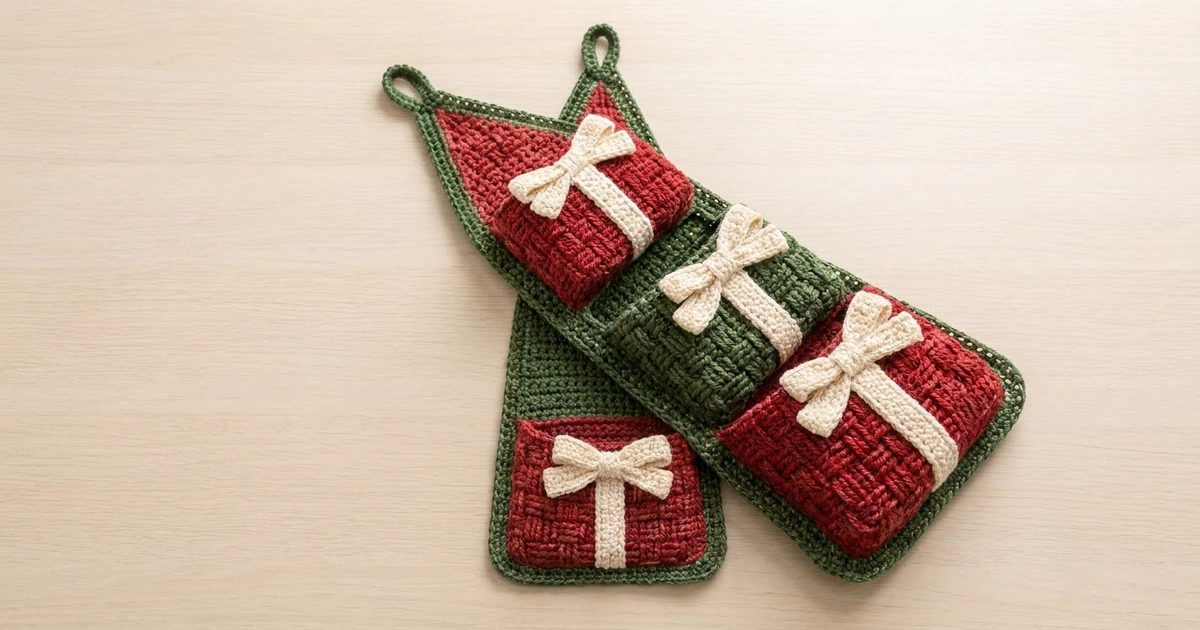
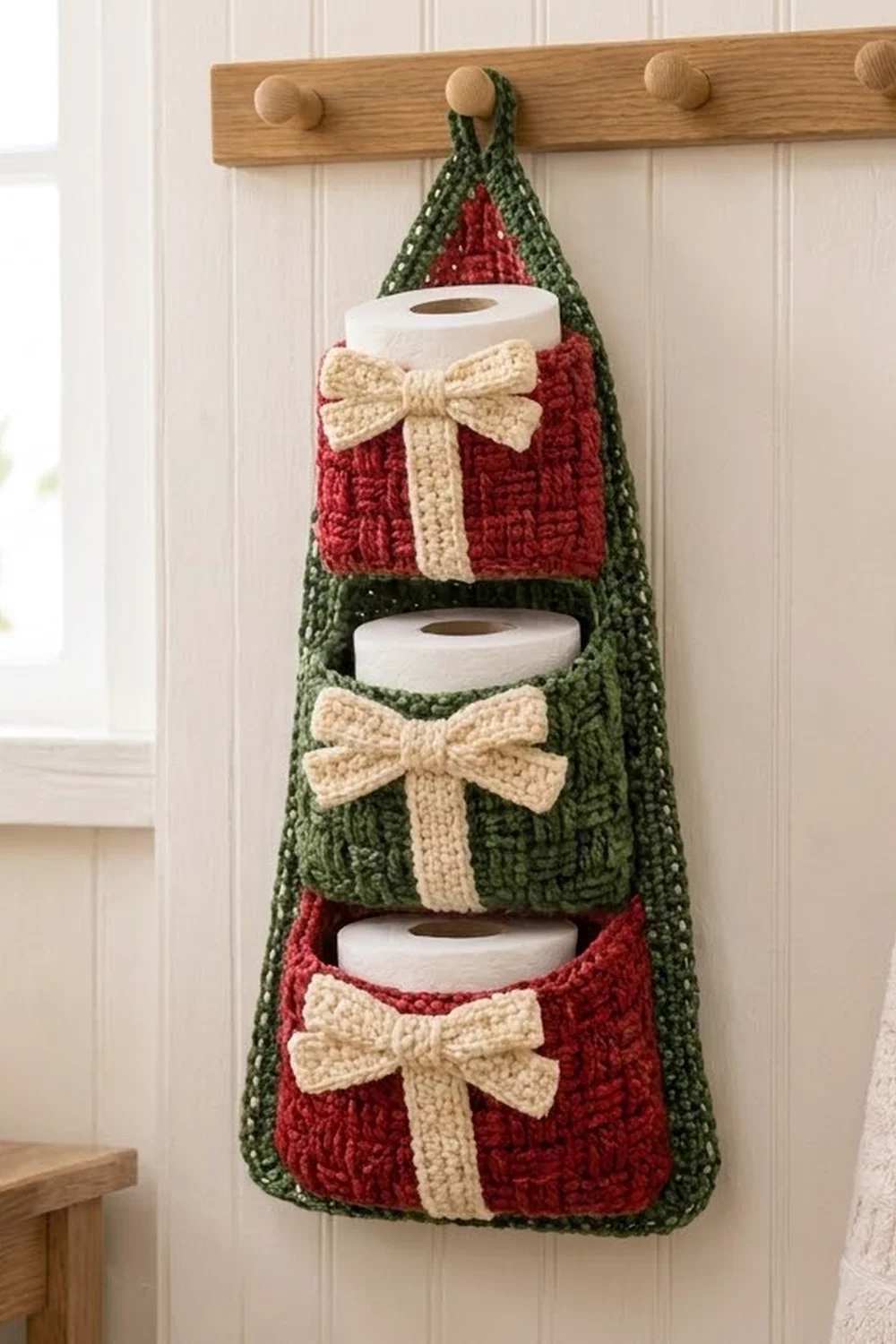
This wall-hanging holder looks like a little stack of wrapped presents. A tall, tapered backing panel holds three box-shaped pockets. Each pocket is worked in a chunky basketweave and trimmed with a cream ribbon and bow. The holder takes three standard rolls and hangs from a peg or hook by a crocheted loop.
The colors are classic Christmas: cranberry red, pine green, and warm cream. The backing is green with a red pointed top. The top and bottom pockets are red, and the middle pocket is green. Every edge is finished in green, so the whole piece reads as one framed shape.
The pattern uses US crochet terms. The finished backing measures 9 in (22.9 cm) wide at the bottom and 21.75 in (55.2 cm) tall, plus a hanging loop of about 2 in (5.1 cm). Each pocket stands 3.25 in (8.3 cm) tall and 4.5 in (11.4 cm) deep.
You work the backing from the bottom up in single crochet, tapering it to a point. Each pocket starts as a flat single crochet base, and then the walls are worked upward in the round in basketweave. You sew on the cream ribbon strips and bows, whipstitch the pockets to the backing, and finish the panel with a two-round border.
Finished Size and Construction
- Finished size: 9 in (22.9 cm) wide x 21.75 in (55.2 cm) tall, not counting the loop
- Skill level: Intermediate
- Terminology: US
- Yarn weight: Worsted (#4)
- Hook: 5.0 mm (H-8)
- Number of pieces: 16 (1 backing, 3 pockets, 3 ribbon strips, 3 bow bodies, 3 bow centers, 3 tail pieces)
- Layout: 3 pockets stacked vertically on one backing
- Pocket fronts: 8 in (20.3 cm), 6.9 in (17.5 cm), and 5.7 in (14.5 cm) wide, bottom to top
- Backing before border: 8 in (20.3 cm) x 20.75 in (52.7 cm)
- Border depth: 0.5 in (1.3 cm)
Materials
Choose a smooth worsted acrylic or cotton blend with good stitch definition. Basketweave uses a lot of yarn, and a crisp yarn shows the woven texture best.
- Red: 120 g, about 216 m
- Green: 110 g, about 198 m
- Cream: 25 g, about 45 m
These amounts include about 20 percent extra.
Tools:
- 5.0 mm (H-8) crochet hook
- Tapestry needle
- Stitch markers
- Scissors
- Rigid ruler or tape measure
- Rust-proof pins and a blocking mat
- Spray bottle
Abbreviations (US Terms)
- ch: chain
- sl st: slip stitch
- sc: single crochet
- dc: double crochet
- sc2tog: single crochet 2 together
- BLO: back loop only
- st(s): stitch(es)
- rnd(s): round(s)
- rep: repeat
Special stitches:
- FPdc (front post double crochet): Yo, insert hook from front to back to front around the post of the stitch below, yo and pull up a loop, (yo and pull through 2 loops) twice.
- BPdc (back post double crochet): Yo, insert hook from back to front to back around the post of the stitch below, yo and pull up a loop, (yo and pull through 2 loops) twice.
Gauge and Checkpoints
Single crochet gauge: 14 sts and 16 rows = 4 in (10.2 cm). That is 3.5 sts and 4 rows per inch.
Basketweave gauge: 14 sts and 8 rnds = 4 in (10.2 cm), measured flat across a pocket wall.
Make the top (smallest) pocket first as your test piece. It uses the least yarn and checks both gauges at once.
Checkpoints:
- Top pocket base after Row 18: 5.7 in (14.5 cm) x 4.5 in (11.4 cm)
- Top pocket wall after Rnd 9: 3.25 in (8.3 cm) tall
- Backing after Row 56: 14 in (35.6 cm) tall, 5.7 in (14.5 cm) wide at the top edge
- Backing after Row 83: 20.75 in (52.7 cm) tall
- Backing after border: 9 in (22.9 cm) x 21.75 in (55.2 cm)
If your pieces come out too big, go down half a hook size. If they come out too small, go up half a size. Post stitches often pull in a little. If only the basketweave is too small, use a 5.5 mm hook for Rnds 3 to 7 of the walls.
Backing Panel
Work in rows from the bottom up. The ch 1 at the start of each row does not count as a stitch.
Decrease row: Ch 1, turn, sc2tog, sc across to last 2 sts, sc2tog. (2 sts fewer than the row before.)
With green, ch 29.
Row 1: Sc in 2nd ch from hook and in each ch across, turn. (28 sts)
Rows 2–17: Ch 1, sc in each st across, turn. (28 sts)
Row 18: Decrease row. (26 sts)
Rows 19–29: Ch 1, sc across, turn. (26 sts)
Row 30: Decrease row. (24 sts)
Rows 31–41: Ch 1, sc across, turn. (24 sts)
Row 42: Decrease row. (22 sts)
Rows 43–53: Ch 1, sc across, turn. (22 sts)
Row 54: Decrease row. (20 sts)
Rows 55–56: Ch 1, sc across, turn. (20 sts) Change to red on the last yarn over of Row 56. Fasten off green.
Checkpoint: 14 in (35.6 cm) tall.
Rows 57–65: With red, ch 1, sc across, turn. (20 sts)
Row 66: Decrease row. (18 sts)
Row 67: Ch 1, sc across, turn. (18 sts)
Rows 68–81: Rep Rows 66–67 seven more times. Counts after each decrease row: 16, 14, 12, 10, 8, 6, 4 sts.
Row 82: Decrease row. (2 sts)
Row 83: Ch 1, turn, sc2tog. (1 st) Fasten off.
Checkpoint: 83 rows = 20.75 in (52.7 cm). Bottom edge is 8 in (20.3 cm).
The sides narrow gently through the green section and then come to a steep red triangle at the top.
Pockets
Make 3: the top pocket in red (W = 20), the middle pocket in green (W = 24), and the bottom pocket in red (W = 28). W is the number of stitches along the front and back walls.
Base
Ch W + 1 (21, 25, or 29).
Row 1: Sc in 2nd ch from hook and in each ch across, turn. (W sts)
Rows 2–18: Ch 1, sc across, turn. (W sts) Do not turn at the end of Row 18.
Checkpoint: W ÷ 3.5 in wide x 4.5 in (11.4 cm) deep.
Walls
Rnd 1 (edging): Ch 1, rotate and work down the short side: sc in next 8 row ends, skip 1 row end, sc in next 8 row ends, skip 1 row end (16 sc). Sc in each foundation ch across (W sc). Work 16 sc down the second short side the same way. Sc in each st across Row 18 (W sc). Sl st to first sc. (2W + 32 sts: 72, 80, or 88)
Rnd 2: Ch 1, sc in BLO of each st around, sl st to first sc. (72, 80, or 88 sts) This round makes the wall fold upward.
Rnd 3: Ch 2 (does not count), dc in each st around, sl st to first dc. (72, 80, or 88 sts)
Rnds 4–5: Ch 2, *FPdc in next 4 sts, BPdc in next 4 sts; rep from * around, sl st to first st. (72, 80, or 88 sts; 9, 10, or 11 repeats)
Rnds 6–7: Ch 2, *BPdc in next 4 sts, FPdc in next 4 sts; rep from * around, sl st to first st. (72, 80, or 88 sts)
Rnds 8–9: Ch 1, sc in each st around, sl st to first sc. (72, 80, or 88 sts) Fasten off.
Checkpoint: the wall is 3.25 in (8.3 cm) tall. A 4.25 in (10.8 cm) roll should stand about 1 in (2.5 cm) above the rim.
The foundation-chain side is the front wall, and the Row 18 side is the back wall.
Ribbon and Bow (Make 3 Sets)
Work all of these pieces in cream.
Ribbon strip: Ch 5. Row 1: Sc in 2nd ch from hook and across, turn. (4 sts) Rows 2–13: Ch 1, sc across, turn. (4 sts) Fasten off. Size: 1.1 in (2.8 cm) x 3.25 in (8.3 cm).
Bow body: Ch 25. Row 1: Sc in 2nd ch from hook and across, turn. (24 sts) Rows 2–4: Ch 1, sc across, turn. (24 sts) Fasten off. Size: 6.9 in (17.5 cm) x 1 in (2.5 cm).
Bow center: Ch 4. Row 1: Sc in 2nd ch from hook and across, turn. (3 sts) Rows 2–8: Ch 1, sc across, turn. (3 sts) Fasten off, leaving a long tail. Size: 0.9 in (2.3 cm) x 2 in (5.1 cm).
Tails: Ch 15. Row 1: Sc in 2nd ch from hook and across, turn. (14 sts) Row 2: Ch 1, sc across. (14 sts) Fasten off. Size: 4 in (10.2 cm) x 0.5 in (1.3 cm).
Assemble the bow: Fold both short ends of the bow body to the center so they overlap slightly. This makes two loops about 3.5 in (8.9 cm) across. Wrap cream yarn around the middle a few times to cinch it. Fold the tail piece in half into an upside-down V and lay it behind the cinch. Wrap the bow center around both, front to back, and sew its ends together at the back.
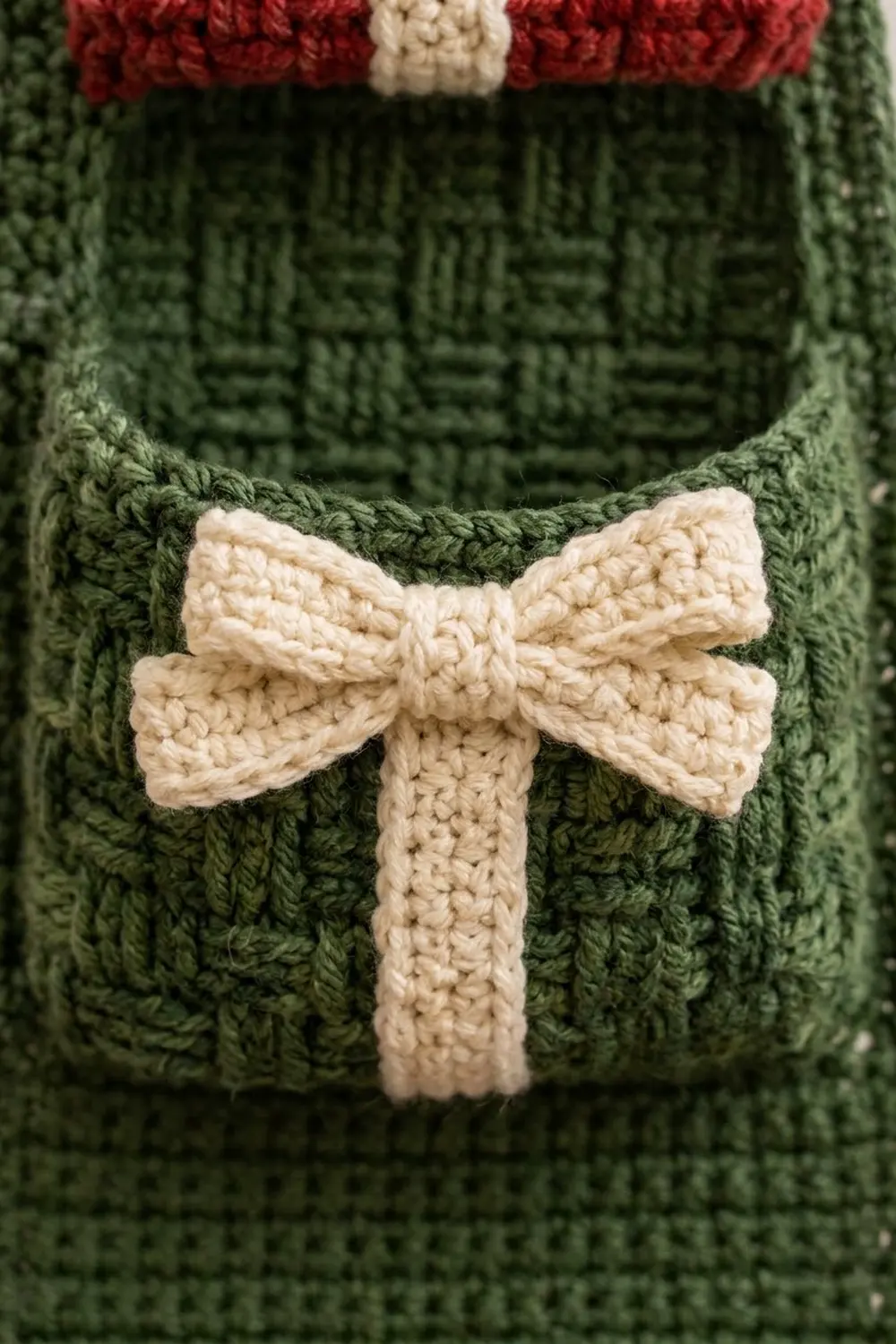
Attach: Center the ribbon strip vertically on the front wall, running from the rim down to the base fold. Whipstitch both long edges. Sew the bow over the top of the ribbon, just below the rim.
Make All Pieces
- Red: backing top section (Rows 57–83), top pocket (W = 20), bottom pocket (W = 28)
- Green: backing body (Rows 1–56), middle pocket (W = 24), border, hanging loop
- Cream: 3 ribbon strips, 3 bow bodies, 3 bow centers, 3 tail pieces
Layout (front view, top to bottom):
          (loop)
            /\
           /  \        red point
          [RED ]       top pocket, rows 45-57
         [GREEN ]      middle pocket, rows 25-37
        [  RED   ]     bottom pocket, rows 5-17
        ----------     green border
Joining
Weave in all ends on the pockets and the ribbon and bow pieces before joining. Using green yarn and a tapestry needle, whipstitch each pocket’s back wall flat against the front of the backing.
Placement (by backing row):
- Bottom pocket: Place the back base edge along the top of Row 4 and the rim along the top of Row 17. All of these rows have 28 sts, matching W = 28.
- Middle pocket: Place the base along the top of Row 24 and the rim along the top of Row 37. Rows 24–29 have 26 sts, so leave 1 st free on each side. Rows 30–37 have 24 sts, matching W = 24.
- Top pocket: Place the base along the top of Row 44 and the rim along the top of Row 57. Rows 44–53 have 22 sts, so leave 1 st free on each side. Rows 54–57 have 20 sts, matching W = 20.
Stitch-to-stitch logic: Both fabrics have 3.5 sts per inch. Sew one back-wall stitch to one backing stitch along the base, and again along the rim. The wall is 3.25 in (8.3 cm) tall, which equals 13 backing rows. Sew the two back corners up with one stitch per backing row.
Tension: Pull each stitch snug but not tight. The backing should stay flat, with no puckers behind the pocket.
Each pocket covers 13 rows. That leaves 7 rows, or 1.75 in (4.4 cm), of backing between pockets. The top pocket’s rim covers Row 57, so the red triangle starts right at its edge.
Checkpoint: the backing is still 8 in (20.3 cm) x 20.75 in (52.7 cm) and lies flat.
Border
Border gauge:
- Bottom: work 1 sc per stitch.
- Near-vertical sides (Rows 1–64): work 7 sc per 8 row ends. This gives 3.5 sc per inch.
- Slanted top (Rows 65–82): work 1 sc per row end. Each slanted row edge is longer than one row is tall, so it needs the extra stitch.
Join green at the bottom right corner, in the first foundation ch.
Rnd 1: Ch 1, 3 sc in first ch (corner), sc in next 26 ch, 3 sc in last ch (corner). Work up the side: sc in next 7 row ends, skip 1 row end 8 times (56 sc over Rows 1–64), then sc in each of the next 18 row ends (Rows 65–82). Work 3 sc in the single stitch of Row 83 (point). Work down the other side the same way in reverse: 18 sc, then 56 sc. Sl st to first sc. (183 sts: bottom 26, each side 74, plus three 3-sc corner groups)
Rnd 2: Ch 1, sc in each st around, working 3 sc in the center st of each corner group. Sl st to first sc. (183 sts worked 1 per stitch + 6 extra at corners = 189 sts: bottom 28, each side 76, plus three 3-sc corner groups)
Hanging loop: Join green in the center sc at the point. Ch 16, sl st in the same st. Ch 1, work 24 sc into the loop, sl st to the first sc. Fasten off.
Why the math works:
- 26 + 74 + 74 + 9 = 183, and 28 + 76 + 76 + 9 = 189.
- In Rnd 2, the bottom border has 28 sts, matching the 28-stitch first row of the backing.
- The side counts work out to 3.5 sts per inch, so the edges lie flat.
- The two sc rounds add 0.5 in (1.3 cm) on every side. That takes the backing from 8 in x 20.75 in to 9 in (22.9 cm) x 21.75 in (55.2 cm).
Final Blocking
- Weave in all remaining ends.
- Lay the holder face up on a blocking mat.
- Pin the backing to 9 in (22.9 cm) wide at the bottom and 21.75 in (55.2 cm) tall. Ease the two bottom corners into a soft curve.
- Mist the backing and border evenly until damp.
- Put a toilet roll or a folded towel in each pocket so the walls stand square.
- Mist the pocket walls lightly. Do not flatten the basketweave.
- Shape each bow loop with your fingers.
- Let it dry completely, then remove the pins and rolls.
Final Quality-Control Checklist
- The backing measures 9 in (22.9 cm) x 21.75 in (55.2 cm).
- Border Rnd 2 has 189 sts.
- Each pocket wall is 3.25 in (8.3 cm) tall.
- The pockets have 72, 80, and 88 sts.
- The basketweave blocks switch cleanly every 2 rnds.
- The ribbons are centered and run straight.
- The bows sit level just below each rim.
- The back walls lie flat, with no puckers.
- The hanging loop is firmly anchored.
Troubleshooting
Backing edges ripple: You picked up too many border stitches. Recheck the 7-per-8 row-end ratio.
Border cups or pulls in: You have too few border stitches, or your tension is too tight. Rework it with a looser hand.
Pocket walls flare: The basketweave is too loose. Go down a hook size for Rnds 3–7.
Pocket walls lean outward: Rnd 2 was not worked in BLO. Redo it to get a crisp fold.
Blocks look staggered: Check that each wall round is a multiple of 8 stitches.
Pocket sags forward: Add a few tacking stitches where the side walls meet the backing.
Care
Hand wash in cool water and lay flat to dry, reshaping the pockets while damp. Do not wring or tumble dry.
Final Notes
Here is the measurement chain:
- The backing starts 8 in (20.3 cm) wide and grows to 20.75 in (52.7 cm) tall over 83 rows.
- Each pocket starts with a 4.5 in (11.4 cm) deep base and rises to a 3.25 in (8.3 cm) wall.
- Each pocket covers 13 backing rows and is sewn on stitch for stitch.
- The two-round border finishes the panel at 9 in (22.9 cm) x 21.75 in (55.2 cm).
Check each checkpoint as you go, and the pieces will fit together without fuss.
Happy crocheting!