

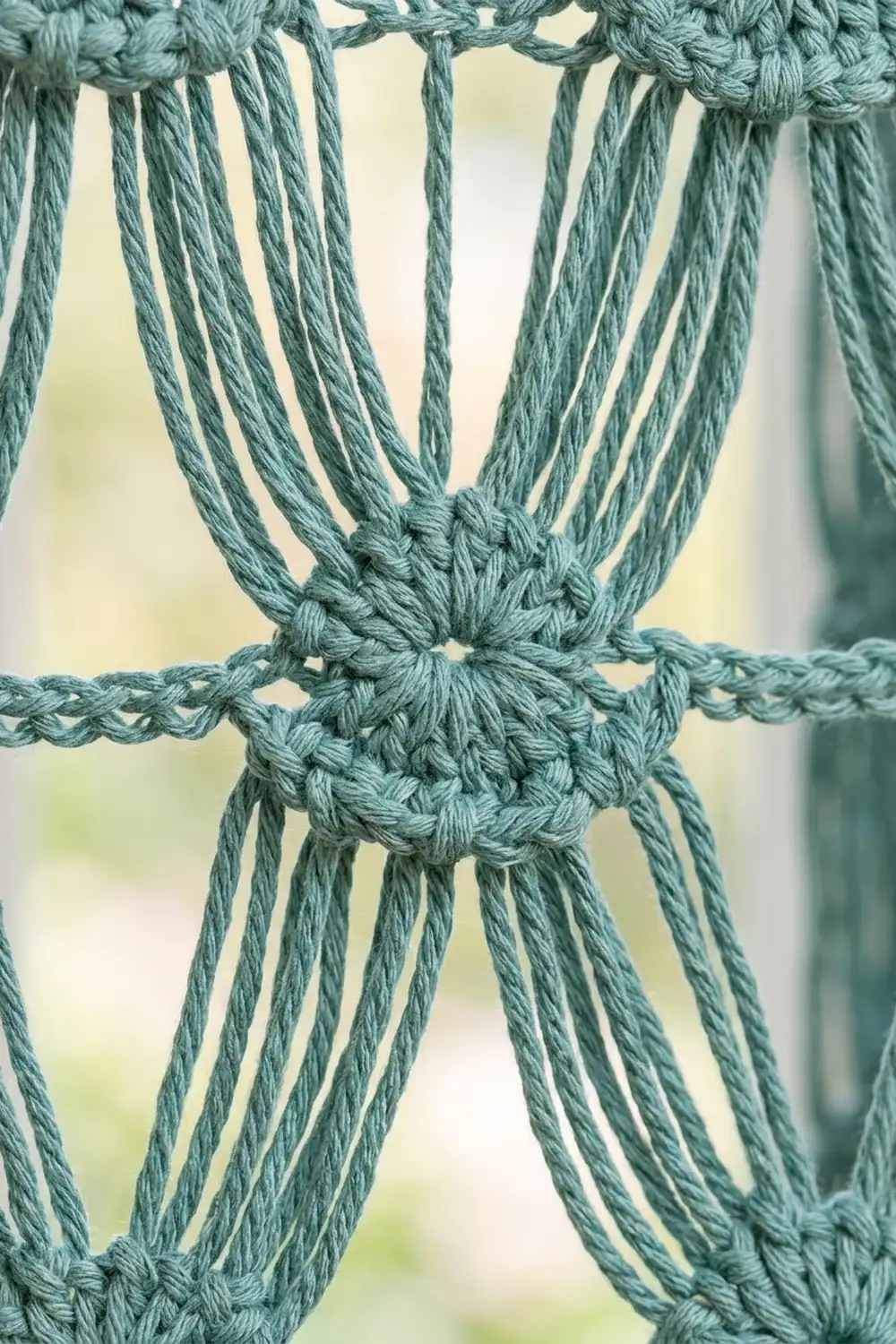
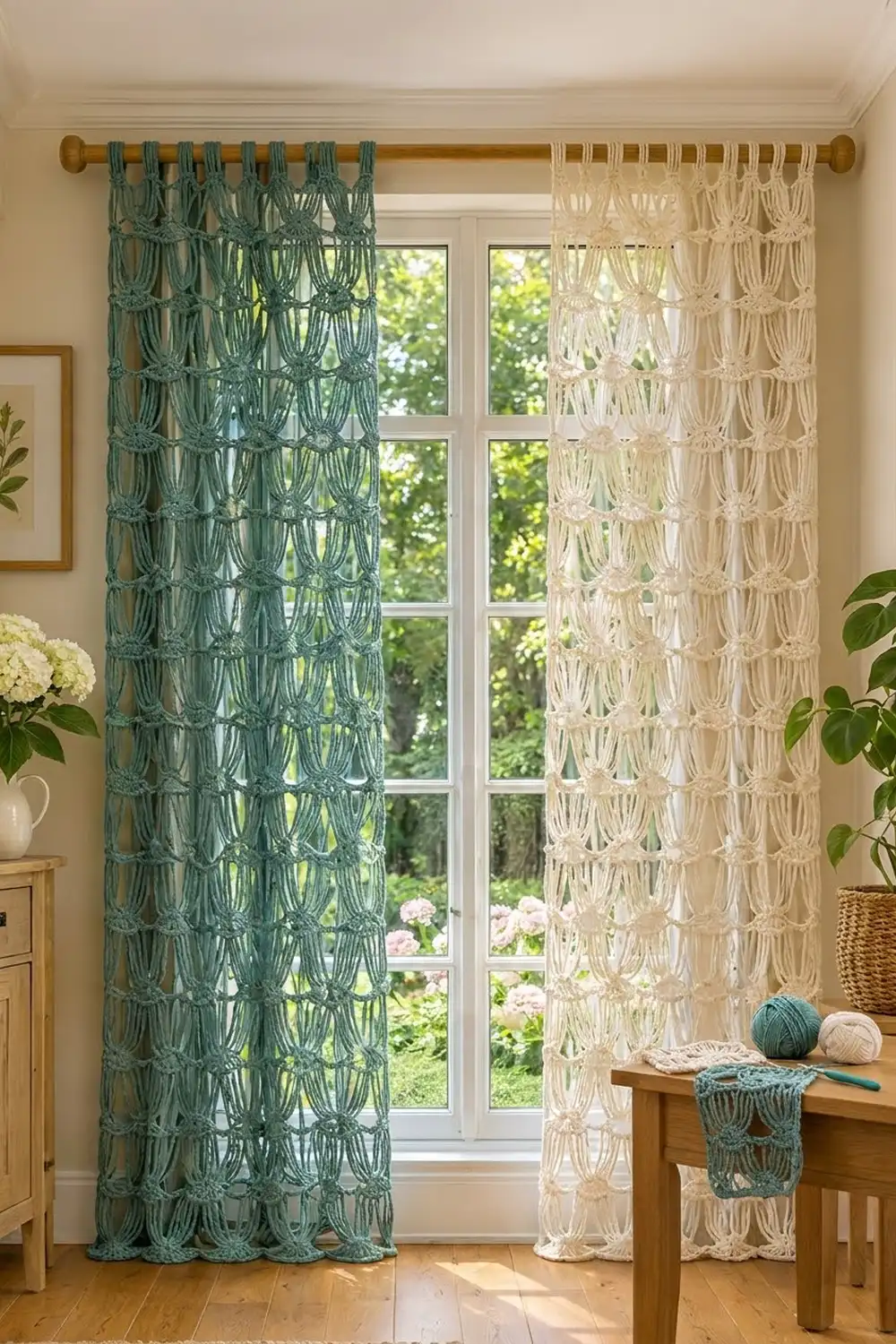
These airy curtain panels are made of long, open strands that gather into rounded nodes and fan back out again. The result is rows of hourglass shapes stacked between narrow single crochet bands. It looks like macramé, but it is all crochet.
The pair shown is one panel in muted seaglass teal and one in natural cream. They hang side by side on a wooden rod from simple folded tabs. The style is relaxed and coastal. The open lace lets daylight through while still softening the window.
This pattern uses US crochet terms. Each finished panel measures 36.5 in (92.7 cm) wide by 81 in (205.7 cm) long. That doesn’t count the tab loops, which add about 3 in (7.6 cm) above the top edge.
Each panel is worked flat in rows from the bottom up. A two-row single crochet band alternates with two rows of triple treble stitches. In the first of those rows, six stitches are gathered into one cluster; in the second, six stitches fan back out of that same point. A slim edging, a top band and nine folded tabs finish each panel.
Finished Size and Construction
- Finished size (one panel): 36.5 in x 81 in (92.7 cm x 205.7 cm), plus 3 in (7.6 cm) tab loops
- Skill level: Intermediate
- Terminology: US
- Yarn weight: Worsted (#4) cotton or cotton blend
- Hook: 6.0 mm (US J-10)
- Number of pieces: 2 separate panels, never sewn together
- Layout: Two panels hung side by side on one rod
- Piece size before border: 36 in x 80.5 in (91.4 cm x 204.5 cm)
- Border depth: 0.25 in (0.6 cm) on each side, bottom and top, plus tabs
Materials
Choose a smooth mercerized or combed cotton in worsted weight, about 180 m per 100 g (197 yd per 3.5 oz). Cotton hangs heavily and keeps the long strands straight. Avoid fuzzy or very stretchy yarns, which blur the hourglass shapes.
- Color A, Seaglass Teal: 600 g, about 1,080 m (1,181 yd), for one panel
- Color B, Natural Cream: 600 g, about 1,080 m (1,181 yd), for one panel
Quantities include a margin of at least 15% over the estimated use. That leaves room for a gauge swatch and small adjustments.
Tools:
- 6.0 mm (US J-10) crochet hook
- Tapestry needle
- 8 stitch markers
- Measuring tape
- Rust-proof pins and a large blocking surface (a bed or a clean floor with towels works)
- Scissors
- Curtain rod up to 1.5 in (3.8 cm) in diameter
Abbreviations (US Terms)
- ch – chain
- sc – single crochet
- sl st – slip stitch
- st(s) – stitch(es)
- yo – yarn over
- rep – repeat
- RS / WS – right side / wrong side
- trtr – triple treble crochet: yo 4 times, insert hook in st, yo and pull up a loop (6 loops on hook), [yo, pull through 2 loops] 5 times.
Special stitch – trtr6tog (6-leg gathered cluster): [Yo 4 times, insert hook in next st, yo and pull up a loop, (yo, pull through 2 loops) 4 times] 6 times, working each leg into its own st; 7 loops on hook. Yo and pull through all 7 loops. The six legs start apart and meet at one point, forming the node.
Gauge and Checkpoints
Gauge: 12 sc and 16 sc rows = 4 in (10.2 cm). One trtr row = 2.25 in (5.7 cm). One full repeat (2 trtr rows + 2 sc rows) = 5 in (12.7 cm).
Test one small piece first. Ch 37 and work Rows 1–6 below with 3 clusters instead of 9, giving 36 sts. Block it lightly.
- Swatch width: 12 in (30.5 cm)
- Swatch height after Row 6: 5.5 in (14.0 cm)
If the swatch is too big, go down one hook size. If it is too small, go up one hook size. If the width is right but the trtr rows are short, pull up the first loop of each trtr a little taller rather than changing hooks.
Panel checkpoints:
- After Row 2: 36 in (91.4 cm) wide, 0.5 in (1.3 cm) tall
- After Row 6: 5.5 in (14.0 cm) tall
- After Row 18: 20.5 in (52.1 cm) tall
- After Row 34: 40.5 in (102.9 cm) tall
- After Row 66: 80.5 in (204.5 cm) tall
Always measure the panel lying flat, not hanging. Lace stretches under its own weight.
Panel Pattern
The stitch count is a multiple of 12. Each 12-st repeat holds one hourglass: 6 sts are gathered into a cluster, and 6 sts are skipped between clusters.
Foundation: Ch 109.
Row 1 (RS): Sc in 2nd ch from hook and in each ch across, turn. (108 sc)
Row 2 (WS): Ch 1, sc in each sc across, turn. (108 sc)
Rows 1–2 form the first sc band.
Row 3 (RS, Gather Row): Ch 6 (counts as first trtr), ch 5, skip next 2 sc, trtr6tog over next 6 sc, *ch 11, skip next 6 sc, trtr6tog over next 6 sc; rep from * 7 more times, ch 5, skip next 2 sc, trtr in last sc, turn. (2 trtr, 9 clusters, 98 ch)
Check the base: 1 + 2 + (9 x 6) + (8 x 6) + 2 + 1 = 108 sts used. Each ch-11 runs between two cluster tops and forms the horizontal tie line at node height.
Row 4 (WS, Fan Row): Ch 6 (counts as first trtr), ch 2, 6 trtr in top of next cluster, *ch 6, 6 trtr in top of next cluster; rep from * 7 more times, ch 2, trtr in top of turning ch, turn. Do not work into the ch-5 or ch-11 spaces. (56 trtr, 52 ch, total 108)
Each group of 6 trtr fans out from a node, so the lower and upper halves of every hourglass mirror each other.
Row 5 (RS, Conversion Row): Ch 1, sc in each trtr and in each ch across, ending with sc in 6th ch of turning ch, turn. (56 sc worked into trtr + 52 sc worked into ch = 108 sc)
Work into each chain itself, not around it, so the band stays firm.
Row 6 (WS): Ch 1, sc in each sc across, turn. (108 sc)
Rows 7–66: Rep Rows 3–6 fifteen more times. Fasten off. (16 hourglass tiers, 17 sc bands, 108 sc in Row 66)
Height check: 17 bands x 0.5 in + 16 tiers x 4.5 in = 80.5 in (204.5 cm).
Put a marker in every fourth tier as you go. Markers make the checkpoints quick to find and help you match the two panels later.
Make All Pieces
Make 2 panels in total:
- Color A, Seaglass Teal: 1 panel
- Color B, Natural Cream: 1 panel
Both panels are identical: 108 sts wide, 66 rows tall, 16 tiers.
Layout on the rod (viewed from inside the room):
[ ROD ===================================== ]
[ Teal panel  ]          [ Cream panel ]
[ 9 tabs      ]          [ 9 tabs      ]
[ 16 tiers    ]          [ 16 tiers    ]
Joining
The two panels are never sewn to each other. They hang as a pair, so “joining” here means a matching step, not a seam.
Method: Lay both finished panels side by side on a flat surface with the bottom edges lined up.
Stitch-to-stitch logic: Each panel has 108 sts per row and 17 sc bands. Line up band 1 with band 1, band 5 with band 5, and so on, using your markers. The nodes should sit at the same height on both panels.
Tension advice: If one panel is longer, check the trtr rows first, because loose triple trebles are the most common cause. Only re-work a tier if the difference is more than 1 in (2.5 cm).
Size checkpoint: Before the border, both panels should measure 36 in x 80.5 in (91.4 cm x 204.5 cm).
Border
Border gauge: 3 sc per inch (12 sc = 4 in / 10.2 cm) along every edge.
Side Edging (each long side): With RS facing, join yarn at a bottom corner and work up the side. Work 1 sc into each sc band (over both row-ends of the 2-row band as one unit) and 7 sc into the side of each trtr row. Fasten off. Repeat on the other side.
Count per side: 17 bands x 1 + 32 trtr rows x 7 = 17 + 224 = 241 sc.
Why it works: 241 sc ÷ 3 sc per inch = 80.3 in (204.0 cm). That’s within normal ease of the 80.5 in (204.5 cm) side, so the edge neither ruffles nor pulls in.
Bottom Edge: With RS facing, join yarn at the bottom right corner. Sc in end of side edging row, sc in each of the 108 foundation ch, sc in end of other side edging row. Fasten off. (1 + 108 + 1 = 110 sc)
Top Band: With RS facing, join yarn at the top right corner. Sc in end of side edging row, sc in each of the 108 sts of Row 66, sc in end of other side edging row. Fasten off. (1 + 108 + 1 = 110 sc)
Why it works: 110 sc ÷ 3 sc per inch = 36.7 in (93.2 cm). That matches the finished 36.5 in (92.7 cm) width, which includes the two side edgings.
Tabs: Use markers to divide the 110 top-band sts into 9 tabs of 6 sts, with 7-st gaps between them. The tabs go on sts 1–6, 14–19, 27–32, 40–45, 53–58, 66–71, 79–84, 92–97 and 105–110.
Check: 9 x 6 + 8 x 7 = 54 + 56 = 110 sts.
For each tab, join yarn in the first st of the tab with RS facing.
- Row 1: Ch 1, sc in each of next 6 sts, turn. (6 sc)
- Rows 2–24: Ch 1, sc in each sc across, turn. (6 sc)
Fasten off, leaving a 12 in (30.5 cm) tail. Each tab is 2 in (5.1 cm) wide and 6 in (15.2 cm) long.
Fold the tab to the WS. Whipstitch its last row, stitch by stitch, to the back loops of the same 6 top-band sts. The finished loop stands about 3 in (7.6 cm) tall and fits a rod up to 1.5 in (3.8 cm) in diameter. Keep the whipstitches snug but not tight, so the tab lies flat.
Final Blocking
- Weave in all ends along the sc bands, where they hide best.
- Soak one panel in cool water with a little gentle fiber wash for 15 minutes.
- Press the water out gently, then roll the panel in towels. Do not wring it.
- Lay it flat on dry towels and pat it out to 36.5 in x 81 in (92.7 cm x 205.7 cm).
- Pin the side edgings straight, and pin each sc band level across the full width.
- Gently straighten each fan so all 6 strands spread evenly from the node.
- Let the panel dry completely, then repeat with the second panel.
- Compare both panels side by side before hanging.
Final Quality-Control Checklist
- Every sc band has 108 sts before the border.
- Each panel has 16 tiers, and each tier has 9 nodes.
- The nodes line up in vertical columns.
- Each side edging has 241 sc.
- The bottom edge and top band each have 110 sc.
- Each panel has 9 evenly spaced tabs, each 6 sts wide and 24 rows long.
- Both panels measure 36.5 in x 81 in (92.7 cm x 205.7 cm).
- All ends are woven in securely.
Troubleshooting
Panel narrows toward the top: You may be skipping the last st of an sc row. Recount to 108 after every band.
Strands look slack or loopy: Your trtr loops are uneven. Pull each first loop up to the same height and keep your tension steady through all five yarn-over passes.
Nodes drift sideways: Make sure each Row 4 fan goes into a cluster top only, never into the ch spaces.
Sc band ripples: In Row 5 you worked around the chains instead of into them. Work into each ch.
Tabs twist: Whipstitch through matching sts only, without skipping or doubling up.
Panels differ in length: Block the shorter panel with a little extra length, or re-work one tier.
Care
Hand wash cool, or machine wash on a gentle cycle in a mesh bag, then dry flat. Never hang a wet panel, because the weight will stretch the lace.
Final Notes
The measurement chain is simple. At 12 sc = 4 in (10.2 cm), 108 sts give 36 in (91.4 cm) of width. Each 5 in (12.7 cm) repeat stacks into 16 tiers and 17 bands for 80.5 in (204.5 cm) of length. A 0.25 in (0.6 cm) border brings each panel to 36.5 in x 81 in (92.7 cm x 205.7 cm), and nine 6 in (15.2 cm) tabs fold into loops for the rod. Check your swatch, count every band, and your two panels will hang as a matched pair.
Happy crocheting!