

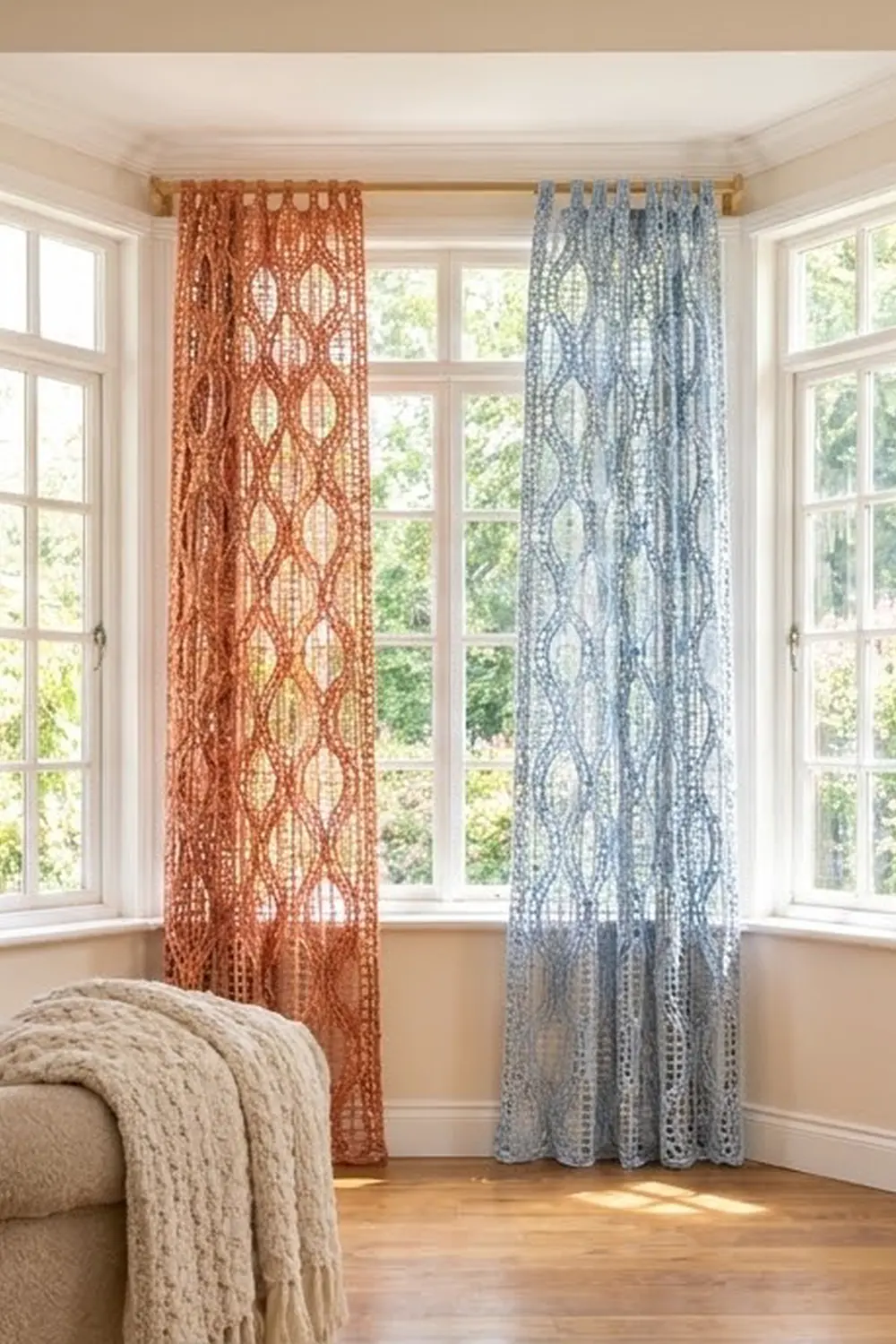
The Windowlight Ogee Curtain Panel is a floor-length filet lace panel covered in tall, interlocking ovals. Solid bars of double crochet weave in and out across an open mesh ground. With daylight behind it, the panel reads as a soft ogee lattice.
The sample comes in two colorways, warm terracotta and soft powder blue, and each color is its own separate panel. Hang one panel alone, or hang the two side by side as a mismatched pair like the sample. The look is relaxed and handmade, somewhere between boho macramé and classic filet lace.
This pattern uses US crochet terms. One finished panel measures 29.75 in (75.6 cm) wide and 83.75 in (212.7 cm) long. Eight tab loops at the top add about 2 in (5.1 cm).
The construction is simple. You crochet one rectangle in rows from the bottom up, using filet blocks and spaces in a 16-row repeat. Then you work one round of single crochet around the edge and crochet 8 tabs directly onto the top edge. There are no separate pieces to sew or join.
Finished Size and Construction
- Finished size (one panel): 29.75 in x 83.75 in (75.6 cm x 212.7 cm), plus tabs
- Skill level: Easy intermediate (simple stitches, careful counting)
- Terminology: US crochet terms
- Yarn weight: Worsted / #4, cotton or cotton blend
- Hook: 5.5 mm (US I-9)
- Number of pieces: 1 per panel (the tabs are worked onto the panel). The pair shown is 2 separate panels.
- Layout: 52 filet squares wide x 148 rows tall
- Motif repeat: 8 squares x 16 rows = 4.5 in x 9 in (11.4 cm x 22.9 cm)
- Size before border: 29.25 in x 83.25 in (74.3 cm x 211.5 cm)
- Border depth: 0.25 in (0.6 cm) on every side
Materials
Choose a smooth, plied or chainette cotton or cotton blend in worsted weight. Cotton drapes well, keeps the open mesh crisp, and doesn’t stretch much while hanging. Avoid very fuzzy yarns, because they blur the oval outlines.
Yarn per panel (based on about 175 m per 100 g):
- Terracotta panel: 1,000 g (about 1,750 m / 1,914 yd)
- Powder blue panel: 1,000 g (about 1,750 m / 1,914 yd)
Make one panel per color. If you only want one panel, buy only one color.
Tools:
- 5.5 mm (US I-9) crochet hook
- Tapestry needle
- Stitch markers (at least 8)
- Measuring tape
- Rustproof pins and a large flat blocking surface (a floor covered with towels works)
- Spray bottle
- Curtain rod up to 1.25 in (3.2 cm) in diameter
The quantities include a margin of about 10% to cover your swatch and small differences in tension. Buy all the yarn for one panel from the same dye lot.
Abbreviations (US Terms)
- ch – chain
- sc – single crochet
- dc – double crochet
- sk – skip
- st(s) – stitch(es)
- sp – space
- RS / WS – right side / wrong side
Special stitches (filet squares):
- Block (B): dc in each of next 2 sts (a ch-1 sp counts as a st). A block adds 2 sts.
- Space (Sp): ch 1, sk next st, dc in next st. A space adds 2 sts.
- Edge (E): dc in each of next 4 sts (2 solid squares).
Every row starts with ch 3, which counts as the first dc. Work the last st of every row into the top of the turning ch-3 from the row before. A full row is 105 sts: 1 turning ch plus 52 squares of 2 sts each.
Gauge and Checkpoints
Gauge in filet pattern: 8 squares (16 sts) = 4.5 in (11.4 cm) wide, and 16 rows = 9 in (22.9 cm) tall. Each square is about 0.56 in (1.4 cm) wide, and each row is about 0.56 in (1.4 cm) tall.
Test a swatch first. Ch 27. Dc in 4th ch from hook and in each ch across (25 sts). Work the 16 chart rows, with 1 Edge, 1 repeat and 1 Edge in each row. Fasten off, wet the swatch and let it dry flat. The 8-square repeat should measure 4.5 in (11.4 cm), and the 16 rows should measure 9 in (22.9 cm).
- Too big: go down to a 5 mm (US H-8) hook.
- Too small: go up to a 6 mm (US J-10) hook.
- Row height matters as much as width. If your rows are too short, pull up the first loop of each dc a little taller.
Checkpoints for the panel:
- After Row 1: 29.25 in (74.3 cm) wide.
- After Row 17: 9.56 in (24.3 cm) tall, with one complete row of ovals visible.
- After Row 145: 81.56 in (207.2 cm) tall.
- After Row 148: 83.25 in (211.5 cm) tall.
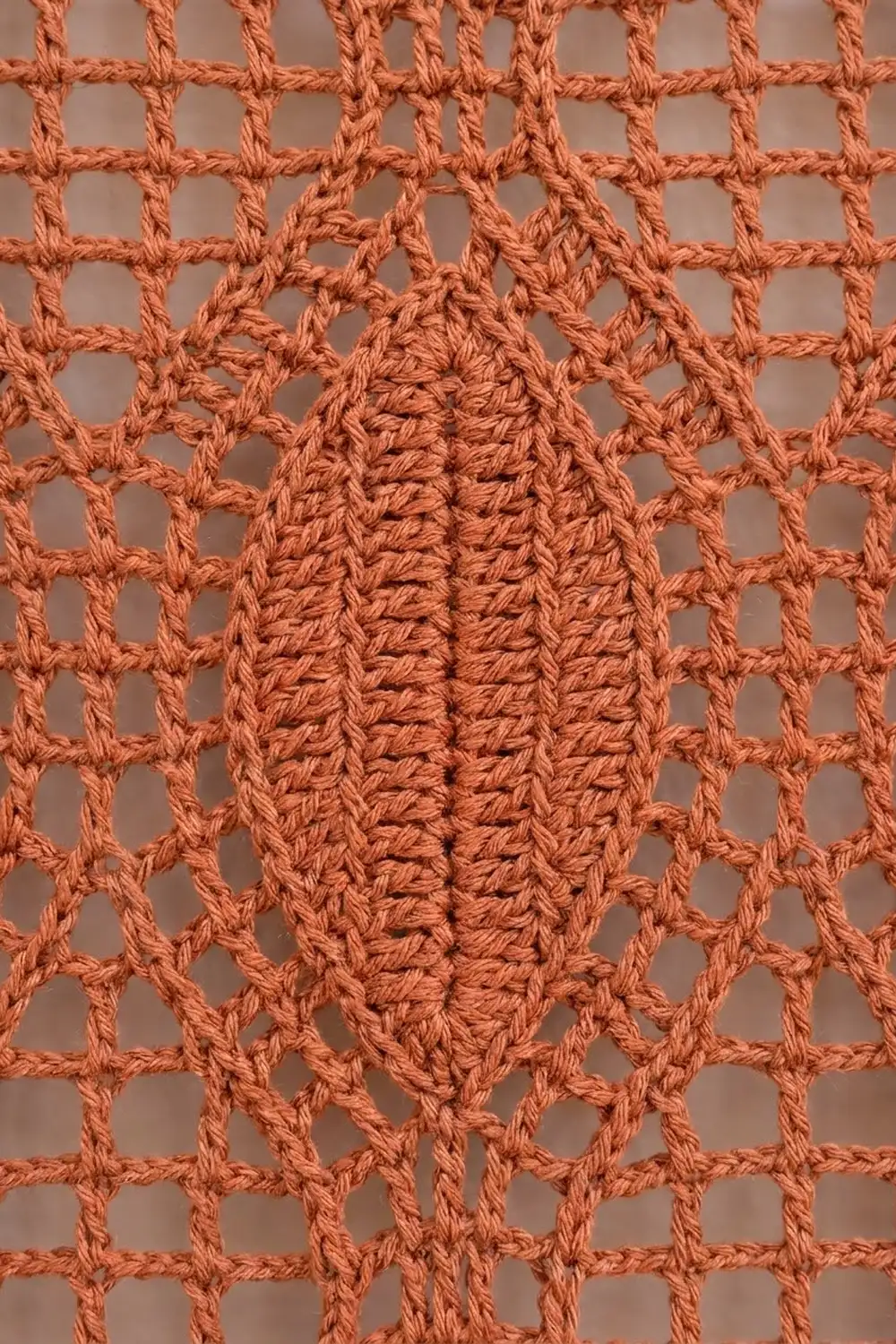
Chart Rows (One 8-Square Repeat)
Each line gives the order of the squares inside one repeat. The repeat is symmetrical, so it reads the same on RS and WS rows.
- Chart rows 1–2: Sp 3 times, B 2 times, Sp 3 times (blocks at squares 4 and 5, where the lines cross)
- Chart rows 3–4: Sp 2 times, B, Sp 2 times, B, Sp 2 times (blocks at 3 and 6)
- Chart rows 5–6: Sp, B, Sp 4 times, B, Sp (blocks at 2 and 7)
- Chart rows 7–12: B, Sp 6 times, B (blocks at 1 and 8, the widest part)
- Chart rows 13–14: work as chart rows 5–6
- Chart rows 15–16: work as chart rows 3–4
Where square 8 of one repeat meets square 1 of the next, the two blocks sit side by side. This is where neighboring oval columns touch. It also forms the second, offset set of ovals between the columns, which creates the ogee lattice.
Panel
Foundation: Ch 107.
Row 1 (solid, RS): Dc in 4th ch from hook (the skipped 3 ch count as a dc) and in each ch across. Turn. (105 sts: 104 dc + turning ch)
Rows 2–17 (chart rows 1–16): Ch 3 (counts as dc), E, then work the chart row 6 times (once per repeat), dc in each of next 3 sts, dc in top of turning ch. Turn. (105 sts: 1 + 4 + 96 + 4)
Work chart row 1 on Row 2, chart row 2 on Row 3, and so on, ending with chart row 16 on Row 17.
How to work each square:
- B over a Sp: dc in the ch-1 sp, dc in next dc.
- B over a B: dc in next 2 dc.
- Sp over a B: ch 1, sk next dc, dc in next dc.
- Sp over a Sp: ch 1, sk ch-1 sp, dc in next dc.
On Row 2, place a marker at the start of each repeat, and move the markers up every few rows. There should be 16 sts between markers.
Rows 18–145: Repeat Rows 2–17 eight more times, for 9 full repeats in total. (105 sts per row)
Rows 146–147: Work chart rows 1–2 once more to close the top row of ovals. (105 sts)
Row 148 (solid): Ch 3, dc in each st and ch-1 sp across, dc in top of turning ch. (105 sts) Don’t fasten off.
The panel now has 6 oval columns across and 9 full ovals in each column, with crossings at the top and bottom. Each oval forms as its two block lines move out one square every 2 rows, run straight for 6 rows, then move back in.
Border
Border gauge: about 3.6 sc per inch (1.4 sc per cm) along every edge, the same spacing as the body.
Round 1: Ch 1, then turn the panel so you’re working along the top edge.
- Top: 3 sc in first st, sc in each of next 103 sts, 3 sc in last st.
- First side: 2 sc in each of the 148 row ends (296 sc).
- Bottom: 3 sc in first foundation ch, sc in each of next 103 ch, 3 sc in last ch.
- Second side: 2 sc in each of the 148 row ends (296 sc).
Sl st to first sc. Fasten off.
Round 1 total: 802 sts worked into the existing edge (105 + 105 + 296 + 296), plus 8 extra corner sts (2 extra at each of 4 corners) = 810 sc.
The center sc of each 3-sc group is the corner st. Counted from corner to corner, including both corners:
- Top and bottom: 107 sc each
- Each long side: 300 sc
- Check: 107 + 107 + 300 + 300 − 4 shared corners = 810
Why the math works: Across the top, 105 sts span 29.25 in, or 3.59 sts per inch. Each dc row is 0.5625 in tall, and 2 sc at 3.59 per inch cover 0.557 in. The sides and the top have the same spacing, so the edges lie flat without ruffling or pulling in.
Tabs (make 8): Mark the 105 top sc that sit between the two corner sts. The tab layout is 7 tab sts followed by 7 skipped sts, 7 times, then a final 7 tab sts (56 + 49 = 105).
For each tab, join yarn with RS facing in the first st of a tab section.
- Row 1: Ch 1, sc in same st and in next 6 sts. Turn. (7 sc)
- Rows 2–16: Ch 1, sc in each st across. Turn. (7 sc)
Fasten off, leaving a 12 in (30.5 cm) tail. Fold the tab to the WS and whipstitch Row 16 to the back of Row 148, directly behind Row 1 of the tab. Each tab is about 2 in (5.1 cm) wide and 4 in (10.2 cm) long, and it folds into a 2 in (5.1 cm) loop.
Final Blocking
- Weave in all ends along solid blocks, never across open spaces.
- Soak the panel in cool water for 15 minutes. Press the water out without wringing.
- Roll the panel in towels to remove extra water.
- Lay it flat on towels on the floor, RS up.
- Pin the corners out to 29.75 in x 83.75 in (75.6 cm x 212.7 cm).
- Pin along the sides every 6 in (15.2 cm), keeping the edges straight.
- Nudge each oval so the block lines run smoothly and the spaces open up into squares.
- Let it dry completely, then hang it. Gravity will relax the lace the rest of the way.
Final Quality-Control Checklist
- Every row has 105 sts.
- Each repeat has 16 sts between markers.
- There are 6 oval columns across and 9 full ovals in each column.
- Neighboring columns touch at the widest rows, with 2 blocks side by side.
- The side edges are solid, straight and 2 squares wide.
- Border Round 1 has 810 sc: 107 on the top and bottom, 300 on each long side.
- There are 8 evenly spaced tabs, each 7 sc wide.
- Blocked size is 29.75 in x 83.75 in (75.6 cm x 212.7 cm).
Troubleshooting
The oval lines drift sideways. A Sp or B was skipped or worked twice. Check that each repeat has 16 sts, and check against your markers every row.
The panel narrows toward the top. You’re missing the last st in the turning ch. Always finish the row in the top of the ch-3.
The spaces look like rectangles. Your rows are short compared to your width. Pull up the first loop of each dc a little higher, or go up one hook size.
The side border ruffles. Work the border with a hook one size smaller, keeping 2 sc per row end.
The side border pulls in. Work the border only with a hook one size larger.
The tabs are too tight on the rod. Add 2 rows to each tab (18 rows) before folding.
The bottom edge flares. Your foundation chain is too loose. Rework it with a hook one size smaller.
Care
Hand wash in cool water, or machine wash on a gentle cycle inside a laundry bag. Reshape and dry flat, and avoid the tumble dryer, which can shrink cotton lace.
Final Notes
Every measurement in this panel follows one chain. A filet square measures 0.5625 in (1.4 cm), so 8 squares make a 4.5 in (11.4 cm) repeat. Six repeats plus 2 edge squares on each side give 52 squares (105 sts), which measure 29.25 in (74.3 cm). In length, 148 rows measure 83.25 in (211.5 cm). One round of sc adds 0.25 in (0.6 cm) on every side, so the blocked panel measures 29.75 in x 83.75 in (75.6 cm x 212.7 cm). Eight tabs finish the top.
If your swatch matches the gauge, the rest of the panel will match too. Make one panel in terracotta and one in powder blue, and hang them together in a sunny window.
Happy crocheting!