

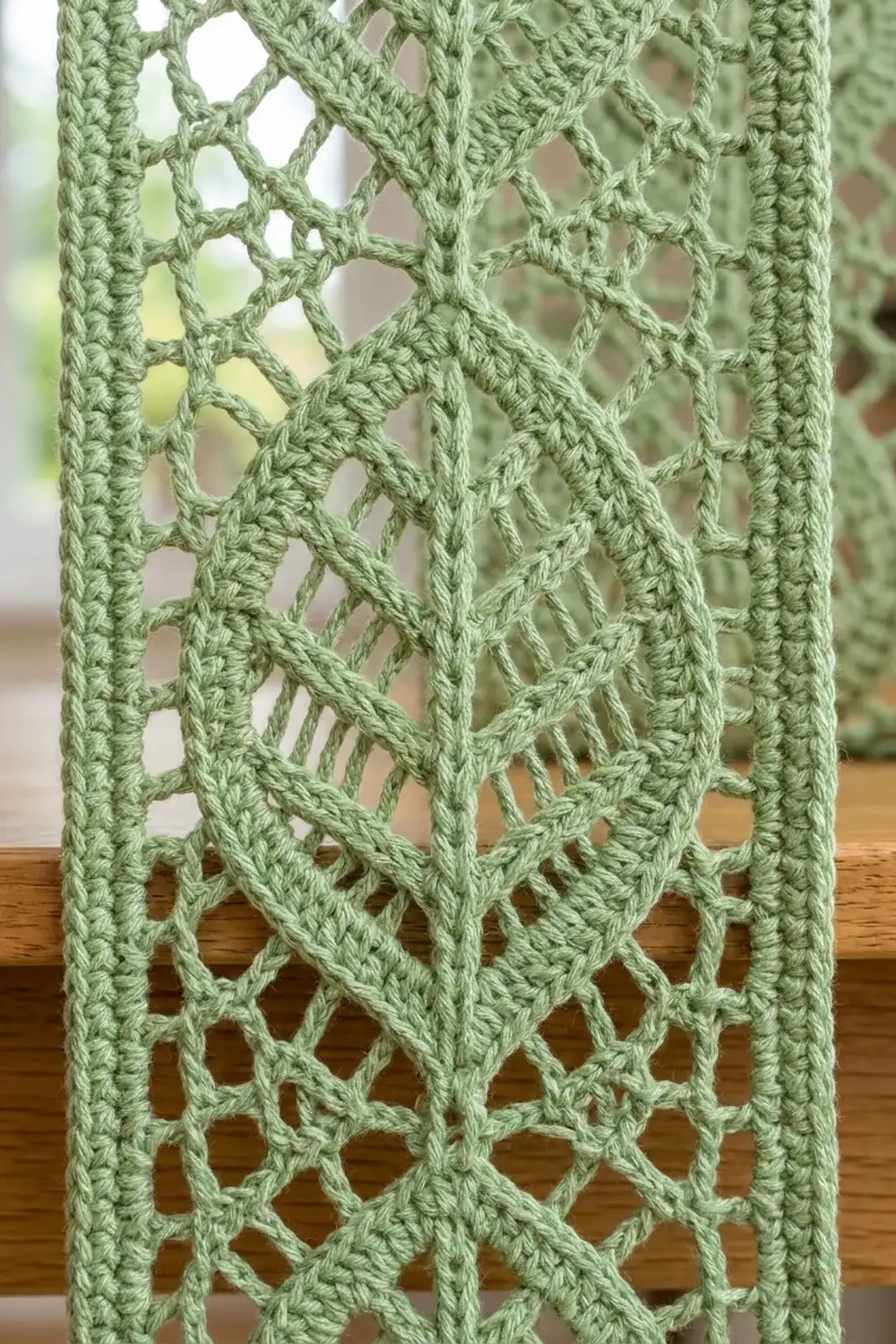
These crochet vertical blind slats turn a plain window track into a soft, leafy screen. Each slat is a long, narrow filet mesh strip with one column of pointed leaves running from bottom to top. A solid single crochet edge frames the strip, and a firm header band at the top clips into a standard vertical blind carrier.
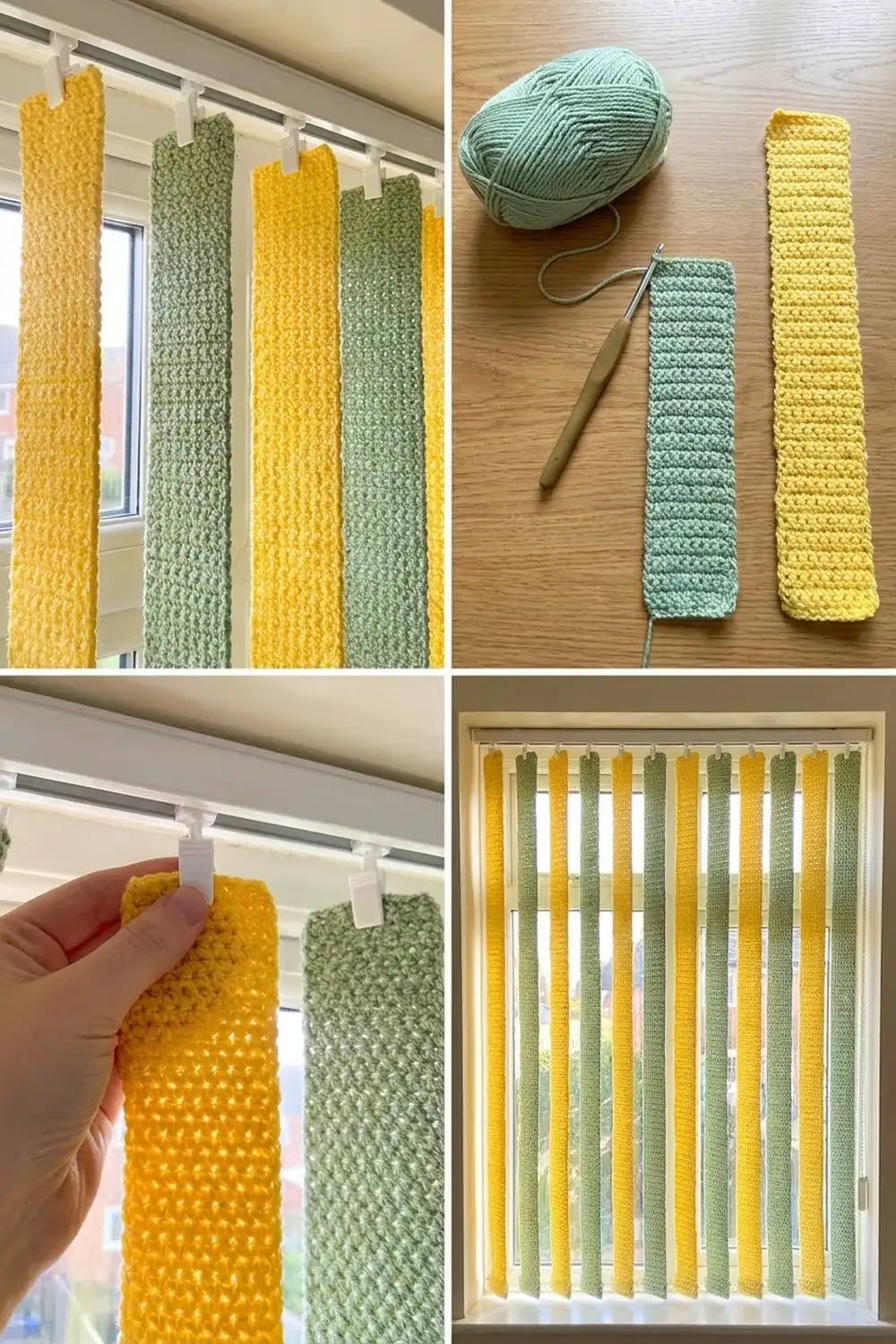
The sample set uses two colors, sunny yellow and soft sage green, hung in alternating order. Daylight shows through the open mesh around the leaves. The solid leaf blocks, center veins and crossbar side veins are easy to see from across the room. The style is fresh, botanical and a little retro.
This pattern uses US crochet terms. Each finished slat measures 4 in (10.2 cm) wide and 60 in (152.4 cm) long after blocking. The pattern makes 10 separate slats, 5 in each color. The slats are not joined to each other; each one hangs on its own carrier.
The construction is simple. Work the filet body in rows from the bottom up, add one round of single crochet border, then work a short header band across the top edge. Make one complete slat first and check every measurement before you make the rest.
Finished Size and Construction
- Finished slat size: 4 in x 60 in (10.2 cm x 152.4 cm)
- Skill level: Intermediate (basic filet crochet)
- Terminology: US crochet terms
- Yarn weight: DK (#3 light) cotton
- Hook: 3.5 mm (E-4)
- Number of pieces: 10 separate slats (5 yellow, 5 sage green)
- Layout: One row of 10 slats on a vertical blind track, colors alternating, not joined
- Piece size (filet body): 3.5 in x 58 in (8.9 cm x 147.3 cm), 7 squares wide and 116 rows tall
- Size before border: 3.5 in x 58 in (8.9 cm x 147.3 cm)
- Border depth: 0.25 in (0.6 cm) on each side
- Header band: 1.5 in (3.8 cm) tall, added above the top border
Materials
Choose a smooth DK cotton, either mercerized or matte. Cotton holds its shape, doesn’t stretch much when hung, and shows the filet blocks crisply. Avoid acrylic for long hanging pieces, because it tends to grow over time.
- Color A, sunny yellow: 375 g (825 m)
- Color B, sage green: 375 g (825 m)
Each slat uses about 75 g (165 m). These quantities include a margin of about 15 percent for swatching, tension differences and weaving in ends. With a typical 50 g / 110 m ball, that’s 8 balls per color.
Tools:
- 3.5 mm (E-4) crochet hook
- Tapestry needle
- Stitch markers
- Measuring tape
- Rust-proof pins and a long blocking surface (foam mats or a clean carpet covered with a towel)
- Spray bottle
- Optional: 10 small sew-in curtain weights
Abbreviations (US Terms)
- ch – chain
- sc – single crochet
- dc – double crochet
- sk – skip
- sl st – slip stitch
- sp – space
- st(s) – stitch(es)
- RS – right side
Filet squares:
- Mesh (M): ch 2, sk 2 sts (or the ch-2 sp), dc in next dc.
- Block (B): dc in each of next 2 sts (over a block) or 2 dc in the ch-2 sp (over a mesh), then dc in next dc.
- Starting a row with M: ch 5 (counts as dc + ch 2), sk first 2 sts or ch-2 sp, dc in next dc.
- Starting a row with B: ch 3 (counts as dc), work 2 dc in next ch-2 sp or 1 dc in each of next 2 sts, dc in next dc.
Every filet row has 8 dc “posts” and 7 squares, for 22 sts total. Work the last dc of each row into the 3rd ch of the turning chain.
Gauge and Checkpoints
Filet gauge: 2 squares and 2 rows = 1 in (2.5 cm). One square is 0.5 in x 0.5 in (1.3 cm x 1.3 cm).
Single crochet gauge: 6 sc and 4 sc rows = 1 in (2.5 cm).
Test with a swatch before starting a full slat. Ch 25, work Row 1, then work 7 mesh rows as written below. The swatch should measure 3.5 in (8.9 cm) wide and 4 in (10.2 cm) tall. Because the slat is 116 rows long, a small gauge error adds up fast. Being off by just 1/16 in per row adds more than 7 in (17.8 cm) to the length.
Checkpoints:
- After Row 16 (first leaf complete): 3.5 in x 8 in (8.9 cm x 20.3 cm)
- After Row 58: 3.5 in x 29 in (8.9 cm x 73.7 cm)
- After Row 116: 3.5 in x 58 in (8.9 cm x 147.3 cm)
- After border: 4 in x 58.5 in (10.2 cm x 148.6 cm)
- After header: 4 in x 60 in (10.2 cm x 152.4 cm)
If your swatch is too big, go down to a 3.25 mm (D-3) hook. If it’s too small, go up to a 3.75 mm (F-5) hook. If the width is right but the rows are too tall, pull up a shorter loop on each dc instead of changing hooks.
Filet Body
Make the body in your first color, working back and forth in rows. The leaf chart is symmetrical from left to right, so every row reads the same in either direction.
Foundation: Ch 25.
Row 1 (solid): Dc in 4th ch from hook (the skipped ch count as the first dc) and in each ch across. Turn. (22 dc)
Row 2 (mesh): Ch 5 (counts as dc + ch 2), sk next 2 dc, dc in next dc, ch 2, sk 2 dc, dc in next dc 5 times, ch 2, sk 2 dc, dc in top of turning ch. Turn. (7 M: 8 dc and 7 ch-2 sps, 22 sts)
Leaf Repeat (Rows 3–16)
Each row lists all 7 squares. Each leaf is 14 rows, or 7 in (17.8 cm), tall. Columns 1 and 7 are always mesh, which makes the open lattice down each side of the leaf. Column 4 is the center vein and stem.
- Repeat Row 1: 3 M, 1 B, 3 M. (10 dc, 6 ch-2 sps) – leaf tip
- Repeat Row 2: 2 M, 3 B, 2 M. (14 dc, 4 ch-2 sps)
- Repeat Row 3: M, B, M, B, M, B, M. (14 dc, 4 ch-2 sps) – outline and center vein
- Repeat Row 4: M, 5 B, M. (18 dc, 2 ch-2 sps) – side vein crossbar
- Repeat Row 5: M, B, M, B, M, B, M. (14 dc, 4 ch-2 sps)
- Repeat Row 6: M, 5 B, M. (18 dc, 2 ch-2 sps)
- Repeat Row 7: M, B, M, B, M, B, M. (14 dc, 4 ch-2 sps) – widest point
- Repeat Row 8: M, 5 B, M. (18 dc, 2 ch-2 sps)
- Repeat Row 9: M, B, M, B, M, B, M. (14 dc, 4 ch-2 sps)
- Repeat Row 10: M, 5 B, M. (18 dc, 2 ch-2 sps)
- Repeat Row 11: M, B, M, B, M, B, M. (14 dc, 4 ch-2 sps)
- Repeat Row 12: 2 M, 3 B, 2 M. (14 dc, 4 ch-2 sps)
- Repeat Row 13: 3 M, 1 B, 3 M. (10 dc, 6 ch-2 sps) – leaf tip
- Repeat Row 14: 3 M, 1 B, 3 M. (10 dc, 6 ch-2 sps) – stem linking to the next leaf
Every row totals 22 sts: the dc count plus 2 ch for each ch-2 sp. For example, Repeat Row 4 is 18 dc + 2 x 2 ch = 22.
The rows mirror each other around Repeat Row 7, so each leaf comes out as a pointed oval. Repeat Row 14 and the next Repeat Row 1 form a short two-row stem. This links the leaves tip to tip in one continuous vertical chain.
When the first leaf is done, place a marker in Row 16 and check the 8 in (20.3 cm) checkpoint.
Rows 17–114: Work Repeat Rows 1–14 seven more times. (8 leaves total, 112 repeat rows)
Row 115 (mesh): Work 7 M across. (8 dc, 7 ch-2 sps, 22 sts)
Row 116 (solid): Ch 3 (counts as dc), 2 dc in next ch-2 sp, dc in next dc, 2 dc in next ch-2 sp, dc in next dc 6 times, working the last dc in 3rd ch of turning ch. Do not turn. (22 dc)
Row count check: 1 solid + 1 mesh + 112 repeat rows + 1 mesh + 1 solid = 116 rows. At 2 rows per inch, that’s 58 in (147.3 cm).
Do not fasten off.
Make All Pieces
Make 10 complete slats, each with its own border and header:
- Color A, sunny yellow: 5 slats
- Color B, sage green: 5 slats
Layout on the track (left to right):
| A | B | A | B | A | B | A | B | A | B |
A = yellow, B = sage green. Store finished slats flat or loosely rolled, not folded, until you hang them.
Hanging the Slats (No Joining)
The slats are never sewn or crocheted together. Each slat hangs from its own carrier clip, just like a fabric vane, so the blind can still rotate and draw back.
Clip each header band into a carrier so that the clip grips the solid sc rows, not the filet mesh. If your carriers use a hook instead of a clip, work the eyelet in Header Row 4 and slide the hook through it.
Size checkpoint: Measure your carrier spacing before hanging. The slats are 4 in (10.2 cm) wide, so carriers spaced 4 in (10.2 cm) or more apart leave small gaps of light between the slats. With closer spacing, the slats overlap slightly when closed, which is normal for vertical blinds.
Border
Border gauge: 6 sc = 1 in (2.5 cm); 1 round = 0.25 in (0.6 cm) deep.
The side counts below are the sc between corner groups. Each corner is a separate group of 3 sc.
Round 1: Ch 1, turn. Work 3 sc in first dc (corner), sc in each of next 20 dc, then 3 sc in top of turning ch (corner). Rotate to work down the long side and work 3 sc in each row-end, 116 times. Working in the free loops of the foundation chain, work 3 sc in the first ch (corner), sc in each of next 20 ch, then 3 sc in the last ch (corner). Work 3 sc in each row-end up the second long side, 116 times. Join with sl st to first sc.
Counts per side:
- Top: 20 sc
- Bottom: 20 sc
- Each long side: 116 rows x 3 sc = 348 sc
- Corners: 4 x 3 sc = 12 sc
- Round total: 20 + 20 + 348 + 348 + 12 = 748 sc
Why the math works: Each dc row is 0.5 in (1.3 cm) tall, and 3 sc at 6 sc per inch also cover 0.5 in (1.3 cm). That means the side border lies flat without ruffling or pulling in. Across the top and bottom, 1 sc per stitch matches the body width. The extra sc at each corner lets the border turn the corner without cupping.
Header Band:
Sl st in next sc (the center sc of the first corner).
Header Row 1: Ch 1, sc in same center sc, sc in each of next 22 sc (corner side sc, 20 top sc, corner side sc), sc in center sc of next corner. Turn. (24 sc)
Header Rows 2–3: Ch 1, sc in each sc across. Turn. (24 sc)
Header Row 4: Ch 1, sc in each of first 11 sc, ch 2, sk 2 sc, sc in each of last 11 sc. Turn. (22 sc + 1 ch-2 sp = 24 sts) For clip carriers, you can skip the eyelet and work 24 sc.
Header Row 5: Ch 1, sc in each of first 11 sc, 2 sc in ch-2 sp, sc in each of last 11 sc. Turn. (24 sc)
Header Row 6: Ch 1, sc in each sc across. (24 sc) Fasten off and weave in ends.
24 sc at 6 sc per inch gives 4 in (10.2 cm), which matches the bordered width. Six rows at 4 rows per inch add 1.5 in (3.8 cm).
Final Blocking
- Weave in all ends securely along solid blocks, not across open mesh.
- Lay the slat flat on your blocking surface, RS up.
- Spray evenly with water until damp but not dripping.
- Pin the four corners to 4 in x 60 in (10.2 cm x 152.4 cm).
- Pin along each long side every 4 in (10.2 cm), keeping the edge straight.
- Gently open each mesh square with a fingertip and square up the leaf outlines.
- Let the slat dry completely, for at least 24 hours, before unpinning.
- Optional: tuck a small sew-in curtain weight behind the bottom border and stitch it in place to help the slat hang straight.
Final Quality-Control Checklist
- The slat measures 4 in x 60 in (10.2 cm x 152.4 cm).
- The filet body has 116 rows and 8 complete leaves.
- Every row has 7 squares, with mesh in columns 1 and 7.
- The leaves link tip to tip with a two-row stem.
- Border Round 1 totals 748 sc.
- The header has 6 rows of 24 sc, with the eyelet centered if used.
- The long edges are straight, with no waves.
- All ends are hidden in solid stitches.
- You have 5 yellow and 5 sage green slats.
Troubleshooting
The slat is getting too long. Your dc rows are too tall. Pull up shorter loops or go down a hook size, then check again against the Row 16 checkpoint.
Mesh squares look like rectangles. Your chains are tighter than your dc. Loosen your ch-2, or use a hook one size larger for the chains only.
The side border ruffles. You’re working too loosely or adding extra sc. Keep exactly 3 sc per row-end.
The side border pulls in. Loosen your border tension slightly, and make sure you didn’t drop to 2 sc on any row-end.
The leaf looks lopsided. Check that column 4 is a block in every leaf row and that Repeat Rows 3–11 alternate correctly.
The slat twists while hanging. Block it again and add the optional bottom weight.
Care
Hand wash in cool water with a mild detergent, roll in a towel to remove the moisture, and dry flat, pinned to size. Do not tumble dry or hang the slat while wet, because the weight of the water will stretch it.
Final Notes
Here’s the measurement chain. At 2 squares and 2 rows per inch, the filet body is 3.5 in x 58 in (8.9 cm x 147.3 cm). One border round adds 0.25 in (0.6 cm) on every side, for 4 in x 58.5 in (10.2 cm x 148.6 cm). The 1.5 in (3.8 cm) header brings each slat to 4 in x 60 in (10.2 cm x 152.4 cm). Check your gauge, measure at every checkpoint, and all 10 slats will hang evenly.
Happy crocheting!