

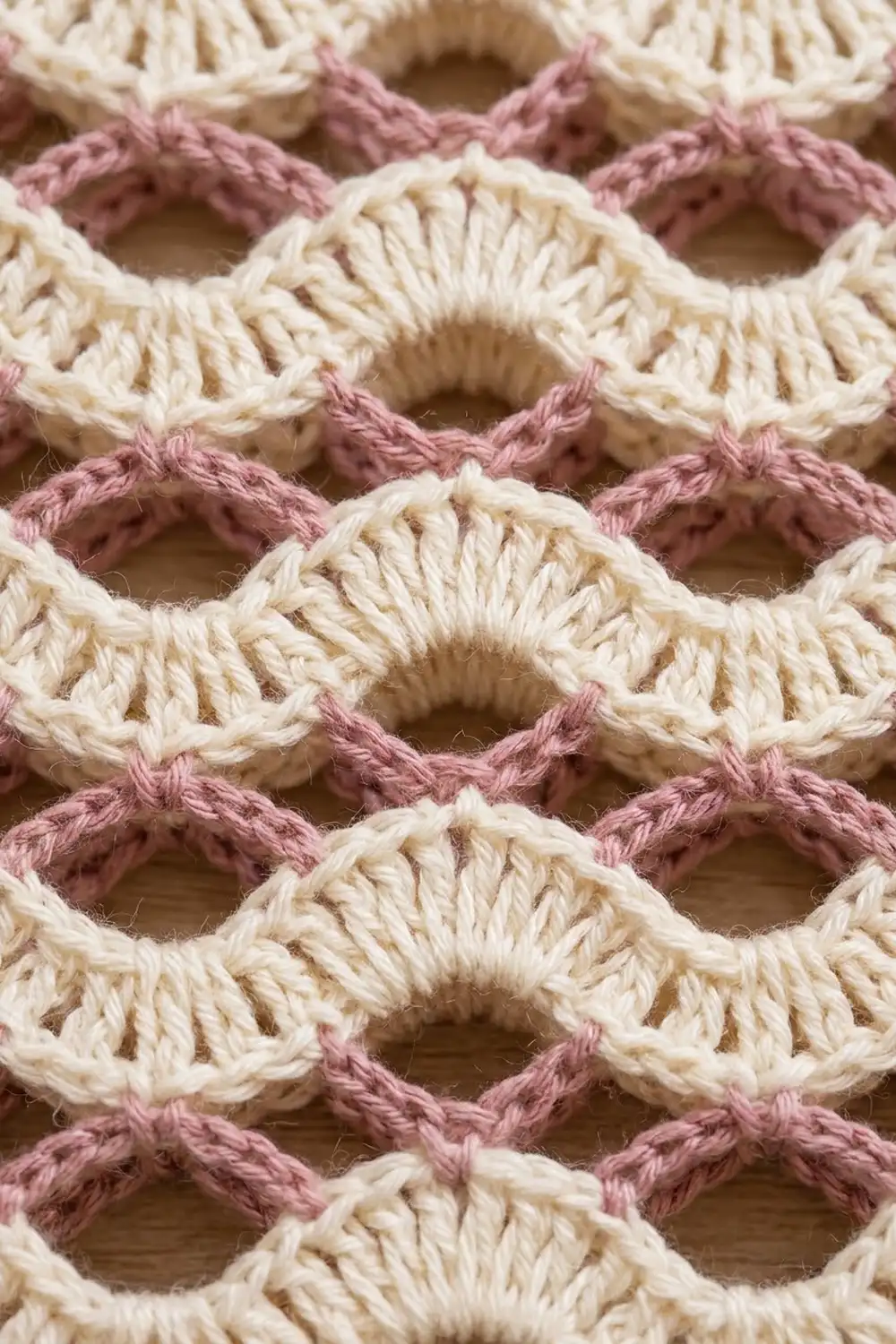
The Rosewave Lace Curtain is a light, airy window panel. Soft ivory waves alternate with rows of dusty rose chain lace. Each ivory row is a series of rounded dc fans, and each fan arches over an oval opening. The rose rows follow the curves and add more eye-shaped spaces, so daylight shows through in a gentle, rippled pattern.
The look is cottage-romantic but not fussy. With only two colors, the panels suit a bedroom, nursery, or breakfast nook. Make them in cotton or a cotton blend: it hangs well, washes well, and holds the fan shapes crisply.
This pattern uses US crochet terms. Each finished panel measures 43.25 in wide x 81.75 in long (109.9 cm x 207.6 cm) after blocking. The set is two identical panels.
Each panel starts with a rose foundation chain and one single crochet row. A four-row band then repeats up the panel: two ivory rows build the arched fans, and two rose rows add the chain lace and level the valleys. Two rose sc rows finish the top, and a two-round sc border frames the whole panel.
Finished Size and Construction
- Finished panel size: 43.25 in x 81.75 in (109.9 cm x 207.6 cm)
- Skill level: Easy intermediate
- Terminology: US crochet terms
- Yarn weight: DK (light #3) cotton or cotton blend
- Hook: 4.0 mm (G-6)
- Number of pieces: 2 separate panels, not joined
- Layout: Panels hang side by side on one rod
- Panel size before border: 42.25 in x 80.75 in (107.3 cm x 205.1 cm)
- Pattern repeat: 12 stitches = 3 in (7.6 cm) wide; one 4-row band = 2.5 in (6.4 cm) tall
- Border depth: 0.5 in (1.3 cm) on every side
Materials
Yarn: Use a smooth DK cotton or a cotton-acrylic blend with about 105 m per 50 g. Mercerized cotton gives the crispest fans. A matte cotton gives a softer, more rustic look. Avoid fuzzy yarns, because they blur the lace openings.
- Color A – Dusty Rose: 600 g (about 1,260 m) total, or 300 g (about 630 m) per panel
- Color B – Ivory: 850 g (about 1,785 m) total, or 425 g (about 893 m) per panel
These quantities include a margin of about 10% for the gauge swatch, border, and weaving in ends.
Tools:
– 4.0 mm (G-6) crochet hook
– Locking stitch markers
– Tapestry needle
– Measuring tape
– Blocking mats or a clean floor area with a sheet, plus rust-proof pins
– Spray bottle
– 30 curtain clip rings (15 per panel) and a curtain rod
Abbreviations (US Terms)
- ch – chain
- sc – single crochet
- dc – double crochet
- dtr – double treble crochet
- sl st – slip stitch
- sp – space
- st(s) – stitch(es)
- RS / WS – right side / wrong side
Special stitches:
- Double treble (dtr): Yarn over 3 times, insert the hook in the stitch, yarn over and pull up a loop (5 loops on the hook). Then yarn over and pull through 2 loops 4 times.
- Fan: Work 13 dc into the same ch-7 space.
Gauge and Checkpoints
Single crochet gauge: 16 sc and 16 rows = 4 in (10.2 cm). That is 4 sc per inch, and the border uses the same gauge.
Lace gauge: One 12-stitch repeat = 3 in (7.6 cm) wide. One 4-row band = 2.5 in (6.4 cm) tall.
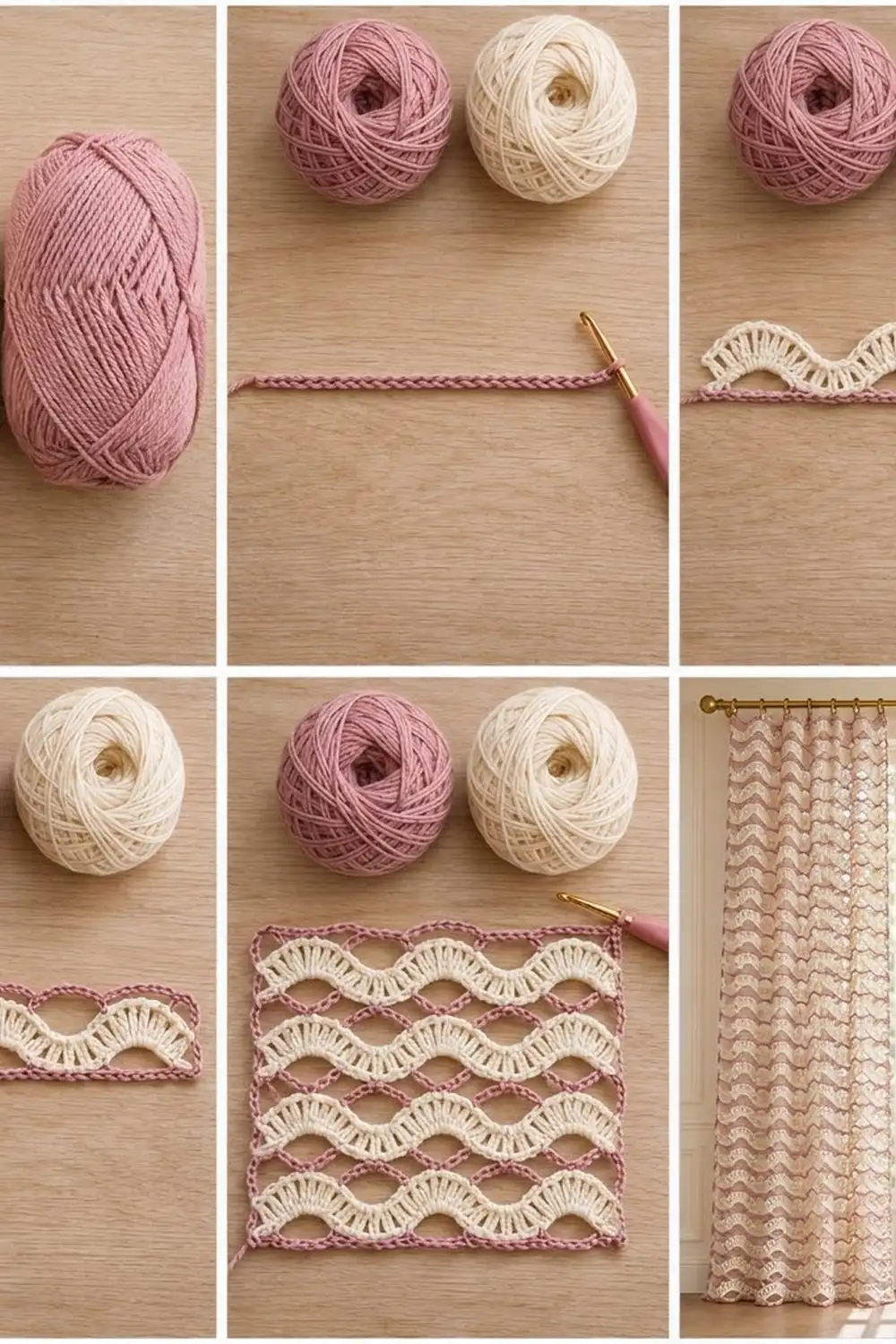
Test one piece first. Make the gauge swatch shown in the step photos: ch 38, then follow Rows 1–5 and repeat Rows 2–5 until you have 4 bands. That is 3 repeats wide.
Swatch checkpoints:
– After Row 1 (37 sc): 9.25 in (23.5 cm) wide
– After Rows 2–3: the fans stand about 1.75 in (4.4 cm) above Row 1
– After Rows 4–5: add about 0.75 in (1.9 cm), so one complete band = 2.5 in (6.4 cm)
– After 4 bands: 10.25 in (26.0 cm) tall in total
Measure the swatch after you wet it and let it dry flat.
If your swatch is too big, go down one hook size, to 3.75 mm (F-5). If it is too small, go up to 4.5 mm (7). If the width matches but the bands are too short, check your dtr: pull each loop up to its full height before you finish the stitch.
Panel Pattern (Make 2)
Foundation: With Color A, ch 170. That is 12 x 14 repeats + 2.
Row 1 (RS, Color A): Sc in the 2nd ch from the hook and in each ch across. (169 sc)
Measure now: Row 1 should be 42.25 in (107.3 cm) wide. Do not cut Color A. Drop it at this edge and join Color B in the last sc.
The Band (Rows 2–5)
Row 2 (Color B): Ch 1, turn. Sc in the first sc. Ch 7, skip the next 11 sts, sc in the next sc. Repeat from * across. (15 sc and 14 ch-7 sps = 113 sts)
Each ch-7 lifts away from the row below. This creates the oval opening under each fan.
Row 3 (Color B): Ch 1, turn. Sc in the first sc. Work a Fan (13 dc) in the next ch-7 sp, sc in the next sc. Repeat from * across. (14 fans of 13 dc and 15 sc = 197 sts)
The 13 dc crowd onto the 7-chain and push it into a rounded hump. The sc between the fans pull down into valleys, which forms the ivory wave. Drop Color B at this edge and pick up Color A, carrying it loosely up the side.
Row 4 (Color A): Ch 1, turn. Sc in the first sc. Ch 6, skip the next 6 dc, sc in the 7th (center) dc of the fan, ch 6, skip the remaining 6 dc, sc in the next valley sc. Repeat from * across. (29 sc and 28 ch-6 sps = 197 sts)
The rose chains rise from each valley to each fan peak, so they follow the wave.
Row 5 (Color A): Ch 5 (counts as the first dtr), turn. The first dtr is worked in the first sc. Ch 5, sc in the next center sc, ch 5, dtr in the next valley sc. Repeat from * across, ending with a dtr in the last sc. (15 dtr, 14 sc, and 140 ch = 169 sts)
The tall dtr in each valley lifts the low points back toward the peaks. This leaves the eye-shaped openings and a nearly level top edge. The row has 169 stitches, the same as Row 1, so the band can repeat.
Drop Color A and pick up Color B.
Repeat Rows 2–5. From now on, work Row 2 into Row 5 like this: ch 1, turn, sc in the first dtr. Ch 7, skip the next 11 sts (ch 5, sc, ch 5), sc in the next dtr. Repeat from * across, working the last sc in the top of the turning ch-5. You still get 15 sc and 14 ch-7 sps, so the fans stack directly above the fans below.
Work 32 bands in total. That covers Rows 2–129.
Length checkpoints:
– After 8 bands: 20.25 in (51.4 cm)
– After 16 bands: 40.25 in (102.2 cm)
– After 32 bands: 80.25 in (203.8 cm)
Measure with the piece laid flat and lightly smoothed, not stretched.
Cut Color B after the final Row 5.
Top Edge
Rows 130–131 (Color A): Ch 1, turn. Sc in each st across, including every chain. (169 sc)
Fasten off after Row 131. The panel now measures 42.25 in x 80.75 in (107.3 cm x 205.1 cm).
To change the length, add or remove whole bands. Each band changes the length by 2.5 in (6.4 cm). To change the width, add or remove 12 foundation chains. Each repeat changes the width by 3 in (7.6 cm).
Make All Pieces
Make 2 identical panels:
- Per panel: 300 g Color A and 425 g Color B
- Total: 600 g Color A and 850 g Color B
Layout on the rod (as seen from inside the room):
[ Panel 1 ][ Panel 2 ]
   43.25 in   43.25 in
  (109.9 cm) (109.9 cm)
Joining
The panels are not joined. Each panel is finished separately and hangs on its own clip rings, so the pair can open from the center like standard curtains.
Hanging layout: Row 131 sits directly above the 15 valley columns of the pattern, which are 3 in (7.6 cm) apart. Clip one ring above each valley column. Clipping at the valleys keeps the folds even and lines the waves up across the panel.
Checkpoint: Before you hang them, lay both blocked panels side by side. The tops should line up and the lengths should match within 0.5 in (1.3 cm).
Border
Border gauge: 4 sc per inch, which matches Row 1 and the top rows.
Side spacing: For each band, work 10 sc along the side edge:
– 4 sc along the ends of Rows 2–3
– 1 sc in the end of Row 4
– 5 sc around the dtr post of Row 5
Each band is 2.5 in tall, and 10 sc over 2.5 in is the same 4-per-inch gauge as the top and bottom. The edges therefore stay flat, with no ruffling or cupping.
Round 1 (Color A, RS): Join with a sl st in the last sc of Row 131.
- Top: 3 sc in that st (corner), sc in each of the next 167 sts, 3 sc in the last st (corner).
- Left side: 1 sc in the end of Row 130, 10 sc per band down all 32 bands, and 1 sc in the end of Row 1. (322 sc)
- Bottom: Work into the unused loops of the foundation ch. 3 sc in the first ch (corner), sc in each of the next 167 ch, 3 sc in the last ch (corner).
- Right side: Repeat the left side. (322 sc)
Join with a sl st to the first sc.
Counts for Round 1:
– Top and bottom: 171 sts per side, including both corner center sts
– Left and right: 326 sts per side, including both corner center sts
– Total: 990 sts, since each corner center st is shared by two sides
Round 2: Ch 1. Sc in each st around, working 3 sc in each corner center st. Join.
Counts for Round 2:
– Top and bottom: 173 sts per side
– Left and right: 328 sts per side
– Total: 998 sts
Fasten off and weave in the ends.
Why the math works: On each side, only the corner sts change between rounds. Every round adds 2 sts per side, which is exactly the 2 extra sts of the 3-sc corner. Each round grows by 0.25 in (0.6 cm) on every side, so the top’s 173 sts at 4 per inch equal 43.25 in (109.9 cm), and the border adds 0.5 in (1.3 cm) all around.
Final Blocking
- Weave in all ends along the side edges, where the border hides them.
- Soak one panel in cool water for 15 minutes. Press out the water; do not wring.
- Roll the panel in towels to remove extra moisture.
- Lay it flat on mats or a sheet-covered floor.
- Pin the corners first, to 43.25 in x 81.75 in (109.9 cm x 207.6 cm).
- Pin the long edges every 6 in (15.2 cm). Keep the side edges straight.
- Push each fan into a rounded hump with your fingertips, and open each oval and eye-shaped space.
- Let it dry completely. This usually takes 24–48 hours.
- Repeat for the second panel. Use the same pin spacing so the two panels match.
Final Quality-Control Checklist
- Each panel has 32 bands and 14 fans per ivory row.
- Every fan sits directly above the fan below it.
- Row 1 and Row 131 each have 169 sc.
- The border has 998 sts after Round 2, with flat corners.
- The side edges lie straight, without waves or ruffles.
- Each panel measures 43.25 in x 81.75 in (109.9 cm x 207.6 cm).
- The two panels match in length within 0.5 in (1.3 cm).
- No color carries show on the RS beyond the border.
- All ends are woven in securely.
Troubleshooting
The fans look flat instead of humped. Your ch-7 is too loose, or your dc are too tight. Chain a little more firmly, or use 14 dc per fan. If you change to 14 dc, keep the center sc in Row 4 on the 7th dc.
The fans drift sideways. You skipped the wrong number of sts in Row 2. Count 11 skipped sts (ch 5, sc, ch 5) between the dtr, every repeat.
The top edge of Row 5 is wavy. Your dtr are too short. Pull each loop up fully, or replace the valley dtr with a triple treble.
The panel is narrowing. You missed the turning ch-5 at the end of Row 5. Always work the last sc of the next Row 2 into the top of that chain.
The side edges ripple. You put too many border sc on the sides. Work exactly 10 sc per band.
The panel is longer than expected after hanging. Cotton lace stretches a little under its own weight. Leave out 1 band, or hem the bottom border up by one round.
Care
Hand wash or machine wash on a gentle cool cycle inside a mesh laundry bag, then lay flat to dry and re-pin if needed. Do not tumble dry, because the heat can shrink cotton and distort the fans.
Final Notes
The whole curtain depends on one chain of measurements. Row 1 is 42.25 in (107.3 cm) wide. Each 4-row band adds 2.5 in (6.4 cm), and 32 bands bring the panel to 80.25 in (203.8 cm). The top rows bring it to 80.75 in (205.1 cm). The 0.5 in (1.3 cm) border finishes each panel at 43.25 in x 81.75 in (109.9 cm x 207.6 cm).
Check your swatch, count each band, and measure at every checkpoint, and your two panels will hang evenly side by side.
Happy crocheting!