
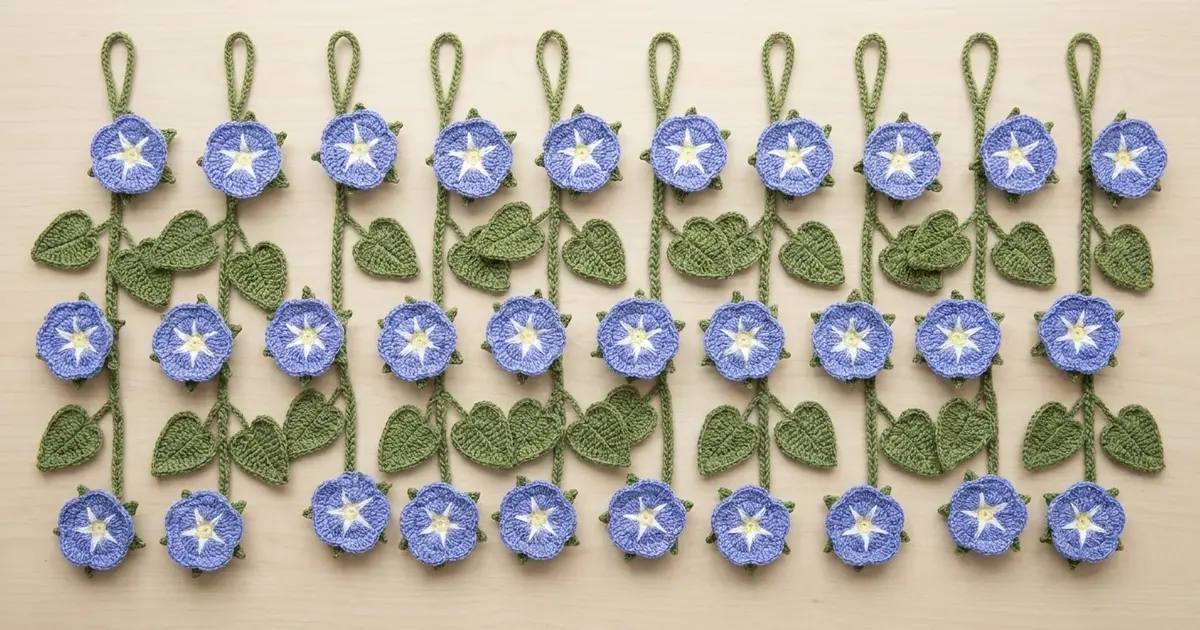
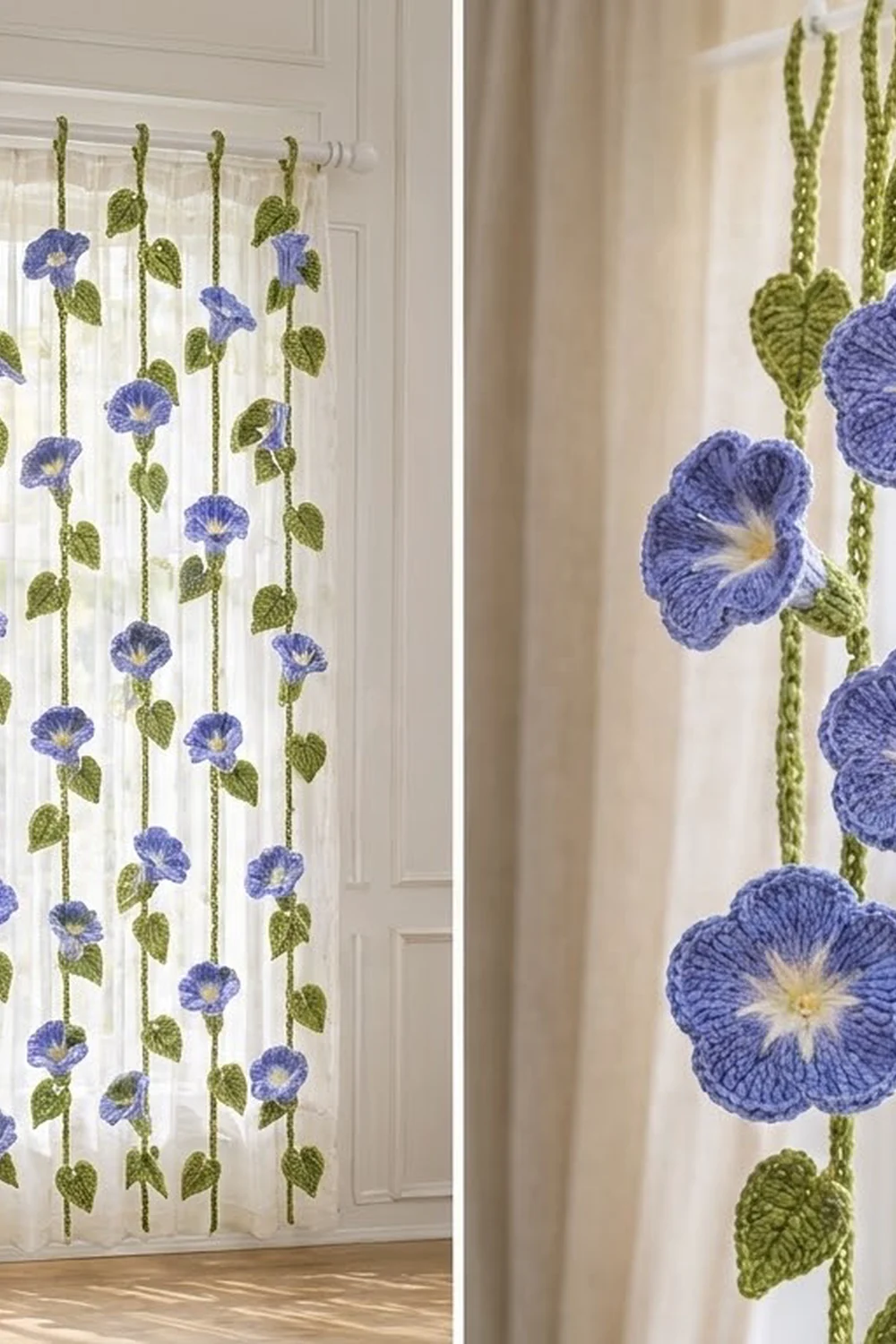
This vine curtain brings a climbing morning glory into your window. Each strand is a slim green cord with periwinkle trumpet flowers and heart-shaped leaves sewn along it. The strands hang loose from a curtain rod, so light passes between them and the flowers seem to float.
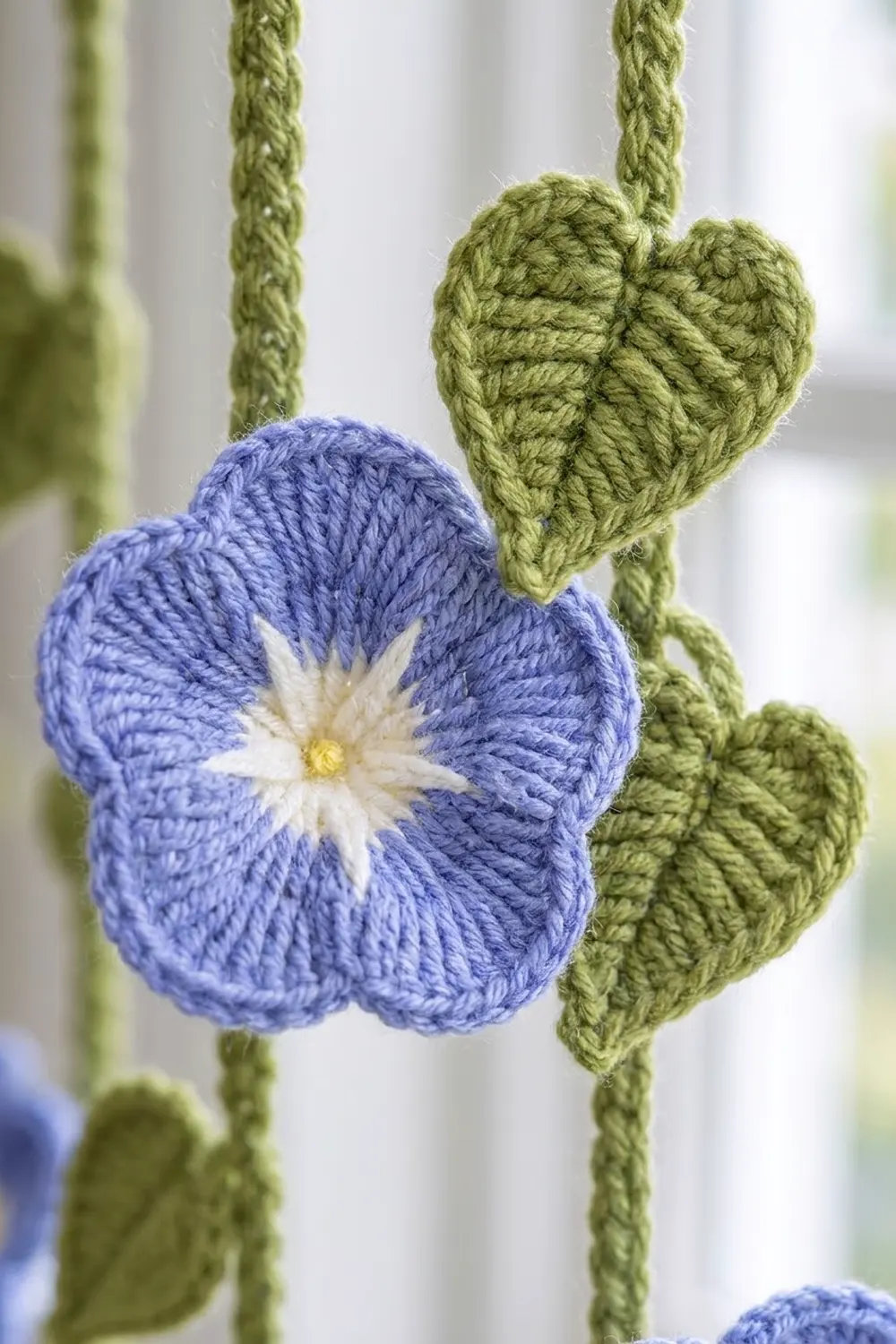
The colors are soft and fresh: periwinkle blue petals, a white throat that shows as a star in the center, a tiny pale yellow heart, and moss green for the leaves, calyxes and cords. The style is realistic but simple. Every flower is worked in the round, and every leaf is worked around a single foundation chain.
This pattern uses US crochet terms. One strand measures 60 in (152.4 cm) from the rod to the tip, plus a hanging loop. Ten strands spaced 3.5 in (8.9 cm) apart make a curtain about 33.5 in (85.1 cm) wide, counting the flowers that stick out at the sides.
You make the cords, flowers, calyxes and leaves as separate pieces, then sew the flowers and leaves onto each cord. The strands are not joined to each other. Each one hangs from the rod by its own loop.
Finished Size and Construction
- Strand length: 60 in (152.4 cm) below the rod
- Curtain width (10 strands): about 33.5 in (85.1 cm)
- Skill level: Easy to Intermediate
- Terminology: US crochet terms
- Yarn weight: DK (light worsted, #3) cotton
- Hook: 3.5 mm (E-4)
- Number of pieces: 10 cords, 60 flowers, 60 calyxes, 120 leaves
- Layout: 10 separate hanging strands, each with 6 flower nodes
- Piece sizes: flower 3 in (7.6 cm) across the mouth and 2.75 in (7.0 cm) long; leaf 2.5 in (6.4 cm) by 2 in (5.1 cm); calyx 1 in (2.5 cm) long
- Flower size before the rim edging: 2.75 in (7.0 cm) across the mouth
- Rim edging depth: about 0.25 in (0.6 cm)
Materials
Use a smooth, mercerized DK cotton. It keeps the petal edges crisp, holds the trumpet shape, and doesn’t stretch much while the strands hang.
- Periwinkle Blue (petals): 460 g (1,104 m)
- White (throat and star): 110 g (264 m)
- Pale Yellow (center knot): 10 g (24 m)
- Moss Green (cords, calyxes, leaves): 420 g (1,008 m)
These amounts include a margin of about 10%. For a single strand, divide each amount by 10.
Tools:
– 3.5 mm (E-4) crochet hook
– Tapestry needle
– Stitch markers (at least 12)
– Scissors and tape measure
– Spray bottle and rust-proof pins
– A pencil or a little fiberfill for shaping
Abbreviations (US Terms)
- ch – chain
- sl st – slip stitch
- sc – single crochet
- hdc – half double crochet
- dc – double crochet
- tr – treble crochet
- BLO – back loop only
- st(s) – stitch(es)
- sp – space
- MR – magic ring
Back-bump slip stitch cord: Turn the chain over so the row of bumps on the back faces you. Put the hook under one back bump only, yarn over, and pull through the bump and the loop on the hook. This makes a firm cord that looks braided.
Gauge and Checkpoints
Fabric gauge: 20 sc and 22 rows = 4 in (10.2 cm).
Cord gauge: 20 back-bump sl sts = 4 in (10.2 cm), which is 5 sts per inch.
Make one flower, one calyx and one leaf first, and measure them before you start the full set.
Checkpoints:
– After flower Round 6: the white tube is 0.75 in (1.9 cm) wide and 1 in (2.5 cm) long.
– After flower Round 12: the mouth is 2.75 in (7.0 cm) across when gently flattened.
– After flower Round 13: the mouth is 3 in (7.6 cm) across.
– Finished leaf: 2.5 in (6.4 cm) by 2 in (5.1 cm).
– First 20 sts of the cord: 4 in (10.2 cm).
Too big: go down to a 3.25 mm hook. Too small: go up to a 3.75 mm hook. If your cord gauge is off, use the inch positions in the placement chart instead of the stitch counts.
Flower (make 60)
Work in joined rounds. On sc and hdc rounds, the starting ch 1 does not count as a stitch. On dc rounds, the starting ch 2 does not count as a stitch. Join each round with a sl st to the first st.
With White:
Round 1: MR, 5 sc in ring. (5 sts)
Round 2: 2 sc in each st around. (10 sts)
Rounds 3–5: Sc in each st around. (10 sts)
Round 6: (Sc in next st, 2 sc in next st) 5 times. (15 sts)
Fasten off White, leaving a 24 in (61.0 cm) tail for the star.
With Periwinkle Blue:
Round 7: Join in any st. Working in BLO, sc in each st around. (15 sts) This makes a small ridge where the white throat meets the blue.
Round 8: (Sc in next 2 sts, 2 sc in next st) 5 times. (20 sts)
Round 9: (Hdc in next 3 sts, 2 hdc in next st) 5 times. (25 sts)
Round 10: (Dc in next 4 sts, 2 dc in next st) 5 times. (30 sts)
Round 11: (Dc in next 2 sts, 2 dc in next st) 10 times. (40 sts)
The stacked dc columns in Rounds 10–11 make the fine vertical ribbing up the bell.
Round 12 (petals): *Sc in next st, hdc in next st, dc in next st, 2 dc in each of next 2 sts, dc in next st, hdc in next st, sc in next st; repeat from * 4 more times. (5 petals of 10 sts, 50 sts)
Each petal uses 8 sts of Round 11, and 5 × 8 = 40, so the petals sit evenly around the bell. Don’t fasten off. Go straight on to the rim edging in the Border section.
Calyx (make 60)
With Moss Green:
Round 1: MR, 5 sc in ring. (5 sts)
Round 2: 2 sc in each st around. (10 sts)
Round 3: Sc in each st around. (10 sts)
Round 4 (sepals): *Ch 4, sl st in 2nd ch from hook, sc in next ch, hdc in next ch, sl st in next 2 sts of Round 3; repeat from * 4 more times. (5 sepals)
Fasten off, leaving a 16 in (40.6 cm) tail. The calyx has 10 sts around, the same as the white tube, so it fits snugly over the flower base.
Leaf (make 120)
The leaf is worked around both sides of a chain. The chain stays visible down the middle as the vein. The first ch you work into is the stem end, and the last ch is the tip.
With Moss Green: Ch 12.
Round 1: Start in the 2nd ch from the hook and work along one side: hdc, dc, tr in each of next 3 chs, dc in each of next 2 chs, hdc in each of next 2 chs, sc in next ch. (10 sts) In the last ch (the tip), work sc, ch 2, sc. Turn the piece and work along the other side of the chain: sc, hdc in each of next 2 chs, dc in each of next 2 chs, tr in each of next 3 chs, dc, hdc. (10 sts) Sl st to the first hdc. (22 sts and one ch-2 sp)
The trebles sit near the stem end, so the leaf is widest close to its base, which gives the heart shape. The sl st join makes a small notch at the stem. Go straight on to the leaf edging in the Border section.
Make All Pieces
Each strand uses 1 cord, 6 flowers, 6 calyxes and 12 leaves.
Totals for 10 strands:
– Blue and White: 60 flowers
– Moss Green: 10 cords, 60 calyxes, 120 leaves
Cord (make 10): With Moss Green, ch 30 and sl st in the first ch to make the hanging loop. Ch 301. Sl st in the back bump of the 2nd ch from the hook and in each back bump across, ending at the loop. (300 sts) Sl st into the loop join and fasten off. The cord body is 300 ÷ 5 = 60 in (152.4 cm). The loop is about 6 in (15.2 cm) around and fits a rod up to 1.5 in (3.8 cm) thick.
Placement on one strand (count sts down from the loop, 5 sts = 1 in):
LOOP (over rod)
st  25 | 5 in (12.7 cm)   | FLOWER, left
st  40 | 8 in (20.3 cm)   | LEAF left + LEAF right
st  75 | 15 in (38.1 cm)  | FLOWER, right
st  90 | 18 in (45.7 cm)  | LEAF left + LEAF right
st 125 | 25 in (63.5 cm)  | FLOWER, left
st 140 | 28 in (71.1 cm)  | LEAF left + LEAF right
st 175 | 35 in (88.9 cm)  | FLOWER, right
st 190 | 38 in (96.5 cm)  | LEAF left + LEAF right
st 225 | 45 in (114.3 cm) | FLOWER, left
st 240 | 48 in (121.9 cm) | LEAF left + LEAF right
st 275 | 55 in (139.7 cm) | FLOWER, right
st 290 | 58 in (147.3 cm) | LEAF left + LEAF right
st 300 | 60 in (152.4 cm) | CORD TIP
The nodes are 50 sts, or 10 in (25.4 cm), apart. Each pair of leaves sits 3 in (7.6 cm) below its flower. On every second strand, swap left and right so the flowers stagger across the window.
Joining
All pieces are sewn together. The strands stay separate.
Calyx to flower: Slide the calyx over the white tube. Using the calyx tail, whipstitch the 10 sts of calyx Round 3 to the 10 sts of flower Round 5, one stitch to one stitch. Point the sepals up toward the blue.
Flower to cord: Place the calyx base against the marked cord st, with the mouth angled outward and slightly down. Sew through the calyx magic ring and that cord st 3 times, then catch 1 cord st above and 1 below.
Leaves to cord: Hold the stem notch of each leaf against the marked st. Sew it on with 4 stitches using its 10 in (25.4 cm) tail. Sew the second leaf on the opposite side of the same st.
Tension: Pull each sewing stitch just snug. If you pull too hard, the cord puckers and gets shorter.
Size checkpoint: Hang one finished strand. The cord body should still be 60 in (152.4 cm). If it’s shorter than 59.5 in (151.1 cm), loosen the sewing at the nodes.
Border
Here the “border” is the edging round on each flower and each leaf. It sets the outline and stops the edges from curling.
Border gauge: 20 sc = 4 in (10.2 cm), the same as the fabric gauge.
Flower Round 13 (rim, Blue): Ch 1. On each 10-st petal, sc in next 3 sts, 2 sc in next st, sc in next 2 sts, 2 sc in next st, sc in next 3 sts. (12 sts per petal) Repeat on all 5 petals. Join and fasten off. (50 sts worked once each + 10 extra = 60 sts)
Why the math works: The 2 extra sc on each petal sit over the 2-dc increases of Round 12, which rounds the top of the petal. The plain sc at the petal edges make soft valleys between the petals. Sixty sc at 5 per inch is a 12 in (30.5 cm) edge. A flat 3 in (7.6 cm) circle is only about 9.4 in (23.9 cm) around, so the rim ripples gently, like a real morning glory.
Leaf Round 2 (edging, Green): Ch 1. First side: sc in next 2 sts, 2 sc in each of next 3 tr, sc in next 5 sts. (13 sts) Tip: sc in next sc, (sc, ch 2, sc) in ch-2 sp, sc in next sc. (4 sts and one ch-2 sp) Second side: sc in next 5 sts, 2 sc in each of next 3 tr, sc in next 2 sts. (13 sts) Sl st to the first sc and fasten off, leaving a 10 in (25.4 cm) tail. (22 sts worked once each + 6 extra on the trebles + 2 in the ch-2 sp = 30 sts and one ch-2 sp)
Why the math works: The increases sit only on the trebles, where the leaf is widest, so the lobes round out. The tip gets a ch-2 point, and the stem end gets no increases, so the notch stays.
Star and center: With the White tail, work 5 straight stitches from the center of the throat out into the blue. Make each one 0.75 in (1.9 cm) long and line it up with the middle of a petal. With Pale Yellow, work 1 French knot in the center.
Final Blocking
- Weave in all ends except the sewing tails.
- Mist each flower and leaf until damp but not dripping.
- Put a pencil or a little fiberfill into the flower tube to round it.
- Pin each flower mouth to 3 in (7.6 cm), with a pin at the top of each petal.
- Pin each leaf to 2.5 in (6.4 cm) by 2 in (5.1 cm), opening the lobes and pointing the tip.
- Hang each cord with a light weight at the tip and mist it to relax any twist.
- Let everything dry completely before you sew.
Final Quality-Control Checklist
- Each flower has 5 even petals and a 60-st rim.
- Each flower mouth measures 3 in (7.6 cm).
- The white star rays line up with the petal centers.
- Each calyx is snug, with all 5 sepals showing.
- Each leaf has a clear vein, rounded lobes and a pointed tip.
- Each cord body measures 60 in (152.4 cm).
- Each strand has 6 flowers and 12 leaves at the marked positions.
- All ends are secure.
Troubleshooting
Flower mouth cups inward: Rounds 10–11 are too tight. Work them one hook size up.
Rim ruffles too much: Work Round 13 one hook size down.
Petals are uneven: Recount Round 11. It must be exactly 40 sts.
Leaf curls: Check that Round 2 has 30 sts, then block firmly.
Cord twists: This is normal for back-bump cords. Mist it and let it hang with a weight.
Strand hangs crooked: Make sure the flowers alternate sides as shown in the chart.
Care
Hand wash in cool water with mild soap and dry flat. Reshape the flowers while damp, and hang the strands again only once they are fully dry.
Final Notes
Here is how the measurements connect. A fabric gauge of 20 sc = 4 in (10.2 cm) gives a 3 in (7.6 cm) flower and a 2.5 in (6.4 cm) leaf. A cord gauge of 5 sts per inch turns 300 sts into a 60 in (152.4 cm) strand, with a flower node every 10 in (25.4 cm). Ten strands spaced 3.5 in (8.9 cm) apart fill a window about 33.5 in (85.1 cm) wide.
Test one of each piece first and keep your counts exact, and the whole curtain will come out even. Happy crocheting!