

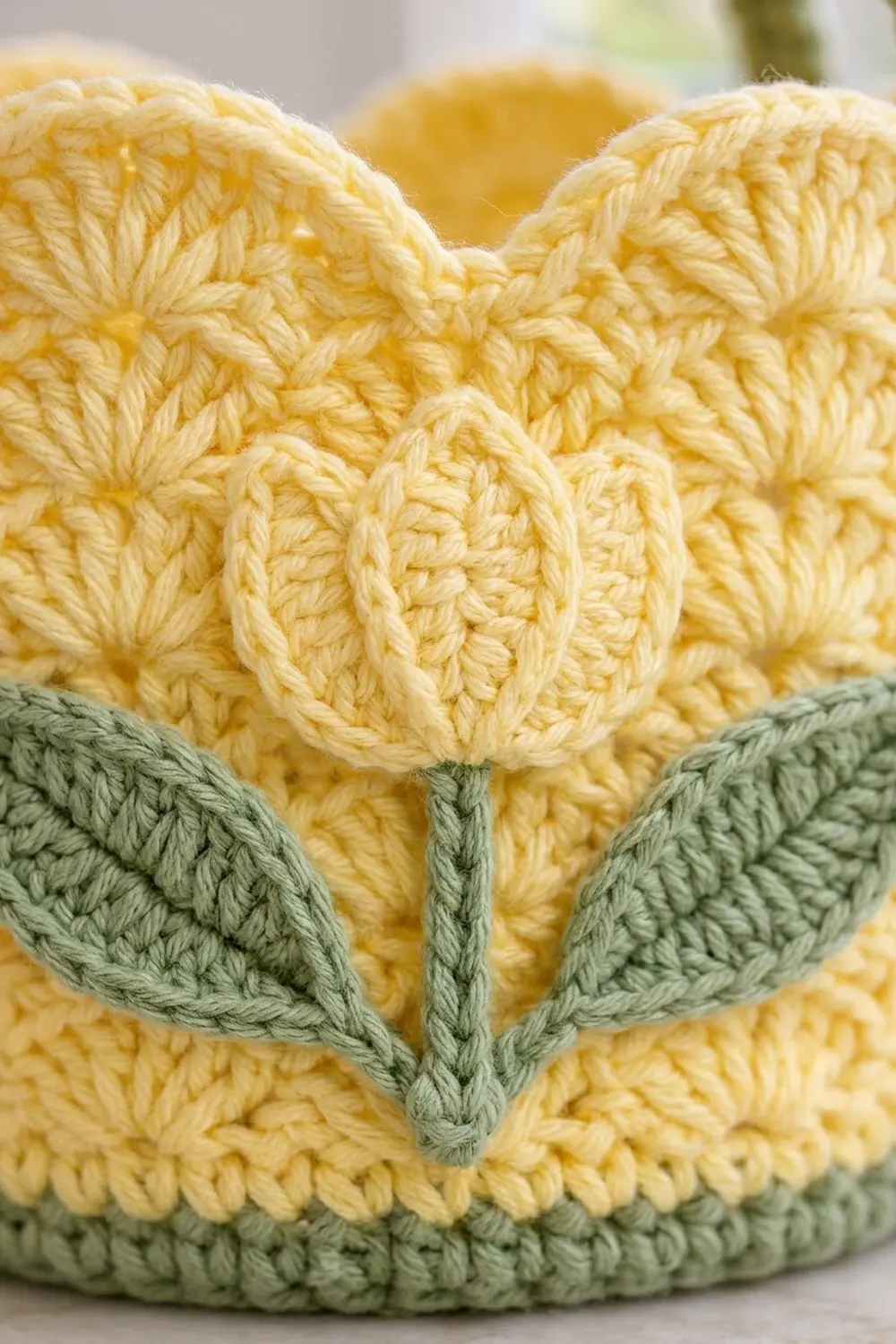
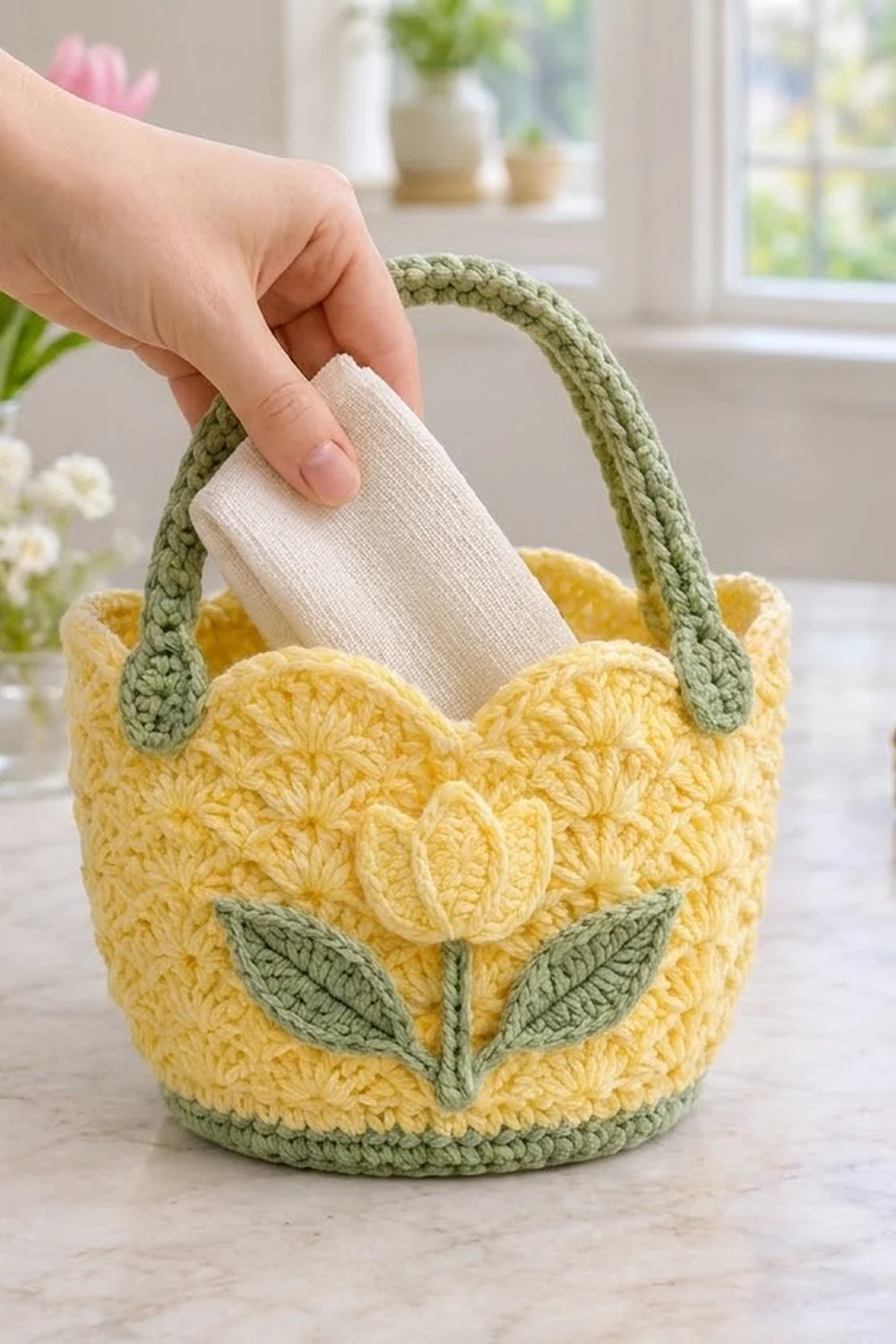
This little basket is all about spring. The butter-yellow walls are worked in a soft fan stitch that ends in thirteen rounded scallops, and a sage-green base and band anchor everything at the bottom.
A yellow tulip with a chain stem and two pointed leaves sits on the front, and a green arched handle with oval end tabs finishes the look. It is sweet enough for an Easter basket and sturdy enough to hold washcloths, yarn, or small gifts.
The pattern uses US crochet terms. The finished basket measures about 7.75 x 3 in (19.7 x 7.6 cm) at the base, about 8.5 x 4.5 in (21.6 x 11.4 cm) across the scalloped rim, and 5.75 in (14.6 cm) tall to the scallop tips.
Construction is simple: the oval base is worked in joined rounds around a foundation chain, the wall is worked straight up from the base, and the scalloped border finishes the rim. The handle, tabs, tulip, and leaves are made separately and sewn on.
Finished Size and Construction
- Finished size: 7.75 x 3 in (19.7 x 7.6 cm) base; 5.75 in (14.6 cm) tall; handle rises about 4.5 in (11.4 cm) above the rim
- Skill level: Easy-intermediate
- Terminology: US crochet terms
- Yarn weight: Worsted (#4) cotton
- Hook: 4.5 mm (US 7)
- Number of pieces: 7 (basket body, handle, 2 tabs, tulip with stem, 2 leaves)
- Layout: one oval basket; appliqués on the front long side, handle across the length
- Base size: 7.75 x 3 in (19.7 x 7.6 cm), 78 sts around
- Size before border: wall 4.75 in (12.1 cm) tall
- Border depth: 1 in (2.5 cm)
Materials
Choose a smooth, mercerized or matte worsted-weight cotton, about 85 m (93 yd) per 50 g. Cotton keeps the shells crisp and helps the basket stand on its own.
- Butter yellow: 100 g, about 170 m (body wall, base edge round, tulip)
- Sage green: 60 g, about 102 m (base, band, handle, tabs, stem, leaves)
- 4.5 mm (US 7) crochet hook
- 4 stitch markers
- Tapestry needle
- Scissors
- Measuring tape
- Rust-proof pins and a blocking mat
- Optional: an oval of plastic canvas cut to 7.25 x 2.75 in (18.4 x 7.0 cm) for a firmer floor
Quantities include a margin of roughly 15% for your gauge swatch and differences in tension.
Abbreviations (US Terms)
- ch – chain
- sl st – slip stitch
- sc – single crochet
- hdc – half double crochet
- dc – double crochet
- tr – treble crochet
- BLO – back loop only
- st(s) – stitch(es)
- inc – 2 sc in the same st
Special stitch – Shell: 5 dc in the same st.
Special stitch – Picot: ch 2, sl st in 2nd ch from hook.
Gauge and Checkpoints
Sc gauge: 16 sts and 18 rounds = 4 in (10.2 cm).
Shell gauge: one shell repeat (6 sts) = 1.5 in (3.8 cm) wide; 2 shell rounds = 1.1 in (2.8 cm) tall.
Make the base first and use it as your test piece. If it matches the checkpoints below, the wall will fit.
- After Round 6: base measures about 7.25 x 2.75 in (18.4 x 7.0 cm).
- After Round 7: base measures 7.75 x 3 in (19.7 x 7.6 cm), 78 sts.
- After Round 11: green band and first yellow round stand about 0.9 in (2.3 cm) tall.
- After Round 18: wall measures 4.75 in (12.1 cm) from the base fold.
- After Round 21: wall measures 5.75 in (14.6 cm) to the scallop tips.
If your base is too big, go down half a hook size. If it is too small or stiff, go up half a size. If the base cups, you are crocheting the end increases too tightly; if it ruffles, too loosely. Fix your gauge before starting the wall, because the stitch count stays at 78 from then on.
Basket Base
With sage green, ch 21.
Round 1: 3 sc in 2nd ch from hook, sc in next 18 ch, 3 sc in last ch; rotate and work along the opposite side of the chain: sc in next 18 ch; sl st to first sc. (42 sts: 3 per end, 18 per side)
Place a marker in the first and last st of each 3-st end group and move them up each round.
Round 2: Ch 1, 2 sc in each of next 3 sts, sc in next 18, 2 sc in each of next 3 sts, sc in next 18; sl st to first sc. (48 sts: 6 per end)
Round 3: Ch 1, *(sc in next st, inc) 3 times, sc in next 18; rep from * once more; sl st to first sc. (54 sts: 9 per end)
Round 4: Ch 1, *(sc in next 2 sts, inc) 3 times, sc in next 18; rep from * once more; sl st to first sc. (60 sts: 12 per end)
Round 5: Ch 1, *(sc in next 3 sts, inc) 3 times, sc in next 18; rep from * once more; sl st to first sc. (66 sts: 15 per end)
Round 6: Ch 1, *(sc in next 4 sts, inc) 3 times, sc in next 18; rep from * once more; sl st to first sc. (72 sts: 18 per end)
Fasten off green. Join butter yellow in the first st.
Round 7: Ch 1, *(sc in next 5 sts, inc) 3 times, sc in next 18; rep from * once more; sl st to first sc. (78 sts: 21 per end) Fasten off yellow.
This yellow round becomes the thin outline around the base edge.
Basket Wall
Join sage green in any st on a long side.
Round 8: Ch 1, sc in BLO of each st around; sl st to first sc. (78 sts) The unused front loops form the fold line that turns the wall upward.
Rounds 9–10: Ch 1, sc in each st around; sl st to first sc. (78 sts each round) Fasten off green.
Round 11: Join yellow. Ch 1, sc in each st around; sl st to first sc. (78 sts)
From here the wall alternates between two shell rounds. Every round has 78 sts (13 shell repeats of 6 sts).
Round 12 (Shell Round A): Ch 1, sc in first st, *skip 2 sts, shell in next st, skip 2 sts, sc in next st; rep from * 11 more times, skip 2 sts, shell in next st, skip 2 sts; sl st to first sc. (13 shells + 13 sc = 78 sts)
Round 13 (Shell Round B): Ch 3 (counts as dc), 2 dc in same st, *skip 2 dc, sc in center dc of next shell, skip 2 dc, shell in next sc; rep from * 11 more times, skip 2 dc, sc in center dc of last shell, skip 2 dc, 2 dc in first st; sl st to top of ch-3. (12 shells + 2 half-shells of 3 and 2 sts + 13 sc = 78 sts)
The ch-3 is the center of the split shell, so the next round starts there.
Round 14 (Shell Round A): Ch 1, sc in top of ch-3, *skip 2 dc, shell in next sc, skip 2 dc, sc in center dc of next shell; rep from * around, ending skip 2 dc, shell in last sc, skip 2 dc; sl st to first sc. (78 sts)
Rounds 15–18: Repeat Rounds 13 and 14 twice. (78 sts each round; 7 shell rounds total, ending on Round A)
The shells are wider than single crochet, so the wall flares gently outward without any increases. Checkpoint: the wall is 4.75 in (12.1 cm) tall from the fold.
Handle
With sage green, ch 65.
Row 1: Sc in 2nd ch from hook and in each ch across. (64 sts)
Rows 2–3: Ch 1, turn, sc in each st across. (64 sts each row)
Do not fasten off. Edging: Ch 1, then sl st evenly around the whole strip: 1 sl st per st on the long edges, 1 sl st per row end, and 2 sl sts in each corner. Fasten off, leaving a 12 in (30.5 cm) tail.
The handle measures 16 x 0.75 in (40.6 x 1.9 cm).
Handle Tabs (Make 2)
With sage green, ch 5.
Round 1: Sc in 2nd ch from hook, sc in next 2 ch, 3 sc in last ch; along opposite side, sc in next 2 ch, 2 sc in same ch as first sc; sl st to first sc. (10 sts)
Round 2: Ch 1, sc in each side st and 2 sc in each of the 3 sts at each end; sl st to first sc. (16 sts: 2 per side, 6 per end)
Fasten off, leaving a 10 in (25.4 cm) tail. Each tab measures 1.5 x 1 in (3.8 x 2.5 cm).
Tulip with Stem
With butter yellow, ch 6.
Row 1: Sc in 2nd ch from hook and in each ch across. (5 sts)
Row 2: Ch 1, turn, inc in first st, sc in next 3, inc in last st. (7 sts)
Row 3: Ch 1, turn, sc in each st. (7 sts)
Row 4 (petals): Ch 1, turn. Sl st in st 1; (hdc, dc, picot, dc, hdc) in st 2 for the first side petal; sl st in st 3; (dc, tr, picot, tr, dc) in st 4 for the taller center petal; sl st in st 5; (hdc, dc, picot, dc, hdc) in st 6 for the second side petal; sl st in st 7. Fasten off.
Stem: Join sage green at the center of the foundation chain. Ch 12, then sl st in the back bump of the 2nd ch from hook and in each ch back to the tulip. (11 sl sts) Fasten off, leaving a long tail.
The tulip head measures 1.75 x 1.5 in (4.4 x 3.8 cm), and the stem measures 2.25 in (5.7 cm).
Leaves (Make 2)
With sage green, ch 11.
Round 1: Working along one side of the chain: sc in 2nd ch from hook, hdc in next 2 ch, dc in next 4 ch, hdc in next 2 ch, (sc, ch 2, sc) in last ch for the tip; along the opposite side: hdc in next 2 ch, dc in next 4 ch, hdc in next 2 ch, sc in last ch; sl st to first sc. (20 sts + ch-2 tip)
The foundation chain down the center looks like the leaf’s vein. Fasten off, leaving a long tail. Each leaf measures 2.75 x 1.25 in (7.0 x 3.2 cm).
Make All Pieces
- Sage green: handle (1), tabs (2), leaves (2), stem (1), base Rounds 1–6 and wall Rounds 8–10
- Butter yellow: base Round 7, wall Rounds 11–21, tulip head (1)
Front-face placement map (long side, viewed from outside):
 [tab]-------- handle arch --------[tab]
 \/\/\/\/\/\/ scalloped rim \/\/\/\/\/\/
 |           ( tulip head )            |
 |      leaf      | stem |   leaf      |
 |  shells        |      |     shells  |
 |=========== green band ==============|
 ( yellow-edged green oval base below )
Joining (Appliqué Assembly)
Sew on the appliqués before you work the border, while it is still easy to reach the wall from inside.
- Find the center of the front long side, halfway between the centers of the two short ends (about 19 sts from each).
- Pin the stem so its bottom sits 0.25 in (0.6 cm) above the green band. The tulip head will sit about 1.25 in (3.2 cm) below the scallop valleys.
- Pin one leaf on each side, tips angled up and outward, bases touching the stem about 0.5 in (1.3 cm) above its end.
- Whipstitch each piece on through its outer loops only, with stitches about 0.25 in (0.6 cm) apart.
Keep your tension relaxed. Pull each stitch just snug enough to close the gap, because tight sewing puckers the shells. Checkpoint: the wall should still measure 19.5 in (49.5 cm) around at Round 18.
Scalloped Border
Border gauge: one scallop = 6 sts of the previous round = 1.5 in (3.8 cm) wide; 13 scallops around.
Round 19: Ch 1, sc in each st around; sl st to first sc. (78 sts: 1 sc in each of Round 18’s 13 sc and 65 dc)
Round 20 (scallops): Ch 1, sc in first st, *skip 2 sts, 7 dc in next st, skip 2 sts, sc in next st; rep from * 11 more times, skip 2 sts, 7 dc in next st, skip 2 sts; sl st to first sc. (13 scallops x 8 sts = 104 sts)
Round 21 (trim): Ch 1, sc in each st around; sl st to first sc. (104 sts worked 1 per existing st + 0 added = 104 sts) Fasten off.
Why the math works: 78 divides evenly by 6, so 13 scallops fit exactly with no leftover sts. Each scallop sits directly above a Round 18 shell because Round 20’s first sc lands above a Round 18 sc, and each 7-dc group lands above that shell’s center dc.
Attach the handle: Center one handle end on the outside of each short end, with its top edge just below the scallop valley and 1 in (2.5 cm) overlapping the wall. Whipstitch all around the overlap. Pin a tab over each handle end and sew around its edge.
Final Blocking
- Weave in all ends, running each tail through 2 in (5.1 cm) of the matching color.
- Mist the basket evenly with water until damp, not soaked.
- Stuff it firmly with a towel to shape the oval and straighten the wall.
- Pin each scallop tip outward so all 13 sit evenly.
- Smooth the tulip and leaves flat with your fingers; pin the leaf tips.
- Shape the handle into a smooth arch and let it dry upright.
- Let everything dry completely, about 24 hours, before removing the towel.
Final Quality-Control Checklist
- The base measures 7.75 x 3 in (19.7 x 7.6 cm) and sits flat.
- The wall stands 5.75 in (14.6 cm) to the scallop tips.
- Every shell round has 78 sts; the trim round has 104 sts.
- There are 13 even scallops, with no twisted or skipped repeats.
- The tulip is centered on the front, and the stem ends just above the green band.
- The handle ends mirror each other, and each is covered by a tab.
- No tails or puckers show around the appliqués.
Troubleshooting
- Base cups upward: the increases are too tight; go up half a hook size for Rounds 2–7.
- Base ruffles: too many sts or loose tension; recount the end groups (3, 6, 9, 12, 15, 18, 21).
- Shells drift sideways: a Round A started in the wrong place; begin at the ch-3, which is the center of the split shell.
- Wall too floppy: use a smaller hook for the band, or add the plastic canvas insert.
- Scallops uneven: make sure Round 19 has exactly 78 sts before you start Round 20.
- Handle sags: sew the full 1 in (2.5 cm) overlap and add a second line of stitches.
Care
Hand wash in cool water with mild soap, press out the water in a towel, and reshape the basket to dry flat with a towel inside. Do not tumble dry.
Final Notes
The measurements build in a short, simple chain. A 7.75 x 3 in (19.7 x 7.6 cm) base with 78 sts sets the size of the wall. Seven shell rounds raise the wall to 4.75 in (12.1 cm), and a 1 in (2.5 cm) border with 13 scallops brings it to 5.75 in (14.6 cm). Check each measurement as you go and the basket will come together cleanly. For a second version, swap the yellow for soft pink and keep the yellow tulip.
Happy crocheting!