

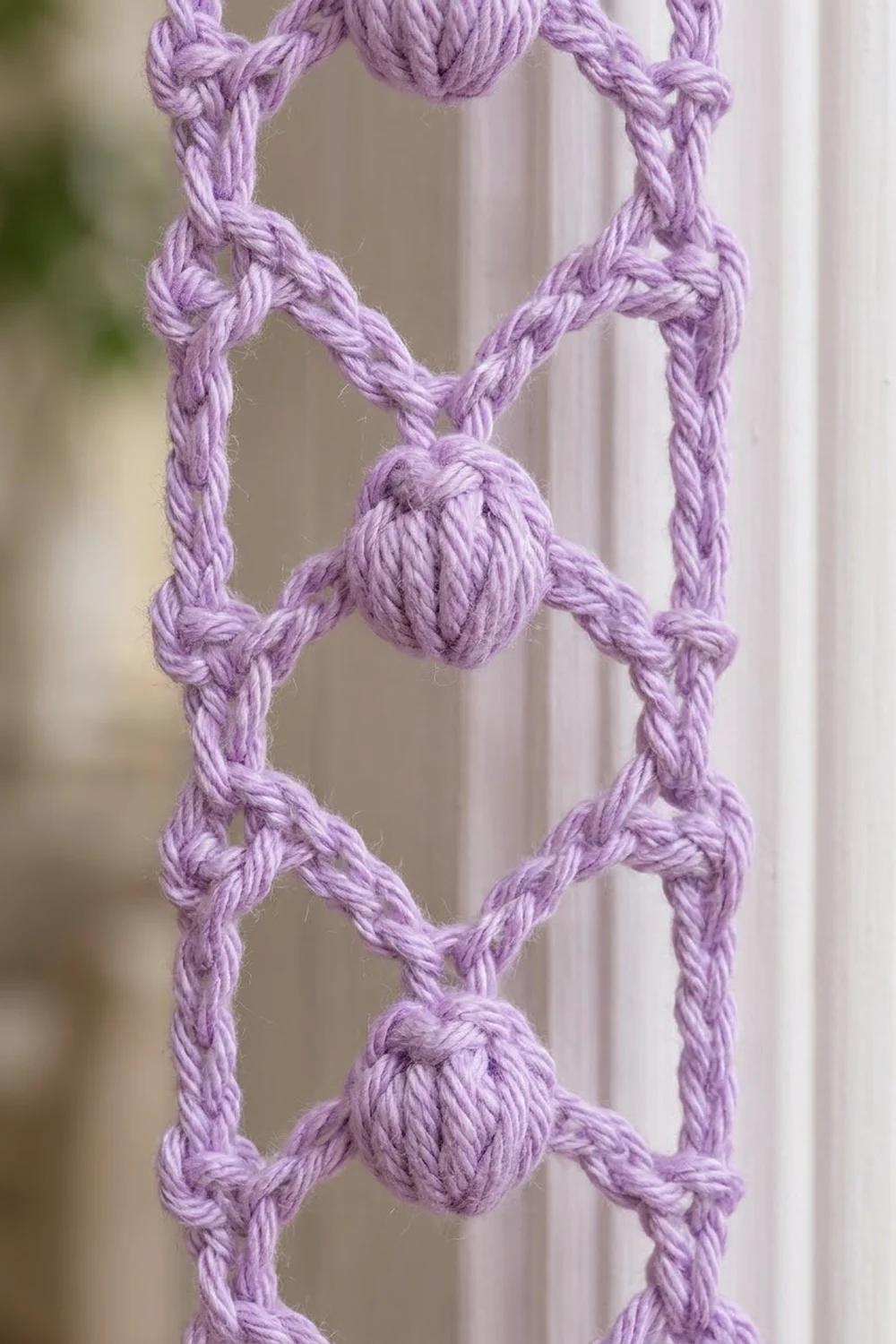
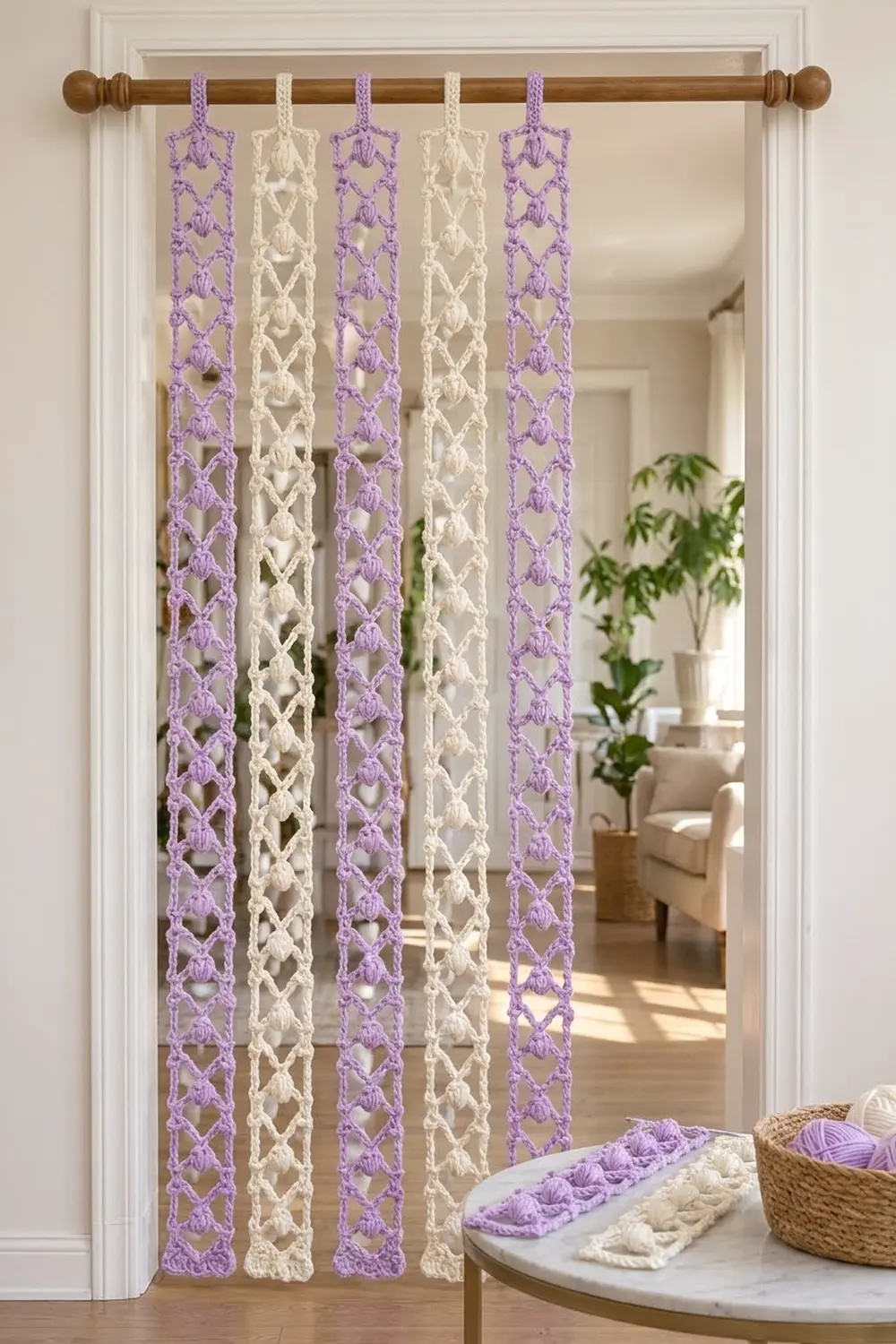
This door curtain is made of seven long, airy strips that hang side by side from a rod. Each strip is a simple ladder of solid side rails filled with crossing chain arms, and a single plump puff stitch sits at the center of every diamond.
The colors alternate between soft lavender and warm cream, so the doorway looks light and striped without blocking the view. The style is cottage-romantic, and the stitches are easy to memorize after the first few rows.
The pattern uses US crochet terms. Each finished strip measures 4.25 in (10.8 cm) wide by 72.25 in (183.5 cm) long, plus a 2.5 in (6.4 cm) hanging loop. Seven strips with gaps of about 1 in (2.5 cm) cover a 36 in (91.4 cm) door.
Each strip is worked flat in short rows from the bottom up. You work a single crochet foundation row, then repeat a 2-row puff-and-lattice pattern, finish with a single crochet row, add one round of single crochet edging, and crochet a tab at the top. The strips are never sewn to each other.
Finished Size and Construction
- Finished strip size: 4.25 in x 72.25 in (10.8 cm x 183.5 cm), not counting the tab
- Total hanging length: about 74.75 in (189.9 cm) from the top of the rod
- Skill level: Easy-intermediate
- Terminology: US
- Yarn weight: Worsted (#4), cotton or cotton blend
- Hook: 5.0 mm (H-8)
- Number of pieces: 7 separate strips (4 lavender, 3 cream)
- Layout: 7 strips in one row, colors alternating, not joined
- Strip size before border: 3.75 in x 71.75 in (9.5 cm x 182.2 cm)
- Border depth: 0.25 in (0.6 cm) on every side
- Curtain width as hung: about 35.75 in (90.8 cm) with gaps of about 1 in (2.5 cm)
Materials
Use a smooth worsted-weight cotton or cotton blend. Cotton hangs straight, shows the puffs clearly, and stretches less than acrylic over a long drop. The amounts below assume about 190 m (208 yd) per 100 g.
- Lavender: 400 g, about 760 m (831 yd), for 4 strips
- Cream: 300 g, about 570 m (623 yd), for 3 strips
Each strip uses about 85 g. These quantities include a margin for your gauge swatch and small tension differences.
Tools:
– 5.0 mm (H-8) crochet hook
– Tapestry needle
– Stitch markers
– Measuring tape
– Rust-proof pins and a long blocking surface (or towels on the floor)
– Spray bottle
– Curtain rod up to 1.25 in (3.2 cm) in diameter
Abbreviations (US Terms)
- ch – chain
- sc – single crochet
- dc – double crochet
- sk – skip
- sp – space
- st(s) – stitch(es)
- RS / WS – right side / wrong side
Puff stitch (puff): (Yarn over, insert hook in the stitch, yarn over, pull up a loop to about 0.75 in [1.9 cm]) 4 times, so you have 9 loops on the hook. Yarn over and pull through all 9 loops, then ch 1 to close. The closing ch 1 is the top of the puff and does not count as a separate stitch.
Stitch-equivalents: In this pattern, every stitch and every chain in a row counts toward the row total. Every row has 15 stitch-equivalents.
Gauge and Checkpoints
Single crochet gauge: 16 sc and 16 rows = 4 in (10.2 cm). One sc is 0.25 in (0.6 cm) wide and one sc row is 0.25 in (0.6 cm) tall.
Pattern gauge: 4 pattern rows = 3 in (7.6 cm). Each pattern row is 0.75 in (1.9 cm) tall.
Instead of a separate swatch, start your first strip and use it as your test piece.
- Checkpoint 1, after Row 1: The strip is 3.75 in (9.5 cm) wide.
- Checkpoint 2, after Row 10: The piece is 7 in (17.8 cm) long: 0.25 in for Row 1 plus 9 pattern rows x 0.75 in.
- Checkpoint 3, after Row 50: The piece is 37 in (94 cm) long.
- Checkpoint 4, after Row 97: The piece is 3.75 in x 71.75 in (9.5 cm x 182.2 cm).
A difference of up to 0.25 in (0.6 cm) in width is fine.
If your strip is too wide or too long, go down half a hook size. If it is too narrow or too short, go up half a hook size. If only the length is off, you can add or remove a pair of pattern rows (Rows 3–4). Each pair changes the length by 1.5 in (3.8 cm). Make the same change on every strip.
Strip Pattern (Make 7)
Work with lavender or cream as noted in the next section.
Foundation: Ch 16.
Row 1 (WS): Sc in the 2nd ch from the hook and in each ch across. Turn. (15 sc)
Row 2 (RS, puff row): Ch 3 (counts as dc), ch 6, sk the next 6 sc, puff in the next sc (the 8th, center st), ch 6, sk the next 6 sc, dc in the last sc. Turn.
(15 stitch-equivalents: 2 dc + 1 puff + 12 ch)
Row 3 (cross row): Ch 3 (counts as dc), ch 3, sc in the first ch-6 sp, ch 2, sc in the top of the puff, ch 2, sc in the next ch-6 sp, ch 3, dc in the 3rd ch of the turning ch. Turn.
(15 stitch-equivalents: 2 dc + 3 sc + 10 ch)
The sc worked into each ch-6 space pulls the long chains inward. This makes the crossing arms of the lattice. The center sc anchors the next puff directly above the last one.
Row 4 (puff row): Ch 3 (counts as dc), ch 6, sk the next 6 stitch-equivalents (ch-3, sc, ch-2), puff in the center sc, ch 6, sk the next 6 stitch-equivalents, dc in the 3rd ch of the turning ch. Turn.
(15 stitch-equivalents: 2 dc + 1 puff + 12 ch)
Rows 5–96: Repeat Rows 3–4 for 46 more times. Rows 3–96 are 47 repeats in total, and the last row you work is a puff row (Row 96). Each strip now has 48 puffs.
Row 97 (top sc row): Ch 1, sc in the first dc, 6 sc in the ch-6 sp, sc in the top of the puff, 6 sc in the next ch-6 sp, sc in the 3rd ch of the turning ch. Turn.
(15 sc)
Length check: Rows 1 and 97 are 0.25 in each, which adds up to 0.5 in. Rows 2–96 are 95 dc rows x 0.75 in, which is 71.25 in. The total is 71.75 in (182.2 cm). Do not fasten off.
Make All Pieces
- Lavender: 4 strips
- Cream: 3 strips
Hang the strips in this order, from left to right:
| L | C | L | C | L | C | L |
  1   2   3   4   5   6   7
L = lavender, C = cream. Lavender strips sit at both outer edges.
Weave in the ends on each strip right after you finish its border and tab. Then label it with its position number.
Joining: Hanging the Strips
The strips are not sewn to each other. Each strip is attached only to the rod with its own loop tab. This keeps the curtain easy to walk through. Because there are no seams between the strips, each border is counted for one strip only. No stitches are added or shared between strips.
Tab (worked on each strip after the border):
Row 1: With the RS facing, count from the top-right corner sc along the top edge and join yarn in the 5th stitch. Ch 1, then sc in the same st and in the next 8 sts. (9 sc)
Rows 2–20: Ch 1, turn, sc in each sc across. (9 sc)
The tab measures 2.25 in (5.7 cm) wide and 5 in (12.7 cm) long.
Forming the loop: Fold the tab to the WS. Line up each of the 9 sts of Row 20 with the 9 sts at the base of the tab on the back of the border, one stitch to one stitch, and whipstitch them together. The loop is 2.5 in (6.4 cm) deep.
Tension advice: Keep the whipstitches snug but not tight, so the tab does not pucker the top edge.
Size checkpoint: Slide all seven strips onto the rod. With gaps of about 1 in (2.5 cm), the curtain measures about 35.75 in (90.8 cm) across: 7 x 4.25 in = 29.75 in (75.6 cm), plus 6 gaps of about 1 in each.
Border
Border gauge: 4 sc per 1 in (2.5 cm) on all sides, which matches the sc gauge.
Continue from Row 97 without fastening off. Work 3 sc in each corner stitch. The middle sc of each 3-sc group is the corner stitch, and each side’s count below includes both of its corner stitches.
Round 1:
1. Top edge: Ch 1, 3 sc in the first sc, sc in each of the next 13 sc, 3 sc in the last sc.
2. Long side: Rotate the strip and work down the side, making 3 sc around each dc row-end (Rows 96 to 2). This gives 285 sc.
3. Bottom edge: Work 3 sc in the first st of Row 1, sc in each of the next 13 sts, then 3 sc in the last st.
4. Second long side: Work 3 sc around each dc row-end (Rows 2 to 96). This gives 285 sc.
5. Sl st to the first sc and fasten off.
Counts per side (including corners):
– Top and bottom: 1 corner + 1 + 13 + 1 + 1 corner = 17 sts
– Each long side: 1 corner + 1 + 285 + 1 + 1 corner = 289 sts
– Round total: (2 x 17) + (2 x 289) − 4 shared corners = 608 sts
Check by groups: 4 corner groups x 3 = 12. Short edges: 2 x 13 = 26. Long sides: 2 x 285 = 570. The total is 12 + 26 + 570 = 608.
Why the math works: Each dc row is 0.75 in tall, and 3 sc at 4 sc per inch also measure 0.75 in. The 285 side sc therefore cover exactly 71.25 in of dc rows. On the short ends, 15 sts at 4 per inch cover 3.75 in. The edging adds 0.25 in on each side, so the strip finishes at 4.25 in x 72.25 in (10.8 cm x 183.5 cm).
Final Blocking
- Weave in all the ends along the solid side rails, where they won’t show.
- Lay one strip flat on a long blocking surface.
- Pin both long sides straight to a width of 4.25 in (10.8 cm), placing a pin about every 6 in (15.2 cm).
- Gently stretch the strip lengthwise to 72.25 in (183.5 cm). Do not overstretch it, because cotton relaxes a little more when it hangs.
- Open each diamond and center each puff with your fingers.
- Spray the strip until it is damp, not soaked.
- Let it dry completely, then unpin it.
- Repeat for all seven strips and compare their lengths side by side.
Final Quality-Control Checklist
- Every row has 15 stitch-equivalents.
- Each strip has 48 puffs, and they line up in a straight center column.
- Each strip measures 3.75 in x 71.75 in (9.5 cm x 182.2 cm) before the border.
- The border counts are 17 / 289 / 17 / 289 for a total of 608 sts.
- Each strip measures 4.25 in x 72.25 in (10.8 cm x 183.5 cm) after blocking.
- Each tab has 9 sts and 20 rows, sits centered, and is stitched one-to-one.
- All seven strips are within 0.5 in (1.3 cm) of each other in length.
- The color order is L, C, L, C, L, C, L.
Troubleshooting
Puffs lean or look flat: Pull every loop up to the same 0.75 in (1.9 cm) height, and always close the puff with ch 1.
Lattice looks crooked: Check that in Row 3 the sc goes into the ch-6 space, not into a chain.
Side rails ripple: Your turning chains may be too loose. Try ch 2 plus a tight first dc instead.
Border flares: You may have worked more than 3 sc per row-end. Count them in sections of 10 rows (30 sc).
Strips hang at different lengths: Add or remove a pair of Rows 3–4 to fix the length, then block again.
Tab twists: Recount the 5th stitch from the corner so the tab is centered.
Care
Hand wash or machine wash on a gentle cold cycle in a mesh bag. Lay the strips flat to dry, then reshape them to 4.25 in x 72.25 in (10.8 cm x 183.5 cm).
Final Notes
Each measurement leads to the next. A gauge of 4 sc per inch gives a 15-stitch row that is 3.75 in (9.5 cm) wide. That row plus 95 pattern rows at 0.75 in makes a strip that is 71.75 in (182.2 cm) long. The 608-stitch border brings it to 4.25 in x 72.25 in (10.8 cm x 183.5 cm). A 5 in (12.7 cm) tab folds into a 2.5 in (6.4 cm) loop. Seven strips with gaps of about 1 in fill a 36 in (91.4 cm) doorway. Check each stage and the curtain will hang even and straight.
Happy crocheting!