
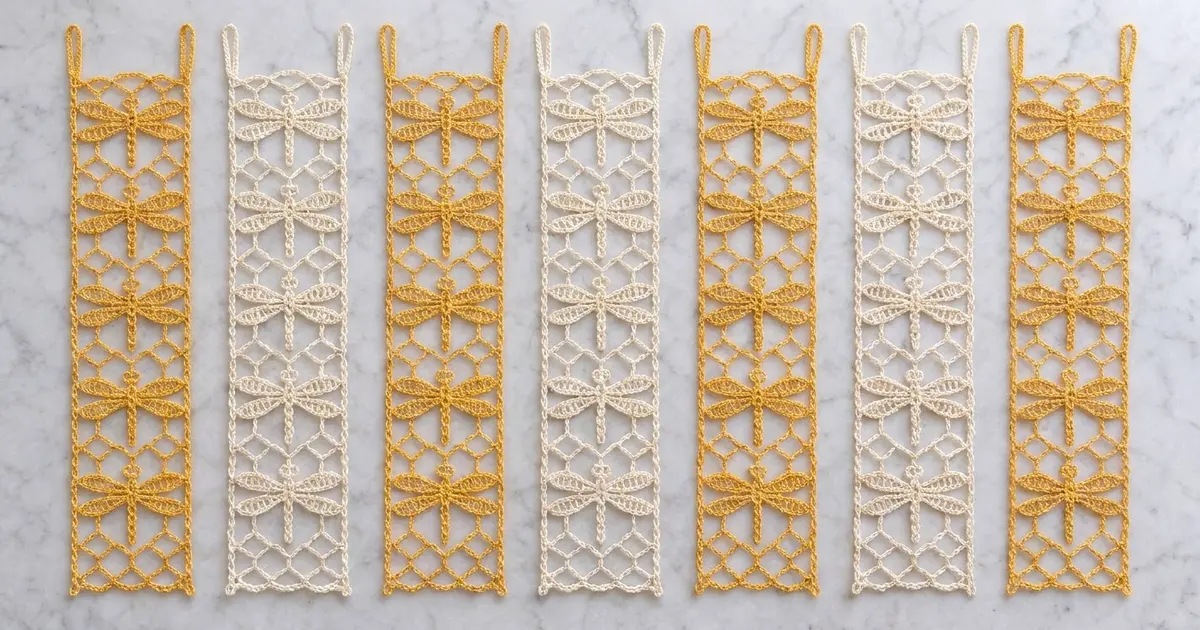
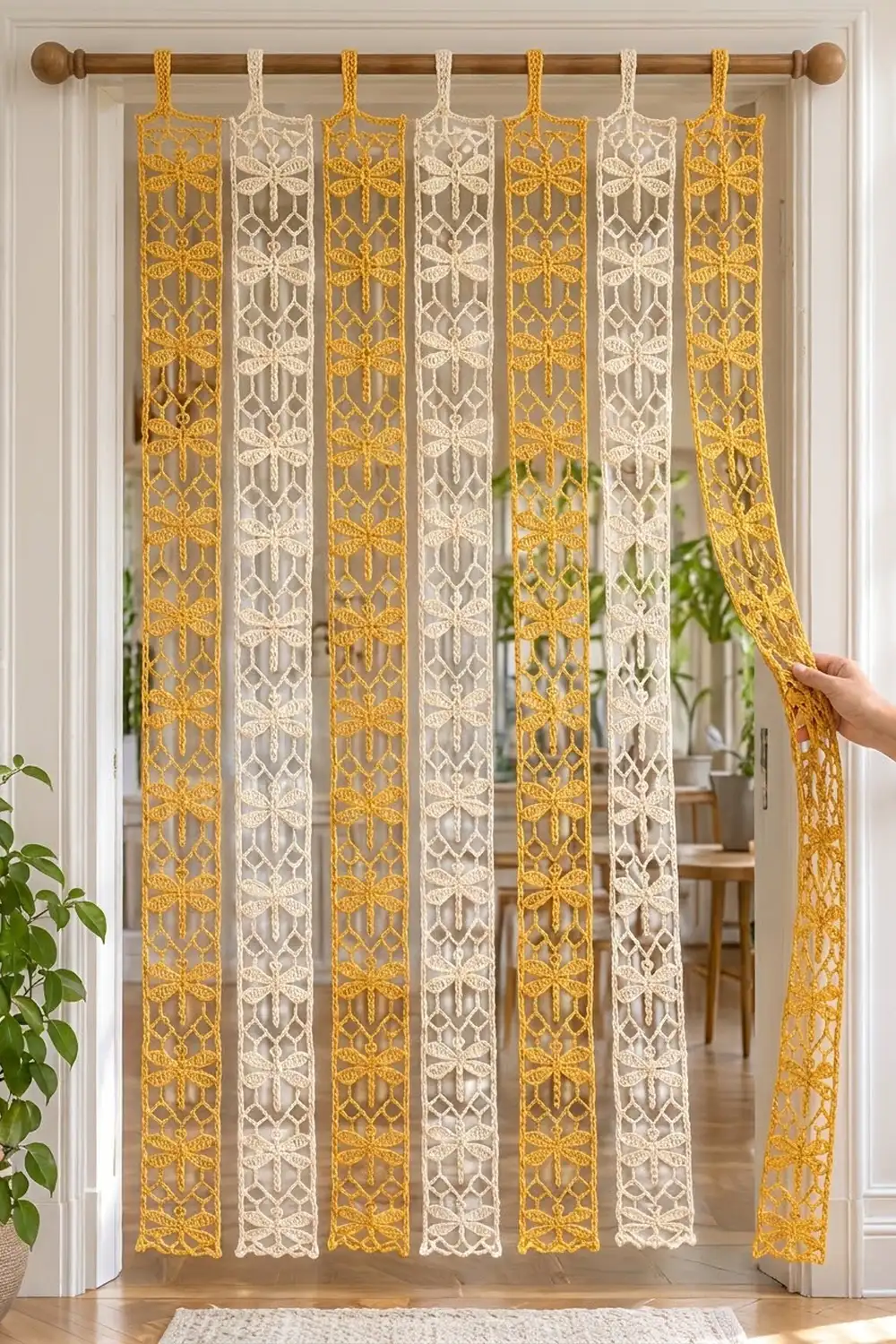
This curtain is made of seven long lace strips. Each strip has a column of dragonflies flying up an open diamond mesh. The strips hang separately from a rod, so you can walk through them and they move when a breeze comes through.
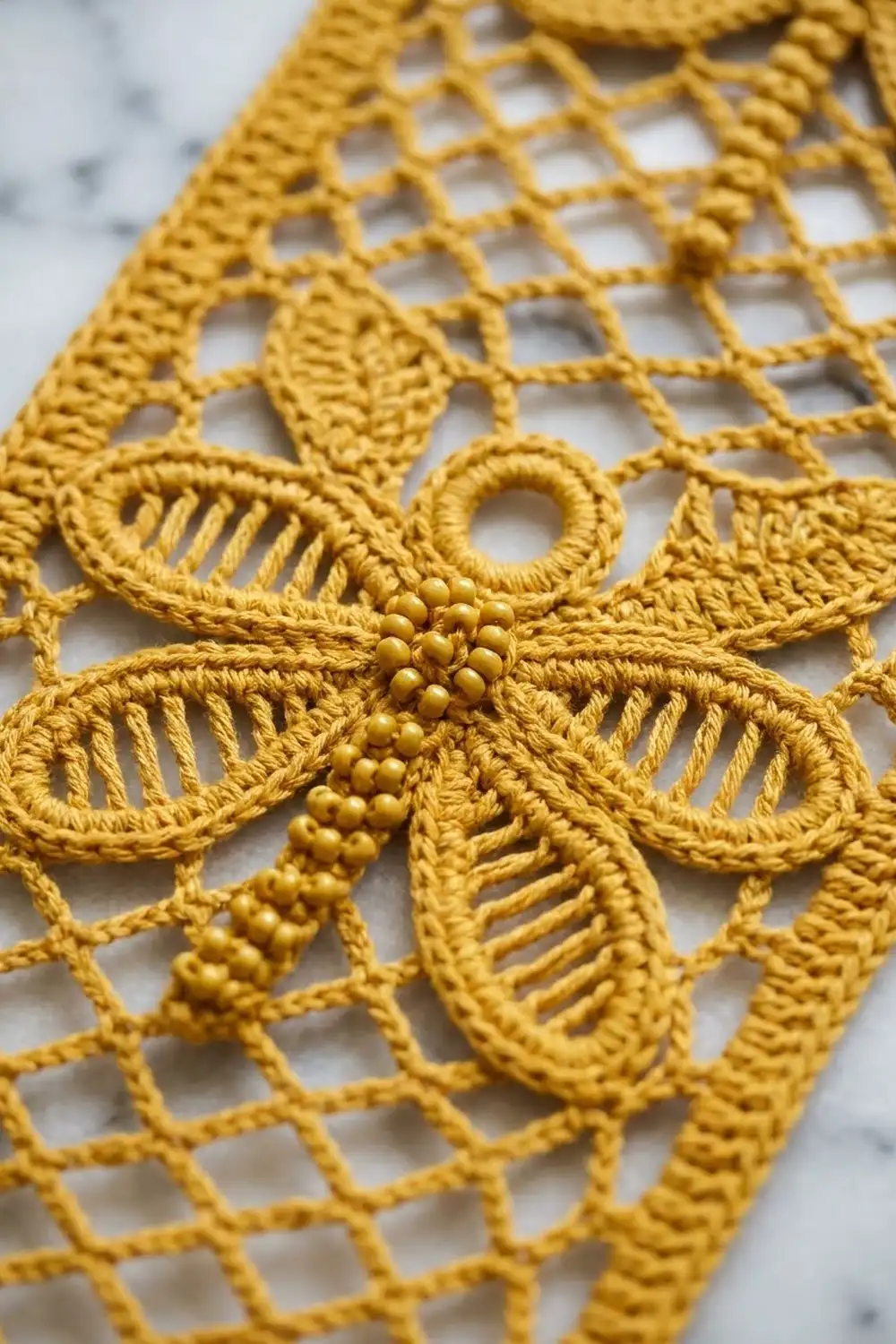
The sample alternates warm mustard yellow and soft cream, giving four mustard strips and three cream strips. Each dragonfly has a beaded body, a small ring head and oval wings with ladder-like rungs. The style sits between vintage filet lace and modern boho décor.
The pattern uses US crochet terms. Each finished strip measures 5.4 in × 77.6 in (13.7 cm × 197.1 cm), not counting the hanging tab. With the tab loop, each strip hangs about 79.6 in (202.2 cm) below the rod.
You work each strip in turned rows across its width, from the bottom up. The rows count as 25 “positions” each, so the width never drifts. Each strip then gets one round of single crochet border and a folded tab at the top. You make seven strips, and they are never seamed together.
Finished Size and Construction
- Finished strip size: 5.4 in × 77.6 in (13.7 cm × 197.1 cm)
- Skill level: Intermediate
- Terminology: US
- Yarn weight: DK / light (#3) cotton
- Hook: 3.5 mm (E/4)
- Number of pieces: 7 strips
- Layout: 7 strips side by side on a rod, alternating M, C, M, C, M, C, M
- Piece size before border: 5 in × 77.2 in (12.7 cm × 196.1 cm)
- Border depth: 0.2 in (0.5 cm) on every edge
- Curtain width: 7 × 5.4 in = 37.8 in (96.0 cm) of lace, plus gaps between strips
Materials
Choose a smooth, mercerized or combed DK cotton. Cotton holds the open mesh crisply and stays put in a doorway. Avoid fuzzy blends, because they blur the wing rungs.
- Color M (mustard yellow): 300 g / 690 m (4 strips)
- Color C (cream): 200 g / 460 m (3 strips)
These quantities include a margin of roughly 15% for swatching and joins. Each strip uses about 57 g / 132 m.
Tools:
– 3.5 mm (E/4) crochet hook
– Tapestry needle
– Stitch markers
– Rust-proof pins and a long blocking surface
– Spray bottle
– Tape measure
– Curtain rod up to 1.25 in (3.2 cm) in diameter
Abbreviations (US Terms)
- ch – chain
- sl st – slip stitch
- sc – single crochet
- hdc – half double crochet
- dc – double crochet
- tr – treble crochet
- sk – skip
- tch – turning chain
- st(s) – stitch(es)
Special stitches
- Cluster (cl): *Yo twice, insert hook in the indicated st, pull up a loop, [yo, pull through 2 loops] twice*. Repeat from * to * twice more in the same st (4 loops on hook). Yo and pull through all 4 loops.
- Head: (sc, ch 4, sl st in the sc just made) all in the same st. The ch-4 ring does not count as a position.
Position: every stitch or chain in a row counts as one position. Every row in this pattern has exactly 25 positions.
Gauge and Checkpoints
Gauge: 25 positions = 5 in (12.7 cm) wide. One tr-height row = 0.5 in (1.3 cm) tall, and one sc-height row = 0.2 in (0.5 cm) tall.
Test piece: Work Row 1, then one full dragonfly repeat (Rows 2–11), and fasten off. It should measure 5 in (12.7 cm) wide × 4.6 in (11.7 cm) tall, lightly blocked. One repeat has 8 tr rows and 2 sc rows, so it measures 4.4 in (11.2 cm), and Row 1 adds 0.2 in (0.5 cm).
Checkpoints (unblocked, measured flat):
– After Row 1: 5 in (12.7 cm) wide
– After 5 repeats: 22.2 in (56.4 cm)
– After 10 repeats: 44.2 in (112.3 cm)
– After 17 repeats: 75.0 in (190.5 cm)
– After Row 175: 77.0 in (195.6 cm)
– After Row 176: 77.2 in (196.1 cm)
If your test piece is too big, go down 0.25 mm. If it is too small, go up 0.25 mm. If only the row height is off, adjust how tightly you pull up the tr loops rather than changing hooks, because width matters most for even strips.
Strip Pattern (make 7)
Foundation: Ch 26.
Row 1: Sc in 2nd ch from hook and in each ch across, turn. (25 sc)
Row 2 (mesh A, worked over Row 1 or Row 11): Ch 4 (counts as tr), ch 2, sk 2 positions, sc in next position, [ch 5, sk 5 positions, sc in next position] 3 times, ch 2, sk 2 positions, tr in last st, turn.
(2 tr + 4 sc + 19 ch = 25 positions: three ch-5 loops and two ch-2 half loops)
Row 3 (mesh B): Ch 4 (counts as tr), ch 5, sc in next ch-5 loop, [ch 5, sc in next ch-5 loop] twice, ch 5, tr in top of tch, turn.
(2 tr + 3 sc + 20 ch = 25 positions: four ch-5 loops)
Row 4 (mesh A, worked over Row B): Ch 4 (counts as tr), ch 2, sc in first ch-5 loop, [ch 5, sc in next ch-5 loop] 3 times, ch 2, tr in top of tch, turn. (25 positions)
Row 5: Repeat Row 3. (25 positions) The center sc now sits at position 13, ready for the dragonfly body.
Row 6 (tail): Ch 4 (counts as tr), ch 2, sc in first ch-5 loop, ch 5, sc in next ch-5 loop, ch 2, cl in center sc, ch 2, sc in next ch-5 loop, ch 5, sc in next ch-5 loop, ch 2, tr in top of tch, turn.
(2 tr + 4 sc + 1 cl + 18 ch = 25 positions)
Row 7 (tail): Ch 4 (counts as tr), ch 5, sc in first ch-5 loop, ch 5, cl in cl, ch 5, sc in next ch-5 loop, ch 5, tr in top of tch, turn.
(2 tr + 2 sc + 1 cl + 20 ch = 25 positions) The two stacked clusters form the beaded tail.
Row 8 (lower wings): Ch 4 (counts as tr), ch 1, sk 1, hdc in next, ch 1, sk 1, dc in next, ch 1, sk 1, tr in next, ch 1, sk 1, tr in next, ch 1, sk 1, dc in next, ch 1, sk 1, cl in cl, ch 1, sk 1, dc in next, ch 1, sk 1, tr in next, ch 1, sk 1, tr in next, ch 1, sk 1, dc in next, ch 1, sk 1, hdc in next, ch 1, sk 1, tr in top of tch, turn.
(13 sts + 12 ch-1 sps = 25 positions) Each wing is 5 rising and falling stitches (hdc, dc, tr, tr, dc). Together they make the oval shape, and the ch-1 spaces between them create the ladder rungs.
Row 9 (wing divider): Ch 1, sc in first st, ch 3, sk 3 positions, sc in each of next 8 positions, sc in cl, sc in each of next 8 positions, ch 3, sk 3 positions, sc in top of tch, turn.
(19 sc + 6 ch = 25 positions) The ch-3 gaps keep the wing tips apart near the rails.
Row 10 (upper wings): Work as Row 8, working the center cl into the center sc and the last tr into the last sc. (25 positions)
Row 11 (top outline and head): Ch 1, sc in first st, ch 3, sk 3 positions, sc in each of next 8 positions, Head in cl, sc in each of next 8 positions, ch 3, sk 3 positions, sc in top of tch, turn.
(19 sc + 6 ch = 25 positions, plus 1 head ring)
Rows 12–171: Repeat Rows 2–11 sixteen more times, for 17 dragonflies in total.
Rows 172–175: Repeat Rows 2–5.
Row 176 (conversion row): Ch 1, sc in first st, [5 sc in next ch-5 loop, sc in next sc] 3 times, 5 sc in last ch-5 loop, sc in top of tch. Do not turn.
(5 sc into existing sts + 20 sc into loops = 25 sc)
Row totals: 176 rows. That is 140 tr-height rows (8 per repeat × 17, plus 4) and 36 sc-height rows (2 per repeat × 17, plus Rows 1 and 176).
Length: 140 × 0.5 in + 36 × 0.2 in = 70 + 7.2 = 77.2 in (196.1 cm).
Make All Pieces
- Color M: 4 strips
- Color C: 3 strips
Layout on the rod, left to right:
| M | C | M | C | M | C | M |
  1   2   3   4   5   6   7
Mark each finished strip with a tag so you keep the order when hanging.
Joining
The strips are not seamed to one another. That open spacing is what makes this a walk-through curtain. The only “join” is each strip’s tab folded over the rod and sewn to itself (see Border).
Stitch-to-stitch logic: Sew the 5 sts of the tab’s last row to the 5 sts of the top border at the back of the strip, with the same 5 positions directly behind the tab’s base. Each tab st meets one border st, so the loop sits straight.
Tension: Sew with a whipstitch that matches the crochet’s tension. If you pull too tight, the top edge puckers; if you sew too loose, the tab twists.
Size checkpoint: On a 42 in (106.7 cm) rod, space the strips at 6.1 in (15.5 cm) center to center. That leaves 0.7 in (1.8 cm) gaps: 37.8 in of lace + 6 gaps × 0.7 in = 42 in (106.7 cm). The gaps total 4.2 in (10.7 cm).
Border
Border gauge: 5 sc per inch (2.5 cm) along all edges. On the side edges, that is 2.5 sc per tr row end and 1 sc per sc row end.
Round 1 (RS): Continue from the end of Row 176.
- Top edge: Ch 1, 3 sc in first st, sc in next 23 sts, 3 sc in last st. (25 sts worked one per st + 4 extra corner sc = 29 sc)
- Long side: Work down the row ends of Rows 175 to 2. Work 2 sc and 3 sc around the tr row ends alternately, and 1 sc in each sc row end. (70 × 2 + 70 × 3 = 350, plus 34 = 384 sc)
- Bottom edge: Working into the foundation ch, 3 sc in first ch, sc in next 23 ch, 3 sc in last ch. (29 sc)
- Second long side: Work up the row ends of Rows 2 to 175 as before. (384 sc)
- Sl st to first sc. (Total: 29 + 384 + 29 + 384 = 826 sc)
The corner groups belong to the short edges, so the long-side counts of 384 exclude them.
Why the math works: Rows 2–175 measure 77.2 − 0.4 = 76.8 in (195.1 cm), and 76.8 × 5 = 384. The top and bottom edges are 5 in × 5 = 25 sts each, plus 2 extra sc at each corner so the corners turn flat. The total also checks as a conversion: (50 one-per-stitch) + (8 corner extras) + (768 side sc) = 826.
Hanging tab: Count the 29 top-edge sc and join yarn in st 13. Row 1: Ch 1, sc in sts 13–17, turn. (5 sc) Rows 2–20: Ch 1, sc in each st, turn. (5 sc)
The tab measures 1 in (2.5 cm) wide × 4 in (10.2 cm) long. Fold it to the back and sew it down as described in Joining. This leaves a loop about 2 in (5.1 cm) deep.
Final Blocking
- Weave in all ends along the side rails, never through the mesh.
- Soak each strip in cool water for 10 minutes. Press out the water in a towel; do not wring.
- Pin each strip in sections to 5.4 in (13.7 cm) wide, starting with the side rails.
- Pin the full length to 77.6 in (197.1 cm). If your surface is short, block in two halves.
- Open every diamond and pull each wing into a smooth oval, with the rungs standing straight.
- Pin each head ring open into a round shape.
- Let the strip dry fully. Steam the tabs flat last.
Final Quality-Control Checklist
- All 7 strips are 5.4 in (13.7 cm) wide and within 0.5 in (1.3 cm) of each other in length.
- Each strip has 17 dragonflies, and they all face the same direction (head up).
- Every row contains 25 positions, with no drift along the rails.
- Each long side of the border has 384 sc.
- The tabs are centered on top-edge sts 13–17.
- The color order is M, C, M, C, M, C, M.
Troubleshooting
- Strip narrows over time: Your chain loops are too tight. Use a looser chain or hold a larger hook just for the ch-5 loops.
- Wings look squashed: You are working the tr too short. Pull each loop up to full height.
- Body clusters drift off center: Recount to position 13 in Rows 6, 7 and 8.
- Border ruffles: Use 2 sc on every tr row end for the next section.
- Border pulls in: Use 3 sc more often.
- Strips hang crooked: The tab is off center. Re-sew it over sts 13–17.
Care
Hand wash in cool water and dry flat, re-pinning if needed. Shake the strips out before rehanging, and do not tumble dry.
Final Notes
The whole curtain rests on one measurement chain. Each row has 25 positions, giving a width of 5 in (12.7 cm). One repeat is 4.4 in (11.2 cm) tall, so 17 dragonfly repeats plus the closing rows give 77.2 in (196.1 cm). The border’s 384 sc per long side brings each strip to 5.4 in × 77.6 in (13.7 cm × 197.1 cm). Seven strips then give 37.8 in (96.0 cm) of lace on the rod. Check each stage and the strips will hang evenly.
Happy crocheting!