
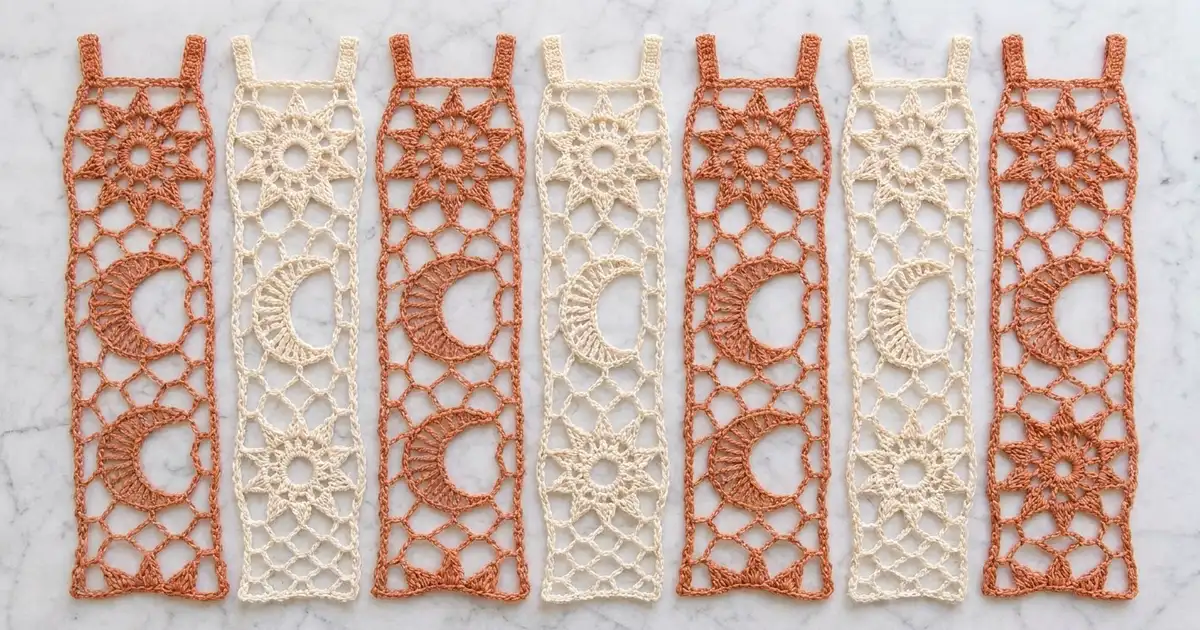
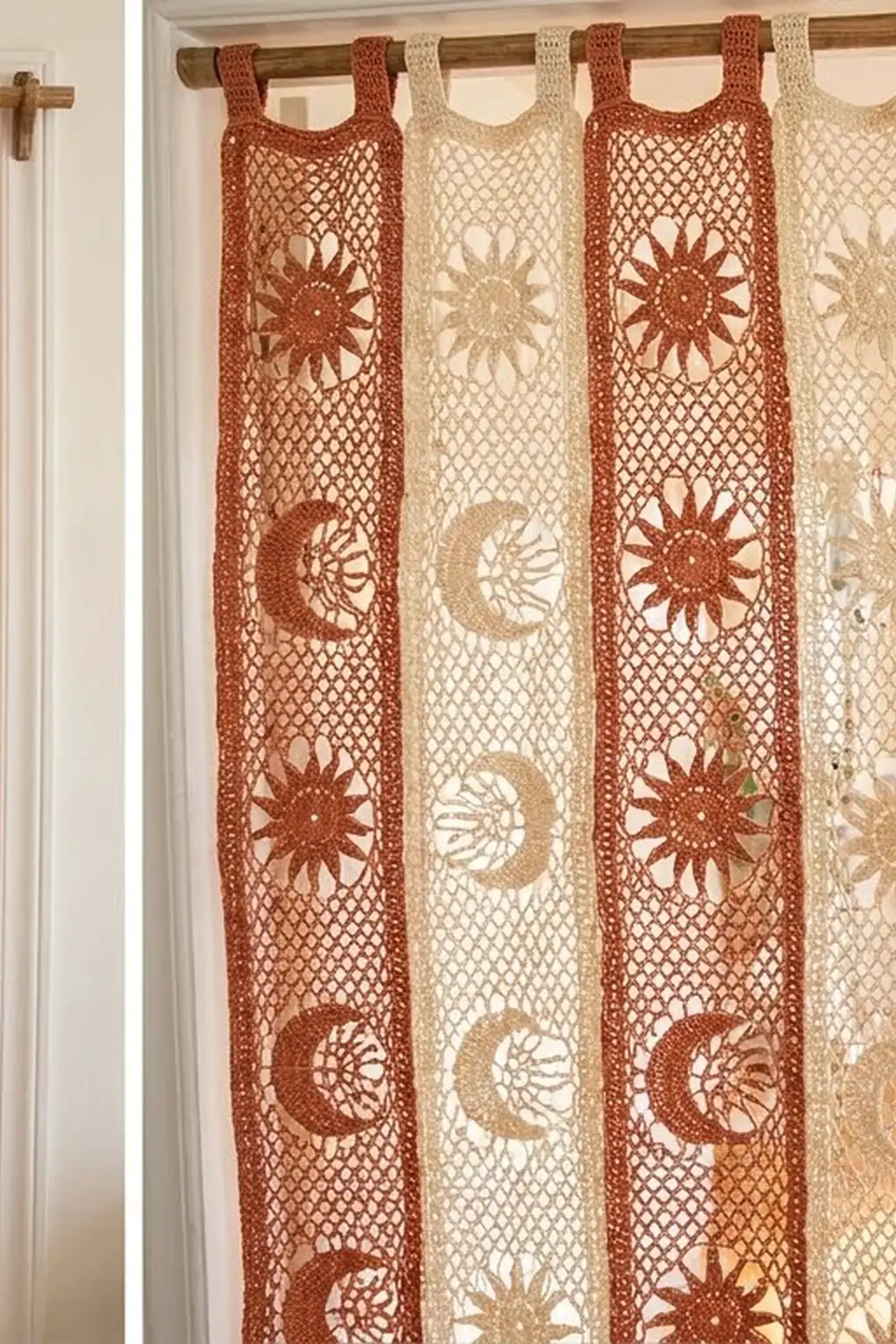
This curtain is made of seven tall lace strips, each one a column of eight-pointed suns and crescent moons set in open diamond mesh. Because the strips hang separately from the rod, you can walk straight through them, and they move in a breeze.
The colors are terracotta and cream, alternating across the rod. Four strips are terracotta and three are cream, so the curtain starts and ends with the warmer color. The look is boho and celestial, with an airy, filet-like texture.
The pattern uses US crochet terms. Each finished strip measures 5.75 in x 55.75 in (14.6 cm x 141.6 cm) before the tabs. With the tab loops, the hanging length is about 57.75 in (146.7 cm).
Each strip is built from 11 square blocks, 5 in (12.7 cm) on each side. Six are sun blocks and five are moon blocks. You join them into a column with slip stitches, add a two-round single-crochet border, and then work two hanging tabs.
Finished Size and Construction
- Finished strip: 5.75 in x 55.75 in (14.6 cm x 141.6 cm), plus tab loops
- Skill level: Intermediate
- Terminology: US
- Yarn weight: DK (#3) cotton or cotton blend
- Hook: 4.0 mm (G-6)
- Number of pieces: 7 strips, each made of 11 blocks (77 blocks total)
- Layout per strip: 1 block wide x 11 blocks tall
- Block size: 5 in x 5 in (12.7 cm x 12.7 cm)
- Strip size before border: 5 in x 55 in (12.7 cm x 139.7 cm)
- Border depth: 0.375 in (1.0 cm) on each edge
- Curtain spread: 7 strips with 1 in (2.5 cm) gaps cover about 46.25 in (117.5 cm)
Materials
Choose a smooth, mercerized or matte cotton in DK weight. Cotton keeps the lace crisp, holds the shape of the sun rays, and hangs straight without stretching. Avoid fuzzy yarns, which blur the mesh.
- Terracotta: 340 g / about 800 m (4 strips)
- Cream: 260 g / about 610 m (3 strips)
Tools:
- 4.0 mm (G-6) crochet hook
- Tapestry needle
- Locking stitch markers
- Rust-proof pins and a large blocking surface (foam mats or a carpeted floor with a towel)
- Spray bottle
- Measuring tape
- Curtain rod up to 1.25 in (3.2 cm) in diameter
The quantities include a margin of about 20% for gauge swatches, joining, and weaving in ends.
Abbreviations (US Terms)
- ch: chain
- sl st: slip stitch
- sc: single crochet
- hdc: half double crochet
- dc: double crochet
- tr: treble crochet
- sp(s): space(s)
- st(s): stitch(es)
- RS / WS: right side / wrong side
Standing sc: Start with a slip knot on the hook. Insert the hook in the stitch or space, yarn over, and pull up a loop. Then yarn over and pull through both loops. This lets you join new yarn without a chain.
Gauge and Checkpoints
Gauge: 24 sc = 5 in (12.7 cm), and 11 sc rows = 2 in (5.1 cm), with a 4.0 mm hook.
Swatch: ch 25, sc in the 2nd ch from the hook and in each ch across (24 sc). Work 10 more rows. Wet the swatch, let it dry, and measure.
Then make one sun block and one moon block, and block both before you commit to 77 blocks. Check them at each stage:
- Sun, after Rnd 1: about 1.5 in (3.8 cm) across
- Sun, after Rnd 2: about 4 in (10.2 cm) from ray tip to ray tip
- Moon, after Rnd 2: about 3 in (7.6 cm) across
- Both blocks, after Rnd 4: about 4.5 in (11.4 cm) square
- Both blocks, after Rnd 5 and blocking: 5 in (12.7 cm) square
If a block is too big, drop to a 3.75 mm hook. If it is too small, go up to a 4.5 mm hook. If only the moon block is off, change Rnd 3 of the moon from ch 9 to ch 8 or ch 10 instead of changing hooks.
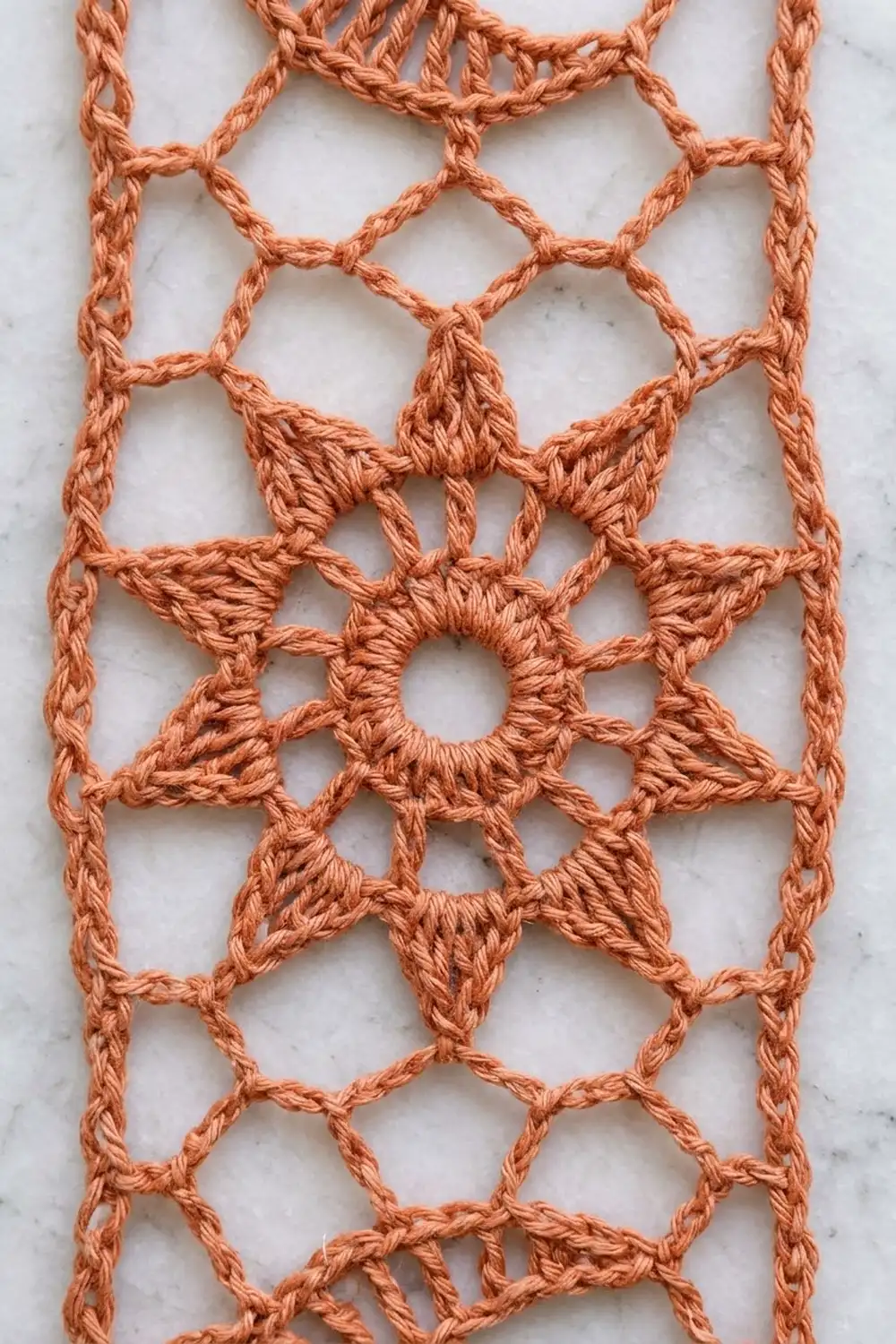
Sun Block (make 6 per strip)
Rnd 1: Ch 8 and join with a sl st to form a ring. Ch 3 (counts as dc), then work 23 dc in the ring. Join with a sl st to the top of the beginning ch-3. (24 dc)
Rnd 2 (rays): Sl st in the same st as the join.
– Ch 6. Working back down the chain: sc in the 2nd ch from the hook, hdc in the next ch, dc in the next ch, tr in each of the next 2 ch. Skip 2 dc on the ring and sl st in the next dc.
– Repeat from * 7 more times. The last sl st lands in the first sl st.
– Fasten off. (8 rays, each 5 sts long, with the skipped ch forming the tip)
Each ray is widest at the tr base and narrows to a point, which gives the triangular sun rays.
Rnd 3: Join with a standing sc in the tip of any ray (this is a corner ray). Ch 3, sc in the same tip.
– Ch 7, sc in the tip of the next ray (side ray). Ch 7, then (sc, ch 3, sc) in the tip of the next ray (corner ray).
– Repeat from * 2 more times.
– Ch 7, sc in the tip of the next ray, ch 7. Join with a sl st to the first sc.
– (12 sc, 8 ch-7 sps, 4 corner ch-3 sps)
Rnd 4 (mesh): Sl st in the corner ch-3 sp. Ch 1, then (sc, ch 5, sc) in the same sp.
– Ch 5, sc in the next ch-7 sp, ch 5, sc in the next sc, ch 5, sc in the next ch-7 sp, ch 5, (sc, ch 5, sc) in the next corner ch-3 sp.
– Repeat from * 3 times, leaving out the final corner on the last repeat. Join with a sl st to the first sc.
– (20 sc and 20 ch-5 sps: 4 at the corners plus 4 along each side)
Rnd 5 (square-up): Sl st in the corner ch-5 sp. Ch 1, then (2 sc, ch 2, 2 sc) in the same sp.
– 5 sc in each of the next 4 ch-5 sps, then (2 sc, ch 2, 2 sc) in the corner sp.
– Repeat from * around, leaving out the final corner on the last repeat. Join with a sl st and fasten off.
– (96 sc: 24 sc per side, with 4 corner ch-2 sps)
The 24 sc on each side are 2 corner sc + 20 side sc + 2 corner sc, so the corner stitches are already counted.
Moon Block (make 5 per strip)
Row 1 (crescent): Ch 17.
– Sl st in the 2nd ch from the hook, sc in the next ch, hdc in the next ch, dc in the next ch.
– Work 2 tr in each of the next 8 ch.
– Dc in the next ch, hdc in the next ch, sc in the next ch, sl st in the last ch.
– (24 sts)
The 16 tr packed into 8 chains make the outer edge longer than the inner one, so the strip curls into a crescent. The tall tr stitches give the radiating ribs.
Rnd 2 (anchor round): Ch 1 and turn. Sc in the first st.
– Ch 5, skip 2 sts, sc in the next st. Repeat from * 6 more times. (You now have 8 sc, in sts 1, 4, 7, 10, 13, 16, 19, and 22.)
– Ch 5 and join with a sl st to the first sc. This last loop crosses the open side of the crescent.
– (8 sc, 8 ch-5 sps)
Keep the closing loop snug so the horn tips sit about 1 in (2.5 cm) apart.
Rnd 3: Sl st in the first ch-5 sp. Ch 1, then (sc, ch 3, sc) in the same sp.
– Ch 9, sc in the next ch-5 sp, ch 9, (sc, ch 3, sc) in the next ch-5 sp.
– Repeat from * 2 more times.
– Ch 9, sc in the next sp, ch 9. Join with a sl st to the first sc.
– (12 sc, 8 ch-9 sps, 4 corner ch-3 sps)
The ch-9 loops are longer than the sun’s ch-7 loops because the crescent sits closer to the center than the sun’s ray tips do.
Rnds 4–5: Work as for the sun block, Rnds 4–5, treating each ch-9 sp as a ch-7 sp. (Rnd 4: 20 sc and 20 ch-5 sps. Rnd 5: 96 sc, 24 per side.)
Make All Pieces
Each strip uses 6 sun blocks and 5 moon blocks.
- Terracotta (4 strips): 24 sun blocks + 20 moon blocks = 44 blocks
- Cream (3 strips): 18 sun blocks + 15 moon blocks = 33 blocks
- Total: 77 blocks
Order of blocks within each strip, top to bottom:
S
M
S
M
S
M
S
M
S
M
S
Order of strips on the rod, left to right:
T C T C T C T
(S = sun block, M = moon block, T = terracotta, C = cream.)
Joining
You only join blocks within a strip. The seven strips are never joined to each other.
Method: Slip-stitch seam through the back loops.
- Turn every moon block so that its crescent opens to the right when the RS faces you.
- Place block 1 (sun) and block 2 (moon) RS together, lining up the bottom edge of block 1 with the top edge of block 2.
- Sl st through both corner ch-2 sps.
- Sl st through the back loops of each pair of matching sc across the edge. That is 24 sl sts, one sc matched to one sc.
- Sl st through the far pair of corner ch-2 sps.
- Join block 3 to block 2 the same way. Continue until all 11 blocks are joined.
Keep the slip stitches loose. They should be as wide as the sc beneath them. If the seam puckers, switch to a 4.5 mm hook just for joining.
Checkpoint: A joined strip measures 5 in x 55 in (12.7 cm x 139.7 cm). Lay it flat and check that every crescent opens to the same side.
Border
Border gauge: 24 sc = 5 in (12.7 cm), the same as the block edges.
Rnd 1: With the RS facing, join with a standing sc in the top-right corner ch-2 sp. Work 2 more sc in the same sp (3 sc in the corner).
– Top edge: sc in each of the 24 sc.
– Top-left corner: 3 sc in the corner ch-2 sp.
– Long side: sc in each sc down the side. Do not work into the joined ch-2 sps at the seams; go straight from the last sc of one block to the first sc of the next. That gives 11 x 24 = 264 sc.
– Work the bottom-left corner, the bottom edge (24 sc), the bottom-right corner, and the second long side (264 sc) the same way. Join with a sl st to the first sc.
– (264 sc on each long side + 24 sc on each short side + 4 corners of 3 sc = 588 sc)
Rnd 2: Ch 1. Sc in each st around, working 3 sc in the center st of each corner. Join with a sl st.
– (596 sc: 266 sc on each long side and 26 sc on each short side between the corner center sts, plus the 4 corner center sts)
Check the count: 2 x 266 + 2 x 26 + 4 x 3 = 596.
Each corner center stitch belongs to its 3-sc corner group, so it is counted once.
Why the math works: The border works 1 sc into each block-edge sc, and the border gauge matches the block gauge. That means 264 sc fills exactly 55 in (139.7 cm), and the long edges won’t ruffle or pull in. Adding no stitches at the seams keeps the count tied to the blocks: 11 blocks x 24 sc. The 3-sc corners let the border turn without cupping.
Hanging tabs (make 2 per strip):
- First tab: With the RS facing, join with a standing sc in the top-right corner center st. Sc in the next 3 sts. (4 sc)
- Rows 2–22: Ch 1, turn, sc in each of the 4 sts. (4 sc) The tab is now about 4 in (10.2 cm) long and 0.8 in (2.0 cm) wide.
- Fasten off, leaving a 10 in (25.4 cm) tail. Fold the tab to the WS and sew Row 22 to the back of border Rnd 1, directly behind Row 1. The loop stands about 2 in (5.1 cm) tall.
- Second tab: Join in the 4th st before the top-left corner center st. Sc in that st and the next 3 sts, so the last sc lands in the corner center st. Finish it the same way as the first tab.
That leaves 20 sts of the top edge between the two tabs.
Final Blocking
- Weave in all ends along the sc edges, not through the mesh.
- Soak each strip in cool water for 15 minutes. Press out the water; do not wring.
- Roll the strip in a towel to remove more water.
- Lay it flat and pin it to 5.75 in x 55.75 in (14.6 cm x 141.6 cm), working from the top down.
- Pin each ray tip and each mesh corner so the diamonds open evenly.
- Shape the crescents with your fingers so the tr ribs fan out.
- Let it dry completely before unpinning. Block long strips in sections if your surface is small.
Final Quality-Control Checklist
- Each block is 5 in (12.7 cm) square with 24 sc per side.
- Each strip has 11 blocks in S-M-S order, beginning and ending with a sun.
- Every crescent opens to the same side.
- Border Rnd 1 has 588 sc and Rnd 2 has 596 sc.
- The long sides lie flat with no ripples.
- Both tabs have 22 rows and are sewn securely.
- There are 4 terracotta strips and 3 cream strips.
Troubleshooting
- The sun rays curl: You are pulling the sl st between rays too tight. Loosen it and block the rays flat.
- The moon won’t curl: Check that Row 1 has exactly 16 tr worked into 8 ch.
- The moon block is smaller than the sun block: Lengthen Rnd 3 to ch 10.
- The strip edge waves: You probably worked stitches into the seam ch-2 sps. Recount 264 sc per long side.
- A seam puckers: Rework it more loosely or with a 4.5 mm hook.
- The strip twists when hung: Re-block it and make sure both tabs are the same length.
Care
Hand wash cool and lay flat to dry, reshaping the mesh while damp. Do not tumble dry, since the heat and weight can stretch the long strips.
Final Notes
The measurement chain goes like this:
- Gauge is 24 sc = 5 in (12.7 cm).
- Each block finishes at 24 sc per side, 5 in (12.7 cm) square.
- Eleven joined blocks make a 264-sc long side, 55 in (139.7 cm).
- Two border rounds bring each strip to 5.75 in x 55.75 in (14.6 cm x 141.6 cm).
- Tabs bring the hanging length to 57.75 in (146.7 cm).
If you check each link in that chain, all seven strips will hang evenly in your doorway.
Happy crocheting!