
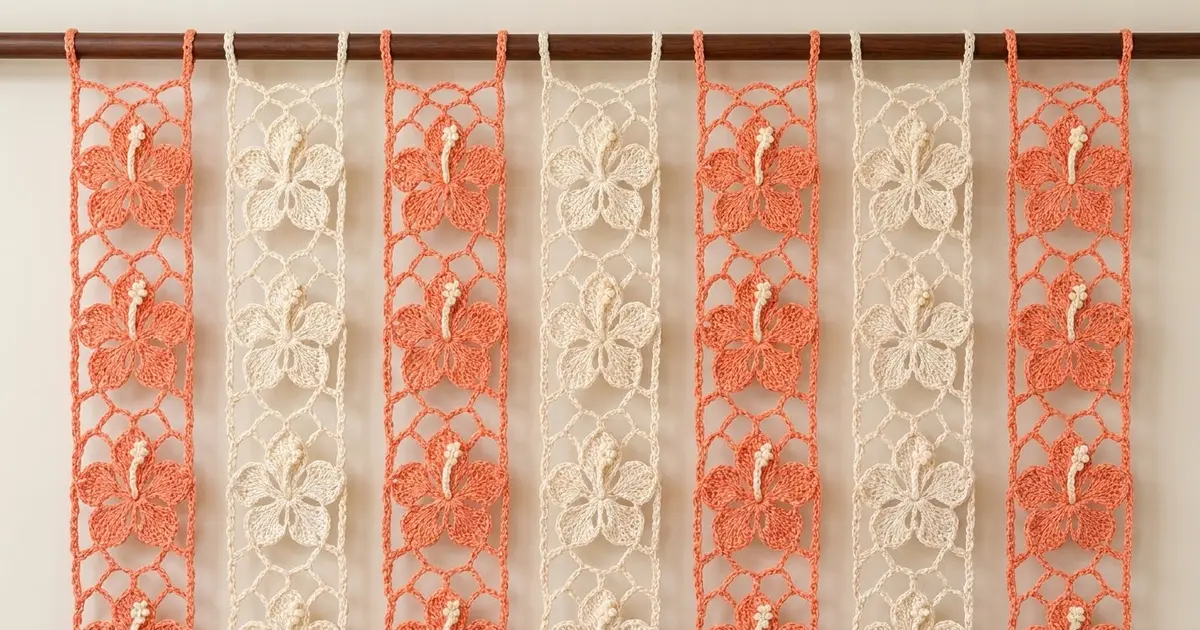
This curtain is made of hibiscus lace strips: long, narrow panels of five-petal flowers. Each flower is framed by a ring of chain loops, and the blocks are stacked end to end. The strips hang side by side from a rod by small loops, so light comes through the lace and the strips part easily when you walk through.
The sample alternates coral and cream strips: four coral and three cream. Every flower has a corded cream stamen with five small knobs at the tip, laid over the top petal. On the coral strips the stamen stands out. On the cream strips it blends in and adds texture. The look is relaxed and tropical, and it suits a sunny doorway, a patio door, or a closet opening.
The pattern uses US crochet terms. Each finished strip measures 6″ x 76″ (15.2 x 193.0 cm), not counting the hanging loops. Seven strips spaced 1″ (2.5 cm) apart cover a width of 48″ (121.9 cm).
Construction is simple and repeatable. You crochet a hibiscus flower in rounds, square it off into a 5″ (12.7 cm) block, and sew a stamen onto it. Then you join 15 blocks into a column, add a two-round border, and finish with two hanging loops at the top. The strips are never joined to each other.
Finished Size and Construction
- Finished strip size: 6″ x 76″ (15.2 x 193.0 cm), plus hanging loops
- Full curtain: 7 strips, about 48″ (121.9 cm) wide when hung with 1″ (2.5 cm) gaps
- Skill level: Intermediate
- Terminology: US crochet terms
- Yarn weight: Sport (#2) cotton
- Hook: 3.25 mm (US D-3)
- Number of pieces: 105 blocks (15 per strip), 105 stamens, 7 strips
- Layout: each strip is 1 block wide x 15 blocks long
- Block size: 5″ x 5″ (12.7 x 12.7 cm)
- Strip size before border: 5″ x 75″ (12.7 x 190.5 cm)
- Border depth: 0.5″ (1.3 cm) on each side
Materials
Choose a smooth mercerized or combed cotton in sport weight. Cotton holds the flower shape, keeps the chain loops crisp, and does not stretch much when the strips hang. Avoid fuzzy or very stretchy yarn, because long strips will drop in length under their own weight.
Yarn (sport cotton, about 155 m per 50 g):
- Coral: 500 g / about 1,550 m (blocks, joining, border, and loops for 4 strips)
- Cream: 400 g / about 1,240 m (blocks, joining, border, and loops for 3 strips, plus all 105 stamens)
These amounts include a margin of about 10% for gauge differences and swatching.
Tools:
- 3.25 mm (US D-3) crochet hook
- Tapestry needle
- Stitch markers
- Tape measure
- Rust-proof pins and a blocking surface
- Scissors
- Curtain rod up to 1.5″ (3.8 cm) in diameter
Abbreviations (US Terms)
- ch: chain
- sl st: slip stitch
- sc: single crochet
- hdc: half double crochet
- dc: double crochet
- tr: treble crochet
- sp(s): space(s)
- st(s): stitch(es)
- RS / WS: right side / wrong side
- BLO: back loop only
Special stitch: knob. Ch 3. Yarn over, insert the hook in the 3rd ch from the hook, yarn over and pull up a loop, yarn over and pull through 2 loops. Repeat from the first yarn over 2 more times in the same ch (4 loops on hook). Yarn over and pull through all 4 loops.
Gauge and Checkpoints
Make one complete block before anything else and check it at every stage. Being off by 1/8″ (0.3 cm) per block adds up to almost 2″ (5.1 cm) over 15 blocks.
- Rim gauge: 6 sc = 1″ (2.5 cm) on Round 8.
- After Round 5: the flower measures about 4″ (10.2 cm) across, from one petal tip straight through the center.
- After Round 7: the framed flower measures about 4.75″ (12.1 cm) across.
- After Round 8: the block measures 5″ x 5″ (12.7 x 12.7 cm).
If your block is too big, go down one hook size (3.0 mm). If it is too small, go up one size (3.5 mm / US E-4). Change the hook rather than the stitch counts, because the joining and border math depend on exactly 30 sc per side.
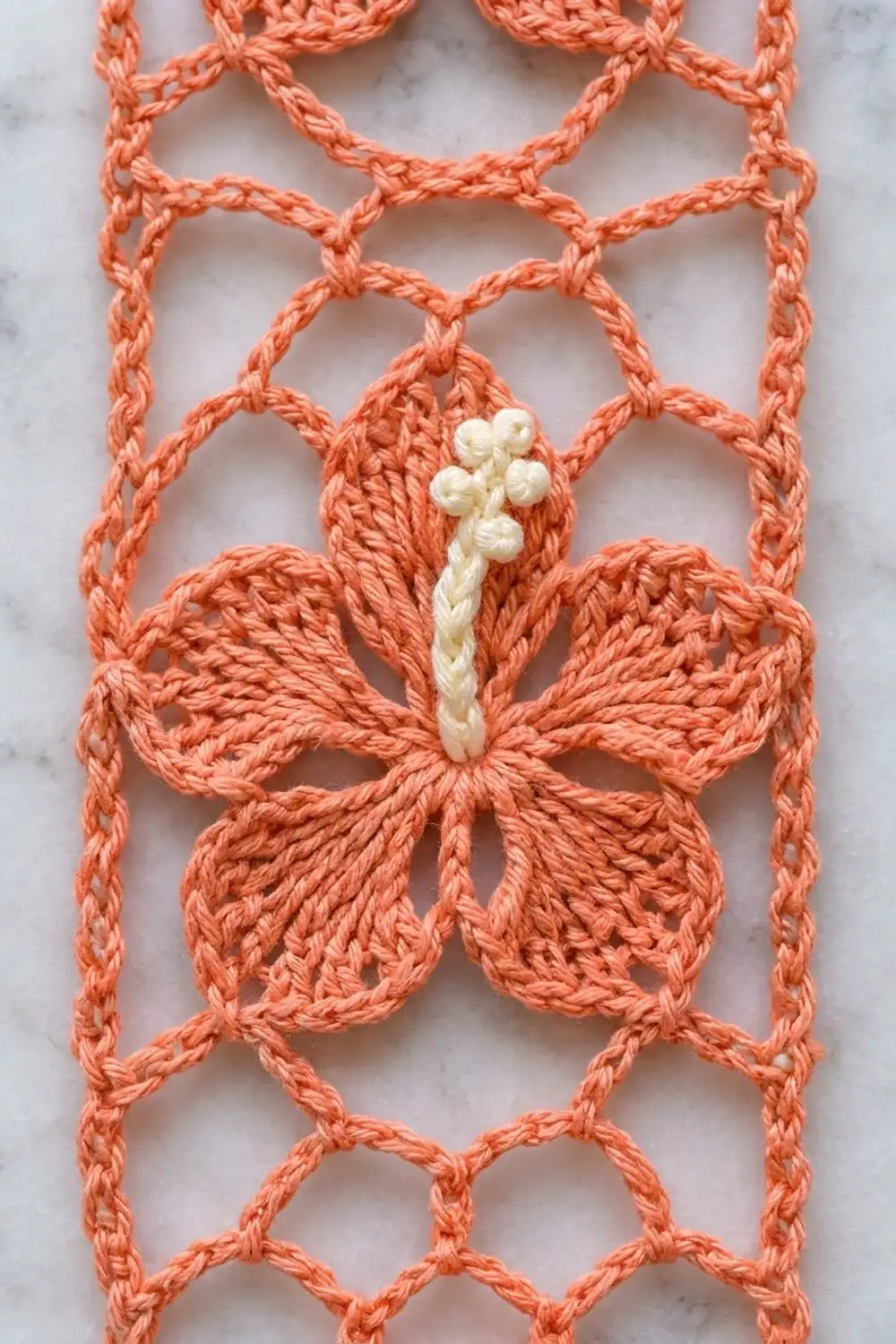
Hibiscus Block
Make 60 in coral and 45 in cream. Work with the RS facing throughout and do not turn.
Round 1: Make a magic ring, ch 1, work 10 sc in the ring, sl st to the first sc. Pull the ring closed. (10 sc)
Round 2: Ch 1, sc in the same st, ch 3, skip the next st, *sc in the next st, ch 3, skip the next st; repeat from * 3 more times, sl st to the first sc. (5 sc, 5 ch-3 sps)
Round 3: Sl st into the first ch-3 sp, ch 1, work (sc, hdc, 3 dc, hdc, sc) in each ch-3 sp around, sl st to the first sc. (5 petals of 7 sts; 35 sts)
Round 4: Ch 1, *sc in the sc, hdc in the hdc, 2 dc in each of the next 3 dc, hdc in the hdc, sc in the sc; repeat from * 4 more times, sl st to the first sc. (5 petals of 10 sts; 50 sts)
Round 5: Ch 1, *sc in the sc, hdc in the hdc, dc in the next dc, 2 tr in each of the next 4 dc, dc in the next dc, hdc in the hdc, sc in the sc; repeat from * 4 more times, sl st to the first sc. (5 petals of 14 sts; 70 sts)
The tall tr stitches fan out at the top of each petal and give the petals their open, radiating texture. Each petal tip sits between its 7th and 8th sts.
Round 6 (frame anchors): Sl st in the next st. Ch 1, *sc in the 3rd st of the petal, ch 5, sc in the 6th st, ch 5, sc in the 9th st, ch 5, sc in the 12th st, ch 5; repeat from * on each remaining petal, sl st to the first sc. (20 sc, 20 ch-5 loops)
Round 7 (squaring): Sl st in the next 3 ch to reach the center of the first loop. Ch 1, *(sc, ch 7, sc) in this loop for the corner, [ch 5, sc in the next loop] 4 times, ch 5, move to the next loop; repeat from * 3 more times, sl st to the first sc. (4 corner ch-7 sps, 20 ch-5 sps, 24 sc)
Each side now has 1 corner sc at each end, 5 ch-5 sps, and 4 sc between them.
Round 8 (rim): Sl st into the corner ch-7 sp. Ch 1, *(2 sc, ch 2, 2 sc) in the corner sp, sc in the next sc, [4 sc in the next ch-5 sp, sc in the next sc] 4 times, 4 sc in the next ch-5 sp, sc in the next sc; repeat from * 3 more times, sl st to the first sc. Fasten off. On 14 of the 15 blocks for each strip, leave a 12″ (30.5 cm) tail for joining. (120 sc, 4 ch-2 corner sps)
Side count: each side has exactly 30 sc between the ch-2 corner sps: 2 + 1 + 20 + 4 + 1 + 2 = 30. The ch-2 corner sps are not counted as stitches.
Stamen
Make 105 in cream.
Step 1: Ch 13.
Step 2: Work a knob, then sl st in the last ch of the foundation. Repeat 4 more times, all into the same ch, angling each knob a little so the five knobs form a small cluster. (5 knobs)
Step 3: Sl st in the back bump of each of the remaining 12 ch, working back to the start. This doubles the stalk and gives it a corded, slightly twisted look. Fasten off, leaving a 10″ (25.4 cm) tail.
Attach: Turn the block so one petal points to the center of the top edge. Sew the end of the stalk to the center ring, then tack the stalk up the middle of that top petal. Let the knob cluster lie on the upper half of the petal, and stitch once through the base of each knob so the cluster stays in place. Once sewn, the stalk is about 2″ (5.1 cm) long.
Make All Pieces
For each strip, make 15 blocks in one color and 15 cream stamens.
- Coral: 60 blocks (4 strips x 15)
- Cream: 45 blocks (3 strips x 15) and 105 stamens
Curtain layout (C = coral strip, W = cream strip; each column is one strip of 15 blocks):
Strip:    1   2   3   4   5   6   7
Block 1:  C   W   C   W   C   W   C
Block 2:  C   W   C   W   C   W   C
  ...     (same for blocks 3-14)
Block 15: C   W   C   W   C   W   C
The strips hang separately. Do not join one strip to the next.
Joining
Join the blocks of each strip into one column of 15. Before joining, check that every stamen points toward the same edge.
Method: Hold two blocks with WS together and both stamens pointing up. Using the long tail, sl st through the BLO of both blocks along the matching edge. The back loops are the two inner loops that touch each other. This makes a flat seam that adds almost no height.
Stitch-to-stitch logic: Start with a sl st through both corner ch-2 sps. Work 1 sl st through each matching pair of sc, 30 sl sts in total. Finish with a sl st through the next pair of corner ch-2 sps. Every sc lines up with a partner, because both sides have 30 sc.
Tension: Keep the sl sts at the same tension as the rim. Tight sl sts pull the seam in, and the strip will look pinched at every join. If your sl sts tend to be tight, go up one hook size for the seams only.
Size checkpoint: After all 14 seams, the strip should measure 5″ x 75″ (12.7 x 190.5 cm). Lay it flat and measure it without stretching.
Border
Work the border in the strip color with the RS facing.
Border gauge: 6 sc = 1″ (2.5 cm), the same as the block rim. This keeps the long edges flat.
Round 1: Join the yarn in the top right corner ch-2 sp. Ch 1, *(sc, ch 2, sc) in the corner sp, sc in each sc along the side to the next corner; repeat from * around, sl st to the first sc.
At every seam, do not work into the joined corner sps. Go straight from the last sc of one block to the first sc of the next.
- Long sides: 1 corner sc + (15 blocks x 30 sc = 450) + 1 corner sc = 452 sc per side
- Short sides: 1 + 30 + 1 = 32 sc per side
- Total: 452 + 452 + 32 + 32 = 968 sc, plus 4 corner ch-2 sps
Round 2 (chain rail): Sl st into the corner ch-2 sp. Ch 1, *(sc, ch 3, sc) in the corner sp, [ch 3, skip the next st, sc in the next st] across the side to the next corner; repeat from * around, sl st to the first sc. Fasten off.
- Long sides: 452 / 2 = 226 ch-3 loops per side
- Short sides: 32 / 2 = 16 ch-3 loops per side
- Total: 484 side loops plus 4 corner ch-3 loops
Why the math works: Round 1 puts one sc in each rim stitch, so the border matches the blocks’ 6 sc per inch and adds no fullness. Each side count is even, so the skip-one repeat ends with its last sc exactly on the corner sc and never leaves half a repeat. The two rounds add 0.5″ (1.3 cm) on every side: 5″ + 1″ = 6″ (15.2 cm) wide, and 75″ + 1″ = 76″ (193.0 cm) long.
Hanging loops: Join the strip color in the top left corner ch-3 loop. Ch 36, sl st in the same corner loop, then work 40 sc into the ch-36 loop and sl st to the first sc. Fasten off. Repeat in the top right corner. Each loop is about 6″ (15.2 cm) around and fits a rod up to 1.5″ (3.8 cm) in diameter.
Final Blocking
- Weave in all ends along the seams and rims, never through the petals.
- Soak the strip in cool water for 10 minutes, then press the water out gently in a towel. Do not wring it.
- Lay the strip flat. If your blocking surface is shorter than 76″ (193.0 cm), block one half, let it dry, then block the other half.
- Pin the long edges straight at 6″ (15.2 cm) wide, with a pin every 2″ (5.1 cm).
- Pin the length to 76″ (193.0 cm). Do not stretch it longer, because the strip will drop slightly once it hangs.
- Shape each flower: ease the petals open, and pin the tip of any petal that curls.
- Pin each stamen cluster flat on its top petal.
- Let the strip dry completely before you unpin it.
Final Quality-Control Checklist
- Every block measures 5″ x 5″ (12.7 x 12.7 cm).
- Every block has 30 sc per side and 120 sc in total.
- Every stamen points toward the top edge.
- All 14 seams in each strip are flat and not pinched.
- Border Round 1 has 452 sc on each long side and 32 sc on each short side.
- Border Round 2 has 226 loops on each long side and 16 loops on each short side.
- Each strip measures 6″ x 76″ (15.2 x 193.0 cm).
- The hanging loops are the same size and slide easily over the rod.
- All ends are woven in securely.
Troubleshooting
Petals cup or ruffle: Your tr stitches are too tight or too loose. Check your tension on Round 5, and change the hook by one size if needed.
The block is not square: Check that Round 7 has exactly 5 ch-5 sps along each side. Pin the block square while blocking.
Side count is not 30: Recount Round 8. Usually the sc in the sc after a ch-5 sp was missed.
Seams pucker: Redo them with a larger hook, and check that you worked through the BLO of both layers.
Strip edges wave: Border Round 1 has too many stitches. Recount for 452 per long side, and make sure you skipped the corner sps at the seams.
Strips grow while hanging: This is normal for cotton. Wet block the strip again and dry it flat, or remove one block from each strip.
Stamens flop: Add one more tacking stitch halfway up the stalk.
Care
Take the strips off the rod and hand wash each one separately in cool water with a mild detergent. Dry flat, and re-pin the length if needed.
Final Notes
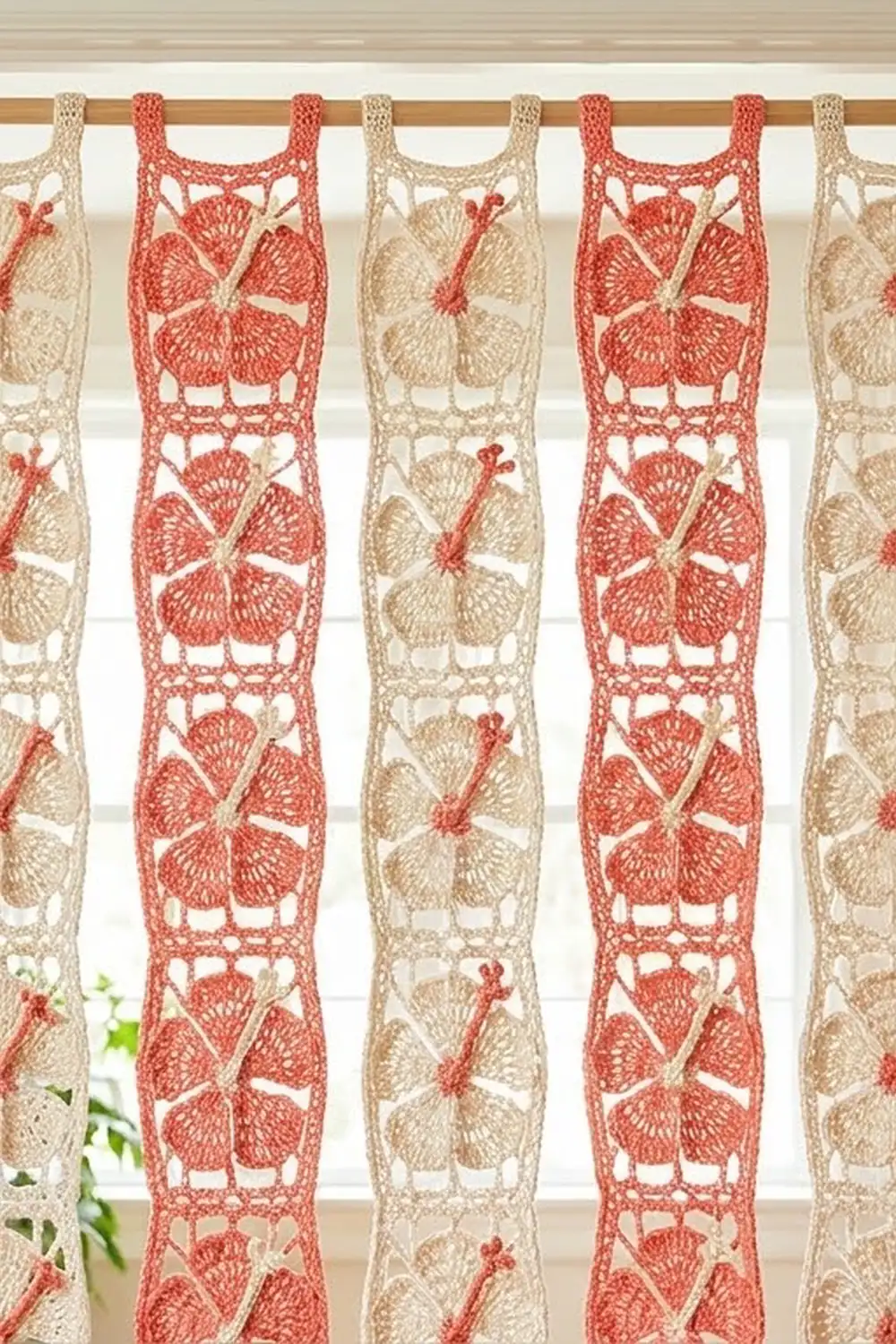
The whole curtain follows one measurement chain. A gauge of 6 sc per inch gives a 30-sc side and a 5″ (12.7 cm) block. Fifteen blocks make a 5″ x 75″ (12.7 x 190.5 cm) strip. The border adds 0.5″ (1.3 cm) all around, for a 6″ x 76″ (15.2 x 193.0 cm) strip. Seven strips spaced 1″ (2.5 cm) apart cover 48″ (121.9 cm). If your first block measures correctly, the rest of the curtain will too.
Happy crocheting!