

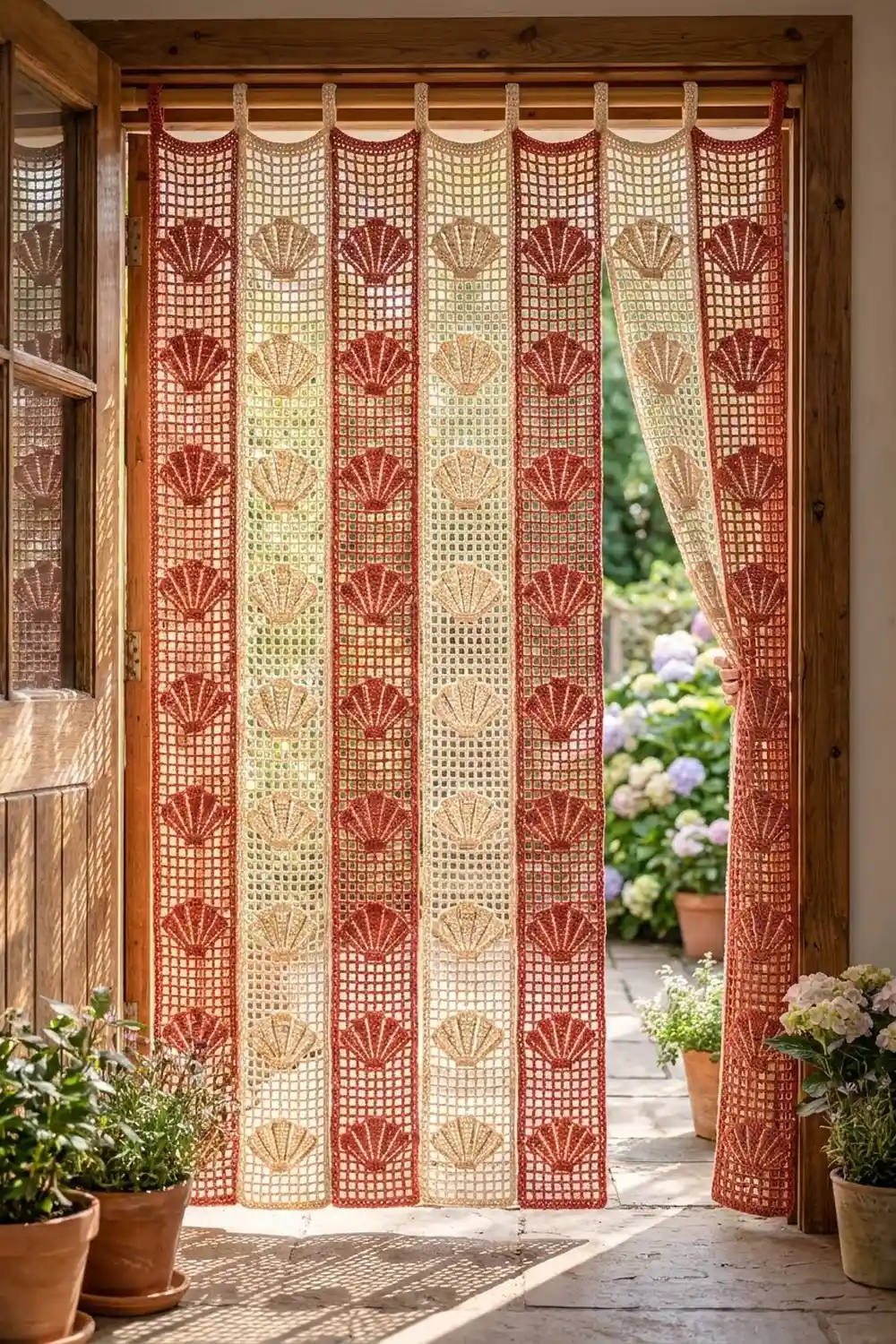
This door curtain is made of seven long filet mesh strips, each decorated with a column of ten scallop shells. The strips alternate between a warm coral and a soft cream, and each one hangs from the curtain rod by two small tab loops. The open mesh lets light and air through, and the solid shells give the curtain a clear, graphic rhythm.
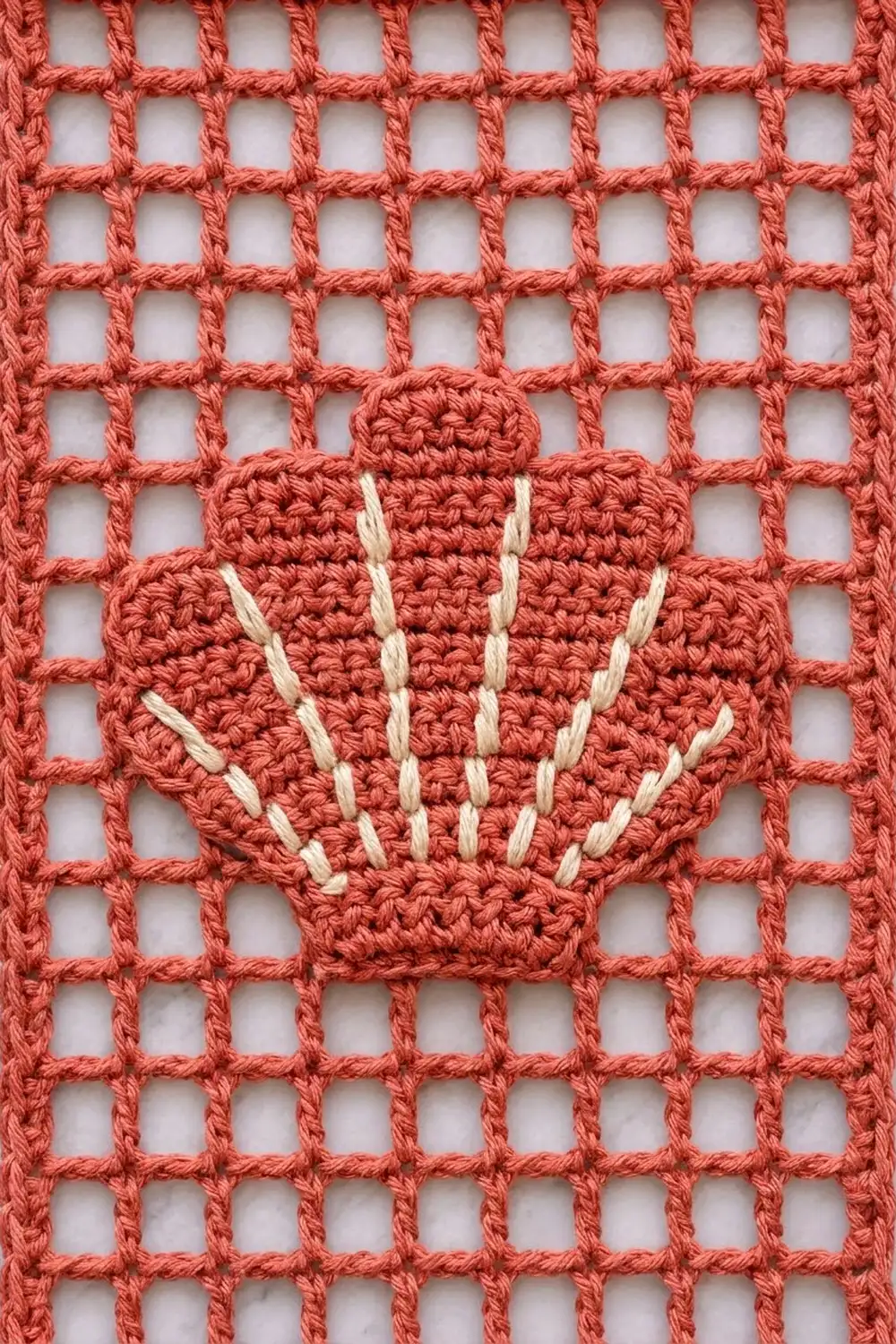
The style is relaxed and coastal. Each shell is a fan of solid filet blocks sitting on a small hinge. Five fine rays are surface-stitched over each shell in a contrasting color: cream rays on the coral strips and coral rays on the cream strips. A firm two-round single crochet frame keeps every strip straight and neat.
This pattern uses US crochet terms. Each finished strip measures 6.5 in (16.5 cm) wide and 75 in (190.5 cm) long, not counting the tabs. When the seven strips hang side by side with small gaps, they cover a standard doorway.
Each strip is worked flat from the bottom up in rows of filet mesh, with the shells charted into the rows as blocks. Next, a two-round single crochet border goes around each strip. Two tabs are worked off the top edge, and the rays are added last with surface slip stitch. The strips are never joined to each other.
Finished Size and Construction
- Finished strip size: 6.5 in (16.5 cm) wide x 75 in (190.5 cm) long, plus tabs
- Skill level: Easy-intermediate
- Terminology: US crochet terms
- Yarn weight: Worsted weight (#4) cotton
- Hook: 4.0 mm (G-6)
- Number of pieces: 7 separate strips (4 coral, 3 cream)
- Layout: 7 strips in one row, alternating colors, hung side by side
- Size before border: 11 squares wide x 148 rows tall = 5.5 in (14.0 cm) x 74 in (188.0 cm)
- Border depth: 2 rounds of sc, 0.25 in (0.6 cm) each, 0.5 in (1.3 cm) total
- Tabs: 2 per strip, each folding into a 1.5 in (3.8 cm) loop
Materials
Use a smooth mercerized or combed cotton in worsted weight, about 190 m per 100 g. Cotton holds the square mesh shape and hangs straight without much stretch, which matters for a long hanging piece. Avoid fuzzy or very stretchy yarns, because they blur the mesh and let the strips grow longer.
- Coral: 650 g (approx. 1235 m) for 4 strips, plus the rays on the cream strips
- Cream: 500 g (approx. 950 m) for 3 strips, plus the rays on the coral strips
These quantities include a margin of about 10–15% for swatching, tension differences, and the border.
Tools:
- 4.0 mm (G-6) crochet hook
- Tapestry needle
- Stitch markers (at least 4)
- Measuring tape
- Rust-proof pins and a blocking surface (or towels on a clean floor) long enough for a 75 in (190.5 cm) strip
- Spray bottle
- Curtain rod, up to 1 in (2.5 cm) in diameter
Abbreviations (US Terms)
- ch: chain
- sc: single crochet
- dc: double crochet
- sl st: slip stitch
- sp: space
- st(s): stitch(es)
- sk: skip
- rep: repeat
Special stitches and terms:
- Open square (OS): ch 1, sk the next st (a ch-1 sp or the middle dc of a block), dc in next dc.
- Block (BL): dc in the next ch-1 sp (or in the middle dc of a block below), dc in next dc.
- Surface slip stitch: hold the yarn behind the work, insert the hook from front to back through the fabric, pull up a loop, and draw it through the loop on the hook. Repeat along the line, keeping each stitch about 0.25 in (0.6 cm) long.
Every row has 12 dc “posts” and 11 squares, so every row counts as 23 sts: 2 sts per square, plus the first post. Blocks don’t change the count. They just fill the ch-1 sp with a dc.
Gauge and Checkpoints
Gauge: in filet mesh, 4 squares = 2 in (5.1 cm) wide and 4 rows = 2 in (5.1 cm) tall. One square is 0.5 in (1.3 cm) on each side.
Border gauge: 4 sc = 1 in (2.5 cm).
Make the first strip completely before you start the others, because it’s your real gauge test. Measure it flat, without stretching, at these points:
- After Row 1: 5.5 in (14.0 cm) wide.
- After Row 8: 4 in (10.2 cm) tall.
- After Row 22 (first shell plus its open rows): 11 in (27.9 cm) tall. The shell should measure 3.5 in (8.9 cm) wide and 3 in (7.6 cm) tall.
- After Row 78: 39 in (99.1 cm) tall.
- After Row 148: 74 in (188.0 cm) tall.
If your piece is too big, go down a hook size (3.75 mm). If it’s too small, go up a hook size (4.5 mm). If only the height is off, change how far you pull up your dc loops. Small errors add up on a long strip: 0.05 in (0.1 cm) extra per row becomes about 7.4 in (18.8 cm) over 148 rows, so correct your gauge early.
Strip Pattern
Make 4 strips in coral and 3 strips in cream. The strips are identical apart from color.
Turning chain: the ch 4 at the start of each row counts as dc + ch 1. Work the last dc of every row into the 3rd ch of the turning ch-4 below.
Foundation
Row 1: Ch 26. Dc in 6th ch from hook (the skipped ch count as dc, ch 1, and one skipped ch). *Ch 1, sk 1 ch, dc in next ch; rep from * 9 more times. Turn. (12 dc + 11 ch-1 sp = 23 sts; 11 open squares)
Open Row: Ch 4 (counts as dc + ch 1), dc in next dc, *OS; rep from * 9 more times, working the last dc in the 3rd ch of the turning ch. Turn. (23 sts; 11 open squares)
Rows 2–8: Work the Open Row. (23 sts per row; 8 open rows in total)
Shell Repeat (14 rows)
The squares are numbered 1 to 11 across the row. The shell is centered on square 6 and covers squares 3 to 9. Because the shell is symmetrical, each row reads the same in both directions.
Shell Row S1 (hinge): Ch 4, dc in next dc (square 1), OS 3 times (squares 2–4), BL 3 times (squares 5–7), OS 4 times (squares 8–11). Turn. (23 sts; 3 blocks)
Shell Row S2: Ch 4, dc in next dc (square 1), OS 2 times (squares 2–3), BL 5 times (squares 4–8), OS 3 times (squares 9–11). Turn. (23 sts; 5 blocks)
Shell Rows S3–S5 (full fan): Ch 4, dc in next dc (square 1), OS once (square 2), BL 7 times (squares 3–9), OS 2 times (squares 10–11). Turn. (23 sts; 7 blocks per row)
Shell Row S6 (rounded top): Ch 4, dc in next dc (square 1), OS 2 times (squares 2–3), BL 5 times (squares 4–8), OS 3 times (squares 9–11). Turn. (23 sts; 5 blocks)
Open Rows (8 rows): Work the Open Row 8 times. When you work an OS over a block, skip the block’s middle dc so the squares stay aligned. (23 sts per row)
One repeat = 14 rows = 7 in (17.8 cm).
Full Strip
Rows 9–148: Work the Shell Repeat 10 times in total. (10 shells; 140 rows)
The strip ends with 8 open rows at the top, matching the 8 open rows at the bottom. That makes 148 rows in total, with 23 sts in every row. Don’t fasten off; continue straight into the border.
Size check: 5.5 in (14.0 cm) x 74 in (188.0 cm).
Make All Pieces
- Coral: 4 strips, with cream rays
- Cream: 3 strips, with coral rays
Layout, left to right across the rod (C = coral, K = cream):
| C | K | C | K | C | K | C |
The coral strips sit at both outer edges. Tag each finished strip with a scrap of yarn so you can compare lengths before hanging.
Hanging (No Joining)
The strips aren’t sewn or crocheted together. Each one hangs from its own two tabs, so the curtain parts easily when someone walks through.
Slide the tabs onto the rod in the layout order above and space the strips about 0.75 in (1.9 cm) apart. Seven strips at 6.5 in (16.5 cm) each, plus six gaps of 0.75 in (1.9 cm), cover 50 in (127.0 cm) of rod.
Size checkpoint: all strips should be within 0.5 in (1.3 cm) of each other in length. If one strip is longer, re-block it rather than changing rows.
Border
Each strip gets its own two-round sc border in the strip color. Each corner sc counts as its own stitch.
Border gauge: 4 sc = 1 in (2.5 cm). Each filet row is 0.5 in (1.3 cm) tall, so working 2 sc per row-end matches the gauge exactly.
Round 1: Ch 1. Working across the top edge (the last row): 3 sc in the first st (corner), sc in each of the next 21 sts, 3 sc in the last st (corner). Turn to the long side and work 2 sc around the post of each row-end dc or turning chain, down all 148 rows. Along the foundation chain: 3 sc in the first st (corner), sc in each of the next 21 sts, 3 sc in the last st (corner). Work 2 sc around each of the 148 row-ends up the second long side. Sl st to the first sc.
Round 1 counts:
- Short sides: 23 sc between the corners (1 from each corner group + 21), or 25 sc including both corners
- Long sides: 298 sc between the corners (1 + 296 + 1), or 300 sc including both corners
- Total: 4 corners + 2 x 23 + 2 x 298 = 646 sc
Round 2: Ch 1, sc in each sc around, working 3 sc in each corner sc. Sl st to the first sc and fasten off.
Round 2 counts:
- Short sides: 25 sc between the corners, or 27 sc including both corners
- Long sides: 300 sc between the corners, or 302 sc including both corners
- Total: 4 corners + 2 x 25 + 2 x 300 = 654 sc (646 + 8)
Why the math works: the long edge has 296 sc over 74 in (188.0 cm), which is exactly 4 sc per inch. The short edge has 23 sts over 5.5 in (14.0 cm), close enough to lie flat. The 3-sc corners add 2 sts per side each round, so the corners turn without cupping. Two rounds add 0.5 in (1.3 cm) to each edge, which is 1 in (2.5 cm) to each dimension: 5.5 + 1 = 6.5 in (16.5 cm) wide and 74 + 1 = 75 in (190.5 cm) long.
Tabs
Number the 27 sts along the top short side of Round 2, from 1 (corner) to 27 (corner).
Left tab: Join yarn in st 2. Ch 1, sc in sts 2–5. Turn. (4 sc) Rows 2–12: Ch 1, sc in each sc. Turn. (4 sc per row; 12 rows = 3 in / 7.6 cm) Fasten off, leaving a long tail.
Right tab: Work the same way as the left tab, in sts 23–26.
Fold each tab to the back so its last row sits on Round 1 of the border, and sew it down with the tail. Each tab makes a 1.5 in (3.8 cm) loop.
Shell Rays
Add the rays after the border is finished, in the contrast color. Work them on the right side with surface slip stitch. All five rays start at the top of the center block of Row S1 (square 6):
- Ray 1: straight up through square 6 to the top of Row S6.
- Rays 2 and 3: angled out to the top of Row S6 at squares 4 and 8.
- Rays 4 and 5: angled out to the top of Row S5 at squares 3 and 9.
Weave the ends into the back of the solid blocks only, never through the open mesh.
Final Blocking
- Weave in all ends inside the solid blocks or the border.
- Lay the strip flat, right side up, on towels or a blocking surface.
- Pin it to 6.5 in (16.5 cm) wide x 75 in (190.5 cm) long.
- Straighten the mesh so each square measures 0.5 in (1.3 cm), and pin the long edges every 4 in (10.2 cm).
- Mist evenly with water until damp but not soaked.
- Let it dry completely, for at least 24 hours.
- Unpin and compare the lengths of all seven strips.
Final Quality-Control Checklist
- Every strip has 148 rows with 23 sts in each row.
- Each strip has 10 shells, with 8 open rows at the bottom and 8 at the top.
- Every shell is centered on square 6 and spans squares 3–9.
- Border Round 2 totals 654 sc, with neat 3-sc corners.
- Each strip measures 6.5 in (16.5 cm) x 75 in (190.5 cm).
- The tabs sit on sts 2–5 and 23–26.
- Every shell has five even rays in the contrast color.
- The strips hang in C-K-C-K-C-K-C order.
Troubleshooting
The strip leans to one side: you missed the last dc in the turning chain. Count 12 posts in every row.
The shells look off-center: count squares from the edge, not stitches. Square 6 is the middle of the 11 squares.
The border ripples on the long sides: your sc are tighter than 4 per inch. Go up a hook size for the border only.
The border pulls in: work a little looser, and keep the count equal on both long sides.
The strip grows after hanging: cotton relaxes over time. Re-block the strip. On the next strip, work 2 fewer open rows: 1 at the top and 1 at the bottom.
The rays pucker the shell: your surface slip stitches are too short or too tight. Pull them out and redo them with longer stitches.
Care
Hand wash, or machine wash cold on a gentle cycle in a mesh bag. Lay the strips flat to dry and re-block them if needed; don’t hang them while wet.
Final Notes
Here’s the measurement chain to check at each stage. One square is 0.5 in (1.3 cm), so 11 squares make a strip 5.5 in (14.0 cm) wide, and 148 rows make it 74 in (188.0 cm) long. Two rounds of sc border bring each strip to 6.5 in (16.5 cm) x 75 in (190.5 cm). Seven strips with small gaps fill 50 in (127.0 cm) of rod.
For a taller or shorter door, add or remove open rows in pairs, one at the top and one at the bottom. Each pair changes the length by 1 in (2.5 cm) and changes each long side of the border by 4 sc.
Happy crocheting!