
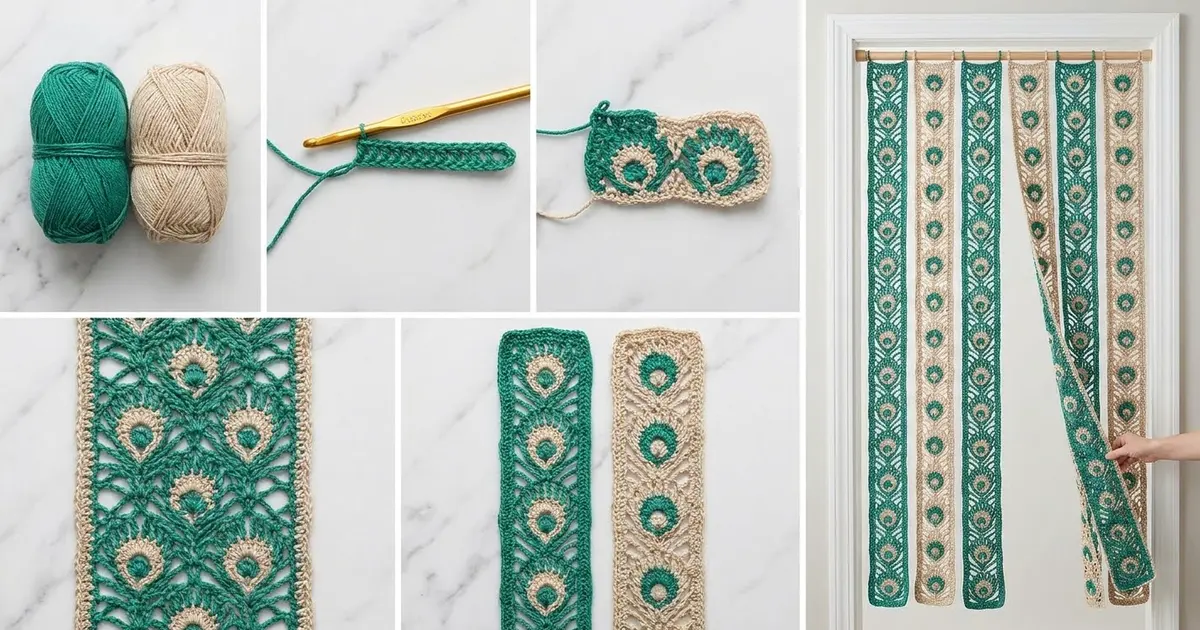
The Peacock Plume Lace Door Curtain is made of six long, narrow lace strips that hang side by side from a curtain rod. Each strip carries a column of stacked peacock feathers. A thin stem rises up the center, opens into a fan of rays, and holds a teal teardrop “eye” with a beige center. Small chain arches run up both long sides of every strip.
The palette is teal green (Color A) and natural beige (Color B). The feathers are beige on every strip. Three strips get a teal frame and three get a beige frame, and you hang them alternating. All instructions use US crochet terms.
Each finished strip measures 6.0 in (15.2 cm) wide by 74.0 in (188.0 cm) long, plus a 1.5 in (3.8 cm) hanging loop. Six strips hung edge to edge cover 36.0 in (91.4 cm).
Construction is simple. Each strip is worked flat in rows from the bottom up, with a 10-row feather repeat. You then sew a small eye appliqué onto each feather, work a two-round border, and add a hanging loop. The strips are never sewn to each other.
Finished Size and Construction
- Finished strip size: 6.0 in x 74.0 in (15.2 cm x 188.0 cm), loop not included
- Skill level: Intermediate
- Terminology: US
- Yarn weight: DK (#3) cotton
- Hook: 4.0 mm (G-6)
- Number of pieces: 6 strips plus 72 eye appliqués (12 per strip)
- Layout: 6 strips across x 1 down, hung separately
- Strip body before border: 5.0 in x 73.0 in (12.7 cm x 185.4 cm)
- Border depth: 0.5 in (1.3 cm) on every side
- Feather repeat: 6.0 in (15.2 cm) tall
Materials
Pick a smooth mercerized or combed DK cotton. A crisp cotton shows the stitch definition well and holds its shape when hanging. Avoid fuzzy blends, because they blur the arches.
- Color A, teal green: 200 g / about 460 m (503 yd), for 72 eye rings, 3 borders, and 3 loops
- Color B, natural beige: 950 g / about 2,185 m (2,390 yd), for 6 strip bodies, 72 eye centers, 3 borders, and 3 loops
These quantities assume about 115 m per 50 g. They include a margin of roughly 10% for swatching and length adjustments.
Tools:
– 4.0 mm (G-6) crochet hook
– Tapestry needle
– 8 stitch markers
– Rust-proof pins and blocking mats
– Spray bottle
– Measuring tape
– Curtain rod, at least 40 in (101.6 cm) long
Abbreviations (US Terms)
- ch – chain
- sl st – slip stitch
- sc – single crochet
- hdc – half double crochet
- dc – double crochet
- tr – treble crochet
- sk – skip
- sp(s) – space(s)
- st(s) – stitch(es)
- beg – beginning
Special stitches
- Anchor dc: the dc on each side of the center panel. It separates the side arches from the feather. Mark both anchors in Row 2 and move the markers up as you work.
- Ray: one of the 7 dc or tr worked across the opened fan.
Gauge and Checkpoints
Gauge: 27 sc = 5.0 in (12.7 cm). 4 sc rows = 1 in (2.5 cm). 2 dc rows = 1 in (2.5 cm). 4 tr rows = 3.0 in (7.6 cm). One 10-row feather repeat = 6.0 in (15.2 cm). All measurements are after blocking.
Test one piece first. Ch 28 and work Rows 1–12. Then work one top-edge row as in Row 123. The blocked swatch should measure 5.0 in x 7.0 in (12.7 cm x 17.8 cm).
Checkpoints (blocked or lightly stretched):
– After Row 1: 5.0 in (12.7 cm) wide
– After Row 12: 6.75 in (17.1 cm) tall
– After Row 62: 30.75 in (78.1 cm) tall
– After Row 122: 72.75 in (184.8 cm) tall
– After Row 123: 73.0 in (185.4 cm) tall
– After the border: 6.0 in x 74.0 in (15.2 cm x 188.0 cm)
If your swatch is too big, go down 0.5 mm in hook size. If it is too small, go up 0.5 mm. If the width is right but the repeat is too tall or too short, change the height of your tr stitches. Pull the loops up a little more for taller rows, or a little less for shorter ones.
Strip Body (make 6)
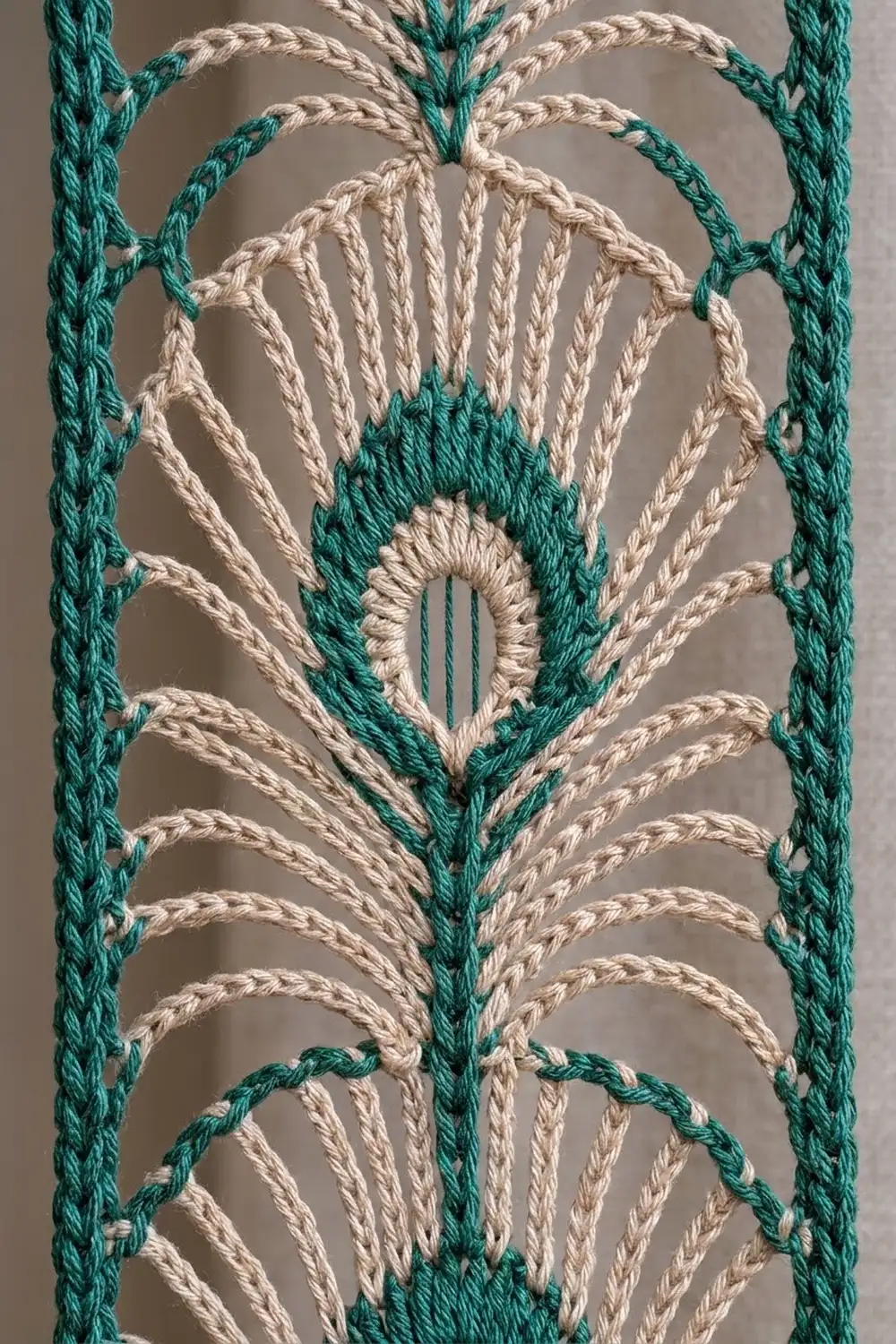
Use Color B for every body. Each row is written in three parts: the left side arches, the center feather, and the right side arches. Turn at the end of every row.
Foundation: Ch 28.
Row 1: Sc in 2nd ch from hook and in each ch across. (27 sc)
Row 2 (setup stem row): Ch 6 (counts as dc + ch 3). Sk next 2 sc, dc in next sc, ch 3, sk next 2 sc, dc in next sc (anchor). Ch 6, sk next 6 sc, dc in next sc (stem). Ch 6, sk next 6 sc, dc in next sc (anchor). [Ch 3, sk next 2 sc, dc in next sc] 2 times. (7 dc, 4 ch-3 sps, 2 ch-6 sps)
The dc land on stitches 1, 4, 7, 14, 21, 24, and 27, so the stem sits exactly in the center. Each ch-3 covers only 2 skipped stitches. That extra chain is what makes the side spaces bow into small arches.
Side-arch shorthand:
– Left side (dc rows): Ch 6 (counts as dc + ch 3), dc in next dc, ch 3, dc in anchor dc.
– Right side (dc rows): Dc in anchor dc, ch 3, dc in next dc, ch 3, dc in top of beg ch.
– On tr rows, start with ch 7 (counts as tr + ch 3) and work tr in place of dc on both sides.
– “Top of beg ch” is the 3rd ch of a beg ch-6 or the 4th ch of a beg ch-7.
Feather Repeat (Rows 3–12)
Row 3 (V): Left side. Ch 4, (dc, ch 3, dc) in stem dc, ch 4. Right side. (8 dc, 5 ch-3 sps, 2 ch-4 sps)
Row 4 (shell): Left side. Ch 3, 7 dc in ch-3 sp of V, ch 3. Right side. (13 dc, 6 ch-3 sps)
Row 5 (dc rays): Left side. Dc in first dc of shell, [ch 1, dc in next dc] 6 times. Right side. (13 dc, 4 ch-3 sps, 6 ch-1 sps)
The first and last rays sit right against the anchors, with no chain between them. That lets the fan fill the full center panel.
Rows 6–9 (tr rays): Left side (tr version). Tr in first ray, [ch 1, tr in next ray] 6 times. Right side (tr version). (13 tr, 4 ch-3 sps, 6 ch-1 sps in each row)
Row 10 (dc rays): Left side. Dc in first ray, [ch 1, dc in next ray] 6 times. Right side. (13 dc, 4 ch-3 sps, 6 ch-1 sps)
Row 11 (crown): Left side. Ch 6, sk next 3 rays, dc in 4th (center) ray, ch 6, sk last 3 rays. Right side. (7 dc, 4 ch-3 sps, 2 ch-6 sps)
Each ch-6 replaces 6 units (3 rays and 3 ch-1 sps), so the center panel stays 13 units wide. This row gathers the fan back into a stem.
Row 12 (stem): Left side. Ch 6, dc in stem dc, ch 6. Right side. (7 dc, 4 ch-3 sps, 2 ch-6 sps)
Rows 11 and 12 match Row 2, so the next V always has a stem to start from.
Rows 13–122: Repeat Rows 3–12 eleven more times, for 12 feathers in total. Row 122 is a stem row.
Row 123 (top edge): Ch 1. Sc in first dc, 2 sc in ch-3 sp, sc in next dc, 2 sc in ch-3 sp, sc in anchor. 6 sc in ch-6 sp, sc in stem dc, 6 sc in ch-6 sp. Sc in anchor, 2 sc in ch-3 sp, sc in next dc, 2 sc in ch-3 sp, sc in top of beg ch. (27 sc)
Check: 1 + 2 + 1 + 2 + 1 + 6 + 1 + 6 + 1 + 2 + 1 + 2 + 1 = 27. The top edge matches Row 1. Fasten off.
Length math: Row 1 (0.25 in) + Row 2 (0.5 in) + 12 repeats x 6.0 in + Row 123 (0.25 in) = 73.0 in (185.4 cm). Each repeat has 6 dc rows (3.0 in) and 4 tr rows (3.0 in).
Peacock Eye Appliqué (make 72)
Rnd 1 (Color B): Ch 6. Sc in 2nd ch from hook and in next 3 ch, 3 sc in last ch. Working along the other side of the chain, sc in next 3 ch, 2 sc in same ch as first sc. Join with sl st to first sc. Fasten off B. (12 sc: 3 at each end, 3 along each side)
Rnd 2 (Color A): Join A in first sc. Ch 1, 2 sc in same st, sc in next 3 sts, hdc in next st, (dc, ch 2, dc) in next st, hdc in next st, sc in next 3 sts, 2 sc in each of last 2 sts. Join. (16 sts and 1 ch-2 sp)
The (dc, ch 2, dc) falls on the middle stitch of the far end, which gives the eye its pointed tip.
Rnd 3 (Color A): Ch 1, sc in each st around, working 3 sc in the ch-2 sp. Join. (19 sc) Fasten off, leaving a 12 in (30.5 cm) tail.
The finished eye measures about 1.5 in x 2.0 in (3.8 cm x 5.1 cm).
Pupil lines: Thread a short length of A and work 3 vertical straight stitches across the beige center.
Attach: Center one eye over Rows 6–9 of each feather, with the point facing up. Whipstitch through the back loops of Rnd 3 to the tr rays. The 13-unit center panel is about 2.4 in (6.1 cm) wide, so the eye sits inside the fan with rays showing on both sides.
Make All Pieces
- 6 strip bodies in B
- 72 eyes (Rnd 1 in B, Rnds 2–3 in A), with 12 sewn to each strip
- Borders and loops: 3 strips in A (Strip T), 3 strips in B (Strip N)
Layout, as seen from the room side:
| T | N | T | N | T | N |
Each cell is one 6.0 in x 74.0 in (15.2 cm x 188.0 cm) strip.
Joining
The strips are not seamed together. Each one is bordered by itself and hangs from its own loop. Leaving them separate lets you walk through the curtain and lets each strip drape cleanly.
Because each strip is bordered alone, every border count below comes from one strip’s own 27-stitch width and 123 rows. Nothing is added for seams.
Hanging: Slide the loops onto the rod in T, N, T, N, T, N order. Space the loops 6.0 in (15.2 cm) apart, center to center, so the borders just touch. Keep the loops relaxed on the rod so no strip pulls sideways.
Size checkpoint: The hung curtain should span 36.0 in (91.4 cm) across. Each strip should hang 75.5 in (191.8 cm) from the top of the loop to the bottom edge.
Border
Border gauge: 4 sc = 1 in (2.5 cm) along row ends, so a dc row-end takes 2 sc and a tr row-end takes 3 sc. Along the top and bottom edges, work 1 sc per stitch. Use A for Strip T and B for Strip N.
Rnd 1:
1. Join yarn in the last sc of Row 123. Ch 1, 3 sc in same st (corner).
2. Work down the long side, from Row 122 to Row 2: 2 sc in each dc row-end and 3 sc in each tr row-end.
3. Work 3 sc in the first foundation ch (corner), sc in each of the next 25 foundation chs, and 3 sc in the last ch (corner).
4. Work up the second long side the same way.
5. Work 3 sc in the first sc of Row 123 (corner), then sc in the next 25 sts. Join to the first sc.
Counts, from corner center to corner center (inclusive):
– Short sides: 29 sts each. That is 1 corner center + 1 + 25 + 1 + 1 corner center.
– Long sides: 294 sts each. That is 2 corner sts at each end plus 290 row-end sc.
– Row-end math: Row 2 takes 2 sc. Each repeat takes 6 x 2 + 4 x 3 = 24 sc, and 12 repeats take 288 sc. 2 + 288 = 290.
– Total: 2 x 29 + 2 x 294 − 4 shared corners = 642 sts. Checked another way: 31 + 31 + 290 + 290 = 642.
Rnd 2: Ch 1, sc in each st around, with 3 sc in each corner center. Join and fasten off. (Short sides 31, long sides 296; total 650)
Why the math works: 290 sc at 4 per inch is 72.5 in (184.2 cm). That matches the row-end height of Rows 2–122 exactly, so the long sides lie flat. The short sides follow the 27 stitches 1 to 1. Each round adds 0.25 in (0.6 cm) all around. That brings the width to 5.0 + 1.0 = 6.0 in (15.2 cm) and the length to 73.0 + 1.0 = 74.0 in (188.0 cm).
Hanging loop: Join the border color in the 16th st of the top side on Rnd 2. This is the exact center, with 15 sts on each side. Ch 16, sl st in the same st. Work 22 sc into the loop and sl st into the base. Fasten off. (1.5 in / 3.8 cm tall)
Final Blocking
- Weave in all ends along stitch paths. Leave long tails until after blocking.
- Soak the strip in cool water for 15 minutes. Press out the water in a towel, without wringing.
- Pin it in sections on mats to 6.0 in (15.2 cm) wide. Put one pin in each side arch.
- Pin each feather. Open the 7 rays into an even fan, and stretch each repeat to 6.0 in (15.2 cm).
- Pin the eye flat, with its point up and centered.
- Measure the full 74.0 in (188.0 cm) length. Adjust the pins and let the strip dry completely.
- Trim the tails you kept.
Final Quality-Control Checklist
- Rows 1 and 123 both have 27 sc
- Every pattern row matches its stated count
- 12 feathers per strip, each 6.0 in (15.2 cm) tall
- Stems are centered on the 14th stitch
- 12 eyes per strip, points up, centered over Rows 6–9
- Rnd 1 has 642 sts and Rnd 2 has 650
- The loop is on the 16th st of the top side
- Each strip is 6.0 in x 74.0 in (15.2 cm x 188.0 cm)
- 3 T strips and 3 N strips, hung alternating
Troubleshooting
- Side edges ruffle: You may have worked more than 2 or 3 sc per row-end. Recount against 290.
- Side edges pull in: Your border is too tight. Go up 0.5 mm for the border only.
- Fan leans to one side: The stem dc missed the center. Check that Row 2 skipped exactly 6 sc on each side.
- Strip twists while hanging: Block it again, pinning the edges straight, and let it dry fully.
- Eye puckers the fan: Sew more loosely, through the back loops only.
- Strip comes out too short: Add one repeat (10 rows). This adds 6.0 in (15.2 cm) and adds 24 sc to each long side of the border.
Care
Hand wash cool, roll in a towel, and dry flat, pinned to size. Rehang only when completely dry.
Final Notes
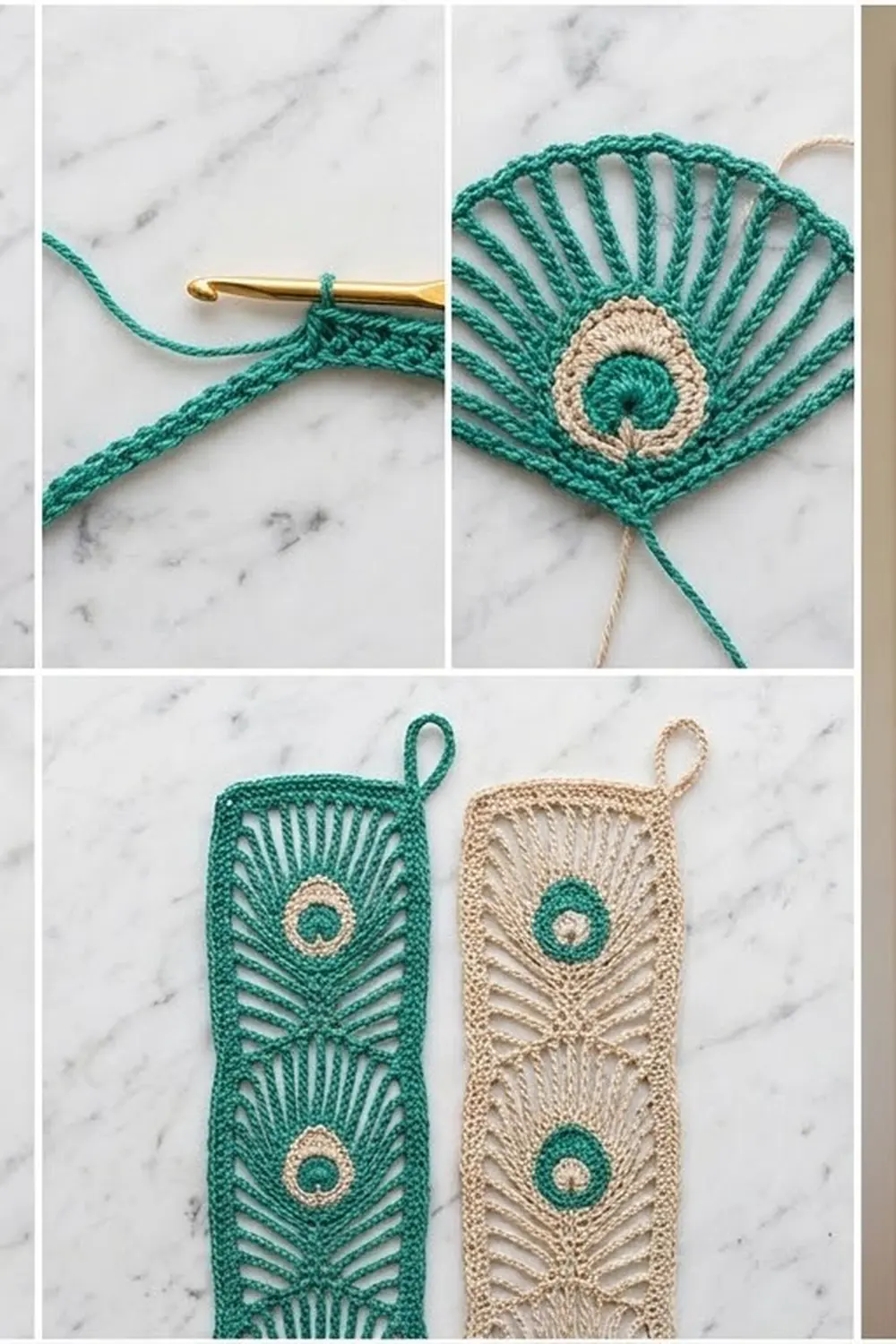
Here is the full measurement chain. 27 sc gives 5.0 in (12.7 cm). Twelve 6.0 in (15.2 cm) repeats plus three edge rows give 73.0 in (185.4 cm). Two border rounds bring each strip to 6.0 in x 74.0 in (15.2 cm x 188.0 cm). Six strips span 36.0 in (91.4 cm). If every checkpoint matches, the curtain will hang true.
Happy crocheting!