
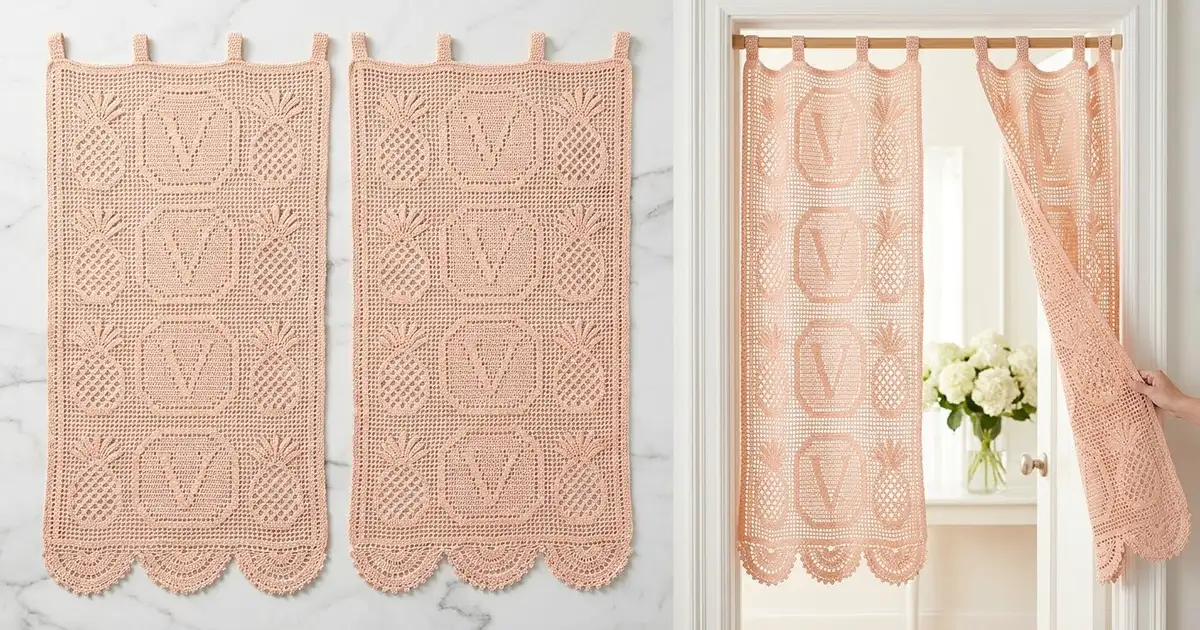
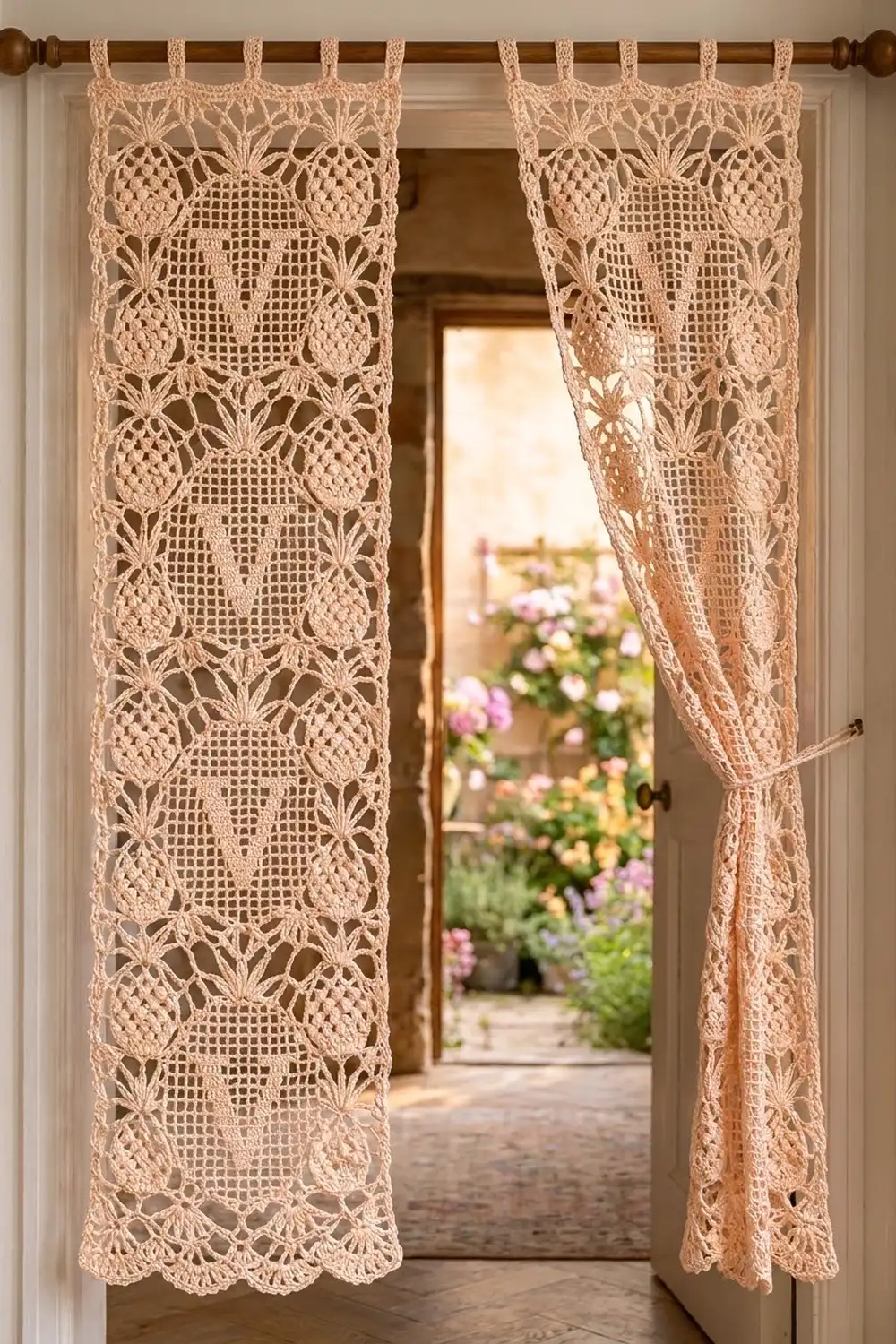
The Verona panels are a pair of romantic lace curtains in soft peach cotton thread. Each panel stacks four round filet medallions down its center, and each medallion holds a crisp “V” monogram. Classic pineapple motifs line both sides, and the bottom finishes in a row of rounded fan scallops.
The look is vintage parlor lace: one color, high texture, and an airy mesh that lets light through. Hung in a doorway, the panels frame the room without hiding it.
This pattern uses US crochet terms. Each finished panel measures 20.25 in (51.4 cm) wide by 35.5 in (90.2 cm) long. Including the hanging tabs, the total length is 37 in (94.0 cm).
Each panel is worked flat in one piece, from the bottom up. Every row has five sections: a solid edge, a pineapple column, a filet center, a second pineapple column, and another solid edge. A one-round border tidies the edges. Short rows then add the scalloped hem and the hanging tabs.
Finished Size and Construction
- Finished panel size: 20.25 in x 35.5 in (51.4 cm x 90.2 cm), plus 1.5 in (3.8 cm) tabs
- Skill level: Intermediate
- Terminology: US crochet terms
- Yarn weight: Size 3 mercerized cotton crochet thread
- Hook: 2.25 mm (US B-1)
- Number of pieces: 2 identical panels, hung separately (not joined)
- Layout: 2 panels side by side on one rod
- Panel size before border: 20 in x 34 in (50.8 cm x 86.4 cm)
- Border depth: 1/8 in (0.3 cm) on the sides and top; 1/8 in (0.3 cm) plus 1.25 in (3.2 cm) of scallops at the bottom; 1.5 in (3.8 cm) tabs at the top
Materials
Yarn: Size 3 mercerized cotton thread, about 150 yd (137 m) per 50 g. Mercerized cotton gives crisp mesh and well-defined pineapples, and it holds up to washing. Avoid fuzzy or very stretchy fibers, because they blur the filet monogram.
- Peach: 400 g, about 1,096 m (8 balls of 50 g) for both panels, or 200 g (548 m) per panel
These quantities include a margin of about 20%, which allows for your gauge swatch and small tension differences.
Tools:
– 2.25 mm (US B-1) crochet hook
– Tapestry needle
– Stitch markers (at least 8)
– Rustproof pins and a blocking surface at least 22 in x 38 in (55.9 cm x 96.5 cm)
– Tape measure
– Spray bottle
Abbreviations (US Terms)
- ch: chain
- sl st: slip stitch
- sc: single crochet
- hdc: half double crochet
- dc: double crochet
- sk: skip
- sp: space
- st(s): stitch(es)
- bl: block
- sp (filet): space mesh
Filet units:
– Space: dc, ch 2, sk 2 sts. Equals 3 sts.
– Block: dc in next 3 sts, or dc in the next dc plus 2 dc in the ch-2 sp. Equals 3 sts.
– Closing dc: the single dc that ends the filet center.
Picot: ch 3, sl st in the top of the last sc made.
Stitch counting: Chains count as stitches in this pattern. Every body row totals 160 sts.
Gauge and Checkpoints
Gauge: 24 sts (8 filet meshes) = 3 in (7.6 cm) wide, and 9 rows of filet mesh = 3 in (7.6 cm) tall. That equals 8 sts and 3 rows per inch.
Swatch: Ch 27. Dc in the 4th ch from the hook and in each ch across (25 sts). Then work 11 rows of filet mesh: ch 5 (counts as dc and ch 2), sk 2, dc in next st, then (ch 2, sk 2, dc in next st) across. Measure 8 meshes across and 9 rows up.
Test one block first: Work Rows 1–27 of the panel (the base rows plus the first medallion block), then measure before continuing.
- After Row 3: 20 in (50.8 cm) wide, 1 in (2.5 cm) tall
- After Row 27 (block 1): 9 in (22.9 cm) tall
- After Row 51 (block 2): 17 in (43.2 cm) tall
- After Row 75 (block 3): 25 in (63.5 cm) tall
- After Row 99 (block 4): 33 in (83.8 cm) tall
- After Row 102: 34 in (86.4 cm) tall
Section widths: Each edge is 3 sts, or 0.375 in (1.0 cm). Each pineapple column is 39 sts, or 4.875 in (12.4 cm). The filet center is 76 sts, or 9.5 in (24.1 cm).
Too big? Go down 0.25 mm in hook size, or keep chains snug. Too small? Go up 0.25 mm. If only the height is off, adjust how far you pull up your dc loops instead of changing the hook.
Panel Pattern (Make 2)
Row 1 (foundation): Ch 162. Dc in the 4th ch from the hook (the skipped ch counts as dc) and in each ch across. Turn. (160 sts)
Row 2 (mesh): Ch 5 (counts as dc and ch 2). Sk 2, dc in next st, then (ch 2, sk 2, dc in next st) across. Turn. (54 dc + 53 ch-2 sps = 160 sts)
Row 3: Repeat Row 2. (160 sts)
Medallion Block (Rows 4–27; repeat for 4 blocks in total)
Every block row follows the same order:
- Edge: Ch 3 (counts as dc), dc in next 2 sts. (3 sts)
- Pineapple row Pn over the next 39 sts.
- Filet row Fn over the next 76 sts.
- Pineapple row Pn over the next 39 sts.
- Edge: Dc in the last 3 sts. Turn. (3 sts)
Row total: 3 + 39 + 76 + 39 + 3 = 160 sts.
Block row 1 uses P1 and F1, block row 2 uses P2 and F2, and so on. P1–P12 runs twice per block, so block row 13 uses P1 and F13. Place markers at the section boundaries.
Both pineapple columns and the filet chart are symmetrical from left to right, so the instructions read the same on right-side and wrong-side rows.
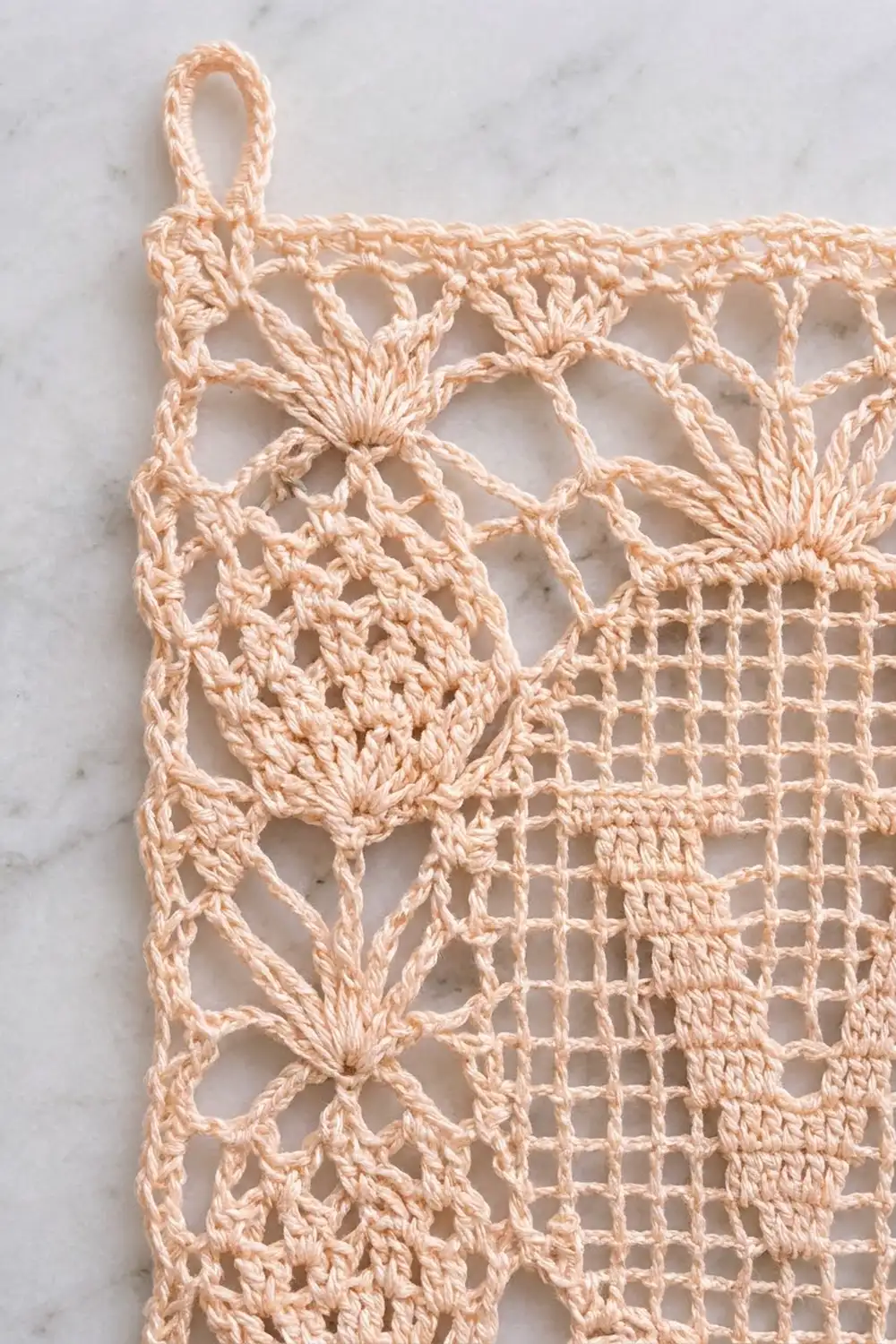
Pineapple Rows (39 sts each)
- P1 (shell base): Ch 15, sk 19 sts, 9 dc in the next st, ch 15, sk 19 sts. (15 + 9 + 15 = 39)
- P2: Ch 11, dc in the first dc of the shell, (ch 1, dc in next dc) 8 times, ch 11. (11 + 17 + 11 = 39)
- P3: Ch 5, dc in the first ch-1 sp, (ch 3, dc in next ch-1 sp) 7 times, ch 5. (5 + 29 + 5 = 39)
- P4: Ch 7, dc in the first ch-3 sp, (ch 3, dc in next ch-3 sp) 6 times, ch 7. (7 + 25 + 7 = 39)
- P5: Ch 9, dc in the first ch-3 sp, (ch 3, dc in next ch-3 sp) 5 times, ch 9. (9 + 21 + 9 = 39)
- P6: Ch 11, dc in the first ch-3 sp, (ch 3, dc in next ch-3 sp) 4 times, ch 11. (11 + 17 + 11 = 39)
- P7: Ch 13, dc in the first ch-3 sp, (ch 3, dc in next ch-3 sp) 3 times, ch 13. (13 + 13 + 13 = 39)
- P8: Ch 15, dc in the first ch-3 sp, (ch 3, dc in next ch-3 sp) 2 times, ch 15. (15 + 9 + 15 = 39)
- P9: Ch 17, dc in the first ch-3 sp, ch 3, dc in the next ch-3 sp, ch 17. (17 + 5 + 17 = 39)
- P10 (crown base): Ch 17, 5 dc in the last ch-3 sp, ch 17. (17 + 5 + 17 = 39)
- P11 (crown fan): Ch 15, dc in the first dc, (ch 1, dc in next dc) 4 times, ch 15. (15 + 9 + 15 = 39)
- P12 (separator mesh): (Dc, ch 2, sk 2) 13 times. (39)
The shell in P1 opens into the lattice in P3. The lattice then narrows one loop per row until P9, which forms the pineapple’s tapered body. P10–P11 fan out into the leafy crown, and P12 resets the column on a flat mesh base.
Filet Rows (76 sts each)
Work 25 filet units in the order listed for each row, then end with the closing dc. That makes 25 x 3 + 1 = 76 sts in every row. Bl means block and sp means space.
- F1: 25 sp
- F2: 8 sp, 9 bl, 8 sp
- F3: 5 sp, 3 bl, 9 sp, 3 bl, 5 sp
- F4: 3 sp, 2 bl, 15 sp, 2 bl, 3 sp
- F5: 2 sp, 1 bl, 19 sp, 1 bl, 2 sp
- F6: 1 sp, 1 bl, 10 sp, 1 bl, 10 sp, 1 bl, 1 sp
- F7: 1 sp, 1 bl, 9 sp, 3 bl, 9 sp, 1 bl, 1 sp
- F8: 1 sp, 1 bl, 8 sp, 5 bl, 8 sp, 1 bl, 1 sp
- F9: 1 sp, 1 bl, 8 sp, 2 bl, 1 sp, 2 bl, 8 sp, 1 bl, 1 sp
- F10–F11: 1 sp, 1 bl, 7 sp, 2 bl, 3 sp, 2 bl, 7 sp, 1 bl, 1 sp
- F12–F13: 1 sp, 1 bl, 6 sp, 2 bl, 5 sp, 2 bl, 6 sp, 1 bl, 1 sp
- F14–F15: 1 sp, 1 bl, 5 sp, 2 bl, 7 sp, 2 bl, 5 sp, 1 bl, 1 sp
- F16–F17: 1 sp, 1 bl, 4 sp, 2 bl, 9 sp, 2 bl, 4 sp, 1 bl, 1 sp
- F18–F19: 1 sp, 1 bl, 3 sp, 2 bl, 11 sp, 2 bl, 3 sp, 1 bl, 1 sp
- F20: 2 sp, 1 bl, 1 sp, 4 bl, 9 sp, 4 bl, 1 sp, 1 bl, 2 sp
- F21: Same as F4.
- F22: Same as F3.
- F23: Same as F2.
- F24: Same as F1.
The blocks in F2–F23 trace the circle outline. The V starts from a single-block point in F6, splits into two arms that move outward, and finishes with the serifs in F20.
Rows 28–99: Work three more medallion blocks, for 4 blocks in total.
Rows 100–101: Work 2 rows of mesh (as in Row 2). (160 sts each)
Row 102: Ch 3 (counts as dc), dc in each st and ch across. (160 sts) Do not fasten off.
Checkpoint: The panel measures 20 in x 34 in (50.8 cm x 86.4 cm).
Make All Pieces
Make 2 panels, both in peach. Each panel needs about 200 g (548 m). Set the second panel’s hook and tension using your notes from the first, and check that it matches at every checkpoint above.
Layout (as hung):
[ Panel A ][ Panel B ]
 4 medallions   4 medallions
Joining (None) and Hanging Check
The panels are not joined to each other. Each one hangs on its own four tabs, which lets you draw either panel aside separately.
Compare the two panels after blocking. Their lengths should match within 1/4 in (0.6 cm). If one is longer, re-wet it and block it to the shorter panel’s length.
Border
Border gauge: 8 sc = 1 in (2.5 cm) along every edge, which matches the body gauge.
Round 1: Continue from Row 102 with the right side facing.
– Top: Sc in each st across. (160 sc) Ch 2 for the corner.
– First side: Work along the row ends. Work 3 sc in each of the next 2 rows, then 2 sc in the next row. Repeat this sequence 34 times. (272 sc) Ch 2 for the corner.
– Bottom: Sc in each foundation ch. (160 sc) Ch 2 for the corner.
– Second side: Work as for the first side. (272 sc) Ch 2 for the corner, then sl st to the first sc.
Round total: 160 + 272 + 160 + 272 = 864 sc, plus 4 ch-2 corner sps. The corner sps are separate from the side counts, so nothing is counted twice.
Why the math works: The sides span 102 rows, or 34 in. At 8 sc per 3 rows, that gives 34 x 8 = 272 sc, or 8 per inch. The top and bottom each have 160 sts over 20 in, which is also 8 per inch, so the edges lie flat. The panel now measures 20.25 in x 34.25 in (51.4 cm x 87.0 cm). Fasten off.
Scalloped Hem (bottom edge only)
Row S1: Join with the right side facing. Sc in the corner sp, then (ch 5, sk 6 sc, sc in next sc) 22 times. Ch 5, sk the last 6 sc, sc in the opposite corner sp. Turn. (23 ch-5 loops, 24 sc)
Why the math works: The 160 sc plus one step into the far corner sp make 161 steps. Since 161 = 23 x 7, every loop spans exactly 7 steps.
Row S2: Ch 1, sl st in the first sc. Then work [(sc, 9 dc, sc) in the next ch-5 loop, sl st in the next sc] 23 times. Turn. (23 fans of 11 sts = 253 sts, plus 24 sl sts)
Row S3: Ch 1. In each fan, sc in each st, adding a picot after the 3rd, 5th, and 7th dc. Skip the sl sts. Fasten off. (253 sc + 69 picots)
Checkpoint: The scallops add 1.25 in (3.2 cm), so the panel now measures 35.5 in (90.2 cm) long.
Hanging Tabs (top edge)
Row T1: Join in the top-right corner sp with the right side facing. Ch 1, then work across the 160 top sc.
– Sc in the first 13 sc.
– Make a tab: sc in next sc, ch 28, sk 6, sc in next sc.
– Then work (sc in next 34 sc, tab) 3 times.
– Sc in the last 13 sc. Turn.
Consumed: 13 + 8 + 34 + 8 + 34 + 8 + 34 + 8 + 13 = 160 sts. Made: 136 sc plus 4 ch-28 loops.
Row T2: Ch 1. Sc in each sc, and work 40 sc over each ch-28 loop. Fasten off. (136 + 160 = 296 sc)
Each ch-28 loop is 3.5 in (8.9 cm) long, which is enough to slide over a 1 in (2.5 cm) rod. The loops stand 1.5 in (3.8 cm) above the edge.
Final Blocking
- Weave in all ends along solid stitches. Never weave them through the mesh.
- Soak the panel in cool water with a little wool wash for 15 minutes. Press out the water in a towel without wringing.
- Pin the four corners to a 20.25 in x 34.25 in (51.4 cm x 87.0 cm) rectangle, not counting the scallops.
- Pin the side edges straight every 2 in (5.1 cm).
- Pin each scallop into a round fan, and open every picot.
- Ease each medallion into a true circle, and square up the filet mesh.
- Spread the pineapple lattices so each ch-3 loop opens evenly.
- Mist with water and let the panel dry completely, for at least 24 hours.
- Repeat for the second panel, matching its pins to the first.
Final Quality-Control Checklist
- Every body row counts 160 sts: 3 + 39 + 76 + 39 + 3.
- Each panel has four medallions, and each has a clear V with its serifs.
- Each panel has eight pineapples down each side (two per medallion), each with a lattice body and a fan crown.
- Border Round 1 has 160 / 272 / 160 / 272 sc plus 4 corner sps.
- There are 23 even scallops with 69 picots.
- Four tabs sit at matching positions on both panels.
- Each panel measures 20.25 in x 35.5 in (51.4 cm x 90.2 cm) after blocking.
Troubleshooting
- Panel narrows toward the top: Your chains are tightening. Count each section at its markers, and chain more loosely in the pineapple rows.
- V looks blurry: Make sure every block has exactly 3 dc. Two-dc blocks thin out the letter.
- Pineapple puckers: The side chains in P1 and P9–P10 are too short or too tight. Loosen them, or go up 0.25 mm for those rows only.
- Wavy side edges: Too many sc in Border Round 1. Return to the 3-3-2 sequence.
- Scallops cup: Block them flat, and make sure each ch-5 loop skips exactly 6 sc.
- Tabs too tight on the rod: Work ch 32 instead, with 46 sc over each loop in Row T2.
Care
Hand wash cool, roll in a towel, and dry flat while pinned to shape. Press on the wrong side with a warm iron and a cloth if needed.
Final Notes
The measurement chain is simple:
– 8 sts and 3 rows per inch give a 160-st row, which is 20 in (50.8 cm) wide.
– 102 rows give 34 in (86.4 cm) of length.
– The sc border brings the panel to 20.25 in x 34.25 in (51.4 cm x 87.0 cm).
– The scallops add 1.25 in (3.2 cm), for 35.5 in (90.2 cm).
– The tabs add 1.5 in (3.8 cm), for 37 in (94.0 cm) of total hanging length.
Check your first block, and the rest will follow. Happy crocheting!