
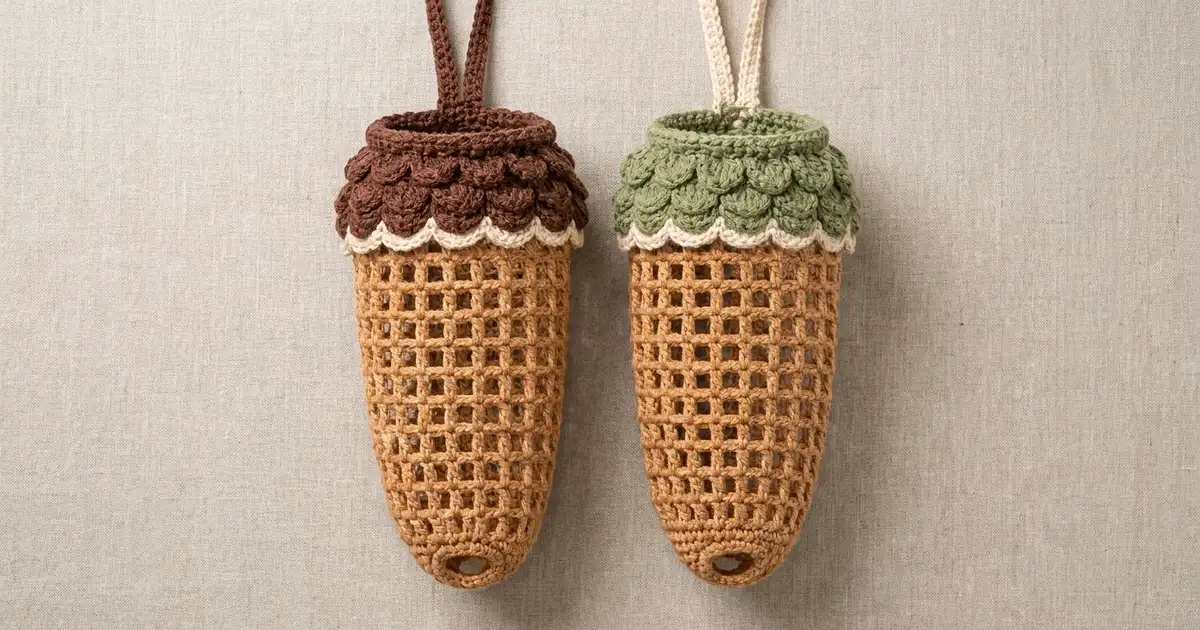
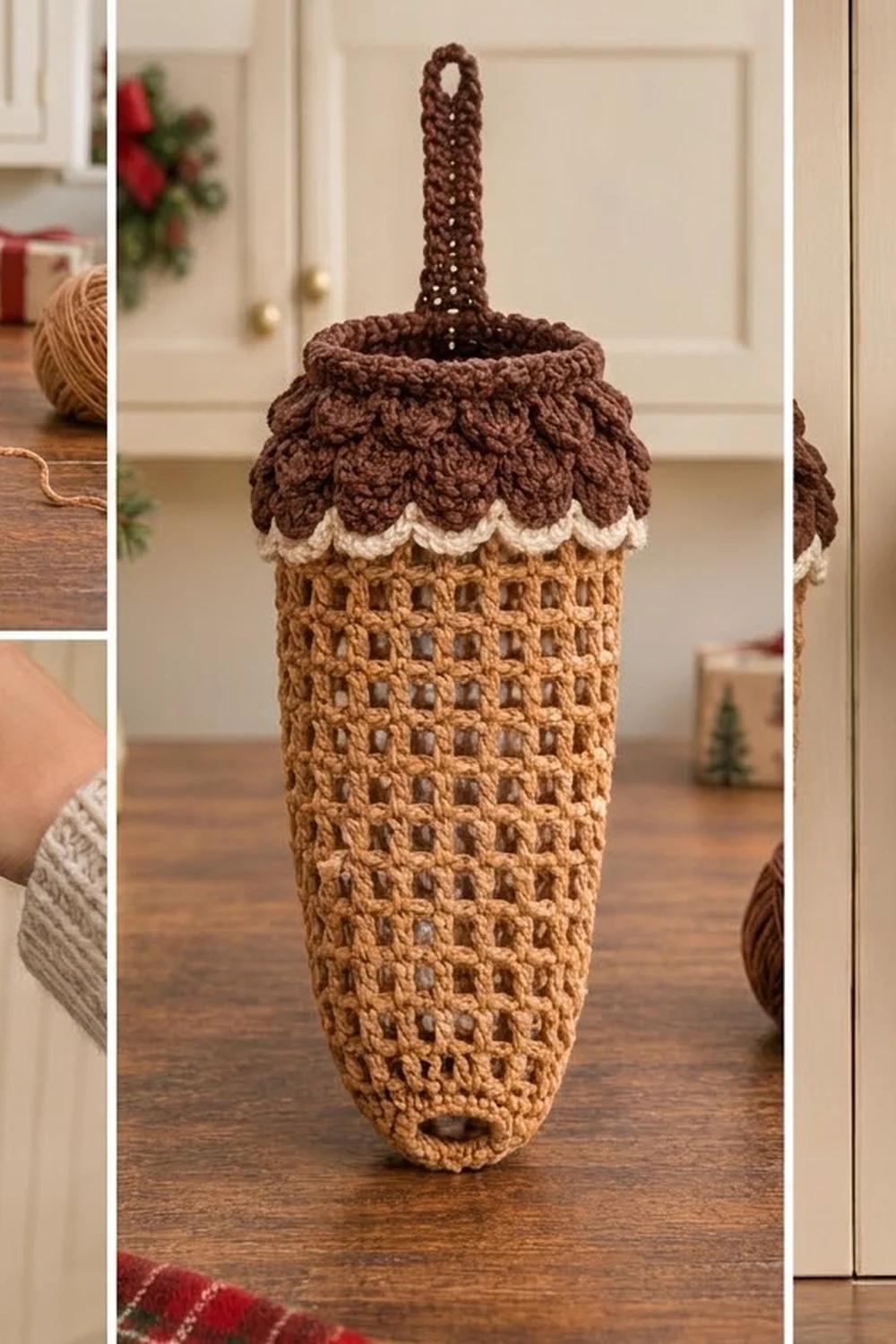
This acorn-shaped plastic bag holder keeps your bag stash tidy. The long, tapered body is an open mesh in warm caramel tan. On top sits a chocolate-brown cap covered in overlapping scales. A small cream scallop edging runs between the cap and the body, and a brown loop is used for hanging. You push bags in through the top and pull them out one at a time from the small opening at the tip.
The style is rustic and cozy. It suits a kitchen all year and looks especially good in autumn and over the holidays. For a softer look, make the cap in sage green and the loop in cream.
This pattern uses US crochet terms. The finished holder is 13 in (33.0 cm) tall from tip to rim and 6.5 in (16.5 cm) wide at its widest point when laid flat. The hanging loop adds 6 in (15.2 cm), so the total hanging length is 19 in (48.3 cm).
You work the holder from the bottom up in joined rounds, starting with a chain ring that becomes the dispensing hole. A short single crochet cone turns into double crochet mesh, which widens and then works even. Next come one cream scallop round and three tiers of brown scales. The scales are worked in front loops, and the base rounds are worked in back loops. A single crochet rim and a strap worked straight from the rim finish the holder. It is all one piece, so the only sewing is tacking down the loop.
Finished Size and Construction
- Finished size: 13 in (33.0 cm) tall x 6.5 in (16.5 cm) wide, measured flat
- Hanging loop: 6 in (15.2 cm) tall
- Skill level: Easy-intermediate
- Terminology: US
- Yarn weight: Worsted (#4) cotton
- Hook: 5.0 mm (H-8)
- Number of pieces: 1 (the strap is worked directly from the rim)
- Layout: One tube, worked bottom-up in joined rounds
- Piece size: 13 in (33.0 cm) tall; 13 in (33.0 cm) around at the widest point
- Size before border: 12 in (30.5 cm) tall through Rnd 28
- Border depth: 1 in (2.5 cm) single crochet rim
Materials
Use a smooth worsted-weight cotton or cotton blend. Cotton keeps the mesh crisp and holds the acorn shape when the holder is full. Acrylic also works, but the body will stretch more under the weight of the bags. Pick a tan that clearly contrasts with your cap color so the scales stand out.
- Caramel tan (body): 70 g / 105 m
- Chocolate brown (cap, rim, loop): 50 g / 75 m
- Cream (scallop edging): 8 g / 12 m
These quantities include a margin of about 15%.
Tools:
– 5.0 mm (H-8) crochet hook
– Locking stitch marker
– Tapestry needle
– Scissors
– Measuring tape
– Rustproof pins and a spray bottle for blocking
Abbreviations (US Terms)
- ch – chain
- sl st – slip stitch
- sc – single crochet
- dc – double crochet
- sc2tog – single crochet 2 together
- sp – space
- st(s) – stitch(es)
- BLO / FLO – back loop only / front loop only
- Rnd – round
- beg – beginning
Square: (dc in next dc, ch 1). One square counts as 2 sts.
Inc square: (dc in next dc, ch 1, dc in the ch-1 sp just after that dc, ch 1). This turns 1 square into 2 squares.
Scale: 7 dc in the same st.
Gauge and Checkpoints
- Single crochet: 16 sts x 16 rnds = 4 in (10.2 cm)
- Mesh: 8 squares = 4 in (10.2 cm) wide; 4 mesh rnds = 2.5 in (6.4 cm) tall
The holder is a single piece, so the body itself is your gauge test. Work through Rnd 9, then measure before you go on. Measure with the piece lying flat and relaxed, not stretched.
Checkpoints:
– After Rnd 3: top edge measures 10 in (25.4 cm) around.
– After Rnd 9: flat width is 6.5 in (16.5 cm).
– After Rnd 19: height is 10.75 in (27.3 cm).
– After Rnd 28: height is 12 in (30.5 cm).
– After Rnd 32: height is 13 in (33.0 cm).
If your piece is too big, go down one hook size and start again. If it is too small, go up one hook size. If only the mesh height is off, add or remove an even round between Rnds 10 and 19. Don’t change any stitch counts, because the cap math depends on them.

Body (Caramel Tan)
Foundation: Ch 20 and sl st in the first ch to form a ring, without twisting it. This ring becomes the dispensing hole, about 1.5 in (3.8 cm) across.
Rnd 1: Ch 1, sc in each ch around, sl st to first sc. (20 sc)
Rnd 2: Ch 1, sc in next st, 2 sc in next st 10 times, sl st to first sc. (30 sc)
Rnd 3: Ch 1, sc in next 2 sts, 2 sc in next st 10 times, sl st to first sc. (40 sc)
The piece is now a shallow cone, the tip of the acorn. It is about 0.75 in (1.9 cm) tall.
Rnd 4 (conversion to mesh): Ch 4 (counts as dc + ch 1), skip next sc, dc in next sc, ch 1, skip next sc 19 times, sl st in 3rd ch of beg ch-4. (40 sts: 20 dc + 20 ch-1 sps = 20 squares)
Every mesh round starts with ch 4 (counts as dc + ch 1) and joins with a sl st in the 3rd ch of the beg ch-4. The beg ch-4 counts as the first square. When an inc square falls on the first square, work: ch 4, dc in next ch-1 sp, ch 1.
Rnd 5: Inc square, 9 squares, inc square, 9 squares. (22 squares = 44 sts)
Rnd 6: Work a square in each square around. (22 squares = 44 sts)
Rnd 7: Inc square, 10 squares, inc square, 10 squares. (24 squares = 48 sts)
Rnd 8: Work a square in each square around. (24 squares = 48 sts)
Rnd 9: Inc square, 11 squares, inc square, 11 squares. (26 squares = 52 sts)
Checkpoint: 13 in (33.0 cm) around and 6.5 in (16.5 cm) flat.
Rnds 10–19: Work a square in each square around. (26 squares = 52 sts in each round)
Each dc sits on top of the dc below, so the mesh forms the straight vertical columns that give the acorn its grid look.
Rnd 20: Ch 1, sc in each dc and in each ch-1 sp around, sl st to first sc. (52 sc: 26 in dc + 26 in ch-1 sps)
Height checkpoint: 11 in (27.9 cm). Fasten off the tan yarn.
Cream Scallop Edging
Rnd 21: Working in FLO of Rnd 20, join cream with a sc in any st. Skip 1 st, 5 dc in next st, skip 1 st, sc in next st around. End the round with skip 1, 5 dc, skip 1, and sl st to the first sc. (13 scallops: 13 sc + 65 dc)
Fasten off the cream yarn. The scallops hang down over the top of the mesh, and the back loops of Rnd 20 are still free.
Scaled Cap (Chocolate Brown)
The cap alternates two kinds of rounds. Each base round is worked in back loops, and each scale round is worked in the front loops of that same base round. This puts every tier of scales in front of the tier below, like the scales on a real acorn cap.
Rnd 22: Working in the free BLO of Rnd 20, join brown with a sc in any st, sc in each st around, sl st to first sc. (52 sc)
Rnd 23 (scale tier 1): Ch 1. Working in FLO of Rnd 22, sc in first st, skip 1, scale in next st, skip 1, sc in next st around. End with skip 1, scale, skip 1, and sl st to first sc. (13 scales: 13 sc + 91 dc)
Rnd 24: Working in the free BLO of Rnd 22, ch 1, sc in next 11 sts, sc2tog 4 times, sl st to first sc. (48 sc)
Rnd 25 (scale tier 2): Working in FLO of Rnd 24, sl st in first 2 sts, ch 1, sc in next st, skip 1, scale in next st, skip 1, sc in next st around. End with skip 1, scale, skip 1, and sl st to first sc. (12 scales: 12 sc + 84 dc)
Starting 2 sts over staggers the scales so they sit between the scales of the tier below.
Rnd 26: Working in the free BLO of Rnd 24, ch 1, sc in next 10 sts, sc2tog 4 times, sl st to first sc. (44 sc)
Rnd 27 (scale tier 3): Work as for Rnd 25, in FLO of Rnd 26. (11 scales: 11 sc + 77 dc)
Rnd 28: Working in the free BLO of Rnd 26, ch 1, sc in next 9 sts, sc2tog 4 times, sl st to first sc. (40 sc)
Checkpoint: 12 in (30.5 cm) tall. The scale rounds add no height because they share stitches with the base rounds.
Border: Top Rim and Hanging Loop
Border gauge: 16 sc = 4 in (10.2 cm); 4 rnds = 1 in (2.5 cm).
Lay the piece flat with the round’s join at one side fold. Rnd 28 has 40 sts, so there are 20 sts on the front and 20 sts on the back.
Rnds 29–32: Ch 1, sc in both loops of each st around, sl st to first sc. (40 sc in each round: 20 front + 20 back)
Don’t fasten off.
Why the math works: At 16 sts per 4 in, 40 sts give a circumference of 10 in (25.4 cm), or 5 in (12.7 cm) measured flat. That matches the mesh at Rnd 4. Because the rim is narrower than the 6.5 in (16.5 cm) widest point, bags stay inside, but there is still room for your hand. Each scale uses a 4-st repeat, which divides evenly into 52, 48 and 44. Each sc2tog round removes exactly 4 sts, which is one repeat, so each tier has one scale fewer than the tier below.
Hanging loop: Find the center 4 sts of the back (sts 9–12 of the 20 back sts). Sl st across the rim to the first of these.
Row 1: Ch 1, sc in the same st and in the next 3 sts, turn. (4 sc)
Rows 2–48: Ch 1, sc in each st across, turn. (4 sc in each row)
The strap is 12 in (30.5 cm) long and 1 in (2.5 cm) wide. Fasten off, leaving a 10 in (25.4 cm) tail.
Fold the strap in half. Sew Row 48 to the inside of the rim directly behind Row 1, stitching through Rnds 31–32. This makes a doubled loop 6 in (15.2 cm) tall. Weave in all ends.
Final Blocking
- Spritz the whole piece lightly with water until it is evenly damp.
- Stuff it firmly with plastic bags or a rolled towel to fill out the acorn shape.
- Straighten the mesh columns so they run vertically from tip to cap.
- Pin each scale so it curves downward and overlaps the tier below.
- Pin the cream scallops so they are evenly spaced and sit level just under the cap.
- Shape the dispensing hole into a round opening about 1.5 in (3.8 cm) across.
- Let the piece dry completely, then remove the stuffing and check your measurements.
Final Quality-Control Checklist
- Height is 13 in (33.0 cm) from tip to rim.
- Flat width is 6.5 in (16.5 cm) at the widest point.
- Rim is 5 in (12.7 cm) flat, with 40 sts.
- Mesh shows 26 straight columns.
- There are 13 cream scallops, plus brown scale tiers of 13, 12 and 11.
- The loop is centered at the back, 6 in (15.2 cm) tall and firmly sewn.
- The dispensing hole is round, and all ends are hidden.
Troubleshooting
Mesh columns lean or spiral: Work each dc into the dc below, not into the ch-1 sp. The only exception is the extra dc in an inc square.
Square count is off: Count the dc posts, and mark the beg ch-4 in every round.
Scales ruffle or cup too much: Your tension is loose. Try 6 dc per scale and keep the 4-st repeat.
Scales lie flat and don’t overlap: Check that each scale round goes into the FLO of the base round, and that the next base round goes into the BLO of that same round.
Cream scallops flip upward: Make sure Rnd 21 is in FLO, then block the scallops pointing down.
Bags slide out of the tip: Start with a ch-18 ring and work 18 sc in Rnd 1. Then work Rnd 2 as sc in next st, 2 sc in each of next 2 sts 6 times, for 30 sc.
Loop stretches: Use cotton yarn, and sew through all layers of the strap.
Care
Hand wash in cool water and dry flat, reshaping the piece while it is damp. Don’t tumble dry, because the mesh can stretch.
Final Notes
Check each measurement as you go. The tip cone ends at 10 in (25.4 cm) around and 0.75 in (1.9 cm) tall. The mesh grows to 13 in (33.0 cm) around and reaches 11 in (27.9 cm) tall after Rnd 20. The scaled cap brings the height to 12 in (30.5 cm), and the rim finishes it at 13 in (33.0 cm), topped by a 6 in (15.2 cm) loop. If every checkpoint matches, your acorn will hang straight and hand out one bag at a time.
Happy crocheting!