

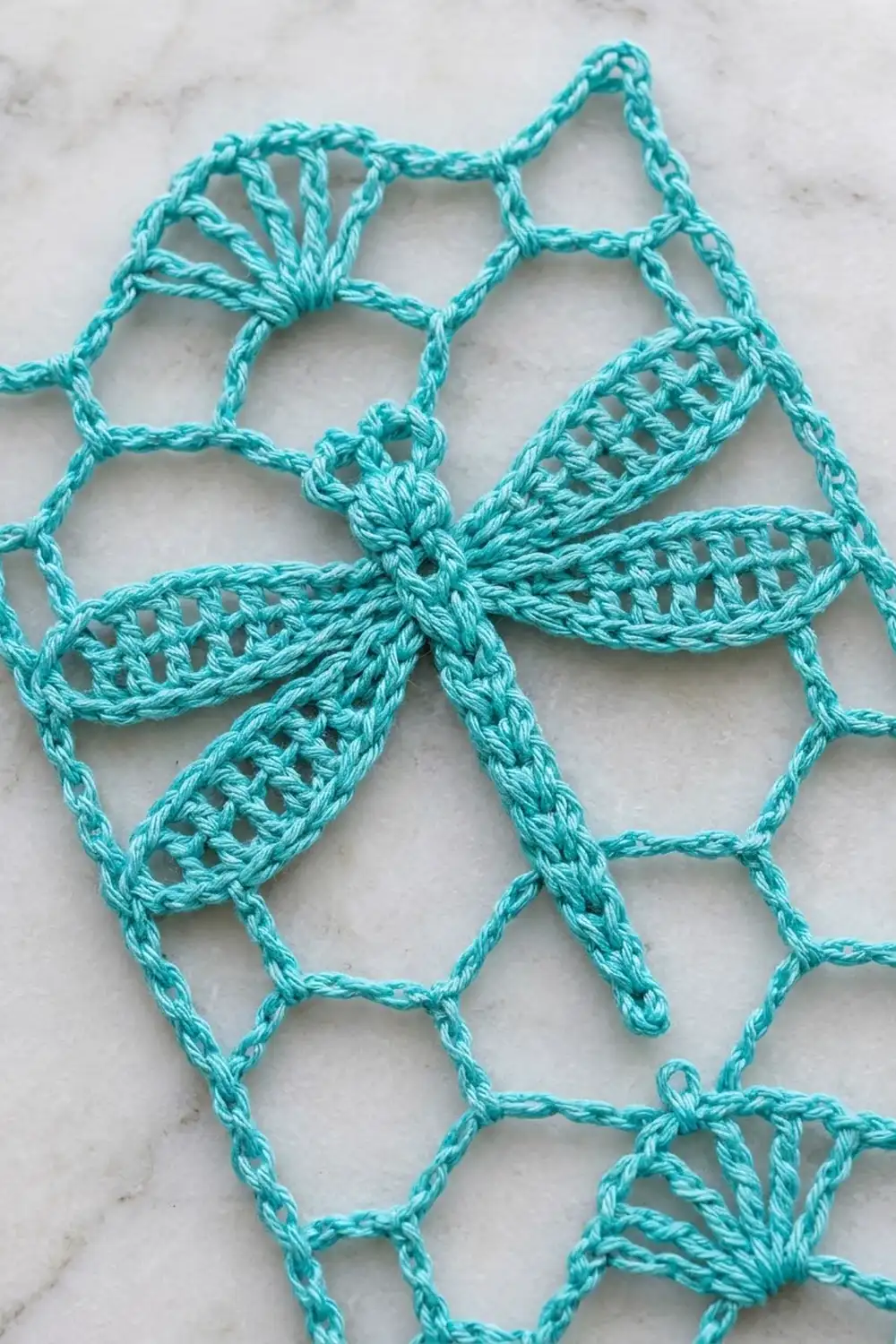
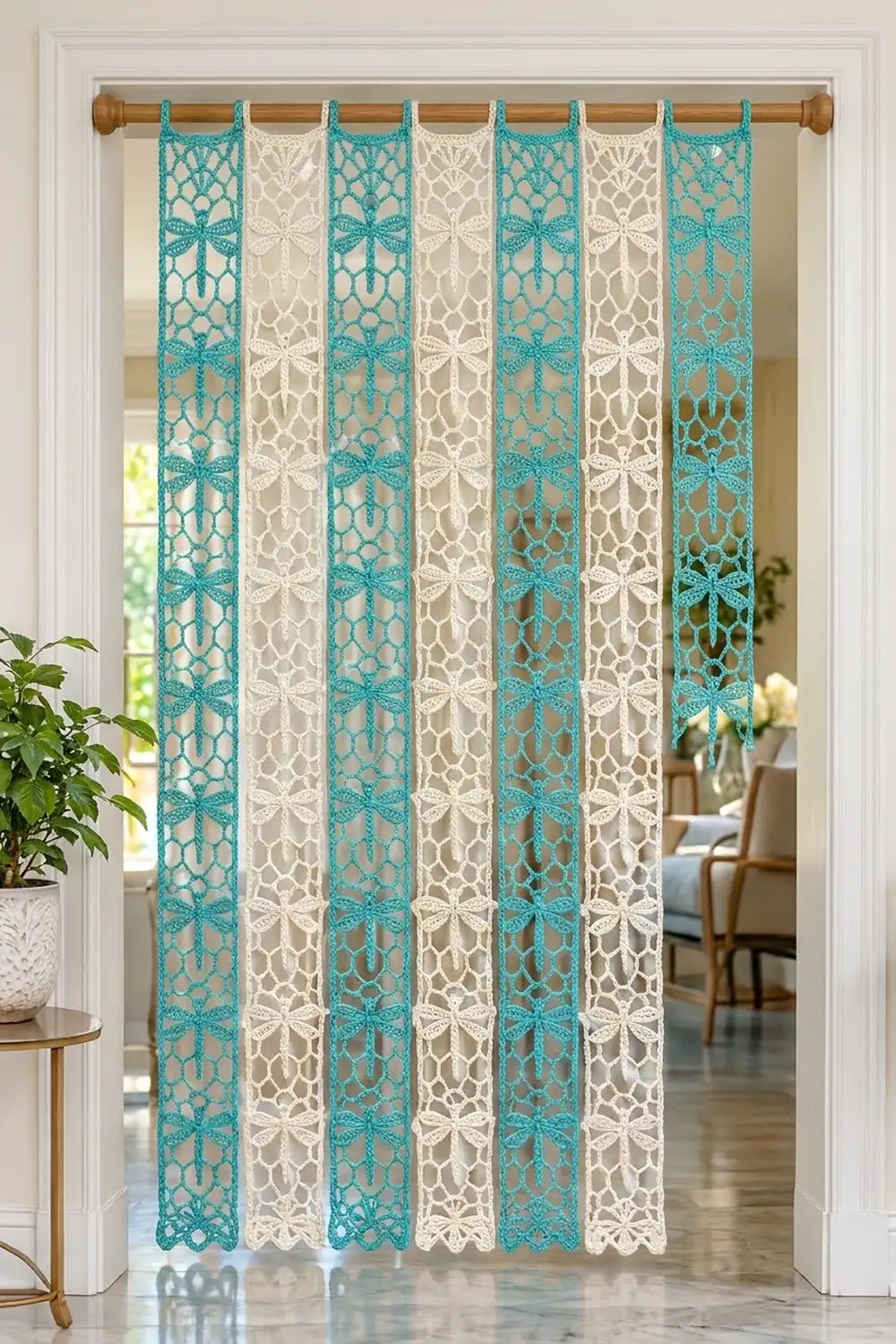
This airy door curtain is seven lacy strips hung side by side from one rod. Each strip is an open honeycomb-style mesh. Every 7 in (17.8 cm), a small upward-opening fan shell sits above a dragonfly with a bobble head, a segmented tail, and two pairs of ladder-textured wings.
The sample alternates four turquoise strips with three cream strips, starting and ending with turquoise. Each dragonfly matches its strip, so the motifs read as texture rather than contrast.
The pattern uses US crochet terms. Each strip measures 5 in (12.7 cm) wide by 79 in (200.7 cm) long after the border. A rod sleeve adds 2 in (5.1 cm) above that. Hung with 0.5 in (1.3 cm) gaps, the curtain is 38 in (96.5 cm) wide.
To make it, work each strip in rows from the bottom up, then add a two-round border and a rod sleeve. Make the dragonflies in three small parts and stitch them on.
Finished Size and Construction
- Finished strip: 5 in x 79 in (12.7 cm x 200.7 cm), plus a 2 in (5.1 cm) rod sleeve
- Skill level: Intermediate
- Terminology: US
- Yarn weight: DK (#3) cotton
- Hook: 3.5 mm (E-4)
- Number of pieces: 7 strips plus 77 dragonflies (3 parts each)
- Layout: 7 strips in a row, hung separately, not joined
- Strip size before border: 4.5 in x 78.5 in (11.4 cm x 199.4 cm)
- Border depth: 0.25 in (0.6 cm) on each side
- Repeat: 11 dragonfly blocks per strip, each 7 in (17.8 cm) tall
Materials
Use a smooth mercerized DK cotton, about 115 m (125 yd) per 50 g. Cotton holds lace open and resists sagging. Avoid fuzzy yarns, which hide the mesh.
- Turquoise: 450 g (about 1,035 m), for 4 strips and 44 dragonflies
- Cream: 350 g (about 805 m), for 3 strips and 33 dragonflies
Each finished strip uses about 100 g (230 m), including its dragonflies. The quantities above include a margin of roughly 50 g per color for swatching and tails.
Tools: 3.5 mm (E-4) hook, tapestry needle, stitch markers, tape measure, rust-proof pins, a long blocking surface, and a curtain rod up to 1.25 in (3.2 cm) in diameter.
Abbreviations (US Terms)
- ch – chain
- sl st – slip stitch
- sc – single crochet
- hdc – half double crochet
- dc – double crochet
- tr – treble crochet
- sk – skip
- sp – space
- tch – turning chain
- BLO / FLO – back loop only / front loop only
- rev sc – reverse single crochet (crab stitch), worked left to right
- Popcorn – 5 dc in the same stitch. Drop the loop, insert the hook in the first dc, and pull the dropped loop through.
Gauge and Checkpoints
- Solid sc: 22 sts and 24 rows = 4 in (10.2 cm)
- Strip width: 25 sts = 4.5 in (11.4 cm)
- One block (12 mesh rows): 7 in (17.8 cm) tall, blocked
Test one piece first. Work Rows 1–14, which are the base plus one block, and pin the swatch out lightly. Also make one dragonfly.
Checkpoints:
- After Row 2: 4.5 in (11.4 cm) wide
- After Row 14: 7.75 in (19.7 cm) tall
- After Row 74: 42.75 in (108.6 cm) tall
- After Row 136: 78.5 in (199.4 cm) tall
- Upper wings: 4.25 in (10.8 cm) tip to tip
- Lower wings: 3.5 in (8.9 cm) tip to tip
- Body including head: 3.75 in (9.5 cm)
If your swatch is too big, go down a hook size. If it’s too small, go up one size. If only the height is off, adjust the tension of your ch-5 loops.
Strip Pattern
There are three row types:
- X rows start and end with sc (7 sc, 6 loops).
- Y rows start and end at dc height (6 sc, 5 loops, and a half loop at each edge).
- X-fan rows are X rows with a fan in the center.
Row 1 (foundation): Ch 26. Sc in 2nd ch from hook and in each ch across. Turn. (25 sc)
Row 2: Ch 1, sc in first sc, [ch 5, sk 3 sc, sc in next sc] 6 times. Turn. (7 sc, 6 ch-5 loops)
The Block (Rows 3–14, repeat 11 times)
Block Row 1: Which version you work depends on the block.
- Block 1 (regular Y): Ch 5 (counts as dc + ch 2), sc in first ch-5 loop, [ch 5, sc in next ch-5 loop] 5 times, ch 2, dc in last sc. Turn. (6 sc, 5 ch-5 loops, 2 half loops)
- Blocks 2–11 (Y-after-fan): Ch 5 (counts as dc + ch 2), sc in first ch-5 loop, ch 5, sc in next ch-5 loop, ch 5, sk ch-2 sp, sc in 3rd dc of fan, ch 5, sc in 7th dc of fan, ch 5, sk ch-2 sp, sc in next ch-5 loop, ch 5, sc in last ch-5 loop, ch 2, dc in last sc. Turn. (6 sc, 5 ch-5 loops, 2 half loops)
In the Y-after-fan row, the center loop arches over the fan.
Block Rows 2, 4, 6, 8, 10 (X rows): Ch 1, sc in first dc, [ch 5, sc in next ch-5 loop] 5 times, ch 5, sc in 3rd ch of tch. Turn. (7 sc, 6 ch-5 loops)
Block Rows 3, 5, 7, 9, 11: Work a regular Y row. (6 sc, 5 ch-5 loops, 2 half loops)
Block Row 12 (X-fan): Ch 1, sc in first dc, ch 5, sc in next ch-5 loop, ch 5, sc in next ch-5 loop, ch 2, 9 dc in center ch-5 loop, ch 2, sc in next ch-5 loop, ch 5, sc in next ch-5 loop, ch 5, sc in 3rd ch of tch. Turn. (6 sc, 4 ch-5 loops, 2 ch-2 sps, one 9-dc fan)
Each block has 6 Y rows and 6 X rows. Block 1 is Rows 3–14, and Block 11 is Rows 123–134.
Top Rows
Row 135: Work a Y-after-fan row.
Row 136 (conversion): Ch 1, sc in first dc, sc in ch-2 sp, [sc in next sc, 3 sc in next ch-5 loop] 5 times, sc in last sc, sc in ch-2 sp of tch, sc in 3rd ch of tch. (1 + 1 + 20 + 1 + 1 + 1 = 25 sc)
Don’t fasten off.
Dragonfly Appliqué
Make 11 per strip, in the strip color. Leave a 12 in (30.5 cm) tail on each part for sewing.
Body
- Ch 20.
- Rnd 1: Sc in 2nd ch from hook and next 17 ch, 3 sc in last ch. Rotate and work in the bottom loops: sc in next 17 ch, 2 sc in last ch. Sl st to first sc. (18 + 3 + 17 + 2 = 40 sc)
- Head: Ch 3, 4 dc in the same st, then close as a popcorn through the top of the ch-3.
- Fasten off.
The stitches on both sides of the chain create the segmented tail.
Upper Wings (one piece)
- Ch 24. The 23 working chains are 11 per wing plus 1 center chain.
- Side 1: Sc in 2nd ch from hook, hdc, dc, [tr, ch 1] in each of next 4 ch, tr, dc, hdc, sc, sl st in center ch, sc, hdc, dc, [tr, ch 1] in each of next 4 ch, tr, dc, hdc, 3 sc in last ch. Work one stitch per chain except where noted.
- Side 2: Rotate and work in the bottom loops: hdc, dc, [tr, ch 1] in each of next 4 ch, tr, dc, hdc, sc, sl st in center ch, sc, hdc, dc, [tr, ch 1] in each of next 4 ch, tr, dc, hdc, 2 sc in the same ch as the first sc. Sl st to first sc.
- Fasten off. (48 sts and 16 ch-1 sps)
The tr posts and ch-1 gaps form the ladder texture. The center sl sts pinch the piece into two ovals.
Lower Wings
Ch 20. Work as for the upper wings, but with only 9 sts per wing: sc, hdc, dc, [tr, ch 1] in each of next 2 ch, tr, dc, hdc, sc. The center sl st goes in the 10th working ch. (40 sts and 8 ch-1 sps)
Make All Pieces
- Turquoise: 4 strips, 44 bodies, 44 upper wings, 44 lower wings
- Cream: 3 strips, 33 bodies, 33 upper wings, 33 lower wings
Rod layout, left to right (T = turquoise, C = cream):
[ T ] [ C ] [ T ] [ C ] [ T ] [ C ] [ T ]
  1     2     3     4     5     6     7
Each strip, bottom to top:
Rows 1-2
Blocks 1-11 (dragonfly below fan)
Rows 135-136, border, rod sleeve
Joining
The strips are never seamed to each other. Each strip gets its own border, so every border count below is for one strip only. In this pattern, “joining” means assembling the dragonflies and attaching them to the strips.
Assemble each dragonfly:
- Lay the body vertically with the head at the top.
- Center the upper wings across the body 0.5 in (1.3 cm) below the head. Sew their center sl sts to the body with 3–4 small stitches.
- Sew the lower wings directly below the upper wings in the same way.
Attach it to the strip, in each block:
- Tack the head to the center loop of Block Row 11, under the fan.
- Tack the body to the center (4th) sc of Block Rows 10, 8, 6, and 4.
- Tack the upper wing tips to the 1st and 6th loops of Row 10.
- Tack the lower wing tips to the 2nd and 5th loops of Row 8, so they angle slightly downward.
Tension: Catch only one strand of the mesh with each tack. Tacks should be firm but should never draw loops together. If a loop distorts, re-stitch it more loosely.
Size checkpoint: With all 11 dragonflies attached, the strip should still lie flat at 4.5 in (11.4 cm) wide.
Border
Border gauge: On the long sides, work 2 sc around each X-row end and 4 sc around each Y-row end. That’s 36 sc per 7 in (17.8 cm) block, or about 5.1 sc per in (2 sc per cm). This is slightly looser than the solid gauge, so the lace edge lies flat.
Rnd 1: With RS facing, ch 1.
- Top edge: 3 sc in the first st of Row 136, sc in next 23 sts, 3 sc in the last st.
- First long side: Working in row ends, work 4 sc in Row 135, 36 sc in each of the 11 blocks, and 2 sc in Row 2. (402 sc)
- Bottom edge: 3 sc in the first st of Row 1, sc in next 23 sts, 3 sc in the last st.
- Second long side: Work 402 sc in the row ends of Rows 2–135.
- Sl st to first sc. (4 x 3 + 2 x 23 + 2 x 402 = 862 sc)
Counts per side, including the corner center stitches:
- Short sides: 1 + 1 + 23 + 1 + 1 = 27 sc
- Long sides: 1 + 402 + 1 + 2 = 406 sc
- Check: 2 x 27 + 2 x 406 − 4 shared corners = 862
Rnd 2: Ch 1. Rev sc in each st around, working the 23 top-edge sts in FLO. Sl st to the first st. (862 worked 1 per existing st + 0 added = 862)
Why the math works: Each short side covers its 25 row stitches plus the corner increases. Each long side follows the row structure: Row 2 + 11 blocks x (6 X + 6 Y) + Row 135 = 2 + 396 + 4 = 402.
Rod Sleeve
- Row 1: Join yarn in the BLO of the first of the 23 top-edge sts. Ch 1, sc in BLO of the same st and next 22 sts. (23 sc)
- Rows 2–24: Ch 1, turn, sc across. (23 sc)
- Fasten off, leaving a 20 in (50.8 cm) tail.
- Fold the sleeve to the WS and whipstitch Row 24 to the back of Row 136.
The finished sleeve is 4.2 in (10.7 cm) wide and 2 in (5.1 cm) deep.
Final Blocking
- Weave in the ends along solid stitches, never through the open mesh.
- Soak each strip in cool water for 15 minutes, then roll it in a towel to remove water. Don’t wring it.
- Pin the strip to 5 in x 79 in (12.7 cm x 200.7 cm), working from the center outward.
- Pin the loops open, and pin each fan into a half circle.
- Ease each wing into an oval and pin the tips.
- Let the strip dry completely, then hang it for 24 hours before the final measurement.
Final Quality-Control Checklist
- Every strip has 11 blocks, with the fans centered and opening upward.
- Each strip is 5 in x 79 in (12.7 cm x 200.7 cm).
- Border Rnd 1 has 862 sc, with 402 sc on each long side.
- Every dragonfly sits head-up directly under its fan.
- All wing ladders are open and flat.
- The rod slides freely through every sleeve.
- The strips alternate four turquoise and three cream.
Troubleshooting
- Strip slants: A loop was missed. X rows have 6 loops, and Y rows have 5.
- Fan off-center: The fan belongs in the 3rd of 5 loops.
- Wavy edges: Your border is too dense. Recheck the 2-and-4 rhythm.
- Tight edges: Use a hook one size larger for Rnd 1.
- Cupped wings: Work the ch-1s looser, or steam the wings flat.
- Stretching when hung: This is normal for cotton. Block the strip, hang it for a day, then measure.
Care
Hand wash in cool water with mild soap and dry flat. Re-block if the mesh shifts.
Final Notes
Here is the measurement chain from start to finish:
- 25 sts give 4.5 in (11.4 cm) of width.
- Each 12-row block adds 7 in (17.8 cm). With the base and top rows, the strip reaches 78.5 in (199.4 cm).
- The border brings each strip to 5 in x 79 in (12.7 cm x 200.7 cm).
- Seven strips with 0.5 in (1.3 cm) gaps hang 38 in (96.5 cm) wide.
Check your first block against these numbers and the rest will follow.
Happy crocheting!