

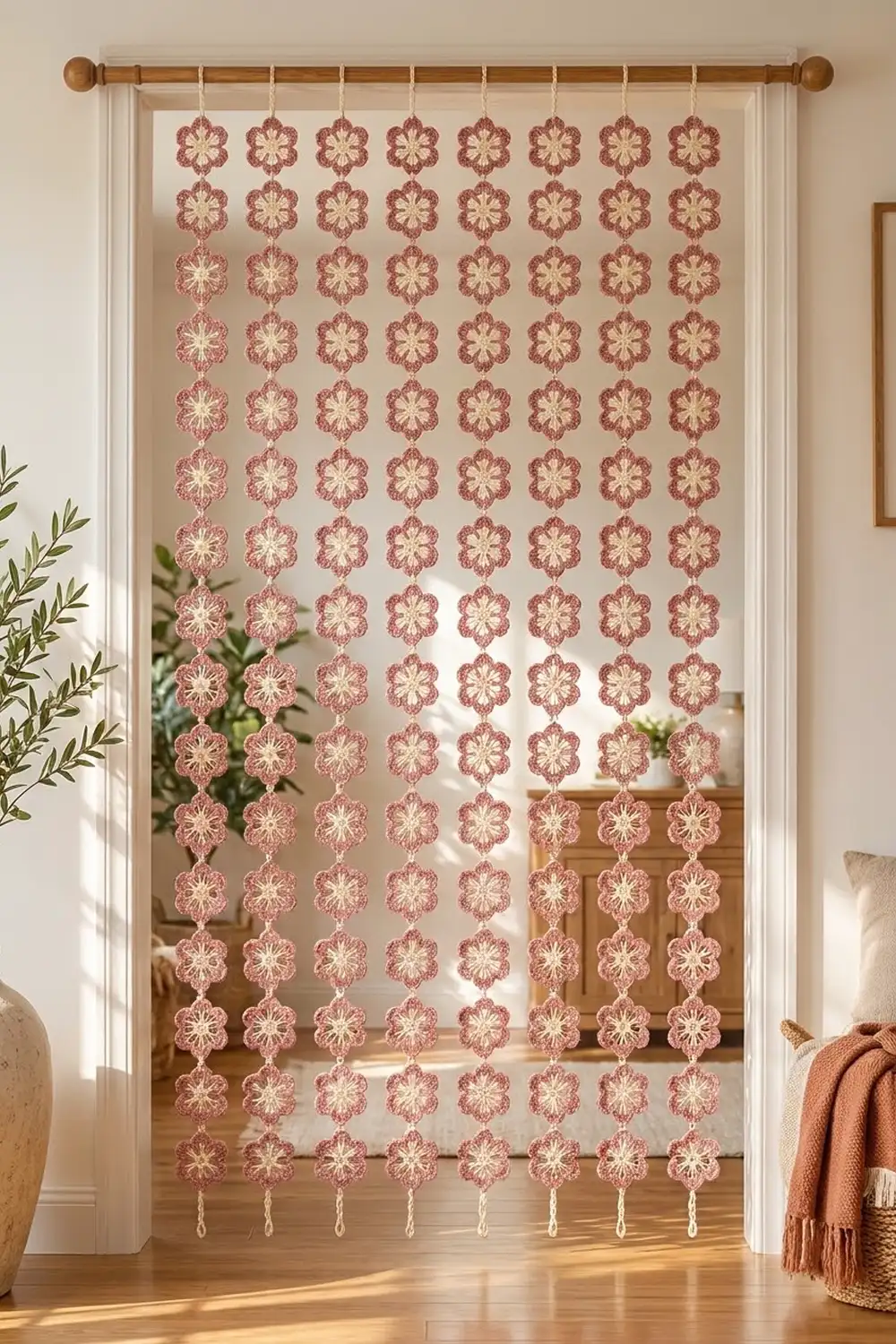
The Blush Blossom curtain is a light, airy doorway curtain made from six-petal lace flowers strung on cream chain links. Each flower has a cream center, cream spokes fanning into every petal, and a soft dusty rose edge. Hung side by side, the strands make a curtain you can walk through, and light still comes in.
The palette is two colors: dusty rose pink and cream. The style is cottage-romantic but simple. Every motif is the same, so after the first few you won’t need the pattern in front of you.
This pattern uses US crochet terms. The finished curtain is 35 in (88.9 cm) wide and 68 in (172.7 cm) long, with 8 strands of 16 flowers each.
Construction overview: you make 128 flower motifs separately, five rounds each. Then you join them into strands with short cream chain links worked valley to valley. Each strand gets a top hanging loop and a bottom tail. Finally, you block the strands and slide them onto a rod.
Finished Size and Construction
- Finished curtain: 35 in (88.9 cm) wide x 68 in (172.7 cm) long
- Skill level: Intermediate (simple stitches, lots of repetition)
- Terminology: US
- Yarn weight: DK / light (#3) cotton
- Hook: 3.5 mm (E-4)
- Number of pieces: 128 flower motifs, joined into 8 strands
- Layout: 8 columns x 16 flowers
- Piece size: 3.5 in (8.9 cm) from petal tip to petal tip, 3 in (7.6 cm) from valley to valley
- Size before border: 2.75 in (7.0 cm) after Round 4
- Border depth: the Round 5 edge adds about 0.375 in (1.0 cm) on each side of each motif. The curtain gets no separate outer border.
Materials
Use a mercerized or combed DK cotton. Cotton holds the petal shape, doesn’t stretch much on a long drop, and washes well. Steer clear of acrylic for this project, because the long strands will slowly stretch.
- Color A, dusty rose pink: about 410 g / 900 m (nine 50 g balls of roughly 110 m each)
- Color B, cream: about 240 g / 520 m (five 50 g balls of roughly 110 m each)
Tools:
- 3.5 mm (E-4) crochet hook
- Tapestry needle
- Scissors
- Stitch marker
- Blocking mat, rust-proof pins, and a spray bottle
- Curtain rod or tension rod, at least 36 in (91.4 cm) usable length
The yarn quantities include a margin of about 15% for gauge differences, joins, and long weaving tails.
Abbreviations (US Terms)
- ch – chain
- sl st – slip stitch
- sc – single crochet
- hdc – half double crochet
- dc – double crochet
- tr – treble crochet (yarn over twice, insert hook, pull up a loop, [yarn over, pull through 2 loops] 3 times)
- sp – space
- MR – magic ring
- st(s) – stitch(es)
Special stitch, tr fan: (tr, ch 2, tr, ch 2, tr) all worked into the same stitch. This makes the three cream spokes inside each petal.
Gauge and Checkpoints
Before buying all the yarn, make one complete motif and block it. Check it against these sizes:
- After Round 2: 1 in (2.5 cm) across
- After Round 3: 2 in (5.1 cm) across the spoke tips
- After Round 4: 2.75 in (7.0 cm) tip to tip
- After Round 5: 3.5 in (8.9 cm) tip to tip, 3 in (7.6 cm) valley to valley
- Chain gauge: 5 ch = 1 in (2.5 cm)
If your motif is larger than 3.5 in (8.9 cm), go down half a hook size. If it’s smaller, go up half a hook size. If only Round 3 is off and the spokes look short or slack, adjust how hard you pull on your tr yarn-overs and leave the hook as it is.
A 0.25 in (0.6 cm) error per motif adds up to 4 in (10.2 cm) over a strand of 16 flowers. That’s why this check matters.
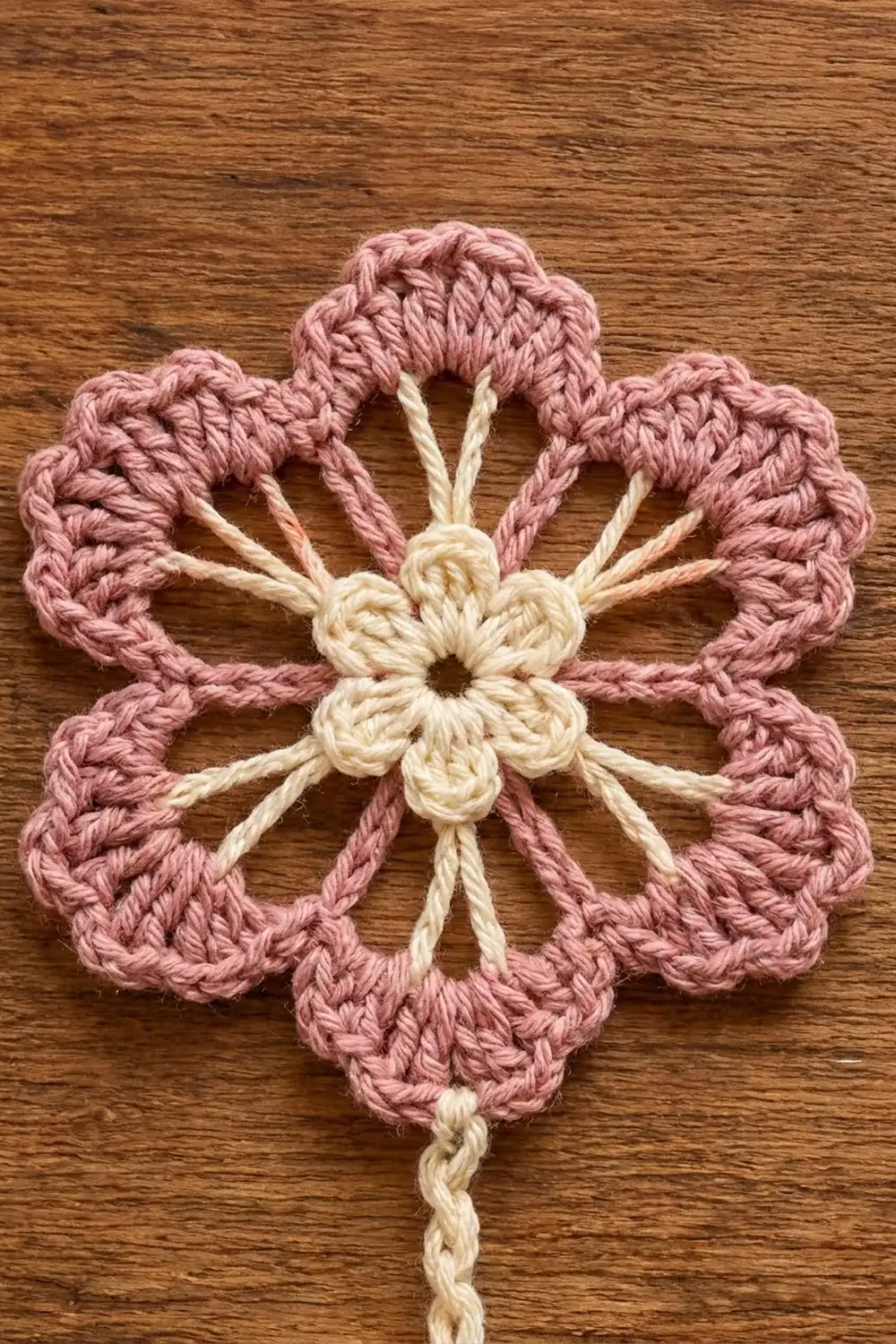
Flower Motif (Make 128)
Round 1 (Color B, cream)
Make a MR. Ch 1, work 12 sc into the ring. Pull the ring closed and join with a sl st to the first sc. (12 sc)
Round 2 (Color B, mini flower)
Ch 1. (Sc, hdc, sc) in next st, sl st in next st. Repeat from * 5 more times. Join with a sl st to the first sc. (6 mini petals; 24 sts: 6 hdc tips, 12 sc, 6 sl sts)
This round makes the small scalloped flower at the center.
Round 3 (Color B, spokes)
Sl st into the next sc and the next hdc. Ch 4 (counts as the first tr), ch 2, tr in the same hdc, ch 2, tr in the same hdc. This is the first tr fan.
Skip next sc, sc in next sl st, skip next sc, tr fan in next hdc. Repeat from * 4 more times. Skip next sc, sc in the last sl st, and join with a sl st to the top of the beginning ch-4. Fasten off Color B.
(18 tr, 12 ch-2 sps, 6 sc)
Each fan becomes one petal’s three spokes. Each sc sits between two petals and becomes a valley.
Round 4 (Color A, solid petals)
Join Color A with a sl st in any sc of Round 3.
Sc in next tr, 4 dc in next ch-2 sp, dc in next (middle) tr, 4 dc in next ch-2 sp, sc in next tr, sl st in next sc. Repeat from * 5 more times. The last sl st goes into the joining sl st.
(12 sts per petal: 1 sc, 9 dc, 1 sc, 1 sl st; 72 sts total)
The 9 dc spread across the fan and hold the spokes open. Don’t fasten off.
Round 5 (Color A, scalloped edge)
This is a trim round, worked over the 12 sts of each petal.
Skip next sc, sc in next dc, hdc in next dc, 2 dc in each of next 2 dc, 3 dc in middle dc, 2 dc in each of next 2 dc, hdc in next dc, sc in next dc, skip next sc, sl st in next sl st. Repeat from * 5 more times.
Per petal, you work into 10 sts (8 dc, the middle dc, and the sl st) and skip 2 sc. Count per petal: 10 sts worked 1-per-stitch + 6 added stitches (1 + 1 + 2 + 1 + 1) = 16 sts per petal.
(96 sts total)
Fasten off and leave a 4 in (10.2 cm) tail. Weave in all tails along Round 4 so they don’t show through the open spokes.
Checkpoint: 3.5 in (8.9 cm) tip to tip and 3 in (7.6 cm) valley to valley.
Make All Pieces
Make 128 motifs, all the same.
- Color A (pink), per motif: about 6 m (Rounds 4–5)
- Color B (cream), per motif: about 3 m (Rounds 1–3)
- Color B for links and loops, per strand: about 8 m, including tails
Spot-block the motifs in batches of 16, one full strand at a time. This keeps the batches consistent.
Layout (8 columns x 16 flowers; each F is one motif and each | is a cream link):
 O   O   O   O   O   O   O   O     <- hanging loops
 |   |   |   |   |   |   |   |
 F   F   F   F   F   F   F   F     row 1
 |   |   |   |   |   |   |   |
 F   F   F   F   F   F   F   F     row 2
 :   :   :   :   :   :   :   :     (rows 3–15)
 F   F   F   F   F   F   F   F     row 16
 |   |   |   |   |   |   |   |
 o   o   o   o   o   o   o   o     <- tails with end loops
Joining
Motifs are joined only top to bottom, never side to side. Each strand hangs free.
Choosing the valleys: Each motif has 6 valleys, which are the Round 5 sl sts between petals. Pick any valley as the top. The bottom valley is the 4th valley counting around from the top, directly opposite. Hung this way, each flower is 3 in (7.6 cm) tall and 3.5 in (8.9 cm) wide.
Stitch-to-stitch logic: Every join goes through the Round 5 sl st and the Round 4 sl st right under it. Both loads then sit on the valley instead of the edge stitches.
Top loop and top chain: With Color B, ch 12 and sl st into the first ch to make the hanging loop. Ch 10, then sl st into the top valley of motif 1. Fasten off. That gives about 1 in (2.5 cm) of loop plus 2 in (5.1 cm) of chain.
Links (15 per strand): Join Color B with a sl st in the bottom valley of motif 1. Ch 5, then sl st into the top valley of motif 2. Fasten off. Repeat down the strand. Each link is 1 in (2.5 cm).
Bottom tail: Join Color B in the bottom valley of motif 16. Ch 8, ch 4 more, and sl st into the 4th ch from the hook to make the small end loop. Fasten off. The tail is 2 in (5.1 cm).
Tension: Chain at your normal gauge, 5 ch = 1 in (2.5 cm). Tight chains pull the valleys into points, and loose chains stretch as soon as the strand hangs. Before you join a link, make sure the motif isn’t twisted, so all flowers face front.
Size checkpoint: 1 in loop + 2 in top chain + (16 x 3 in motifs = 48 in) + (15 x 1 in links = 15 in) + 2 in tail = 68 in (172.7 cm). In cm: 2.5 + 5.1 + 121.9 + 38.1 + 5.1 = 172.7 cm. Lay each strand flat and measure before you hang it. Strands should match each other within 0.5 in (1.3 cm).
Hanging: Slide the 8 loops onto the rod, spaced 4.5 in (11.4 cm) apart center to center. That leaves a 1 in (2.5 cm) gap between neighboring flowers: 7 x 4.5 in + 3.5 in = 35 in (88.9 cm).
Border
The curtain has no outer border, because a border would connect the strands and stop them from swinging. Round 5 on each motif does the job of a border.
Border gauge: Round 5 adds about 0.375 in (1.0 cm) on each side, bringing the motif from 2.75 in (7.0 cm) to 3.5 in (8.9 cm).
Count per petal (“side”): Round 4 gives 12 sts per petal. Round 5 turns those into 16 sts per petal: 10 worked 1-per-stitch + 6 added. Six petals x 16 = 96 sts.
Why the math works: The 6 added stitches sit only on the 5 stitches around the petal tip (+1, +1, +2, +1, +1). The outer arc gets more stitches, so the petal curves out into a scallop. Skipping both sc at the petal base, with a sl st in the valley, keeps each valley deep and tight. That deep notch gives the links a firm anchor and keeps the six petals clearly separate.
Final Blocking
- Wet-block one strand at a time. Lay it out straight on a blocking mat.
- Spray each motif until it’s damp all the way through.
- Pin the 6 petal tips so each motif measures 3.5 in (8.9 cm) tip to tip.
- Pin each middle petal spoke straight out so the cream spokes stay fanned and even.
- Lay each link out straight at 1 in (2.5 cm), but don’t stretch it.
- Check the full strand length: 68 in (172.7 cm).
- Let it dry completely before unpinning. Then hang the strand for 24 hours before trimming any final tails.
Final Quality-Control Checklist
- Every motif is 3.5 in (8.9 cm) tip to tip
- Round 3 has 18 tr in 6 even fans
- Round 4 has 72 sts, and Round 5 has 96 sts
- Each strand has 16 motifs, 15 links, 1 top loop, and 1 tail
- All links are joined through both sl sts at opposite valleys
- All flowers face front with no twists
- Every strand is 68 in (172.7 cm) long, within 0.5 in (1.3 cm)
- No tails show through the open spokes
- 8 strands are ready, spaced 4.5 in (11.4 cm) apart center to center
Troubleshooting
Center cups upward: Round 1 is too tight. Check that it has exactly 12 sc, and loosen your tension.
Petals ruffle: Your Round 5 increases are too loose, or the hook is too big. Go down half a size, or check that the middle dc gets 3 dc, not 4.
Petals curl inward: Round 4 dc are too tight over the ch-2 spaces. Spread the 4 dc evenly across each space.
Spokes look wobbly: Your tr heights vary. Pull each loop to the same height, and block the spokes straight.
Strand hangs crooked: You joined the wrong valleys. Count again: top valley, then the 4th valley around.
Strands differ in length: Your link chain gauge has drifted. Redo the links that are too long or too short.
Strand stretches after hanging: This is normal for cotton. Hang every strand for 24 hours, then compare them and adjust links if needed.
Care
Hand wash in cool water with mild soap and press out the water in a towel. Don’t wring. Lay each strand flat to dry, reshape the petals, and hang it again only when it’s fully dry.
Final Notes
The measurement chain is short and reliable. Round 2 is 1 in (2.5 cm), Round 3 is 2 in (5.1 cm), Round 4 is 2.75 in (7.0 cm), and Round 5 is 3.5 in (8.9 cm). Each flower hangs 3 in (7.6 cm) tall, and each link adds 1 in (2.5 cm). Sixteen flowers make a 68 in (172.7 cm) strand. Eight strands spaced 4.5 in (11.4 cm) apart fill 35 in (88.9 cm) of rod.
To make the curtain longer, add one motif and one link per strand for every extra 4 in (10.2 cm). Check your first motif and your first strand carefully, and the other 127 flowers will be easy.
Happy crocheting!