

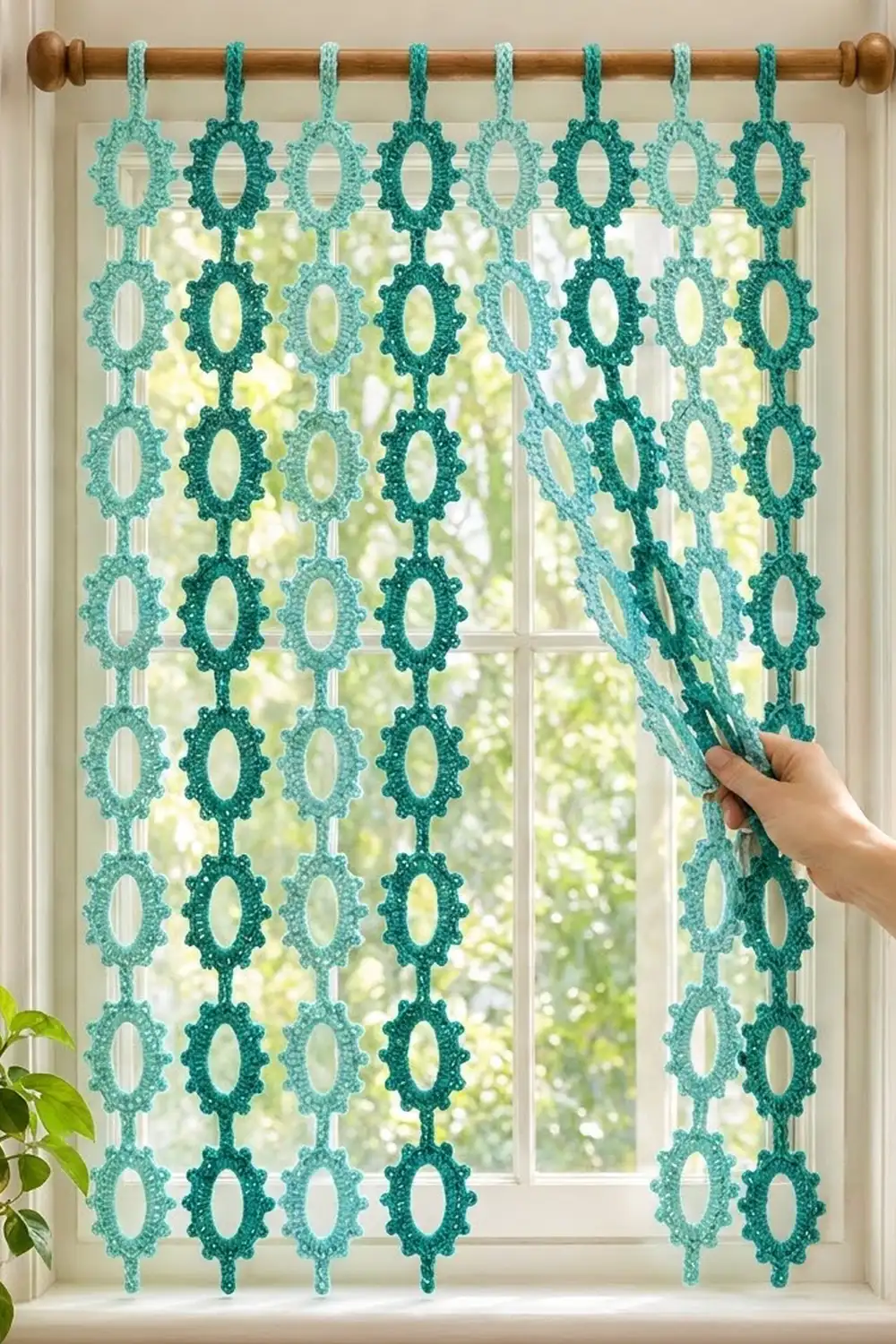
The Seaglass Ovals Strand Curtain is a light, airy window panel made from vertical strands of open oval motifs. Each oval has a clear center, a ring of tall radiating stitches, and a scalloped rim of small picot knobs. Short slip-stitch stems link the motifs top to bottom, so light comes through every gap.
Two shades of cotton alternate across the rod: a soft pale aqua and a deep teal. The look is coastal and fresh, a little like a beaded doorway curtain made in yarn. Each strand hangs on its own, so you can sweep a few aside to open the window.
This pattern uses US crochet terms. The finished curtain is 35 in (88.9 cm) wide and 44.5 in (113.0 cm) long, measured from the top of the hanging loops to the strand tips. Each oval motif is 3.5 in (8.9 cm) wide by 4.25 in (10.8 cm) tall, including picots.
The construction is simple. You work each oval in three rounds around a chain ring and join each new motif to the one above it as you finish it. Eight motifs make one strand, and eight strands (four in each color) make the curtain. Each strand gets a hanging loop at the top and a short drop at the bottom.
Finished Size and Construction
- Finished size: 35 in (88.9 cm) wide x 44.5 in (113.0 cm) long
- Skill level: Easy to intermediate
- Terminology: US crochet terms
- Yarn weight: Worsted (#4) cotton
- Hook: 5 mm (H-8)
- Number of pieces: 64 oval motifs in 8 strands of 8 motifs each
- Layout: 8 strands across, alternating Aqua and Teal, each 8 motifs long
- Piece size: 3.5 in (8.9 cm) wide x 4.25 in (10.8 cm) tall per motif
- Strand size before finishing: 41 in (104.1 cm) long (8 motifs plus 7 bridges)
- Finishing depth: 2.5 in (6.4 cm) hanging loop at the top, 1 in (2.5 cm) drop at the bottom
Materials
Choose a smooth combed or mercerized worsted cotton. Cotton holds the oval shape after blocking and stretches very little under its own weight, which matters for a hanging piece. Avoid fuzzy or very stretchy acrylics, because the strands will get longer over time.
- Color A, Aqua (pale aqua): 150 g, about 285 m (312 yd)
- Color B, Teal (deep teal): 150 g, about 285 m (312 yd)
These amounts assume a yarn of about 190 m (208 yd) per 100 g. Each motif uses about 7 m (7.7 yd). Each color makes 32 motifs, 4 hanging loops and 4 drops. The quantities include a margin of about 20 percent for swatching and gauge differences.
Tools:
- 5 mm (H-8) crochet hook
- Tapestry needle
- At least 2 stitch markers
- Scissors
- Blocking mats and rustproof pins
- Spray bottle
- Measuring tape
- Curtain rod up to 1.25 in (3.2 cm) in diameter
Abbreviations (US Terms)
- ch – chain
- sl st – slip stitch
- sc – single crochet
- dc – double crochet
- tr – treble crochet
- st(s) – stitch(es)
- rnd – round
- RS – right side
Picot: Ch 3, then sl st in the 3rd ch from the hook. The picot sits on top of the last sc you worked and forms one small round knob.
Bridge: The short stem that links two motifs. Ch 6, sl st into a picot on the motif above, then sl st back down each of the 6 chains. This makes a firm, braided-looking stem about 1 in (2.5 cm) long.
Gauge and Checkpoints
Base gauge: 16 sc and 18 rows = 4 in (10.2 cm) in sc with a 5 mm hook.
A flat swatch is not enough here. Make one complete motif first and block it, because the motif is your real gauge piece.
Checkpoints for one motif, lightly pressed flat:
- After Rnd 1: 2 in (5.1 cm) wide x 2.5 in (6.4 cm) tall, with a center hole of about 1.5 in (3.8 cm) x 2 in (5.1 cm)
- After Rnd 2: 2.5 in (6.4 cm) wide x 3.25 in (8.3 cm) tall
- After Rnd 3: 3.5 in (8.9 cm) wide x 4.25 in (10.8 cm) tall, including picot tips
If your motif is too big, go down to a 4.5 mm (7) hook. If it is too small, go up to a 5.5 mm (I-9) hook. If only the center hole is off, change the tension of your foundation chain instead of changing hooks. Being off by 0.25 in (0.6 cm) per motif adds up to 2 in (5.1 cm) over a strand of 8 motifs, so it is worth getting right.
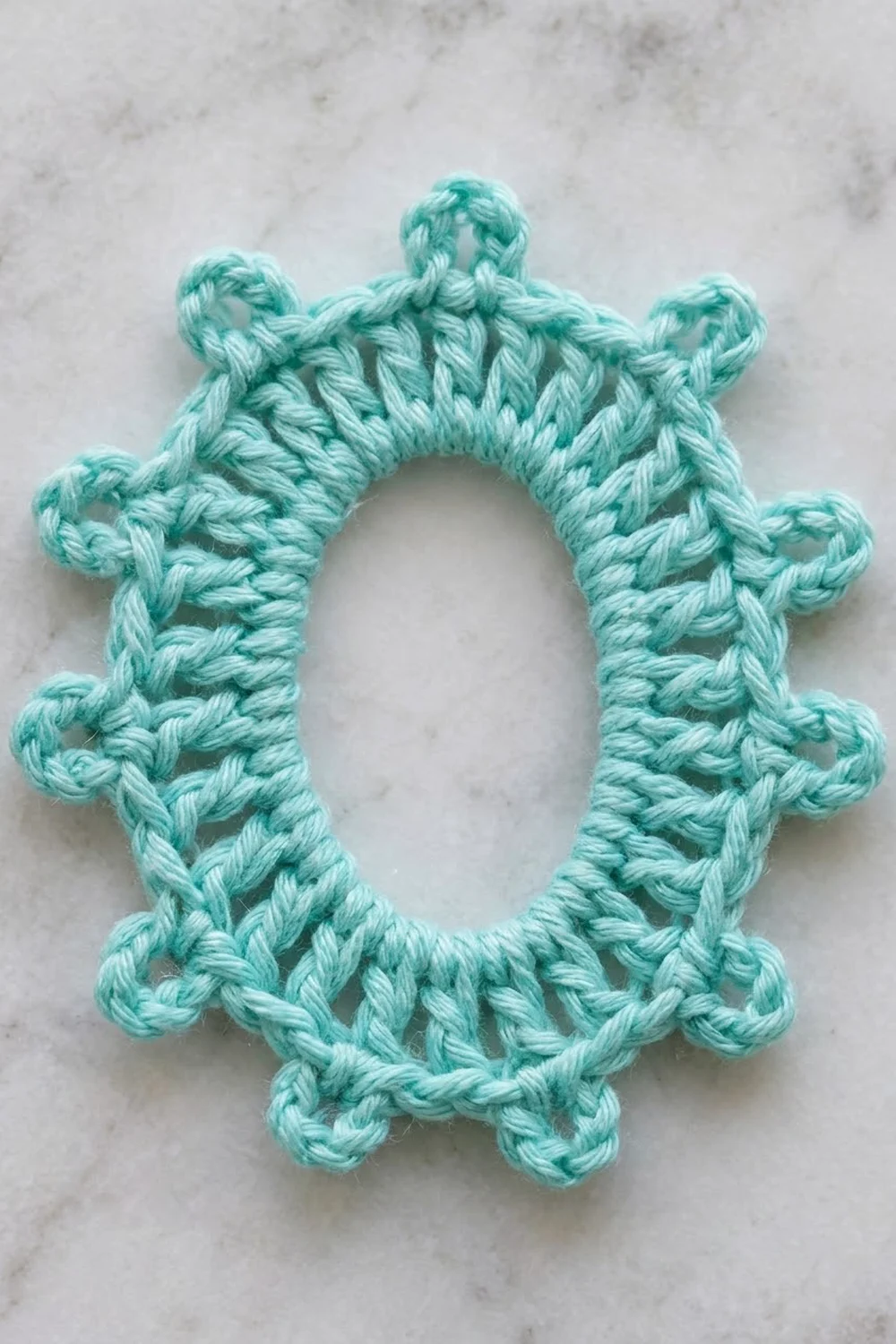
Oval Motif
Work every motif with the RS facing. The join of Rnd 1 marks the top center of the oval. Every round starts and ends there, which keeps the picots lined up for joining.
Foundation: Ch 24, then sl st in the first ch to form a ring. Do not twist the chain.
Rnd 1: Ch 1 (does not count as a st). Work 28 sc into the ring, working over the chain rather than into each ch. Sl st in the first sc to join. (28 sc)
Put a marker in the joining sl st to mark the top center. Gently pinch the ring into an upright oval before you start Rnd 2.
Think of the 28 sts as four zones: top end 8 sts, right side 6 sts, bottom end 8 sts, left side 6 sts. The top center is in the middle of the top end, with 4 top-end sts on each side of the marker.
Rnd 2: Ch 3 (does not count as a st). Work the round as follows:
- Top end, second half: tr in next st, 2 tr in each of next 2 sts, dc in next st. (6 sts)
- Right side: dc in each of next 6 sts. (6 sts)
- Bottom end: dc in next st, 2 tr in each of next 2 sts, tr in each of next 2 sts, 2 tr in each of next 2 sts, dc in next st. (12 sts)
- Left side: dc in each of next 6 sts. (6 sts)
- Top end, first half: dc in next st, 2 tr in each of next 2 sts, tr in next st. (6 sts)
Sl st in the first tr to join. (36 sts: 12 dc, 24 tr)
Check: you used 4 + 6 + 8 + 6 + 4 = 28 sts and made 6 + 6 + 12 + 6 + 6 = 36 sts. The tall stitches and increases at both ends push the outline into an upright oval that matches the center hole.
Rnd 3: Ch 1 (does not count as a st). Sc in each of next 3 sts, picot; repeat from * 11 more times. Sl st in the first sc to join. (36 sc, 12 picots)*
A picot falls after every 3rd sc. The 12th picot sits exactly at the top center, over the join. The 6th picot sits exactly at the bottom center, because the first half of the round holds 6 + 6 + 6 = 18 sts, which is 6 repeats of 3. These two picots are where the motifs connect.
For the first motif of each strand, fasten off and leave a 6 in (15.2 cm) tail. For every other motif, read the Joining section before you finish Rnd 3.
Make All Pieces
Make 64 motifs in total:
- Color A, Aqua: 32 motifs (4 strands of 8)
- Color B, Teal: 32 motifs (4 strands of 8)
Each strand is a single color. The strands alternate across the rod, starting with Aqua on the left.
Layout grid (A = Aqua, B = Teal; columns are strands, rows are motifs counted from the top):
Row 1:  A  B  A  B  A  B  A  B
Row 2:  A  B  A  B  A  B  A  B
Row 3:  A  B  A  B  A  B  A  B
Row 4:  A  B  A  B  A  B  A  B
Row 5:  A  B  A  B  A  B  A  B
Row 6:  A  B  A  B  A  B  A  B
Row 7:  A  B  A  B  A  B  A  B
Row 8:  A  B  A  B  A  B  A  B
Joining
You join the motifs top to bottom within each strand as you go. The strands are not joined to each other; they hang side by side on the rod.
Method: Work Motif 1 completely and fasten off. Work Motif 2 through Rnd 2, then work Rnd 3 until 3 sts remain. Then:
- Sc in each of the last 3 sts.
- Work the bridge in place of the 12th picot: ch 6, take the hook out of the loop, and insert it from front to back through the bottom-center picot (6th picot) of the motif above. Pick up the dropped loop and pull it through.
- Sl st in each of the 6 chains, working back down toward the new motif.
- Sl st in the first sc of Rnd 3 to join. Fasten off.
Repeat for Motifs 3 through 8. Always join the top center of the new motif to the bottom-center picot of the motif directly above.
Stitch-to-stitch logic: Each motif still has 36 sc and 12 picot positions. The top position becomes a bridge instead of a picot, so no stitches are added or removed. The bottom-center picot of each motif carries exactly one bridge.
Tension advice: Make the 6 bridge chains the same size as your usual chains. Work the slip stitches back down loosely enough that the stem lies flat, but firmly enough that it does not stretch. Tight bridges pull the motifs crooked, and loose bridges let the strands get longer.
Size checkpoint: Lay a finished strand flat without pulling it. It should measure 41 in (104.1 cm): 8 motifs x 4.25 in (10.8 cm) = 34 in (86.4 cm), plus 7 bridges x 1 in (2.5 cm) = 7 in (17.8 cm). If it is more than 1 in (2.5 cm) off, check your motif size before you make more strands.
Border: Hanging Loops and Strand Ends
A strand curtain has no edging around it. Its “border” is the hanging loop at the top and the drop at the bottom of each strand. These set the overall length and how the strands sit on the rod.
Border gauge: A 24-ch loop is about 5 in (12.7 cm) around. Working 30 sc into it covers it evenly.
Hanging loop (top of Motif 1, each strand):
Rnd 1: Join yarn with a sl st in the top-center picot (12th picot) of Motif 1. Ch 24, then sl st in the same picot to form a loop. (24 ch)
Rnd 2: Ch 1, work 30 sc into the loop over the chain, and sl st in the first sc. Fasten off. (30 sc: 24 matching the 24 ch, plus 6 extra)
Folded over the rod, the loop hangs 2.5 in (6.4 cm) deep. At 5 in (12.7 cm) around, it fits a rod up to 1.25 in (3.2 cm) in diameter and still slides.
Bottom drop (bottom of Motif 8, each strand):
Join yarn with a sl st in the bottom-center picot (6th picot) of Motif 8. Ch 6, work a picot, then sl st in each of the 6 chains back up to the motif. Fasten off. (6 ch, 1 picot, 6 sl st)
The drop adds 1 in (2.5 cm) and gives each strand a finished tip.
Why the math works:
- Length: 2.5 in (6.4 cm) loop + 41 in (104.1 cm) strand + 1 in (2.5 cm) drop = 44.5 in (113.0 cm).
- Width: 8 motifs x 3.5 in (8.9 cm) = 28 in (71.1 cm), plus 7 gaps x 1 in (2.5 cm) = 7 in (17.8 cm), for a total of 35 in (88.9 cm).
- Loop: The 6 extra sc spread around the curve of the 24 ch, which keeps the loop from cupping or rippling.
Final Blocking
- Weave in all ends along the back of the sc stitches and through the bridge slip stitches.
- Soak each strand in cool water for 10 minutes, then roll it in a towel and press out the water. Do not wring.
- Lay one strand flat and straight down the center of your blocking mats.
- Pin the center hole of each motif into an upright oval 1.5 in (3.8 cm) wide x 2 in (5.1 cm) tall.
- Pin the outer edge to 3.5 in (8.9 cm) x 4.25 in (10.8 cm), with a pin in every picot so the knobs open evenly.
- Pin each bridge straight at 1 in (2.5 cm) long.
- Check that the strand measures 41 in (104.1 cm), not counting the loop and drop.
- Let it dry completely, about 24 hours, before unpinning. Repeat for each strand.
Final Quality-Control Checklist
- Every motif has 36 sc in Rnd 3.
- Motif 1 of each strand has 12 picots, with the hanging loop on its top picot. Motifs 2 to 8 have 11 picots plus a top bridge.
- Every center hole is an upright oval, not a circle.
- Bridges sit at the exact top and bottom centers, not shifted to one side.
- All 8 strands measure 44.5 in (113.0 cm), within 0.5 in (1.3 cm).
- Colors alternate A, B, A, B across the rod.
- Hanging loops slide freely on the rod.
- All ends are secure and hidden.
Troubleshooting
The motif is round instead of oval. You probably spread the tr stitches evenly around. Recheck the Rnd 2 zones: the tr increases must stay at the top and bottom ends.
A bridge sits off center. Rnd 3 did not start at the top-center marker. Start every round at the Rnd 1 join.
The edge ruffles after Rnd 3. Your sc tension is loose. Go down one hook size for Rnd 3 only.
The edge cups. Rnd 2 is too tight. Go up one hook size for Rnd 2 only.
Strands are different lengths. Your bridge tension varies. Measure every bridge and redo any that are longer than 1.25 in (3.2 cm).
The center hole is too small. Your foundation chain is tight. Chain more loosely, or work the chain with a hook one size larger.
Care
Hand wash in cool water with mild soap and lay flat to dry, pinning the motifs back into shape if needed. Do not hang the strands while they are wet, because the weight will stretch them.
Final Notes
Every measurement in this curtain comes from one checked motif. The 24-chain ring gives a 1.5 in (3.8 cm) x 2 in (5.1 cm) hole. Rnd 1 brings the motif to 2 in (5.1 cm) x 2.5 in (6.4 cm), Rnd 2 to 2.5 in (6.4 cm) x 3.25 in (8.3 cm), and Rnd 3 to 3.5 in (8.9 cm) x 4.25 in (10.8 cm). Eight motifs and seven 1 in (2.5 cm) bridges make a 41 in (104.1 cm) strand. A 2.5 in (6.4 cm) loop and a 1 in (2.5 cm) drop bring each strand to 44.5 in (113.0 cm). Eight strands with 1 in (2.5 cm) gaps fill 35 in (88.9 cm) of rod.
If your first motif matches the checkpoints, the rest of the curtain will too.
Happy crocheting!