
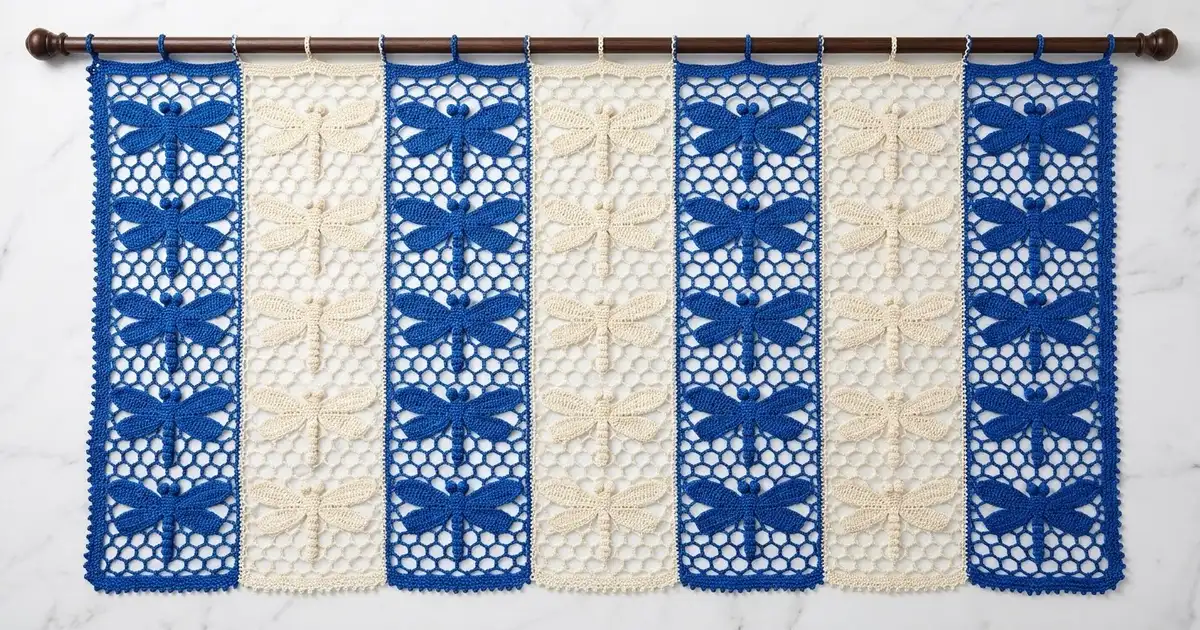
This curtain turns a window into a quiet lace garden. Seven long strips of open honeycomb mesh hang side by side. Each one carries a neat column of dragonflies whose ladder-barred wings catch the light.
The colors are crisp cobalt blue and soft cream, alternating strip by strip. Blue strips carry blue dragonflies and cream strips carry cream ones, so the motifs read as texture rather than contrast.
The pattern uses US crochet terms. With the border, the finished curtain measures 43 in (109.2 cm) wide and 81.5 in (207.0 cm) long. The hanging loops add about 2 in (5.1 cm) above the top edge.
The construction is simple and modular:
- Crochet seven mesh strips in rows.
- Make 49 small dragonfly appliqués and sew seven onto each strip.
- Join the strips with a flat slip-stitch seam.
- Finish with a two-round border that adds a picot edge and the rod loops.
Finished Size and Construction
- Finished size: 43 x 81.5 in (109.2 x 207.0 cm), plus loops
- Skill level: Intermediate
- Terminology: US crochet terms
- Yarn weight: Sport (#2), mercerized cotton
- Hook: 3.5 mm (E-4)
- Number of pieces: 7 strips and 49 dragonflies
- Layout: 7 strips side by side, 1 strip tall
- Piece size: each strip 6 x 80.5 in (15.2 x 204.5 cm)
- Size before border: 42 x 80.5 in (106.7 x 204.5 cm)
- Border depth: 0.5 in (1.3 cm) on each side
Materials
Choose a smooth, mercerized sport-weight cotton. It holds the honeycomb shape after blocking, shows the dragonfly bars clearly, and does not stretch out of shape when it hangs.
The quantities below assume a cotton of about 155 m per 50 g.
- Cobalt blue: 400 g, about 1,240 m (4 strips, 28 dragonflies, full border)
- Cream: 250 g, about 775 m (3 strips, 21 dragonflies, all joining seams)
Both quantities include a margin of roughly 10 to 15 percent for swatching and differences in tension.
Tools:
- 3.5 mm (E-4) crochet hook
- Tapestry needle
- Rust-proof blocking pins
- Blocking mats or a large towel-covered surface
- Measuring tape
- Stitch markers
- Scissors
Abbreviations (US Terms)
- ch chain
- sl st slip stitch
- sc single crochet
- hdc half double crochet
- dc double crochet
- tr treble crochet
- sk skip
- sp space
- st(s) stitch(es)
- RS right side
Special stitch: Bobble eye. Ch 3. [Yarn over, insert hook in 3rd ch from hook, yarn over and pull up a loop, yarn over and pull through 2 loops] 4 times. Yarn over and pull through all 5 loops on hook.
Picot: Ch 3, sl st in the sc just made.
Gauge and Checkpoints
Test one piece first. Work the first 21 rows of a strip and one complete dragonfly. Wet block them, then measure.
Mesh gauge (blocked): 6 ch-5 loops = 6 in (15.2 cm) wide, and 10 rows = 5 in (12.7 cm) tall. Each loop is 1 in (2.5 cm) wide and each row is 0.5 in (1.3 cm) tall.
Checkpoints:
- After Row 1: strip width 6 in (15.2 cm)
- After Row 21: strip length 10.5 in (26.7 cm)
- After Row 81: strip length 40.5 in (102.9 cm)
- After Row 161: strip length 80.5 in (204.5 cm)
- One wing: 2.5 x 1.25 in (6.4 x 3.2 cm)
- Dragonfly body: 3.5 in (8.9 cm) long
- Dragonfly wingspan: 5.5 in (14.0 cm)
If your swatch is too big, go down 0.25 mm in hook size. If it is too small, go up 0.25 mm. The width must be 6 in (15.2 cm) for the border math to work. If only the row height is off, adjust the hook size the same way.
Mesh Strip (make 7)
Make 4 strips in blue and 3 in cream.
Foundation: Ch 26.
Row 1 (RS): Sc in 2nd ch from hook, [ch 5, sk 3 ch, sc in next ch] 6 times. (6 ch-5 loops, 7 sc)
Row 2: Ch 5 (counts as dc + ch 2), turn. Sc in first ch-5 loop, [ch 5, sc in next ch-5 loop] 5 times, ch 2, dc in last sc. (5 full ch-5 loops, 2 half loops)
Row 3: Ch 1, turn. Sc in first dc, [ch 5, sc in next ch-5 loop] 5 times, ch 5, sc in 3rd ch of turning ch-5. (6 ch-5 loops, 7 sc)
Rows 4 to 161: Repeat Rows 2 and 3 another 79 times. (161 rows total)
Row 161 is worked like Row 3, so the top edge matches the bottom with 6 full loops across. Fasten off and weave in the ends.
The 81 odd rows end in sc and the 80 even rows end in dc. You will use these counts in the border.
Dragonfly Appliqué (make 49)
Make 28 in blue and 21 in cream. Each dragonfly is one body and four wings.
Body
Foundation: Ch 16.
Rnd 1:
- Sc in 2nd ch from hook and next 10 ch (abdomen).
- Hdc in next 3 ch (thorax).
- 5 hdc in last ch (head).
- Working along the opposite side of the foundation, hdc in next 3 ch, then sc in next 11 ch.
- 2 sc in same ch as first sc. Join with sl st to first sc.
(35 sts: 11 + 3 + 5 + 3 + 11 + 2)
Fasten off, leaving a 12 in (30.5 cm) tail for sewing.
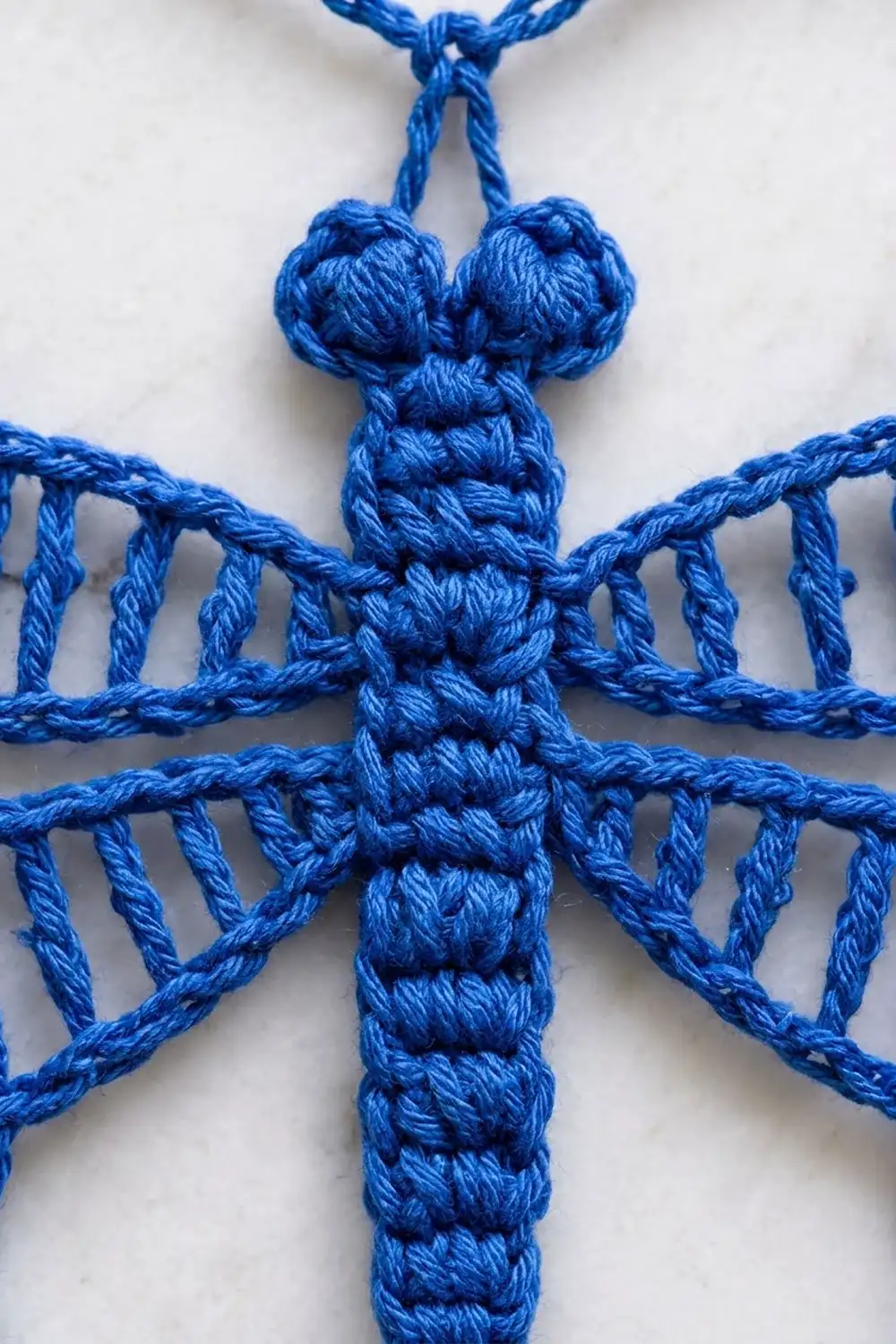
Eyes: Join yarn with sl st in 2nd hdc of the 5-hdc head group. Bobble eye, sl st in same st, sl st in 3rd hdc, sl st in 4th hdc, bobble eye, sl st in same st. Fasten off and weave in the ends.
The body measures 3.5 in (8.9 cm) long and 0.5 in (1.3 cm) wide. The sc section forms the slim abdomen and the hdc section forms the wider thorax.
Wing (make 4 per dragonfly)
Foundation: Ch 18.
Rnd 1, first side: Sl st in 2nd ch from hook (tip), sc in next ch, hdc in next ch, ch 1, sk 1 ch, dc in next ch, [ch 1, sk 1 ch, tr in next ch] 3 times, ch 1, sk 1 ch, dc in next ch, ch 1, sk 1 ch, hdc in next ch, sc in next ch, 3 sl st in last ch.
Rnd 1, second side: Working along the opposite side of the foundation, sc in next ch, hdc in next ch, ch 1, dc in ch holding the next dc, [ch 1, tr in ch holding the next tr] 3 times, ch 1, dc in ch holding the next dc, ch 1, hdc in ch holding the next hdc, sc in next ch, sl st in same ch as first sl st.
Each side has 7 posts (hdc, dc, tr, tr, tr, dc, hdc) separated by 6 ch-1 spaces. The posts on both sides sit in the same foundation chains, so each pair forms one straight vertical bar across the center line. That gives 7 bars per wing, and the graduated post heights round the wing into an oval.
Rnd 2 (outline): Ch 1, 3 sc in tip, sc in sc, sc in hdc, [2 sc in ch-1 sp, sc in next post] 6 times, sc in sc. Work 3 sc in center sl st of end, then repeat from * to * once. Join with sl st to first sc. (48 sc: 3 + 21 + 3 + 21)
These sc only cap the tops of the ch-1 spaces, so the open windows between the bars stay visible. Fasten off, leaving a 6 in (15.2 cm) tail.
Assemble Each Dragonfly
Lay the body flat, head up. Place two wings on each side of the thorax, one above the other, with the inner tips touching the thorax and the outer tips angled slightly outward. Sew each inner tip to the thorax with 3 to 4 small stitches. The wingspan should be 5.5 in (14.0 cm).
Attach the Dragonflies
Pin a strip flat. Mark the dragonfly centers at 5.75 in (14.6 cm) from the bottom edge and then every 11.5 in (29.2 cm):
- 5.75 in (14.6 cm)
- 17.25 in (43.8 cm)
- 28.75 in (73.0 cm)
- 40.25 in (102.2 cm)
- 51.75 in (131.4 cm)
- 63.25 in (160.7 cm)
- 74.75 in (189.9 cm)
That gives 7 evenly spaced dragonflies on an 80.5 in (204.5 cm) strip.
Center each body on the middle column of sc, head toward the top. Using the body tail, tack the body down every 0.5 in (1.3 cm) along its length. Then tack each outer wing tip, and the middle of each wing’s outer edge, to the nearest mesh strand.
Make All Pieces
- Blue: 4 strips, 28 dragonflies (7 per strip)
- Cream: 3 strips, 21 dragonflies (7 per strip)
Layout (left to right, RS facing):
| B | C | B | C | B | C | B |
  1   2   3   4   5   6   7
B = blue strip, C = cream strip. Every strip runs the full length of the curtain.
Joining
Use cream for all 6 seams.
Method:
- Lay strips 1 and 2 side by side, RS up, with the bottom edges level.
- Join cream with sl st in the Row 1 end of strip 1.
- *Sl st in the matching row end of strip 2, sl st in the next row end of strip 1. Repeat from * up the edge.
- Finish with a sl st in the Row 161 end of strip 2. Fasten off.
Stitch-to-stitch logic: Row 1 meets Row 1, Row 2 meets Row 2, and so on up to Row 161. Each seam uses 322 sl sts. No chains are added, so the seam adds no measurable width.
Tension: Keep each sl st as loose as the mesh, pulling the loop up to about 0.25 in (0.6 cm) if needed. A tight seam will pucker and shorten the curtain.
Join strips 2 and 3, then 3 and 4, and continue until all 7 strips are joined.
Checkpoint: Laid flat without stretching, the joined panel measures 42 x 80.5 in (106.7 x 204.5 cm).
Border
Work the border in blue.
Border gauge: 5 sc = 1 in (2.5 cm). This matches the mesh: one 1 in (2.5 cm) loop takes 5 sc, and two 0.5 in (1.3 cm) rows take 5 sc.
Rnd 1: With RS facing, join blue in the first loop of Row 161 on strip 7, at the top right corner.
- Top edge: Work 5 sc in each ch-5 loop across. That is 6 loops x 5 sc = 30 sc per strip, and 7 strips x 30 = 210 sc. Do not work into the sc between loops or into the seams.
- Corner: Ch 2.
- Left side: Down the row ends of strip 1, work 3 sc around each dc row end and 2 sc around each sc row end: 80 x 3 + 81 x 2 = 240 + 162 = 402 sc.
- Corner: Ch 2.
- Bottom edge: Working into the foundation chain, work 5 sc around each skipped ch-3 group. That is 6 groups x 5 sc = 30 sc per strip, and 7 x 30 = 210 sc.
- Corner: Ch 2.
- Right side: Work up strip 7 as for the left side: 402 sc.
- Corner: Ch 2, then join with sl st to first sc.
Rnd 1 total: 210 + 402 + 210 + 402 = 1,224 sc, plus 4 ch-2 corner spaces. The ch-2 spaces are the corners, so the side totals contain no corner stitches.
Rnd 2: Ch 1, do not turn.
- Top edge: For each strip, sc in next 7 sc, ch 20 (hanging loop), sc in next 15 sc, ch 20, sc in next 8 sc. That is 7 + 15 + 8 = 30 sc and 2 loops per strip, for 210 sc and 14 loops across the top.
- Each corner: (Sc, picot, sc) in ch-2 sp.
- Left side: [Sc in next 3 sc, picot] 134 times. (402 sc, 134 picots)
- Bottom edge: [Sc in next 3 sc, picot] 70 times. (210 sc, 70 picots)
- Right side: Work as for the left side. (402 sc, 134 picots)
Join with sl st to first sc. Rnd 2 total: 1,224 sc + 8 corner sc = 1,232 sc, with 14 hanging loops and 342 picots (338 along the edges + 4 at the corners). Fasten off.
Why the math works:
- The top and bottom edges each start from 7 strips x 30 sc, with nothing added at the 6 seams.
- Each side gets 402 sc over 80.5 in (204.5 cm), within a stitch of 5 sc per 1 in (2.5 cm).
- Each Rnd 2 count divides evenly by its repeat (402 / 3 = 134, 210 / 3 = 70), so the picots end evenly at each corner.
- The border adds 0.5 in (1.3 cm) on every side, which turns 42 x 80.5 in (106.7 x 204.5 cm) into 43 x 81.5 in (109.2 x 207.0 cm).
Final Blocking
- Soak the curtain in cool water with a little gentle detergent for 15 minutes.
- Press out the water without wringing, then roll the curtain in towels.
- Lay it flat, RS up, and pin the corners to 43 x 81.5 in (109.2 x 207.0 cm).
- Pin along each seam so the strips sit straight and parallel.
- Ease the mesh loops outward into honeycomb cells, working one strip at a time.
- Smooth each wing into an oval and straighten its bars.
- Pin out the picots and let the curtain dry completely, usually 24 to 48 hours.
Final Quality-Control Checklist
- The curtain measures 43 x 81.5 in (109.2 x 207.0 cm) after blocking.
- The strips alternate B, C, B, C, B, C, B.
- Every strip has 161 rows and 6 loops across.
- There are 7 dragonflies per strip, all at matching heights and all head up.
- Every wing shows 7 clear bars.
- The seams lie flat.
- The top edge has 14 evenly spaced loops.
- All ends are woven in securely.
Troubleshooting
Strip is narrower than 6 in (15.2 cm): Your chains are too tight. Go up a hook size.
Cells look like diamonds: Block wider and pin each loop’s sides outward.
Wing bars lean: Work each second-side post into the same chain as its partner.
Wing outline ruffles: You have extra stitches. Recount Rnd 2 to 48 sc.
Seams pucker: Rework the seam with looser slip stitches.
Picots don’t land at the corners: Recheck the Rnd 1 counts of 402 and 210.
Care
Hand wash in cool water, then dry the curtain flat, reshaping the mesh and wings while damp. Don’t hang it wet, because the weight of the water stretches it.

Final Notes
All the measurements build on each other:
- Each ch-5 loop is 1 in (2.5 cm) wide, so 6 loops make a 6 in (15.2 cm) strip.
- Two rows make 1 in (2.5 cm), so 161 rows make 80.5 in (204.5 cm).
- Seven strips make 42 in (106.7 cm).
- A 0.5 in (1.3 cm) border brings the curtain to 43 x 81.5 in (109.2 x 207.0 cm).
Get the gauge right on one strip and one dragonfly, and the rest will follow.
Happy crocheting!