

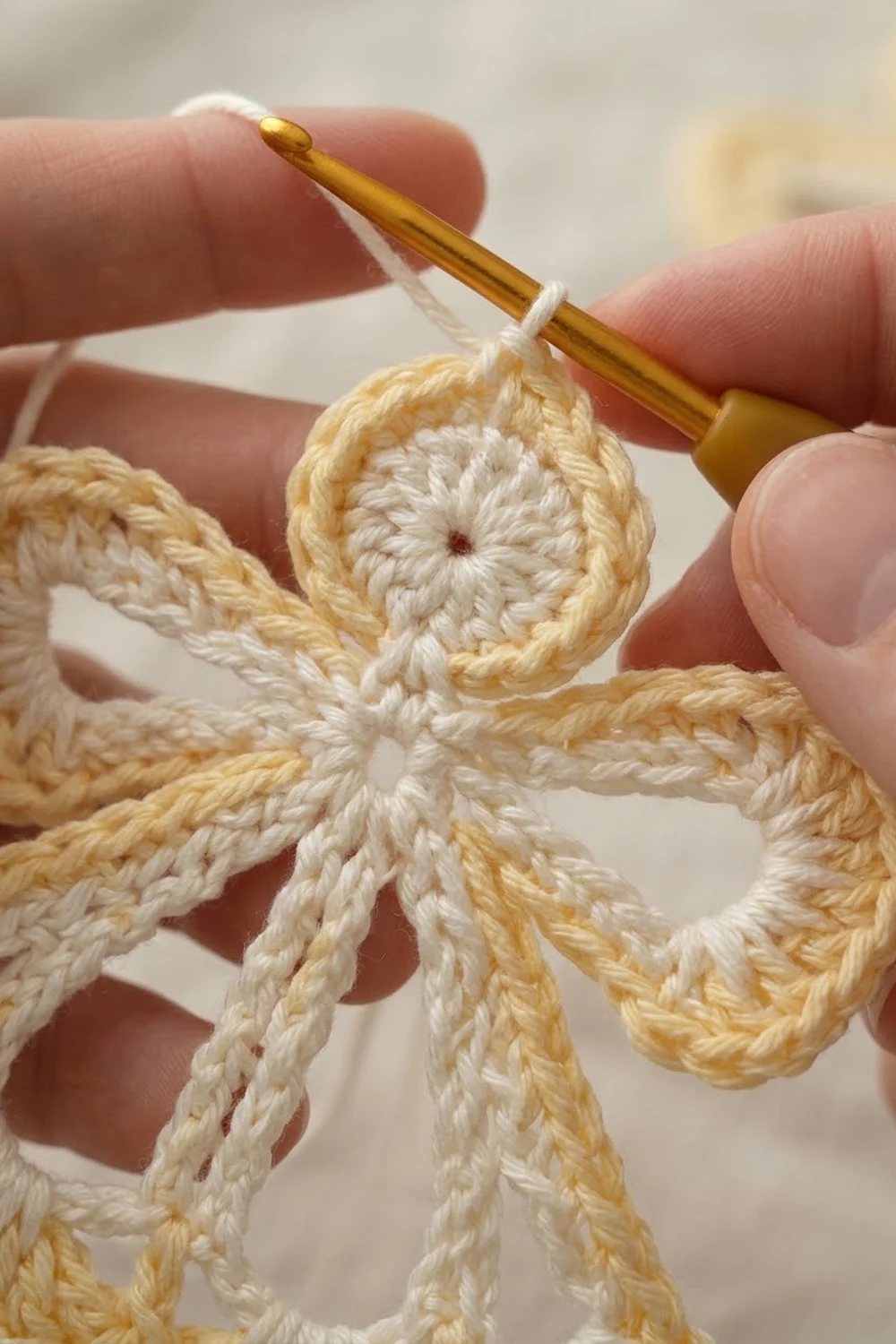
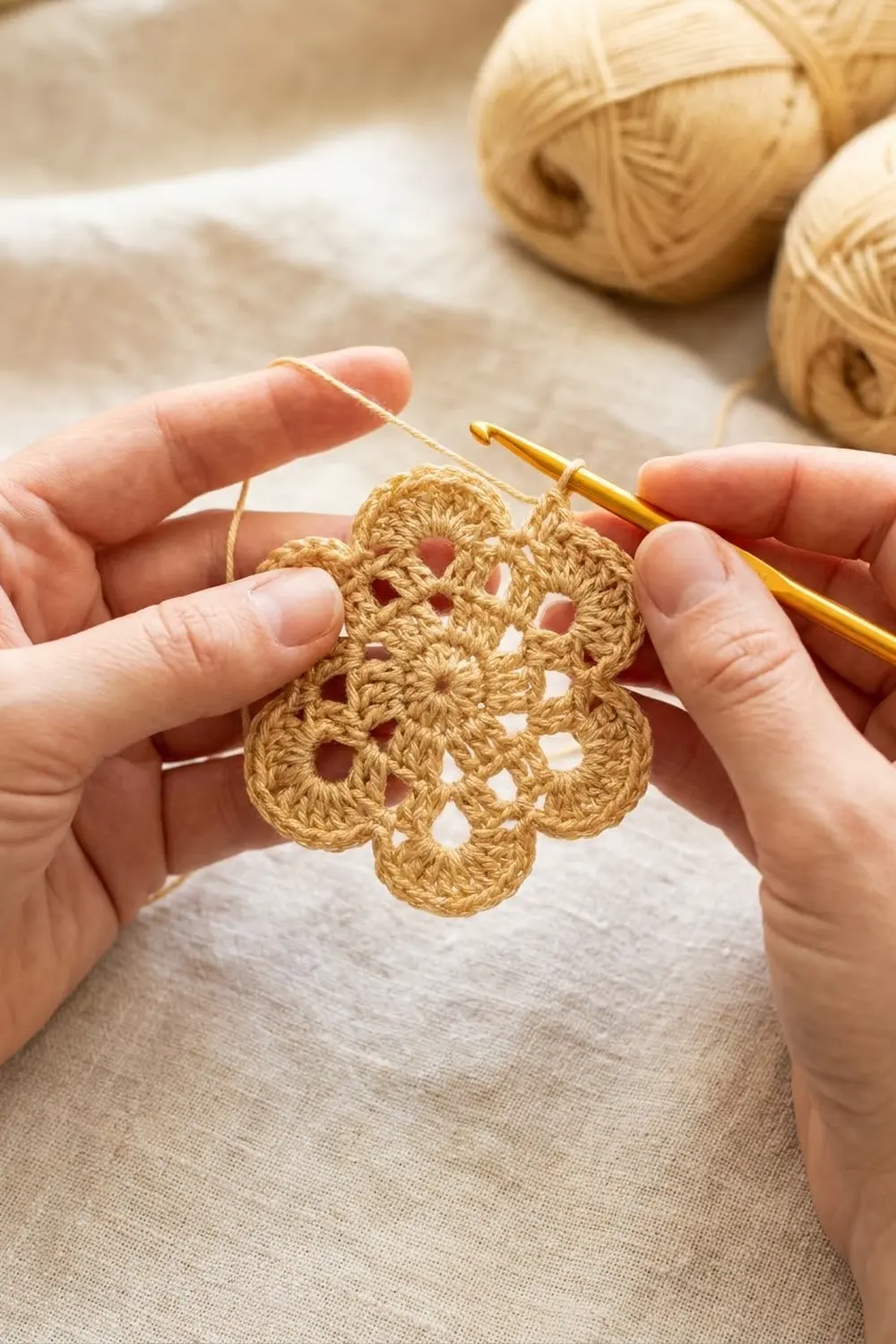
This delicate motif is a single six-petal lace piece worked entirely in one light golden-tan yarn. A small solid hub sits at the center, and six open petals radiate evenly around it. Each petal is built from airy mesh, so light passes through the whole motif, and each petal ends in a soft scalloped edge made of shell stitches.
The look sits between a flower and a pair of angel wings. Laid flat, it reads as a six-petal lace bloom. Slightly cupped after blocking, it takes on a gentle three-dimensional, wing-like shape. The single warm golden-tan color keeps the focus on the openwork texture rather than on color changes.
This pattern uses US crochet terms throughout. The finished motif measures 3 in (7.6 cm) in diameter, measured from scallop tip to opposite scallop tip.
Construction is simple and fully in the round. You work a solid sc hub, then six chain loops that set the petal positions. Two mesh rounds build the open petal texture, and a final shell round forms the scalloped edge. There is no sewing and only one piece, so you have just two ends to weave in.
Finished Size and Construction
- Finished size: 3 in (7.6 cm) diameter, tip to tip
- Skill level: Easy-intermediate (comfortable with magic ring, dc, and working into chain spaces)
- Terminology: US crochet terms
- Yarn weight: Fingering weight (super fine, #1) cotton
- Hook: 2.25 mm (US B-1)
- Number of pieces: 1
- Layout: Single circular motif worked in continuous joined rounds
- Piece size: 3 in (7.6 cm)
- Size before border: 2.5 in (6.4 cm), after Round 5
- Border depth: 0.25 in (0.6 cm) per side, Round 6 shell scallops
Materials
Yarn advice: Choose a smooth, mercerized fingering weight cotton. Mercerized cotton gives crisp stitch definition, holds the mesh open, and responds well to starch. Avoid fuzzy or very stretchy yarns, which blur the lace and make the scallops floppy.
- Light golden-tan: 5 g (about 20 m / 22 yd)
The motif itself uses roughly 3 g. The quantity above includes a margin for a test swatch, a possible restart, and generous tails.
Tools:
- 2.25 mm (US B-1) crochet hook
- Tapestry needle
- Scissors
- Rustproof pins
- Blocking board or folded towel
- Spray starch or a light fabric stiffener (optional, for a firmer, more dimensional finish)
- Ruler or measuring tape
Abbreviations (US Terms)
- ch – chain
- sl st – slip stitch
- sc – single crochet
- dc – double crochet
- st(s) – stitch(es)
- sp(s) – space(s)
- rep – repeat
- MR – magic ring
Special stitches:
- V-stitch (V-st): (dc, ch 2, dc) worked into the same space. The ch-2 at its center is called the “V-sp.”
- Shell: 5 dc worked into the same space. The 3rd (center) dc forms the peak of each scallop.
Gauge and Checkpoints
Exact gauge is less critical than for a garment, but it controls the final size. Since this is a single small piece, the motif itself is your test. Work Rounds 1–2 and measure before going further.
Checkpoints (measured flat, unblocked unless noted):
- After Round 2 (hub): 0.75 in (1.9 cm) diameter
- After Round 3 (petal loops): about 1.5 in (3.8 cm) diameter, loop tip to loop tip
- After Round 4: about 2 in (5.1 cm) diameter
- After Round 5 (before border): 2.5 in (6.4 cm) diameter
- After Round 6 and blocking: 3 in (7.6 cm) diameter
If your hub is too big: switch to a 2 mm hook, or tighten your chains. A loose hub makes every later round larger.
If your hub is too small: switch to a 2.5 mm hook. Tight work also squeezes the mesh closed, so going up a size helps the lace look open.
If only the petals are off: check your chain loops in Round 3. Seven chains should lie flat without pulling the hub into a cup or drooping in a wavy line.
Pattern
Rounds are joined with a sl st and are not turned. The beginning ch 1 does not count as a stitch.
Round 1: Hub Center
Make a MR. Ch 1, work 12 sc into the ring. Pull the ring tight. Sl st to first sc to join.
Stitch count: 12 sc.
Round 2: Hub Increase
Ch 1, 2 sc in each st around. Sl st to first sc.
Stitch count: 24 sc.
This completes the solid circular hub. It should lie flat and measure 0.75 in (1.9 cm).
Round 3: Petal Loops
Ch 1, sc in same st as join. Ch 7, skip next 3 sts, sc in next st. Rep from * 4 more times. Ch 7, skip last 3 sts, sl st to first sc.
Stitch count: 6 sc and 6 ch-7 loops.
Math check: Each repeat uses 4 hub stitches (1 sc + 3 skipped). 24 ÷ 4 = 6 loops, one per petal. The 6 sc are the “divider” stitches that separate the petals for the rest of the motif.
Round 4: First Mesh Round
Ch 1, sc in same st as join (first divider sc).
In next ch-7 loop, work: dc, [ch 2, dc] 3 times. Sc in next divider sc. Rep from * around, but on the 6th repeat, replace the final sc with a sl st to the first sc.
Per petal: 4 dc and 3 ch-2 sps, fanned across the loop.
Stitch count: 24 dc, 18 ch-2 sps, 6 sc.
The dc stitches now fan outward in each loop, opening the first row of mesh. Measure: about 2 in (5.1 cm).
Round 5: Second Mesh Round
Ch 1, sc in same st as join.
Skip next dc. V-st in next ch-2 sp, ch 1, V-st in next ch-2 sp, ch 1, V-st in next ch-2 sp. Skip next dc. Sc in next divider sc. Rep from * around, replacing the final sc with a sl st to the first sc.
Per petal: 3 V-sts (6 dc, 3 V-sps) and 2 ch-1 sps.
Stitch count: 36 dc, 18 V-sps, 12 ch-1 sps, 6 sc.
This is a growth round: each petal goes from 4 dc in Round 4 to 6 dc in Round 5, and the ch-1 spaces between V-sts widen the mesh. The petals now look like distinct open fans with clear gaps at each divider.
Checkpoint: 2.5 in (6.4 cm) diameter. This is your size before border.
Border
Round 6 is the scalloped edge. It is the only border round.
Border gauge: 18 shells around the motif, worked over a Round 5 outer edge of about 7.9 in (20.1 cm). That is about 2.3 shells per inch (2.54 cm), or 3 shells per petal edge.
Round 6: Shell Scallops
Ch 1, sc in same st as join.
Shell (5 dc) in next V-sp, sc in next ch-1 sp, shell in next V-sp, sc in next ch-1 sp, shell in next V-sp, sc in next divider sc. Rep from * around, replacing the final sc with a sl st to the first sc.
Fasten off, leaving an 8 in (20.3 cm) tail.
Per petal (“per side”): 3 shells (15 dc) + 2 sc in ch-1 sps + 1 divider sc = 18 sts.
Stitch count: 90 dc + 12 sc in ch-1 sps + 6 divider sc = 108 sts.
Check: 6 petals × 18 sts = 108 sts. ✓
Why the Math Works
The border does not add new placement points. It works directly into the spaces Round 5 already created:
- Shells: One shell per V-sp. Round 5 has 18 V-sps, so Round 6 has 18 shells (3 per petal).
- Small valleys: One sc per ch-1 sp. Round 5 has 12 ch-1 sps, giving 12 sc that pinch each petal into three small scallops.
- Deep valleys: One sc per divider sc. The 6 divider sc, carried up from Round 3, anchor the deeper notch between petals.
Each shell has an odd number of dc (5). The center dc sits at the peak, and the stitches on each side curve down evenly. Because each shell is anchored by sc on both sides, it flares outward instead of lying flat. That flare is what creates the ruffled scalloped silhouette.
Each scallop adds about 0.25 in (0.6 cm) beyond the Round 5 edge. On both sides of the motif, that is 2.5 in + 0.25 in + 0.25 in = 3 in (7.6 cm).
Final Blocking
Lace motifs look unfinished until blocked. Blocking opens the mesh and defines the scallops.
- Weave in ends. Weave the starting tail through the hub sc stitches on the back. Weave the ending tail along the back of Round 6 and Round 5. Trim close but leave about 0.25 in (0.6 cm) until after blocking.
- Wet the motif. Soak in cool water for 5 minutes, then press gently in a towel. Do not wring.
- Pin the center. Place the motif face up on your board. Pin through the hub to hold it in place.
- Pin the petals. Pin each divider sc so the six deep valleys sit evenly around a 2.5 in (6.4 cm) circle.
- Pin the scallops. Pin the center dc of each shell outward so tip-to-tip measures 3 in (7.6 cm). Use all 18 peaks for the crispest edge.
- Open the mesh. Use a pin tip to nudge each V-sp and ch-1 sp into an open, even shape.
- Starch (optional). Spray lightly with starch for a firmer piece that holds its shape.
- Shape for dimension (optional). Once it is nearly dry, unpin the petals. Gently cup each petal over your fingertip for the soft three-dimensional angel-wing look. Let it finish drying.
- Dry fully. Leave it pinned or shaped until completely dry, usually 2–4 hours. Then trim the remaining tail ends.
Final Quality-Control Checklist
- [ ] Hub lies flat with no cupping or ruffling
- [ ] Exactly 6 petals, evenly spaced
- [ ] Each petal has 3 shells (18 shells total)
- [ ] Each shell has 5 dc with a clear center peak
- [ ] Round 6 total is 108 sts (18 per petal)
- [ ] Mesh spaces are open and even across all petals
- [ ] Deep valleys between petals line up with the divider sc
- [ ] Diameter measures 3 in (7.6 cm) tip to tip after blocking
- [ ] Ends are woven in securely and invisible from the front
- [ ] Color is consistent, with no stray fibers or joins
Troubleshooting
Hub cups upward like a bowl.
Your hub is too tight relative to the loops. Go up a hook size for Rounds 1–2, or loosen your sc.
Hub ruffles or waves.
You may have worked extra stitches in Round 2. Recount: it should be exactly 24 sc.
Petals pull the motif into a cup.
Round 3 chains are too tight. Chain more loosely, or work 8 chains instead of 7 if your tension is very firm.
Mesh looks closed and solid.
Your tension is tight. Use a larger hook, or pull each dc up to its full height before yarning over.
Petal count is off.
Check Round 3. You must skip exactly 3 sts between each sc. 24 ÷ 4 = 6 loops.
Scallops lie flat instead of flaring.
Make sure each shell goes into the V-sp, not around the V-st post. Firm blocking at each center dc also helps.
Valleys between petals are uneven.
Confirm that every repeat ends with a sc in the divider sc. Missing one shifts the next petal.
Motif is the right shape but too small.
Your gauge is tight overall. Restart with a 2.5 mm hook and recheck the 0.75 in (1.9 cm) hub checkpoint.
Care
Hand wash in cool water with mild soap, press dry in a towel, and reshape or re-block as needed. If you used starch, reapply it after washing to restore the crisp, dimensional finish.
Final Notes
This motif comes together in six rounds, and every round builds directly on the one before it. Keep the measurement chain in mind as you work:
- Round 2 hub: 0.75 in (1.9 cm)
- Round 3 loops: about 1.5 in (3.8 cm)
- Round 4 mesh: about 2 in (5.1 cm)
- Round 5 mesh: 2.5 in (6.4 cm), size before border
- Round 6 shells: +0.25 in (0.6 cm) per side
- Finished and blocked: 3 in (7.6 cm)
The stitch counts follow the same logic. 24 hub sts become 6 petal loops. Each petal grows from 4 dc to 6 dc in V-sts. The border closes it all with 18 shells and 108 total stitches.
If your hub hits its checkpoint, the rest of the motif will usually fall into place. Measure early, block carefully, and enjoy the delicate golden lace.
Happy crocheting!