

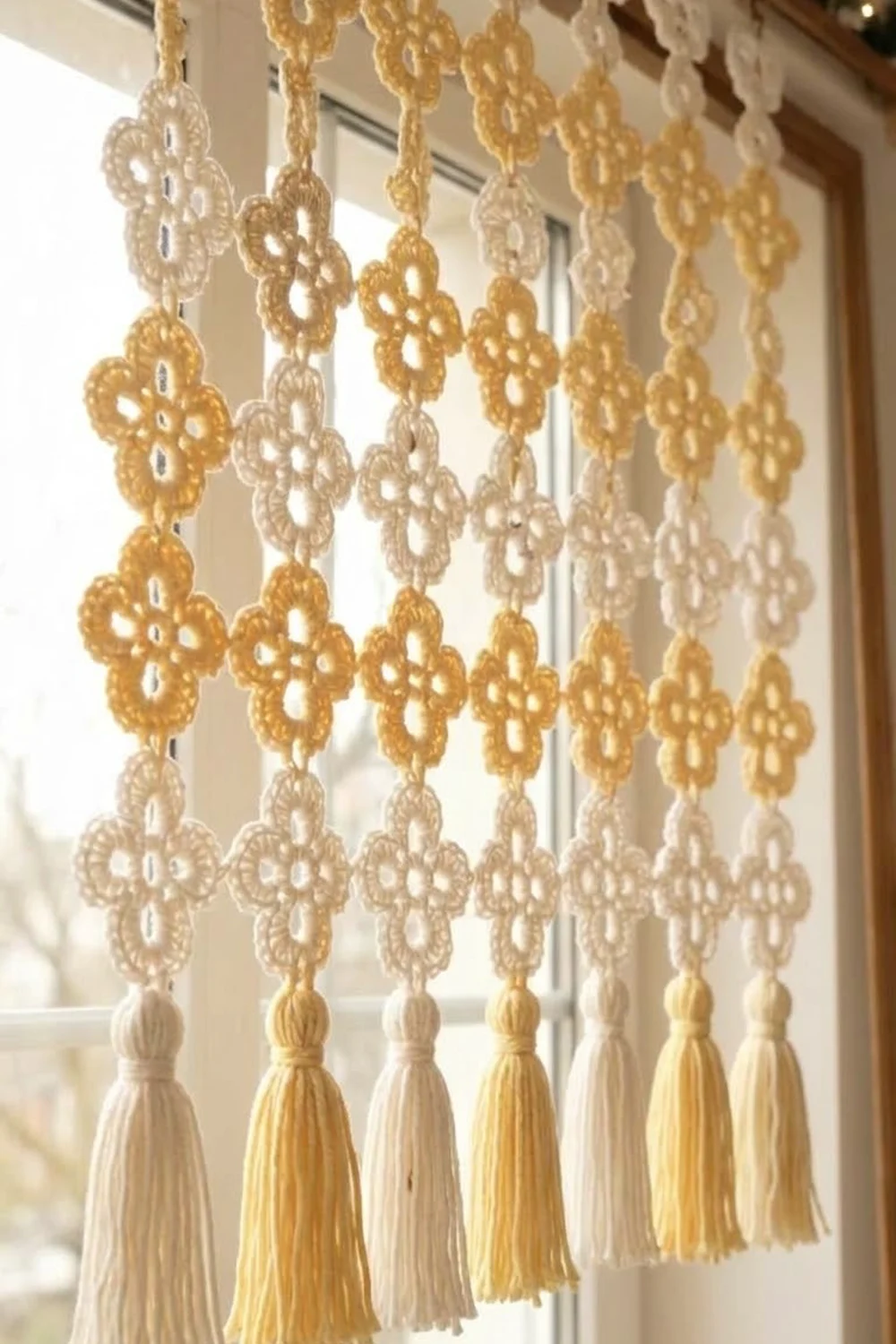
This garland is one long strand of small lace medallions. Each one is a round, doily-style motif with open filet-style spaces and a scalloped picot edge. A plump tassel hangs from the bottom of every medallion. Hung vertically in a sunny window, light shines through the lace and the strand looks almost weightless.
The palette is soft and warm: cream/ivory, pale gold, and warm golden yellow. The medallions repeat in that color order down the strand, and each tassel matches its own medallion. The style is airy, vintage-inspired, and simple to read once you know the motif.
The pattern uses US crochet terms. The finished garland measures 56.5 in (143.5 cm) long including the hanging loop, and 2.5 in (6.4 cm) wide. Each medallion is 2.5 in (6.4 cm) across, and each tassel is 2.5 in (6.4 cm) long.
Construction is straightforward. You make 9 medallions in 4 rounds and 9 tassels with gathered, bulbous tops. Two chain rails then link the medallions into one continuous strand at their side picots. This leaves room for each tassel to hang free. A reinforcing pass and a hanging loop finish the piece.
Finished Size and Construction
- Finished size: 56.5 in (143.5 cm) long x 2.5 in (6.4 cm) wide
- Skill level: Easy+
- Terminology: US crochet terms
- Yarn weight: DK (#3, light), cotton
- Hook: 3.5 mm (E/4)
- Number of pieces: 9 medallions + 9 tassels, joined into one strand
- Layout: 1 vertical column of 9 medallions, colors repeating cream, pale gold, golden yellow
- Piece size: 2.5 in (6.4 cm) medallion; 2.5 in (6.4 cm) tassel
- Medallion spacing: 6 in (15.2 cm) center to center
- Size before border: 53 in (134.6 cm), from the top picot of medallion 1 to the tassel tip of medallion 9
- Border depth: 3.5 in (8.9 cm) added at the top (rail apex plus hanging loop); 0 in added at the sides
Materials
Choose a smooth mercerized or combed DK cotton, about 110 m per 50 g. Cotton gives crisp stitch definition, holds the lace open, and keeps the tassels from fuzzing.
- Cream/ivory (Color A): 30 g, 66 m (3 medallions, 3 tassels, both rails, hanging loop)
- Pale gold (Color B): 20 g, 44 m (3 medallions, 3 tassels)
- Warm golden yellow (Color C): 20 g, 44 m (3 medallions, 3 tassels)
These quantities include a margin of about 25% to cover swatching and tails.
Tools:
- 3.5 mm (E/4) crochet hook
- Tapestry needle
- Scissors
- Stiff card cut to 3 in (7.6 cm) tall, for tassels
- 4 locking stitch markers
- Ruler or tape measure
- Blocking mat and rustproof pins
- Optional: spray starch
Abbreviations (US Terms)
- ch – chain
- sl st – slip stitch
- sc – single crochet
- hdc – half double crochet
- dc – double crochet
- sp(s) – space(s)
- st(s) – stitch(es)
- RS – right side
Special stitch – picot: ch 3, sl st in 3rd ch from hook.
Back bump: the small horizontal bar on the back of a chain stitch.
Gauge and Checkpoints
Make one complete medallion before anything else. It is both your gauge swatch and your first finished piece.
Medallion checkpoints (measured flat):
- After Round 1: 1 in (2.5 cm) across
- After Round 2: 1.5 in (3.8 cm) across
- After Round 3: 2 in (5.1 cm) across
- After Round 4: 2.5 in (6.4 cm) from one picot tip to the opposite picot tip
Rail gauge: 5 ch = 1 in (2.5 cm), using the same hook. A chain of 30 should measure 6 in (15.2 cm).
Too big? Go down to a 3.25 mm hook, or tighten your chains slightly.
Too small? Go up to a 3.75 mm hook.
Check again after any hook change. A difference of only 0.25 in (0.6 cm) per medallion adds up across 9 pieces.
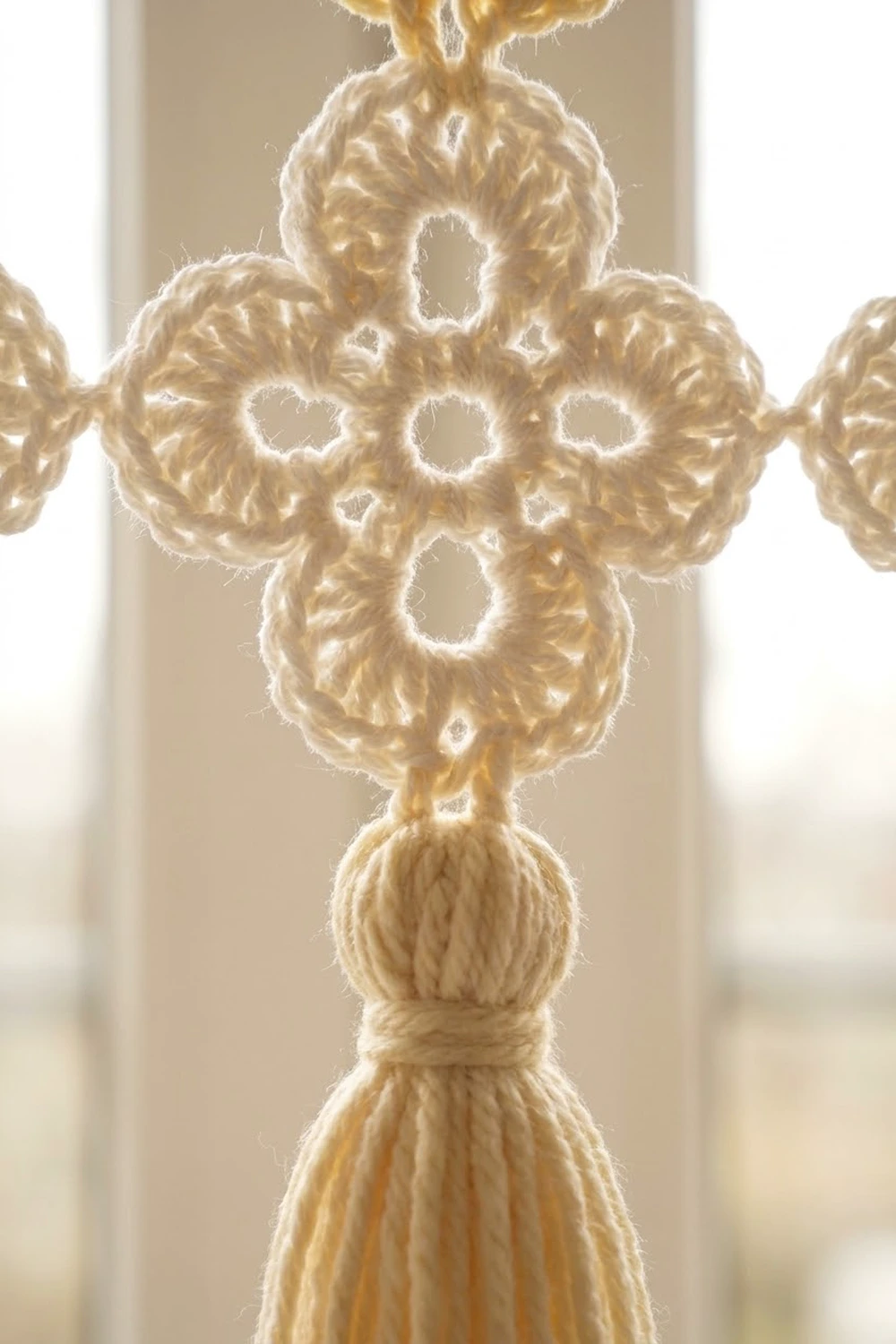
Medallion (make 9)
Work in the round with the RS facing. Do not turn.
Round 1: Make a magic ring. Ch 3 (counts as dc), 15 dc in ring. Pull the ring closed. Sl st to top of beginning ch-3. (16 dc)
Round 2: Ch 3 (counts as dc), dc in same st, ch 2, skip next dc. 2 dc in next dc, ch 2, skip next dc. Repeat from * 7 times. Sl st to top of beginning ch-3. (16 dc in 8 pairs, 8 ch-2 sps)
Round 3: Sl st in next dc and into next ch-2 sp. Ch 3 (counts as dc), (dc, ch 2, 2 dc) in same sp, ch 1. (2 dc, ch 2, 2 dc) in next ch-2 sp, ch 1. Repeat from * 7 times. Sl st to top of beginning ch-3. (8 shells: 32 dc, 8 ch-2 sps, 8 ch-1 sps)
Each ch-1 sp sits above a 2-dc pair from Round 2. This round creates the open, geometric grid.
Round 4 (scalloped edge): Sl st in next dc and into next ch-2 sp. Ch 1. (Sc, hdc, dc, picot, dc, hdc, sc) in ch-2 sp, sc in next ch-1 sp. Repeat from * 8 times total. Sl st to first sc. Fasten off.
This round is worked into spaces, not stitches. The count is 8 shells x 6 sts = 48 sts, plus 8 sc in the ch-1 sps, for a total of 56 sts and 8 picots.
Mark the points: Lay the medallion RS up. Choose any picot as 12 o’clock. Place markers in the picots at 3 o’clock, 6 o’clock, and 9 o’clock (every second picot). Leave the 12 o’clock picot unmarked. The tassel hangs from the 6 o’clock picot, and the 3 and 9 o’clock picots attach to the rails.
Weave in the ends on the wrong side.
Tassel (make 9)
Make each tassel in the same color as its medallion.
- Wrap yarn 25 times around the 3 in (7.6 cm) card.
- Cut a 12 in (30.5 cm) tie strand. Slide it under all the wraps at the top edge and knot it tightly. Leave both ends long.
- Cut the wraps along the bottom edge. You now have 50 strands, folded at the tie.
- Roll about 1 m of matching yarn into a firm ball 0.5 in (1.3 cm) across. Tuck it under the fold, inside the strands, so the strands drape over it.
- Cut an 18 in (45.7 cm) strand. Wrap it 6 times tightly around the tassel 0.75 in (1.9 cm) below the top, just under the ball. Knot it, then thread both ends down into the skirt.
- Trim the skirt so the whole tassel measures 2.5 in (6.4 cm) from top to tip.
- Thread both tie-strand ends through the 6 o’clock picot of the matching medallion. Knot twice, snug against the picot. Bury the ends in the tassel head.
Checkpoint: The head is round and full, the neck is 0.75 in (1.9 cm) below the top, and the tassel hangs straight down from the picot.
Make All Pieces
- Cream (A): 3 medallions, 3 tassels
- Pale gold (B): 3 medallions, 3 tassels
- Golden yellow (C): 3 medallions, 3 tassels
Lay the finished pieces out from top to bottom in this order:
ROW 1: CREAM
ROW 2: PALE GOLD
ROW 3: GOLDEN YELLOW
ROW 4: CREAM
ROW 5: PALE GOLD
ROW 6: GOLDEN YELLOW
ROW 7: CREAM
ROW 8: PALE GOLD
ROW 9: GOLDEN YELLOW
Each row is one medallion with its tassel hanging below it. Make sure every medallion is RS up, with its tassel at 6 o’clock.
Joining
Method: Two chain rails in cream, one down each side. The left rail joins the 9 o’clock picots and the right rail joins the 3 o’clock picots, each with a sl st.
Stitch-to-stitch logic: One picot meets one sl st. Between medallions, each rail has exactly 30 ch. At 5 ch per inch, that sets the center-to-center spacing at 6 in (15.2 cm). That breaks down as 2.5 in (6.4 cm) of medallion, 2.5 in (6.4 cm) of tassel, and 1 in (2.5 cm) of clear space before the next medallion.
Left rail: With cream, join with sl st in the 9 o’clock picot of medallion 1. Ch 30, sl st in the 9 o’clock picot of the next medallion. Repeat from * 7 times, ending at medallion 9. Do not fasten off. (240 ch, 9 picot joins)
Right rail: Work the same way along the 3 o’clock picots. (240 ch, 9 picot joins)
Order of work: Finish the left rail, its border Pass 1, and its top segment before you start the right rail.
Tension advice: Keep your chains at gauge. Tight chains pull the medallions together, so the tassels crowd the next motif. Loose chains sag and stretch over time. Count every group of 30 before each join.
Size checkpoint: Lay the strand flat. Medallion 1 center to medallion 9 center should measure 48 in (121.9 cm), which is 8 gaps x 6 in (15.2 cm). Both rails should match within 0.25 in (0.6 cm).
Border
The border reinforces the rails and adds the hanging point. It uses the same gauge as the rails: 5 sts = 1 in (2.5 cm) for ch, sl st, and sc.
Pass 1 (each rail, worked upward): Sl st in the back bump of each ch back up to medallion 1. Pass over each picot join without adding stitches. (240 sl st per rail; 30 per segment)
This pass locks each chain at its full length, so the rail stretches less under the weight of the medallions.
Pass 2, left top segment: From the 9 o’clock picot of medallion 1, ch 15. Fasten off, leaving a 6 in (15.2 cm) tail. (15 ch)
Pass 2, right top segment: From the 3 o’clock picot of medallion 1, ch 15, then sl st in the last ch of the left top segment. This point is the apex. (15 ch + 1 sl st)
Hanging loop: Ch 20, sl st in the apex. Work 20 sc over the loop (1 sc per ch). Sl st to first sc. Fasten off. (20 sc: 10 per side of the folded loop)
Why the math works:
- Rails: 30 ch ÷ 5 per inch = 6 in (15.2 cm) per segment. The count is the same on both sides, so every medallion hangs level.
- Top segments: 15 ch = 3 in (7.6 cm) each. They start at side picots 2.5 in (6.4 cm) apart and meet in a triangle about 1.5 in (3.8 cm) above the top picot of medallion 1.
- Loop: 20 ch = 4 in (10.2 cm) around, so it hangs 2 in (5.1 cm) when folded.
- Total: 53 in (134.6 cm) joined strand + 1.5 in (3.8 cm) apex + 2 in (5.1 cm) loop = 56.5 in (143.5 cm).
Weave in all remaining ends along the rails.
Final Blocking
- Wet the medallions only. Squeeze out the water in a towel; do not wring.
- Lay the garland flat on a blocking mat, RS up.
- Pin each medallion to 2.5 in (6.4 cm) across, with one pin in each of the 8 picots.
- Check that each center-to-center gap is 6 in (15.2 cm) and that the rails lie straight.
- Optional: mist the medallions lightly with spray starch for crisp lace in a sunny window.
- Let dry completely.
- Steam each tassel lightly from above, then comb the strands straight with your fingers. Trim the tips back to 2.5 in (6.4 cm) if needed.
- Hang the garland for 24 hours, then measure it again.
Final Quality-Control Checklist
- [ ] 9 medallions, each 2.5 in (6.4 cm) across, with 56 sts and 8 picots
- [ ] Colors run cream, pale gold, golden yellow, three times, top to bottom
- [ ] 9 tassels, each 2.5 in (6.4 cm) long, with round heads and even necks
- [ ] Each tassel tied to its own medallion’s 6 o’clock picot
- [ ] Both rails: 240 ch plus 240 reinforcing sl st
- [ ] Center-to-center spacing of 6 in (15.2 cm) throughout
- [ ] Each tassel tip clears the next medallion by about 1 in (2.5 cm)
- [ ] Hanging loop: 20 sc, firm, centered at the apex
- [ ] Total length 56.5 in (143.5 cm)
- [ ] All ends woven in and invisible from the RS
Troubleshooting
Medallion cups. Your stitches are too tight in Round 3 or 4. Go up a hook size, or loosen the ch-2 sps.
Medallion ruffles. Check that Round 3 has exactly 8 shells. An extra shell makes the edge wave.
Medallion tilts on the strand. The rail picots are not opposite each other. Recount: there must be exactly one picot between 3 o’clock and 6 o’clock, and one between 6 o’clock and 9 o’clock.
Tassels touch the medallion below. The rails are too tight. Measure 30 ch against 6 in (15.2 cm) again, and redo them with a looser chain.
Strand hangs crooked. One rail has a miscounted segment. Count each segment; every one must be 30 ch.
Tassel head looks flat. Use a slightly larger filler ball, and wrap the neck tighter.
Rails stretched after hanging. Take the garland down, wet it, and block it flat again. Starch the rails lightly.
Care
Hand wash in cool water with mild soap and dry flat, combing the tassels while damp. Keep the garland out of strong direct sun for long periods if you want the golden shades to stay bright.
Final Notes
The measurement chain is short and easy to check. Each medallion measures 1 in (2.5 cm), 1.5 in (3.8 cm), 2 in (5.1 cm), and 2.5 in (6.4 cm) across after its four rounds. Each tassel is 2.5 in (6.4 cm). The rails set a 6 in (15.2 cm) spacing, giving 48 in (121.9 cm) between the first and last centers and a 53 in (134.6 cm) joined strand. The apex and loop add 3.5 in (8.9 cm), for a finished garland of 56.5 in (143.5 cm).
Optional: to lengthen the strand, add medallions in sets of three colors, with 30 more ch per added medallion on each rail.
Happy crocheting!