

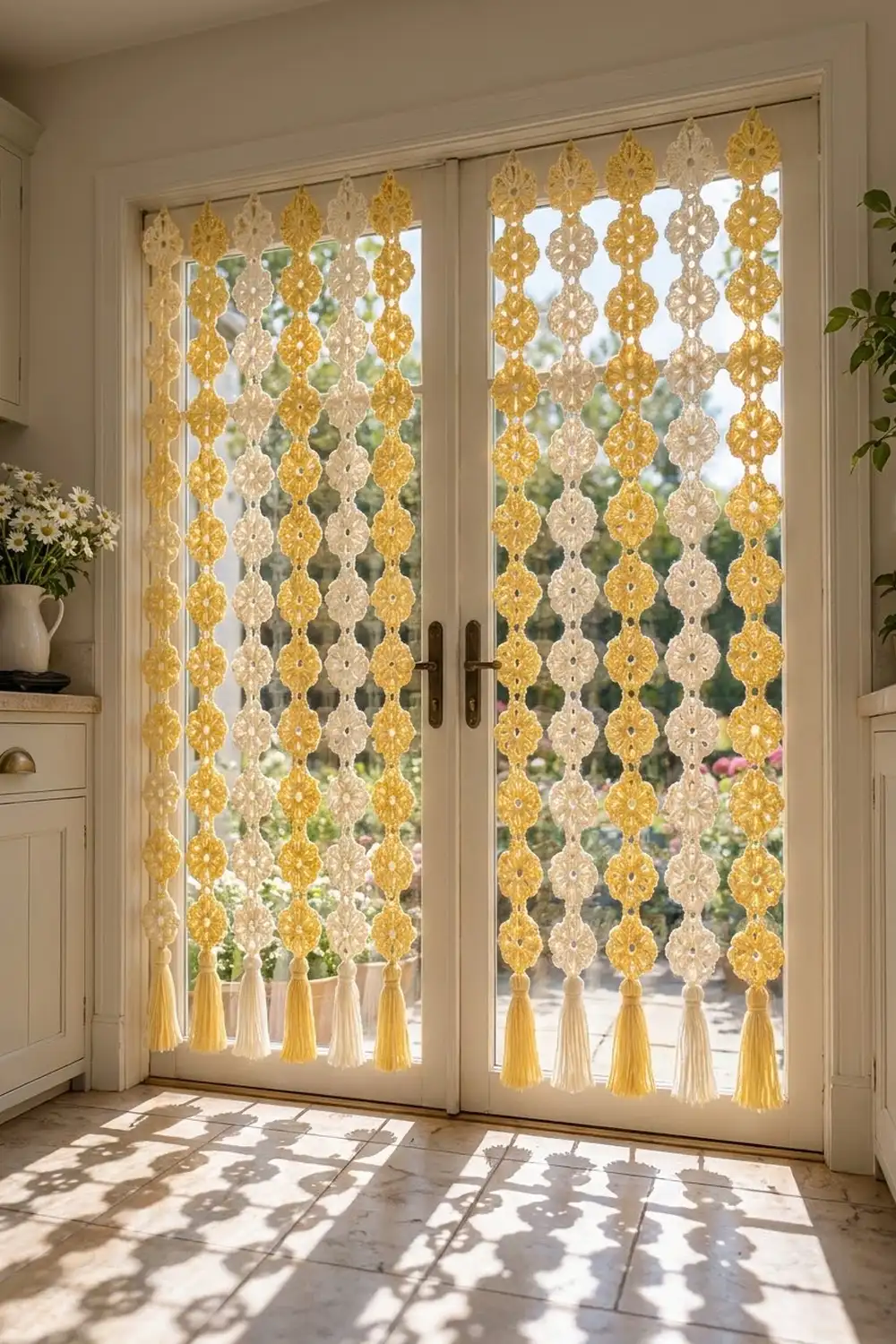
This door curtain is made of long strands of six-petal flowers in butter yellow and cream, and each strand ends in a full tassel. When it hangs in a sunny doorway, light comes through the little holes in each flower and makes soft, lacy shadows on the floor.
The style is light and cottage-inspired. The strands alternate yellow and cream across the width, so even a plain doorway feels like a garden entrance. Each flower has an open center ring, six round eyelets, and rounded petals with a slight point at the tip.
The pattern uses US crochet terms. The finished curtain is 56 in (142.2 cm) wide. The total drop is 77.75 in (197.5 cm) from the top of the rod pocket to the tassel tips. That fits most standard doors and many French-door openings.
The construction has three parts. First you make flowers in three rounds, joining each one to the flower above it as you go, to build 16 strands of 22 flowers. Next you tie a tassel to the bottom of each strand. Finally, you crochet a header band, fold it into a rod pocket, and catch the strands into it in a single closing row.
Finished Size and Construction
- Finished size: 56 in (142.2 cm) wide × 77.75 in (197.5 cm) total drop
- Skill level: Easy–Intermediate (simple stitches, lots of repetition)
- Terminology: US crochet terms
- Yarn weight: Worsted (#4), cotton or cotton blend
- Hook: 4.5 mm (US 7)
- Number of pieces: 352 flowers, 16 tassels, 1 header band
- Layout: 16 strands × 22 flowers each, colors alternating by strand
- Piece size: one flower is 3 in (7.6 cm) from petal tip to petal tip
- Strand length (flowers only): 71.25 in (181.0 cm)
- Size before border: the strands alone have no fixed width until they are joined to the header
- Border depth: the header band is 2 in (5.1 cm) deep flat and 1 in (2.5 cm) folded into the rod pocket
Materials
Yarn advice: Choose a smooth worsted cotton or cotton-acrylic blend, about 190 m per 100 g. Cotton gives crisp petal tips, hangs straight, and doesn’t stretch much. Avoid fuzzy yarns, because they fill in the eyelets.
- Butter Yellow: 550 g (1,045 m / 1,143 yd) for 8 strands, 8 tassels, and the header band
- Cream: 500 g (950 m / 1,039 yd) for 8 strands and 8 tassels
One flower uses about 4.5 m (4.9 yd), and one tassel uses about 8.2 m (9.0 yd). One full strand with its tassel uses about 107.2 m, or about 56 g.
Tools:
– 4.5 mm (US 7) crochet hook
– Tapestry needle
– Sharp scissors
– A stiff card 5 in (12.7 cm) tall for winding tassels
– Measuring tape
– Blocking mats, rustproof pins, and a spray bottle
– A slim curtain rod or tension rod up to 0.5 in (1.3 cm) in diameter
All yarn quantities include a margin of about 10–15% for gauge differences and swatching.
Abbreviations (US Terms)
- ch – chain
- sl st – slip stitch
- sc – single crochet
- hdc – half double crochet
- dc – double crochet
- tr – treble crochet
- sk – skip
- st(s) – stitch(es)
- sp – space
- rep – repeat
Special stitch – Tip Join: Work the tr at the petal tip. Ch 1, then sl st into the top of the tip tr on the bottom petal of the flower above. Ch 1, then sl st into the top 2 loops of the tr you just made, and carry on with the petal. The two ch 1s and the sl st make a link about 0.25 in (0.6 cm) long. These link chains are not counted in stitch totals.
Gauge and Checkpoints
Header gauge: 16 sc × 16 rows = 4 in (10.2 cm) in sc worked in rows.
Make one test flower first. Then check it at each stage:
- After Round 1: the circle measures 1.25 in (3.2 cm) across.
- After Round 2: the arches measure 2 in (5.1 cm) across.
- After Round 3: the flower measures 3 in (7.6 cm) from the top petal tip to the bottom petal tip.
- Link plus flower: each flower adds 3.25 in (8.3 cm) to a strand.
If your flower is bigger than 3 in (7.6 cm), go down to a 4.0 mm hook. If it is smaller than 2.75 in, go up to a 5.0 mm hook. A difference of 0.25 in (0.6 cm) per flower adds up to 5.5 in (14.0 cm) over 22 flowers, so check gauge before you start a whole strand.
Flower Motif Pattern
Make each strand in a single color. Flower 1 is the top flower, and each new flower hangs below the one before it.
Round 1: Make a magic ring. Ch 3 (counts as dc), then work 11 dc into the ring. Pull the ring closed, leaving a small hole about 0.25 in (0.6 cm) wide in the center. Sl st to the top of the beginning ch-3. (12 dc)
Round 2: Ch 1. Sc in the same st as the join, ch 5, sk the next dc. Sc in the next dc, ch 5, sk the next dc; rep from * 4 more times. Sl st to the first sc. (6 sc and 6 ch-5 arches)*
Each arch bridges one skipped dc. The open space under each arch becomes one of the six round eyelets.
Round 3 (petals): Sl st into the first ch-5 arch. Work the next sequence into each of the 6 arches:
(sc, hdc, 2 dc, tr, 2 dc, hdc, sc).
Sl st to the first sc. Fasten off and weave in the ends. (6 petals of 9 sts each = 54 sts)
Round 3 is a growth round: 6 arches × 9 sts = 54 sts. Each petal is shaped by its graded stitches, from sc up to the tr point and back down, which gives the rounded petal with a soft tip.
Petal numbering: The petal you work first is Petal 1, the top of the flower. Petal 4 is directly opposite, at the bottom. These two tips run along the strand.
Flower 1 (top of strand)
Work Rounds 1–2 as written. In Round 3, work Petal 1 like this: sc, hdc, 2 dc, tr. Then ch 6 and sl st into the top 2 loops of that tr to make the hanging loop. Finish with 2 dc, hdc, and sc. Work Petals 2–6 as usual. (54 sts plus a ch-6 hanging loop)
Flowers 2–22
Work Rounds 1–2 as written. In Round 3, work Petal 1 with a Tip Join to Petal 4 of the previous flower. Work Petals 2–6 as usual. (54 sts per flower)
Strand checkpoint: After 4 flowers, the strand measures 12.75 in (32.4 cm). After 11 flowers, it measures 35.5 in (90.2 cm). The finished 22-flower strand measures 71.25 in (181.0 cm): 22 × 3 in plus 21 links × 0.25 in.
Tassel (one per strand)
- Wrap the yarn 30 times around the 5 in (12.7 cm) card.
- Slide a 12 in (30.5 cm) tie strand under the top of the wraps and knot it tightly.
- Cut through the wraps along the bottom edge.
- Wrap a 24 in (61.0 cm) strand of yarn around the bundle 0.75 in (1.9 cm) below the top to form the head. Secure it and bury the end inside the tassel.
- Use the top ties to knot the tassel to the tr tip of Petal 4 on Flower 22.
- Trim the bottom so the tassel is 5 in (12.7 cm) long from the top of the head to the tips.
Make All Pieces
- Yellow: 176 flowers (8 strands × 22), 8 tassels, 1 header band
- Cream: 176 flowers (8 strands × 22), 8 tassels
- Total: 352 flowers, 16 tassels
Layout grid (left to right, viewed from inside the room):
STRANDS 1–8: YELLOW CREAM YELLOW CREAM YELLOW CREAM YELLOW CREAM
STRANDS 9–16: YELLOW CREAM YELLOW CREAM YELLOW CREAM YELLOW CREAM
Every strand is 22 flowers long, so all the tassels hang level.
Joining
Method: The flowers are joined as you go with the Tip Join described above. No sewing is needed between flowers.
Stitch-to-stitch logic: Each join connects exactly one stitch to one stitch: the tip tr of Petal 1 on the new flower to the tip tr of Petal 4 on the flower above. Both tips sit on the vertical center line, so the strand hangs straight. Petals 2, 3, 5, and 6 stay free.
Tension advice: Keep the Tip Join chains at your normal chain tension. Tight links make the flowers rotate and twist the strand. Loose links make the gaps sag and lengthen the strand. Every link should look like a small bar about 0.25 in (0.6 cm) long.
Size checkpoint: Lay all 16 strands side by side. Every strand should measure 71.25 in (181.0 cm), within 1 in (2.5 cm). If one is more than 1 in (2.5 cm) off, check its link tension or remake its tightest flower.
Border: Header Band and Rod Pocket
Here the border is the top header band. It sets the curtain’s width and holds the strands in place.
Border gauge: 16 sc × 16 rows = 4 in (10.2 cm), which is 4 sc per inch.
Use Yellow.
Row 1: Ch 225. Sc in the 2nd ch from the hook and in each ch across. Turn. (224 sc)
Rows 2–8: Ch 1. Sc in each st across. Turn. (224 sc per row)
The band now measures 56 in × 2 in (142.2 cm × 5.1 cm). Each short end is 8 rows tall. Don’t fasten off.
Section markers: Divide the 224 sts into 16 sections of 14 sts each. Place a marker in the 7th st of each section, counting along Row 8. That gives 16 markers, one per strand.
Closing and join row: Fold the band in half lengthwise so that the foundation chain edge sits behind Row 8.
Ch 1. Working through each Row 8 st and the matching foundation ch together, sc across. At each marked st, also insert the hook through a strand’s ch-6 hanging loop before you complete the sc. Attach Strands 1–16 in order, following the layout grid. (224 sc, with 16 strands caught in)
Leave both short ends open so the rod can slide through the pocket.
Why the math works: The band has 16 sections of 14 sts each, and 16 × 14 = 224 sc. At 4 sc per inch, 224 ÷ 4 = 56 in (142.2 cm). Each strand gets a 3.5 in (8.9 cm) section, and 16 × 3.5 in = 56 in. The flowers measure about 2.6 in (6.6 cm) across their sides, so neighboring strands have about 0.9 in (2.3 cm) of air between them and won’t tangle. The closing row is 1 sc into each existing st, so it stays at 224 with nothing added.
Folded, the pocket is 1 in (2.5 cm) deep and fits a rod up to 0.5 in (1.3 cm) in diameter.
Total drop: 1 in pocket + 0.5 in hanging loop + 71.25 in strand + 5 in tassel = 77.75 in (197.5 cm).
Final Blocking
- Lightly mist each strand until it is damp, not soaked.
- Pin each flower flat on mats, with Petals 1 and 4 lined up on a straight line.
- Ease each flower to 3 in (7.6 cm) from tip to tip, and pin each petal tip.
- Pin each tassel straight and comb the strands with your fingers.
- Leave everything to dry completely, which usually takes 12–24 hours.
- Steam the header band flat on a low setting, without pressing it hard.
- Hang the curtain for one day before the final tassel trim.
Final Quality-Control Checklist
- [ ] Every flower has 54 sts in Round 3 and 6 open eyelets
- [ ] Every strand has 22 flowers and measures 71.25 in (181.0 cm)
- [ ] All links are the same 0.25 in (0.6 cm) length
- [ ] Colors alternate correctly across all 16 strands
- [ ] Each strand sits in the 7th st of its 14-st section
- [ ] The band measures 56 in (142.2 cm) and both pocket ends are open
- [ ] All tassels measure 5 in (12.7 cm) and hang level
- [ ] All ends are woven in securely
Troubleshooting
Petals cup or ruffle: Round 1 is too tight or the arches are too short. Check that Round 1 has 12 dc and that each arch is a true ch-5.
Eyelets close up: You worked into the skipped dc. Make sure each arch skips exactly 1 dc.
Strand twists: The Tip Joins are off-center. Join only at the tip tr of Petal 1 and Petal 4.
Strands differ in length: Your tension has drifted. Measure each strand every 4 flowers against 12.75 in (32.4 cm).
Band ripples: Your sc are too loose. Remake the band with a 4.0 mm hook to reach 4 sc per inch.
Tassels look thin: Wrap 35 times instead of 30 and allow an extra 1.3 m per tassel.
Care
Hand wash in cool water with mild soap, press out the water in a towel, and dry the curtain flat in sections. Re-block the flowers if needed and comb the tassels while they are still damp.
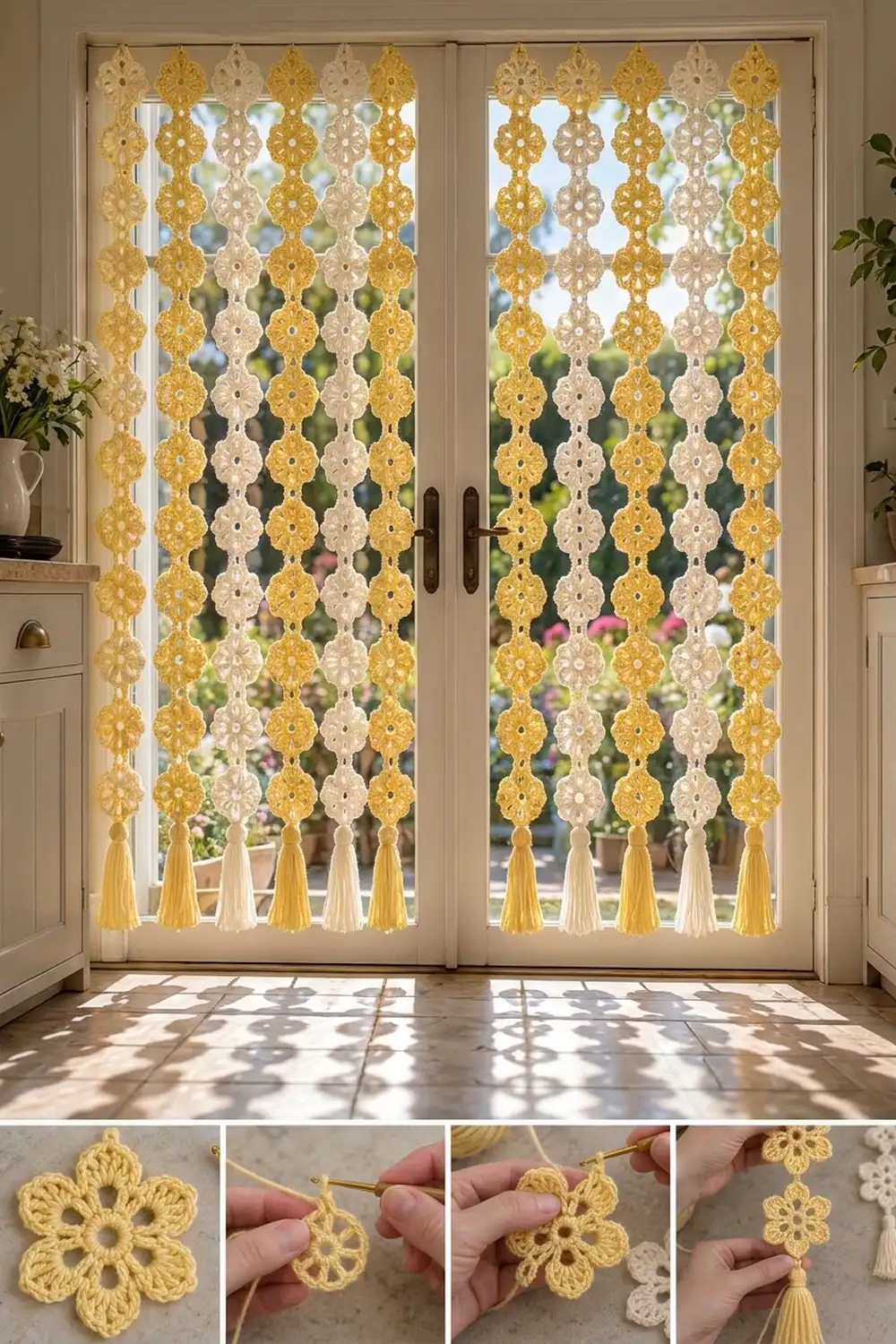
Final Notes
This curtain depends on one measurement chain. Each flower is 3 in (7.6 cm), and with its link it adds 3.25 in (8.3 cm) to a strand. Twenty-two flowers make a 71.25 in (181.0 cm) strand. Sixteen strands set into 14-st sections give a 224-sc header that is 56 in (142.2 cm) wide. The pocket, loop, strand, and tassel together give a 77.75 in (197.5 cm) drop. If your first flower is right, the rest will come out right too.
Happy crocheting!