

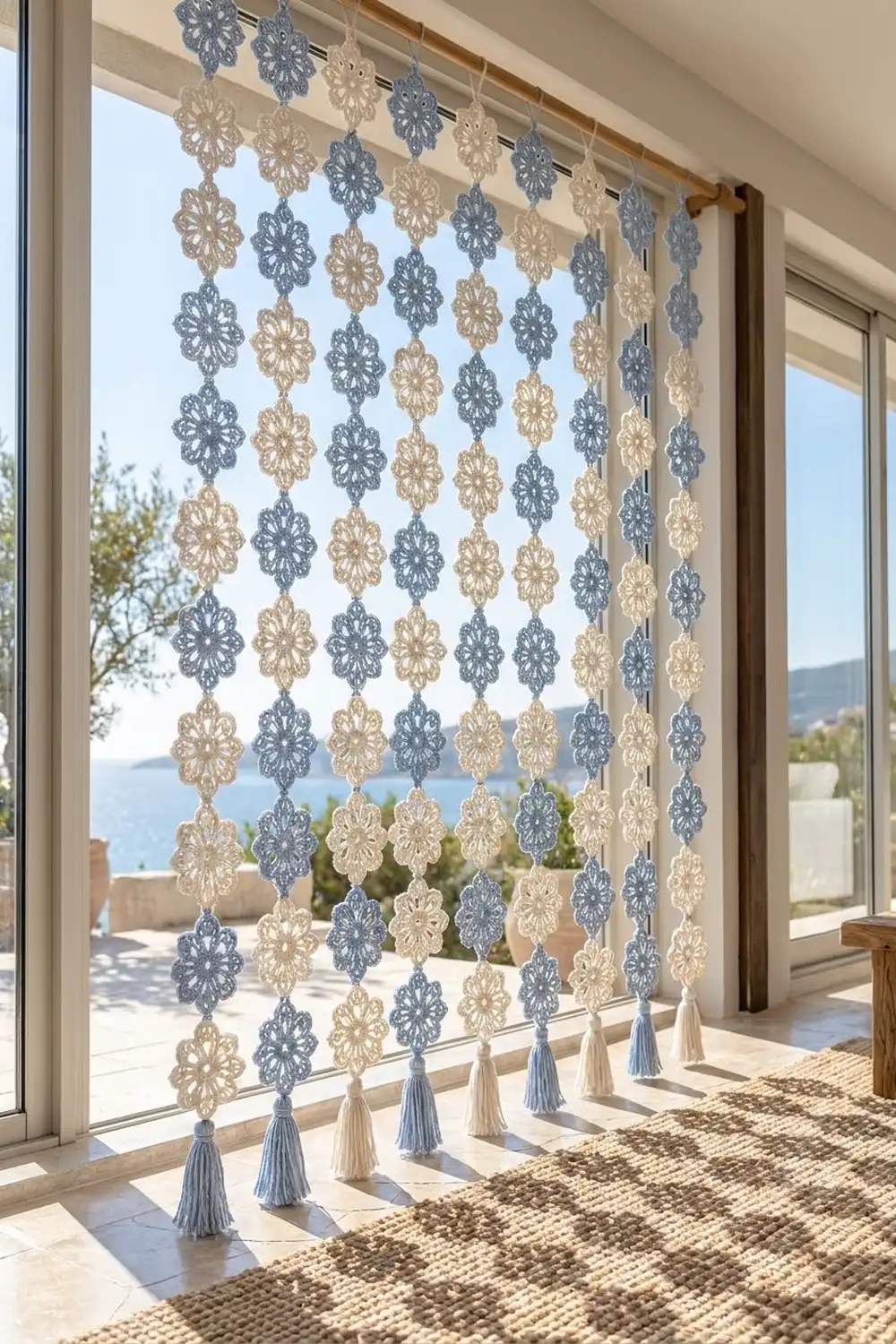
The Seaside Bloom Flower Curtain is a light, airy hanging made of 8-petal openwork flowers strung in long vertical strands. Each flower has a tiny open center, a solid ring of double crochet, and eight pointed petals, each with its own teardrop eyelet. Light comes through every flower and every gap between them.
The palette is soft powder blue and warm cream. Colors alternate down each strand and shift by one motif on the neighboring strand, so the finished curtain reads as a gentle checkerboard. A full tassel finishes the bottom of each strand.
This pattern uses US crochet terms. The finished curtain measures 48 in (121.9 cm) wide along the rod and 62 in (157.5 cm) long from the top of the hanging loops to the ends of the tassels.
Construction is simple. You crochet one 3-round flower motif. From the second motif on, you join each new flower to the one above it on the last round, working down the strand. Each strand gets a hanging loop at the top and a tassel at the bottom. Then the strands are slid onto a rod.
Finished Size and Construction
- Finished size: 48 in (121.9 cm) wide × 62 in (157.5 cm) long
- Skill level: Easy–Intermediate
- Terminology: US crochet terms
- Yarn weight: DK (#3) cotton
- Hook: US E-4 (3.5 mm)
- Number of pieces: 168 flower motifs + 12 tassels
- Layout: 12 strands × 14 motifs each
- Piece size: 3.5 in (8.9 cm) tip to tip, blocked
- Size before border: each strand is 55.5 in (141.0 cm) long, motifs only
- Border depth: a 2 in (5.1 cm) hanging loop at the top, plus a 0.5 in (1.3 cm) link and a 4 in (10.2 cm) tassel at the bottom
Materials
Yarn advice: Use a smooth DK cotton or cotton blend. Cotton holds the pointed petal tips well, blocks crisply and does not stretch much when it hangs. Avoid fuzzy yarns, which blur the eyelets.
- Powder blue: 350 g / 840 m (seven 50 g / 120 m balls)
- Cream: 350 g / 840 m (seven 50 g / 120 m balls)
Each motif uses about 3 g / 7 m. Each tassel uses about 4 g / 9.1 m. Each hanging loop uses about 1.5 m. The quantities above already include a margin of roughly 25% for gauge swatches, dye-lot safety and a few practice motifs.
Tools:
– US E-4 (3.5 mm) crochet hook
– Tapestry needle
– Scissors
– A piece of stiff cardboard, 4.5 in (11.4 cm) tall, for tassels
– Rust-proof pins and a blocking mat
– Spray bottle
– A curtain rod at least 50 in (127.0 cm) long and up to 1.25 in (3.2 cm) in diameter
– Measuring tape
Abbreviations (US Terms)
- ch – chain
- sl st – slip stitch
- sc – single crochet
- hdc – half double crochet
- dc – double crochet
- sk – skip
- sp – space
- st(s) – stitch(es)
- rep – repeat
- MR – magic ring
Special stitch – Petal: Work (sc, hdc, 4 dc, ch 2, 4 dc, hdc, sc) all into the same ch-7 loop. That is 12 stitches plus 1 ch-2 tip per petal.
Joining Petal: Work (sc, hdc, 4 dc, ch 3, sl st in the ch-2 tip of the motif above, ch 3, 4 dc, hdc, sc) into the same ch-7 loop. That is still 12 stitches, with the tip replaced by a short connector.
Gauge and Checkpoints
Make one complete test motif before you start production. Gauge matters here because 14 motifs stack along each strand, so any small error multiplies by 14.
Chain gauge: 6 ch = 1 in (2.5 cm).
Motif checkpoints (measured flat, lightly blocked):
– After Round 1: 1.25 in (3.2 cm) across
– After Round 2: 2.5 in (6.4 cm) across, loop to loop
– After Round 3: 3.5 in (8.9 cm), petal tip to opposite petal tip
Strand checkpoint: 3 joined motifs measure 11.5 in (29.2 cm) from the top tip to the bottom tip.
If your motif is too big: go down to a US D-3 (3.25 mm) hook, or check that your dc are not too loose.
If your motif is too small: go up to a US 7 (4.5 mm) hook, or make sure your ch-7 loops are not pulled tight.
A difference of 0.25 in (0.6 cm) per motif adds 3.5 in (8.9 cm) to each strand, so correct it early.
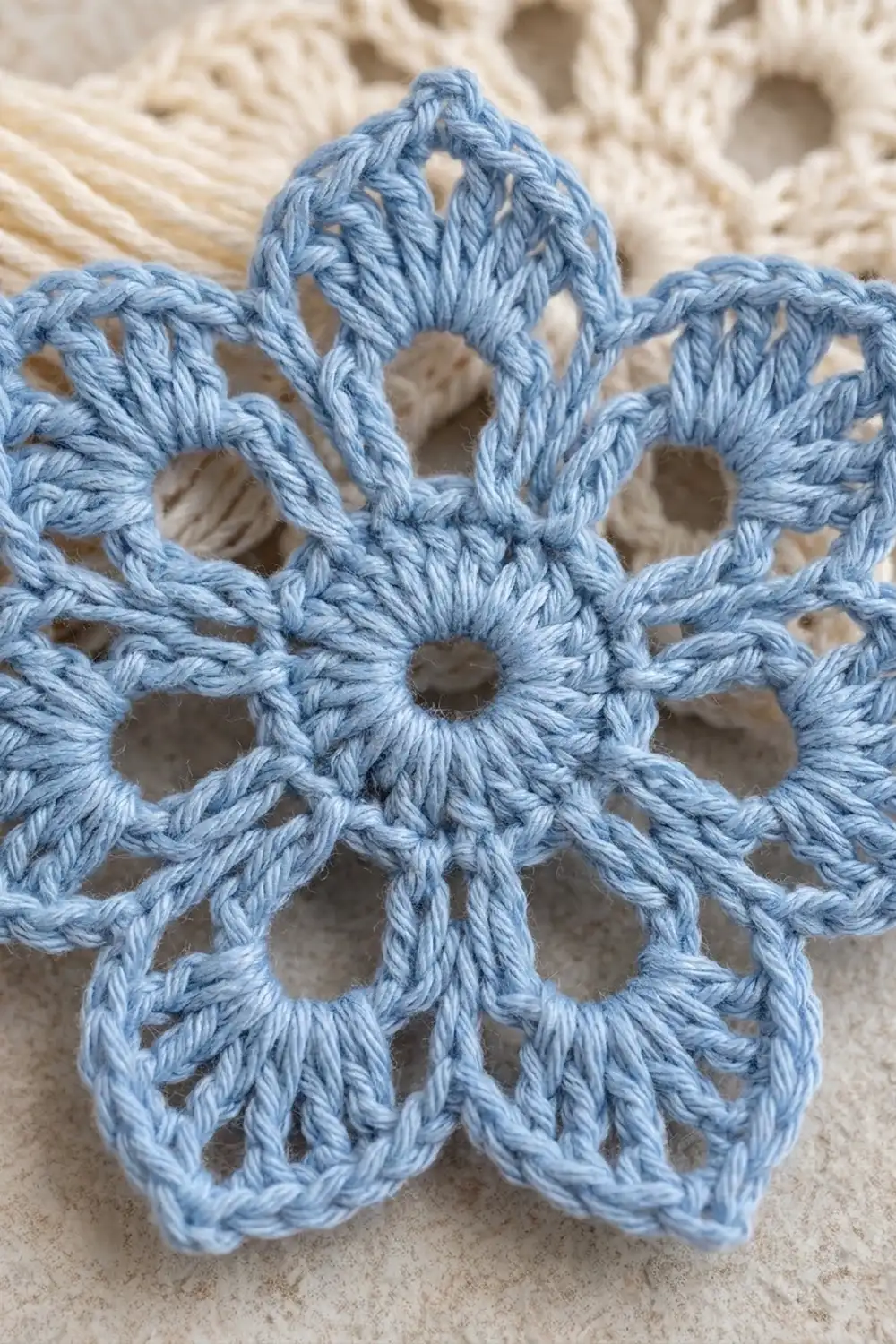
Seaside Bloom Flower Motif
The motif is worked in the round, right side always facing. Do not turn.
Round 1: Make a MR. Ch 3 (counts as dc), work 15 dc into the ring. Pull the ring closed, leaving a small center hole about the size of a pencil. Sl st in the top of the beginning ch-3.
Stitch count: 16 dc.
Round 2: Ch 1, sc in the same st, ch 7, sk next dc, sc in next dc, ch 7, sk next dc. Rep from * 6 more times. Sl st in the first sc.
Stitch count: 8 sc and 8 ch-7 loops.
The 8 sc land on every other dc of Round 1, so the loops are evenly spaced around the center ring. The space each loop encloses becomes the petal’s teardrop eyelet.
Round 3: Work a Petal into the next ch-7 loop. This is Petal 1, the top of the motif. Work a Petal into each of the remaining 7 loops. Sl st in the first sc. Fasten off and weave in the ends.
Stitch count: 96 sts (8 petals × 12 sts) and 8 ch-2 tips.
The short-to-tall stitch sequence (sc, hdc, then 4 dc) rises to the ch-2 point and steps back down on the other side. That shapes each petal with a defined pointed tip. Because there are 8 petals, Petal 1 and Petal 5 sit exactly opposite each other, so the motif hangs straight with one tip pointing up and one pointing down.
Petal map: Petal 1 = top. Petal 5 = bottom. Petals 2–4 and 6–8 are the sides.
Make All Pieces
You need 168 motifs: 84 blue and 84 cream. Only the first motif of each strand is made on its own. The other 13 motifs in each strand are joined as you go (see Joining).
- Blue: 84 motifs, 6 tassels, 6 hanging loops
- Cream: 84 motifs, 6 tassels, 6 hanging loops
Odd strands start with blue. Even strands start with cream. Each strand alternates colors, so motif 14 is always the opposite color to motif 1. The tassel matches the strand’s first motif, which gives the bottom row a mix of blue and cream tassels.
Strand layout (top to bottom):
STRAND 1, 3, 5, 7, 9, 11: BLUE CREAM BLUE CREAM BLUE CREAM BLUE CREAM BLUE CREAM BLUE CREAM BLUE CREAM, then BLUE tassel
STRAND 2, 4, 6, 8, 10, 12: CREAM BLUE CREAM BLUE CREAM BLUE CREAM BLUE CREAM BLUE CREAM BLUE CREAM BLUE, then CREAM tassel
Curtain grid (motif rows across the rod, left to right):
ROW 1: BLUE CREAM BLUE CREAM BLUE CREAM BLUE CREAM BLUE CREAM BLUE CREAM
ROW 2: CREAM BLUE CREAM BLUE CREAM BLUE CREAM BLUE CREAM BLUE CREAM BLUE
ROW 3: BLUE CREAM BLUE CREAM BLUE CREAM BLUE CREAM BLUE CREAM BLUE CREAM
The rows keep alternating like this through ROW 14.
Joining
Method: join-as-you-go on Round 3, tip to tip.
- Make motif 1 of the strand completely, following all 3 rounds.
- For motif 2, work Rounds 1 and 2 as usual in the next color.
- On Round 3, work a Joining Petal into the first ch-7 loop. When you reach the tip, ch 3, then sl st into the ch-2 tip of Petal 5 of the motif above, then ch 3 and finish the petal.
- Work regular Petals into the remaining 7 loops. Close the round as usual.
- Repeat for motifs 3 through 14, always joining the new motif’s Petal 1 to the previous motif’s Petal 5.
Stitch-to-stitch logic: Each join connects exactly one tip to one tip. The new motif still has 96 stitches, because the ch-3 + sl st + ch-3 replaces only the ch-2 tip and adds no petal stitches. The two ch-3 sections hang side by side and make a link about 0.5 in (1.3 cm) long, matching the 3 ch at 6 ch per inch.
Tension advice: Keep the ch-3 sections at your normal chain tension. If they are tight, the motifs crowd each other and the strand shortens. If they are loose, the strand gets longer and the motifs can twist.
Size checkpoint: Each motif adds 3.5 in (8.9 cm), and each link adds 0.5 in (1.3 cm).
- 14 motifs = 49 in (124.5 cm)
- 13 links = 6.5 in (16.5 cm)
- Strand total: 55.5 in (141.0 cm)
Check your first strand at motif 3, where it should measure 11.5 in (29.2 cm), and again when it is complete.
Border: Hanging Loops and Tassel Finish
A hanging curtain has no fabric edge to border. The edge finish here is the hanging loop at the top of each strand and the tassel at the bottom. These two pieces set the final length and the way the curtain sits on the rod.
Border gauge: 6 ch = 1 in (2.5 cm). 7 sc worked into a chain loop = 1 in (2.5 cm).
Hanging loop (top of motif 1, strand color):
Round 1: Join yarn with a sl st in the ch-2 tip of Petal 1 of motif 1. Ch 24, then sl st in the same tip.
Count: 24 ch, making a loop 4 in (10.2 cm) around.
Round 2: Work 28 sc into the loop. Sl st in the first sc and fasten off.
Count: 28 sc, 14 sc per side of the flattened loop.
Why the math works: At 6 ch per inch, 24 ch makes a 4 in (10.2 cm) loop. Flattened, that gives a 2 in (5.1 cm) hanging depth. Packing 28 sc over 24 ch is 7 sc per inch, which is dense enough to stiffen the loop without ruffling it. A rod 1.25 in (3.2 cm) across has a circumference of about 3.93 in (10.0 cm), so it fits inside the 4 in (10.2 cm) loop.
Tassel (one per strand):
- Wrap yarn 40 times around the 4.5 in (11.4 cm) cardboard.
- Slide a 12 in (30.5 cm) tie strand under the wraps at the top and knot it tightly.
- Cut the wraps at the bottom. This gives 40 strands, each 9 in (22.9 cm) long, folded in half.
- Wrap a separate strand tightly 6 times around the bundle 0.75 in (1.9 cm) below the top to form the head. Knot it and bury the ends inside the tassel.
- Trim the ends evenly so the tassel measures 4 in (10.2 cm) from the top of the head.
Tassel link:
Round 1: Join yarn in the ch-2 tip of Petal 5 of motif 14. Ch 3 and fasten off, leaving a 6 in (15.2 cm) tail.
Count: 3 ch = 0.5 in (1.3 cm).
Thread the tassel’s tie through the last chain and knot it securely. Then weave all the tails into the tassel head.
Total strand length check: 2 in loop + 55.5 in motifs + 0.5 in link + 4 in tassel = 62 in (157.5 cm).
Total width check: 12 strands × 4 in (10.2 cm) per strand on the rod = 48 in (121.9 cm). Each 3.5 in (8.9 cm) motif sits in its own 4 in (10.2 cm) space, which leaves a 0.5 in (1.3 cm) gap between neighboring strands.
Final Blocking
- Block each strand separately, before you attach the tassel.
- Lay the strand flat on blocking mats in sections, with Petal 1 pointing up on every motif.
- Spray each motif until it is evenly damp, not soaked.
- Pin each motif at all 8 petal tips to a 3.5 in (8.9 cm) circle. Open each teardrop eyelet with a fingertip.
- Straighten each link so it measures 0.5 in (1.3 cm).
- Pin the hanging loop flat at 2 in (5.1 cm) deep.
- Let everything dry completely, usually 12–24 hours.
- Unpin, attach the tassel, and steam the tassel lightly so its strands hang straight.
Final Quality-Control Checklist
- Every motif has 16 dc in Round 1, 8 loops in Round 2, and 96 sts in Round 3.
- Every motif measures 3.5 in (8.9 cm) tip to tip.
- Each motif’s Petal 1 joins to Petal 5 of the motif above. No side petals are joined by mistake.
- Every strand is 55.5 in (141.0 cm) of motifs.
- Colors alternate correctly down each strand and across neighboring strands.
- All 12 hanging loops are the same depth, 2 in (5.1 cm).
- All 12 tassels are trimmed to 4 in (10.2 cm).
- All ends are woven in securely, with no tails visible from either side.
- The strands hang straight, without twisting, when slid onto the rod.
Troubleshooting
Center hole is too big: Pull the magic ring tail harder before joining Round 1, and weave the tail in around the ring.
Petals ruffle: Your ch-7 loops are too short or your dc are too tall. Check your loop tension or go down a hook size.
Petals look flat or rounded instead of pointed: Make sure you work the full ch 2 at each tip. Don’t skip the hdc steps, because they create the slope.
Strand twists when it hangs: One or more motifs are joined at the wrong petal. Count 4 petals from the join to confirm the bottom tip.
Strands are uneven lengths: The links vary. Measure each 3-motif section, then re-block, pinning the links to exactly 0.5 in (1.3 cm).
Tassel looks thin: Add 10 more wraps. This uses about 2.3 m more yarn per tassel.
Care
Hand wash in cool water with a mild soap. Press out the water in a towel, then reshape and pin flat to dry. Do not tumble dry, because the strands can tangle.
Final Notes
The Seaside Bloom curtain is built on a short, reliable measurement chain:
- 6 ch = 1 in (2.5 cm)
- Each motif blocks to 3.5 in (8.9 cm)
- Each link adds 0.5 in (1.3 cm), so 14 motifs make a 55.5 in (141.0 cm) strand
- The 2 in (5.1 cm) loop and the 0.5 in (1.3 cm) link plus 4 in (10.2 cm) tassel bring each strand to 62 in (157.5 cm)
- 12 strands at 4 in (10.2 cm) each fill 48 in (121.9 cm) of rod
Check your first motif and your first 3 joined motifs, and the rest of the curtain will come out right.
Happy crocheting!