

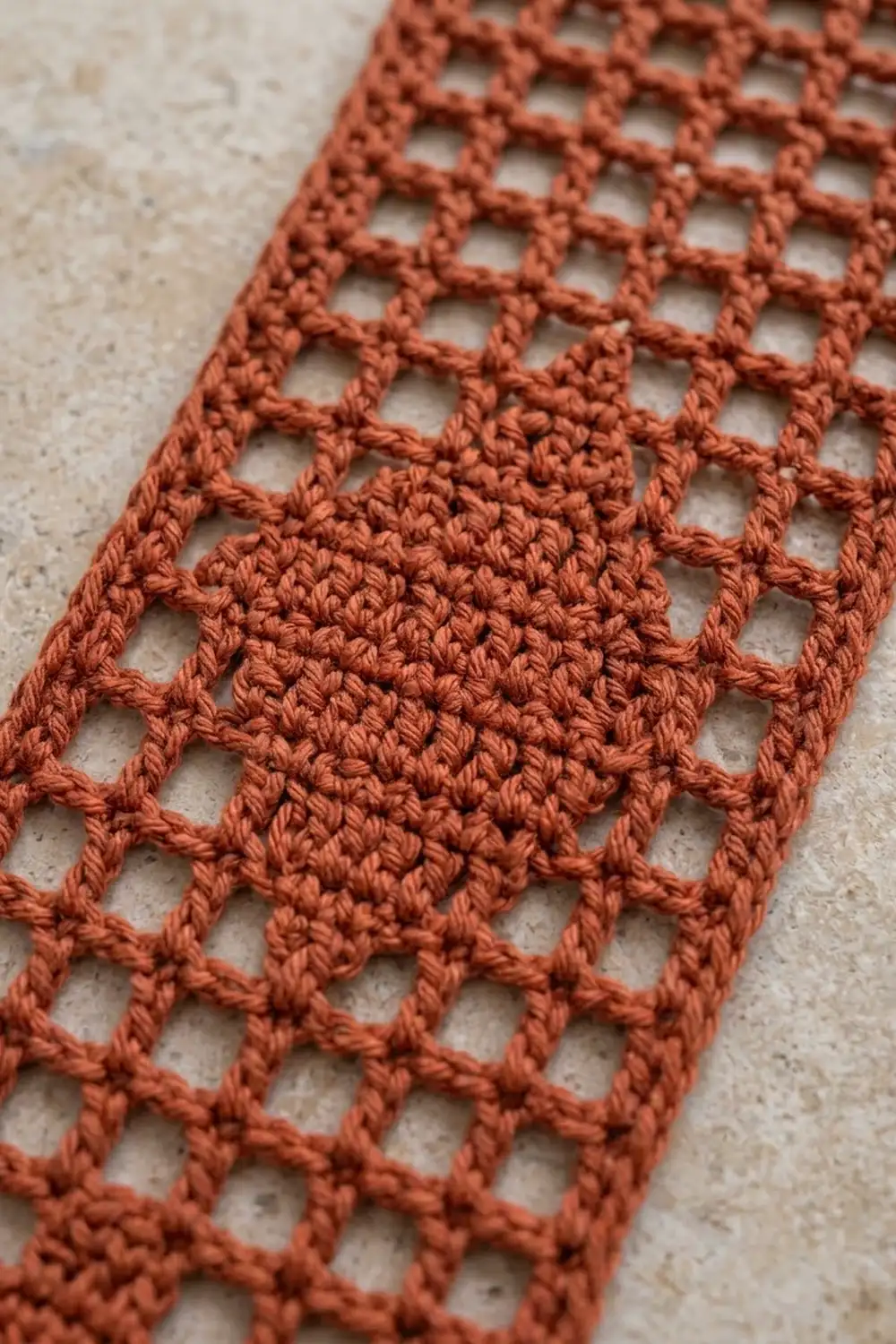
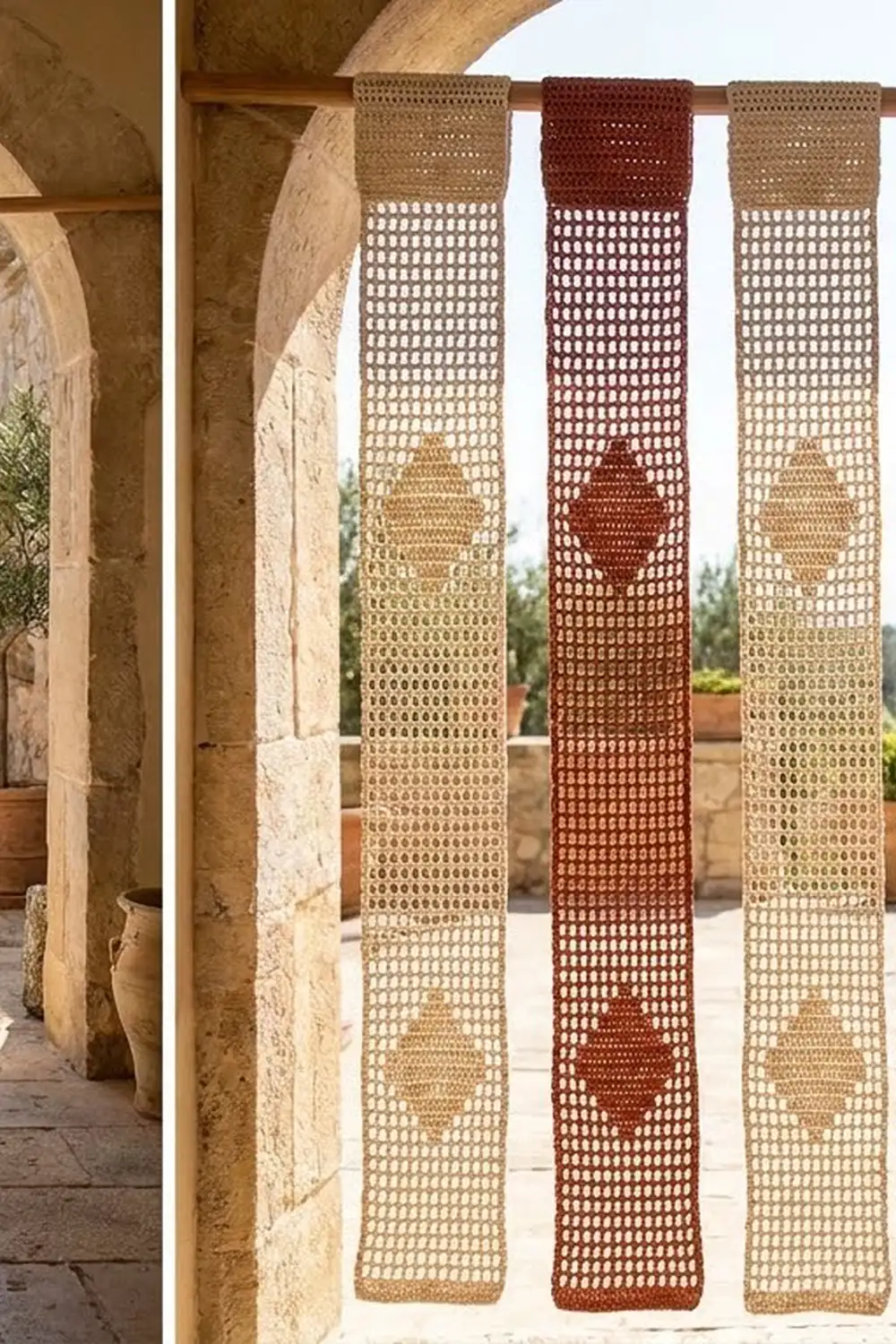
The Terracotta Trellis Curtain is a set of long, narrow filet crochet strips that hang side by side from a wooden rod. Each strip is an open grid of square meshes with a column of solid diamonds running down the center. Light passes through the mesh, and the diamonds cast soft patterned shadows on the floor.
The colors are warm and Mediterranean: rust terracotta strips alternate with natural cream strips. The look is simple and graphic, a bit boho, and suits a doorway, an arched opening, or a sunny window.
This pattern uses US crochet terms. Each finished strip measures 5 in (12.7 cm) wide by 64 in (162.6 cm) long, not counting the hanging tab. Eleven strips spaced 0.5 in (1.3 cm) apart make a curtain 60 in (152.4 cm) wide.
Each strip is worked flat in rows of filet crochet, from the bottom up. One round of single crochet frames the strip. Then you work one tab at the top center, fold it over the rod, and sew it to the back. The strips are never sewn to each other.
Finished Size and Construction
- Finished strip size: 5 in x 64 in (12.7 cm x 162.6 cm), not counting the tab
- Finished curtain width: 60 in (152.4 cm) with 0.5 in (1.3 cm) gaps
- Skill level: Easy to Intermediate
- Terminology: US crochet terms
- Yarn weight: Sport (#2) cotton
- Hook: 3.0 mm (C/2 or D/3)
- Number of pieces: 11 separate strips (6 terracotta, 5 cream)
- Layout: 11 strips in one row, alternating colors, terracotta at both ends
- Strip size before border: 4.5 in x 63.5 in (11.4 cm x 161.3 cm)
- Border depth: 0.25 in (0.6 cm) on every edge
- Diamond motif: 7 meshes wide x 7 rows tall, 3.5 in x 3.5 in (8.9 cm x 8.9 cm)
- Diamond repeat: 12 rows, 6 in (15.2 cm), 10 diamonds per strip
Materials
Choose a smooth, mercerized or combed sport-weight cotton. Cotton holds the square mesh shape, stretches very little when hanging, and keeps the diamonds crisp. Avoid fuzzy or very stretchy yarns. They blur the grid and let long strips grow over time.
The quantities below assume a cotton with about 150 m per 50 g.
- Terracotta (rust): 350 g, about 1,050 m, for 6 strips
- Cream (natural): 300 g, about 900 m, for 5 strips
Each strip uses about 45 to 50 g. These amounts include a margin of about 15 percent for your gauge swatch, differences in tension, and weaving in ends.
Tools:
- 3.0 mm crochet hook
- Tapestry needle
- Stitch markers
- Tape measure
- Rust-proof pins and a blocking surface
- Spray bottle
- Wooden curtain rod, up to 1.25 in (3.2 cm) in diameter and at least 62 in (157.5 cm) long
Abbreviations (US Terms)
- ch – chain
- sc – single crochet
- dc – double crochet
- sk – skip
- sp – space
- st(s) – stitch(es)
- RS / WS – right side / wrong side
Special stitches:
- Open Mesh (OM): ch 2, sk 2 sts (or sk the next ch-2 sp), dc in next dc.
- Block (BL): 2 dc in next ch-2 sp (or dc in each of next 2 sts), dc in next dc.
Every row begins with ch 3, which counts as the first dc. Every OM and BL ends with one dc, so a row of 9 units always has 1 + (9 x 3) = 28 sts. The last dc of each row goes into the top of the turning ch-3.
Gauge and Checkpoints
Gauge: 4 meshes wide (13 sts) x 4 rows = 2 in x 2 in (5.1 cm x 5.1 cm). Each mesh is a 0.5 in (1.3 cm) square.
Make one complete strip first, and check it at every stage before you start the rest.
Checkpoint 1 – after Row 6: 4.5 in (11.4 cm) wide, 3 in (7.6 cm) tall.
Checkpoint 2 – after Row 18 (first diamond repeat finished): 9 in (22.9 cm) tall. The diamond should measure 3.5 in (8.9 cm) each way.
Checkpoint 3 – after Row 66 (five repeats): 33 in (83.8 cm) tall.
Checkpoint 4 – after Row 127: 63.5 in (161.3 cm) tall, still 4.5 in (11.4 cm) wide.
Checkpoint 5 – after the border: 5 in x 64 in (12.7 cm x 162.6 cm).
If your strip is too wide or too tall, go down a hook size to 2.75 mm. If it is too small, go up to 3.25 mm. If only the height is off, look at your dc. Pull the first loop up to the same height every time, and keep your ch-2 spaces relaxed so the meshes stay square. Blocking can fix small differences in width. Height differences add up over 127 rows, so fix them early.
Strip Pattern
Make 6 strips in terracotta and 5 strips in cream. All 11 strips are identical.
Foundation
Row 1 (RS, solid): Ch 30. Dc in 4th ch from hook (the skipped 3 ch count as the first dc) and in each ch across. Turn. (28 sts)
This solid row is 9 blocks wide and forms the bottom frame of the strip.
Lower Open Section
Row 2: Ch 3 (counts as dc), 9 OM, working the last dc into the top of the turning ch. Turn. (28 sts: 10 dc and 9 ch-2 sps)
Rows 3–6: Repeat Row 2. (28 sts per row)
You now have 5 open rows above the solid row. Check Checkpoint 1.
Diamond Repeat (12 rows)
The diamond is centered on the 9-mesh strip. Its widest row has 7 blocks with one open mesh on each side, so the open grid frames the diamond along both long edges.
Row A: Ch 3, 4 OM, 1 BL, 4 OM. Turn. (28 sts)
Row B: Ch 3, 3 OM, 3 BL, 3 OM. Turn. (28 sts)
Row C: Ch 3, 2 OM, 5 BL, 2 OM. Turn. (28 sts)
Row D: Ch 3, 1 OM, 7 BL, 1 OM. Turn. (28 sts)
Row E: Ch 3, 2 OM, 5 BL, 2 OM. Turn. (28 sts)
Row F: Ch 3, 3 OM, 3 BL, 3 OM. Turn. (28 sts)
Row G: Ch 3, 4 OM, 1 BL, 4 OM. Turn. (28 sts)
Rows H–L: Ch 3, 9 OM. Turn. Work 5 rows in total. (28 sts per row)
One diamond uses 1 + 3 + 5 + 7 + 5 + 3 + 1 = 25 blocks.
Rows 7–126: Work Rows A–L 10 times in total. Rows 7–18 are the first repeat, and Rows 115–126 are the tenth.
After Row 126 there are 5 open rows above the last diamond. This matches the 5 open rows below the first diamond.
Top Frame
Row 127 (RS, solid): Ch 3, dc in each dc and 2 dc in each ch-2 sp across, ending with dc in top of turning ch. (28 sts) Fasten off.
Row count check: 1 solid + 5 open + (10 x 12) + 1 solid = 127 rows. At 0.5 in (1.3 cm) per row, the strip is 63.5 in (161.3 cm) tall.
Make All Pieces
- Terracotta: 6 strips
- Cream: 5 strips
- Total: 11 strips
Hang the strips from left to right in this order:
ROW 1: TERRACOTTA CREAM TERRACOTTA CREAM TERRACOTTA CREAM TERRACOTTA CREAM TERRACOTTA CREAM TERRACOTTA
Tie a scrap of yarn to each finished strip as a label so you can compare lengths before hanging.
Joining (Hanging the Strips)
The strips are not stitched to each other. Each one hangs from the rod by its own tab, so the strips move freely and let air and light through. Joining has two steps: you crochet the tab onto the top border, then fold it and sew it down stitch to stitch.
Tab: Work the border first (see Border). With RS facing, count the 30 sts across the top border, from corner center to corner center. Join yarn in st 11.
Tab Row 1: Ch 3 (counts as dc), dc in next 9 sts. Turn. (10 sts)
Tab Rows 2–9: Ch 3, dc in each st across. Turn. (10 sts per row)
Fasten off, leaving a 12 in (30.5 cm) tail. The tab is 10 sts wide, about 1.6 in (4.1 cm), and 4.5 in (11.4 cm) long. It sits centered, with 10 border sts free on each side.
Sewing the tab: Fold the tab to the WS. Lay Tab Row 9 against the back of the top solid row, directly below Tab Row 1. Whipstitch each of the 10 tab sts to the matching st of Row 127, one to one. This makes a loop about 2 in (5.1 cm) tall, which fits a rod up to 1.25 in (3.2 cm) in diameter.
Tension: Sew firmly, but not so tight that the top edge puckers. The front of the strip should lie flat, with no dents behind the tab.
Spacing: Slide the strips onto the rod in layout order. Leave a 0.5 in (1.3 cm) gap between the edges of neighboring strips.
Size checkpoint: 11 strips x 5 in (12.7 cm) = 55 in (139.7 cm). Add 10 gaps x 0.5 in (1.3 cm) = 5 in (12.7 cm). The total is 60 in (152.4 cm).
Border
Work the border on each strip after Row 127 and before the tab.
Border gauge: 2 sc per dc row-end along the long sides, and 1 sc per st across the short sides.
Border Round (RS): With RS facing, join yarn in the first st of Row 127 (its turning ch). Ch 1.
- Top edge: 3 sc in same st (corner), sc in each of next 26 sts, 3 sc in last st (corner).
- First long side: Working down the row-ends, 2 sc in each row-end of Rows 126 through 2. (250 sc)
- Bottom edge: Working into the base of Row 1, 3 sc in corner st, sc in each of next 26 sts, 3 sc in last corner st.
- Second long side: Working up the row-ends, 2 sc in each row-end of Rows 2 through 126. (250 sc)
Join with sl st to first sc. Fasten off. (564 sts)
Counts per side, counted from corner center to corner center, with both corner centers included:
- Top and bottom: 1 + 1 + 26 + 1 + 1 = 30 sts each
- Long sides: 1 + 1 + 250 + 1 + 1 = 254 sts each
Total check: (2 x 30) + (2 x 254) − 4 shared corner centers = 564 sts. Counted another way: 12 corner sts + (2 x 26) + (2 x 250) = 564 sts.
Why the math works: Rows 1 and 127 each have 28 sts. Their first and last sts become the 4 corners, which leaves 26 sts on each short edge. The long sides use the row-ends of the 125 rows in between (Rows 2–126). Two sc per row-end matches the 0.5 in (1.3 cm) height of a dc row, giving 4 sc per inch, so the edges lie flat without ruffling or pulling in. The border adds 0.25 in (0.6 cm) to every side. That takes the strip from 4.5 in x 63.5 in (11.4 cm x 161.3 cm) to 5 in x 64 in (12.7 cm x 162.6 cm).
Final Blocking
- Weave in all ends along solid areas or the border, never across open meshes.
- Soak each strip in cool water for 15 minutes. Press the water out gently; do not wring.
- Roll the strip in a towel to remove extra water.
- Lay the strip flat on a blocking surface. Because the strips are long, block them in thirds, moving the strip along as each section dries.
- Pin to 5 in (12.7 cm) wide, with pins every 2 in (5.1 cm) along both long edges.
- Square the meshes with your fingers so each one is 0.5 in (1.3 cm) and each diamond is 3.5 in (8.9 cm) across.
- Check that the full length is 64 in (162.6 cm), then let the strip dry completely.
- Alternatively, hang the damp strip by its tab and clip a light weight to the bottom edge so it dries evenly.
Final Quality-Control Checklist
- Every row has 28 sts and 9 units.
- Each strip has 10 centered diamonds, with 1 open mesh on each side of the widest row.
- There are 5 open rows above and below each diamond.
- Each strip measures 5 in x 64 in (12.7 cm x 162.6 cm) after the border.
- The border has 30 sts on each short side and 254 sts on each long side.
- The tab is centered on sts 11–20 and sewn stitch to stitch.
- All 11 strips hang level, within 0.5 in (1.3 cm) of each other.
- The colors alternate correctly, with terracotta at both ends.
Troubleshooting
Meshes look like tall rectangles: Your dc is too tall or your ch-2 is too tight. Loosen the chains a little, or pull up the first loop of each dc a little shorter.
Diamond is off-center: Recount the OM on each side. In Rows A–G, the OM count must be the same on the left and the right.
Strip is getting narrower: You are missing the last dc into the turning ch. Place a marker in the top of each turning ch.
Long sides ruffle in the border: Work 2 sc per row-end, not 3. If the sides pull in instead, check that you haven’t worked only 1 sc into some row-ends.
Strips hang at different lengths: Block the longer strips a little wider so they shorten. On strips you haven’t made yet, add or remove one open row above the last diamond, before Row 127.
Tab twists on the rod: Re-sew it so all 10 tab sts line up with the 10 center sts of Row 127.
Care
Hand wash in cool water with a mild detergent, then lay flat or hang to dry. Do not tumble dry; heat can shrink cotton and distort the mesh.
Final Notes
The measurements build on each other simply. Each mesh is 0.5 in (1.3 cm) square. Nine meshes make a strip 4.5 in (11.4 cm) wide, and 127 rows make it 63.5 in (161.3 cm) long. The single crochet border adds 0.25 in (0.6 cm) all around, for a 5 in x 64 in (12.7 cm x 162.6 cm) strip. Eleven strips with 0.5 in (1.3 cm) gaps make a 60 in (152.4 cm) curtain.
For a longer curtain, add full 12-row diamond repeats. Each repeat adds 6 in (15.2 cm) and keeps the pattern balanced top to bottom. For a narrower opening, hang fewer strips, and keep the number odd so terracotta frames both ends.
Happy crocheting!