

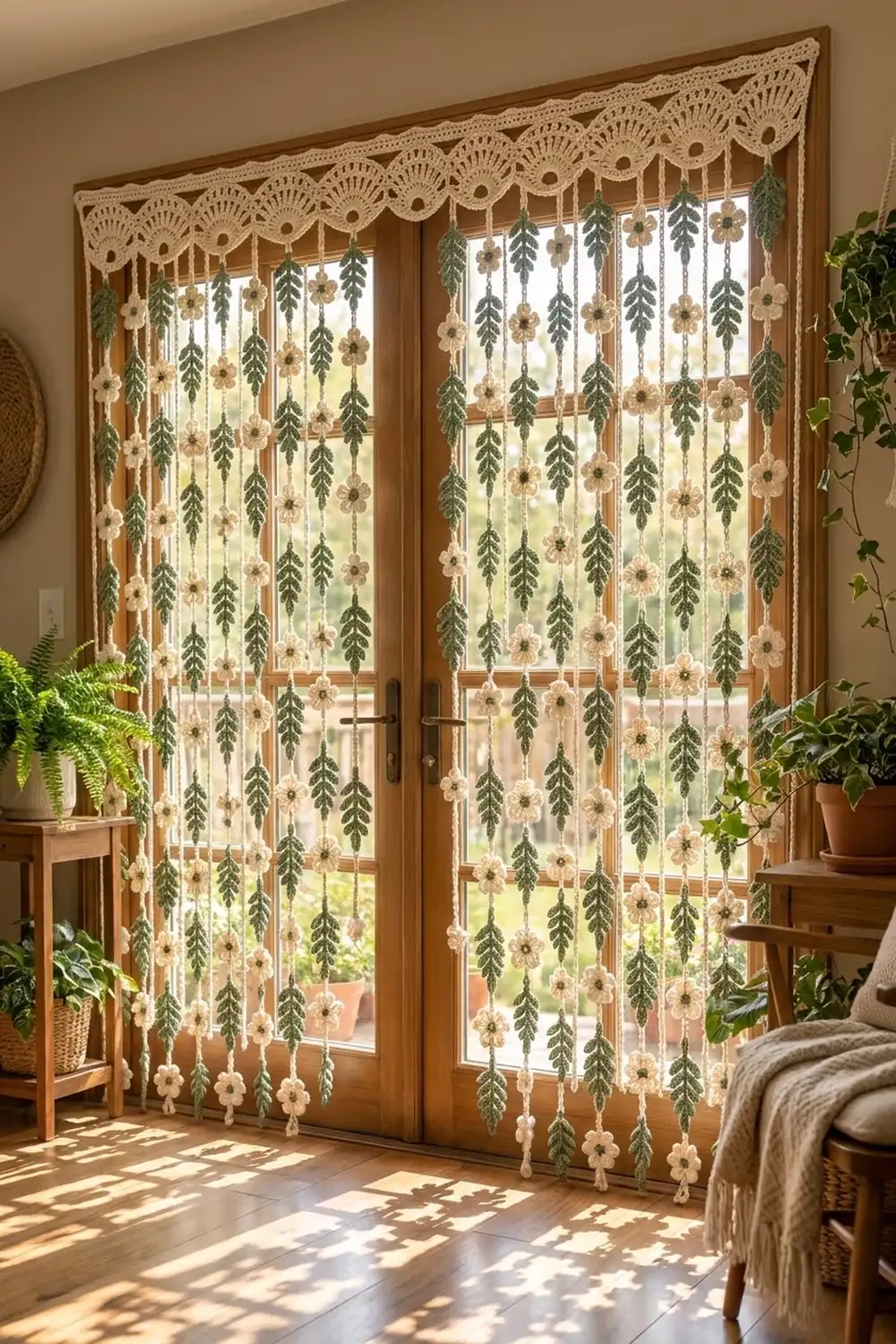
This curtain gives a window the look of a garden. A cream header of lacy half-sunburst fans runs across the top, and 35 slim chain strands hang below it. Sage-green fern leaves and cream six-petal flowers sit along each strand.
The palette is just two colors. Cream is used for the header, the strands and the flower petals. Sage green is used for the leaves and the small flower centers. The style is cottage and botanical, and it looks best with light shining through it.
The pattern uses US crochet terms. The finished curtain is 44.5 in (113.0 cm) wide and 65 in (165.1 cm) long, header included.
Here is how it is built. You crochet one header band in rows, then make 175 leaves and 175 flowers as separate motifs. Then you chain each strand down from the header and slip stitch the motifs into it in a fixed order.
Finished Size and Construction
- Finished size: 44.5 in (113.0 cm) wide × 65 in (165.1 cm) long
- Skill level: Intermediate (simple stitches, a lot of repetition)
- Terminology: US
- Yarn weight: DK (light #3) cotton
- Hook: 4.0 mm (G-6)
- Number of pieces: 1 header, 175 leaves and 175 flowers, joined by 35 chain strands
- Layout: 35 strands across, 10 motif levels down
- Piece sizes: leaf 2.75 in × 1.25 in (7.0 cm × 3.2 cm); flower 2 in (5.1 cm) across
- Header before border: 44 in × 2.75 in (111.8 cm × 7.0 cm)
- Border depth: 0.25 in (0.6 cm) on each edge
- Strand drop below header: 61.75 in (156.8 cm)
Materials
Use a smooth mercerized or combed DK cotton. It shows the leaflets and fan spokes clearly and hangs straight without stretching too much. These estimates assume about 112 m per 50 g.
- Cream: 1,050 m (about 470 g) for the header, strands and flower petals
- Sage green: 700 m (about 315 g) for the leaves and flower centers
Both amounts include a margin of roughly 15%.
Tools:
– 4.0 mm (G-6) crochet hook
– Tapestry needle
– Scissors
– Stitch markers
– Rust-proof pins and a blocking mat
– Measuring tape
– A slim curtain rod up to 3/8 in (1.0 cm) thick, or 19 curtain clip rings
Abbreviations (US Terms)
- ch – chain
- sl st – slip stitch
- sc – single crochet
- hdc – half double crochet
- dc – double crochet
- sc2tog – single crochet 2 together
- sp – space
- st(s) – stitch(es)
- rep – repeat
- RS / WS – right side / wrong side
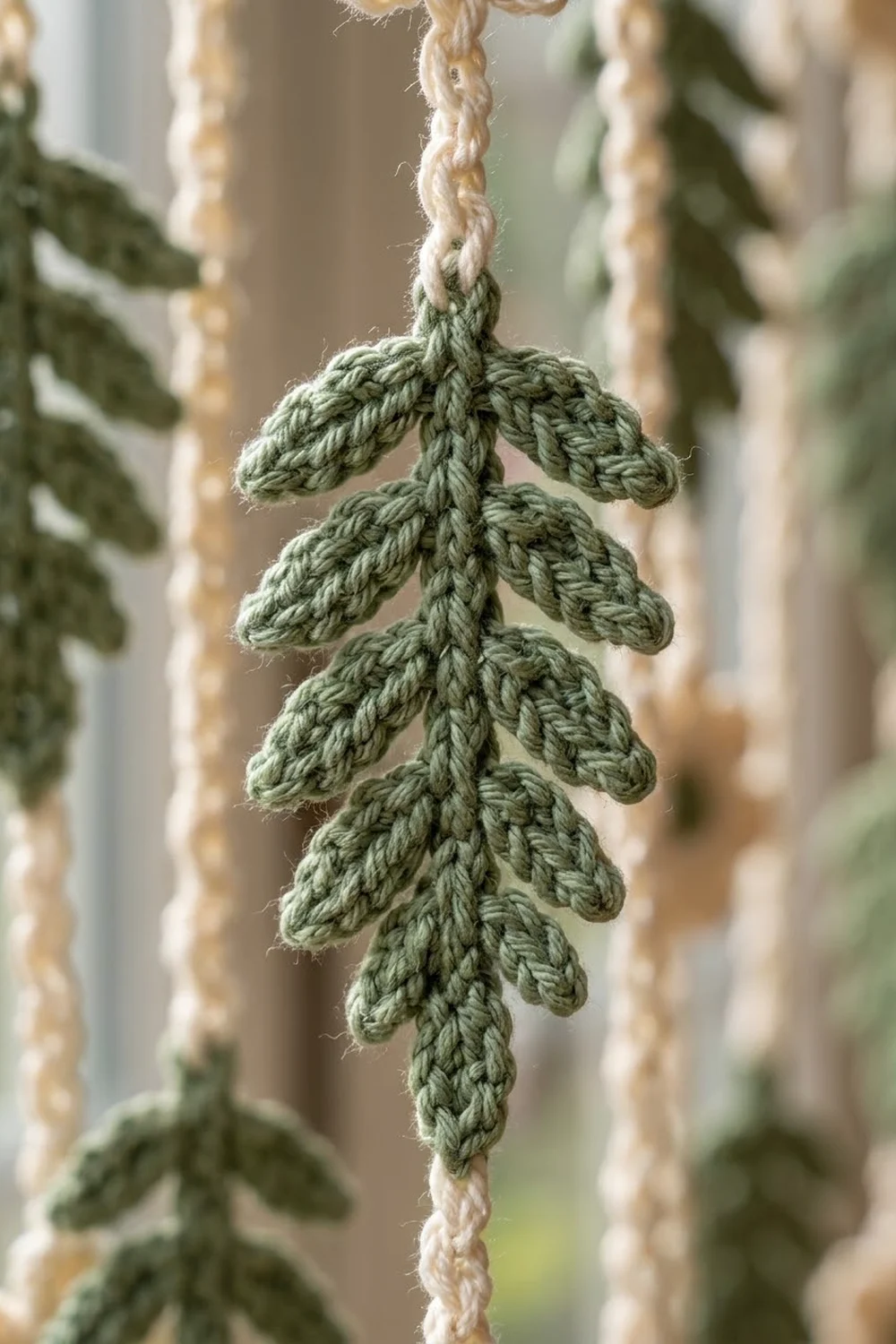
Leaflet (special stitch): Ch 4, sl st in 2nd ch from hook, sc in next ch, hdc in next ch. This makes one small pointed leaflet.
Gauge and Checkpoints
Gauge: 20 sc = 4 in (10.2 cm). Loose chain: 20 ch = 4 in (10.2 cm).
Test one of each piece before you start the full curtain:
- Leaf: 2.75 in × 1.25 in (7.0 cm × 3.2 cm), unblocked.
- Flower: 2 in (5.1 cm) across, from one petal tip to the opposite tip.
- Header swatch: Ch 29 and work Rows 1–5 over 28 sts (2 fans plus edge sts). Row 1 should measure 5.6 in (14.2 cm).
Checkpoints for the full curtain:
– Header Row 1: 44 in (111.8 cm)
– Header after Row 5: 2.75 in (7.0 cm) tall at the scallop peaks
– Header after border: 44.5 in × 3.25 in (113.0 cm × 8.3 cm)
– Each strand once hung: 61.75 in (156.8 cm)
If your pieces are too big: go down to a 3.75 mm hook. If they are too small: go up to a 4.5 mm hook.
Check your chain tension on its own. Strands made with a tight chain end up short, and strands made with a loose chain droop.
Header
Use cream. The header is worked in rows from the bottom up, so the scallops end up along the top edge. One fan repeat is 12 sts, or 2.4 in (6.1 cm).
Row 1 (RS): Ch 221. Sc in 2nd ch from hook and in each ch across. Turn. (220 sc)
Row 2 (eyelet row): Ch 1. Sc in first 6 sc. Ch 4, skip 4 sc, sc in next 8 sc. Rep from * 16 more times. Ch 4, skip 4 sc, sc in last 6 sc. Turn. (144 sc and 18 ch-4 eyelets = 220 sts)
Row 3 (fan row): Ch 3 (counts as dc). Dc in next sc, sc in next sc, skip 3 sc. Work 11 dc in ch-4 eyelet, skip 3 sc, sc in next 2 sc, skip 3 sc. Rep from * 16 more times. Work 11 dc in last eyelet, skip 3 sc, sc in next sc, dc in last 2 sc. Turn.
(198 fan dc + 4 edge dc + 36 sc = 238 sts)
The 11 dc spread out around the eyelet but leave its center open. That open center is the round hole under each fan.
Row 4 (spoke row): Ch 3 (counts as dc). Dc in next dc, skip next sc. Ch 1, (dc in next dc, ch 1) 11 times, sc2tog over next 2 sc. Rep from * 16 more times. Ch 1, (dc in next dc, ch 1) 11 times, skip next sc, dc in last 2 sts. Turn.
(202 dc + 216 ch-1 sps + 17 sc2tog = 435 sts)
Each fan now has 12 ch-1 sps. The sc2tog stitches pull the valleys down, which shapes the arches.
Row 5 (scallop row, RS): Ch 1. Sc in first 2 dc. Hdc in next ch-1 sp, 2 dc in each of next 10 ch-1 sps, hdc in next ch-1 sp, sc in sc2tog. Rep from * 16 more times. Hdc in next ch-1 sp, 2 dc in each of next 10 ch-1 sps, hdc in next ch-1 sp, sc in last 2 sts. Do not fasten off.
(18 scallops × 22 sts + 17 valley sc + 4 edge sc = 417 sts)
Checkpoint: 44 in × 2.75 in (111.8 cm × 7.0 cm).
Leaf (make 175)
Use sage green.
Ch 15. Number these ch from the slip knot: c1 is the base and c15 is at the hook.
Tip: Sl st in 2nd ch from hook (c14), sc in next ch (c13).
Side 1: Work 1 leaflet, then sl st in next 2 spine ch. Rep from * 5 more times. You finish at c1, with 6 leaflets made.
Base: Ch 1. Rotate the work so you can stitch along the free loops on the other side of the spine.
Side 2: Sl st in next 2 ch, work 1 leaflet. Rep from * 5 more times. Sl st in c13, then sl st in the tip. Fasten off and weave in the ends. (12 leaflets + tip)
Each side 2 leaflet sits directly opposite a side 1 leaflet, which gives the paired fern shape. The base ch-1 is the top of the leaf, where it attaches to the strand.
Flower (make 175)
Rnd 1 (sage green): Magic ring. Ch 1, 6 sc in ring. Sl st to first sc. Fasten off. (6 sc)
Rnd 2 (cream): Join cream in any st. Ch 1, 2 sc in each st around. Sl st to first sc. (12 sc)
Rnd 3: Ch 1. Sc in next st, 2 sc in next st. Rep from * 5 more times. Sl st to first sc. (18 sc)
Rnd 4 (petals): Sl st in next st, (hdc, 3 dc, hdc) in next st, sl st in next st. Rep from * 5 more times. Sl st to first sl st. Fasten off. (6 petals, 42 sts)
The middle dc of each petal is the petal tip. Petals 1 and 4 are directly opposite each other.
Make All Pieces
Totals:
– 1 cream header
– 175 sage-green leaves
– 175 flowers (sage-green center, cream petals)
Blocking first: Block every motif before you join anything (see Final Blocking). Flat motifs give strands that hang straight.
Two strand types:
– Strand A (18): hangs from each eyelet and starts with a leaf.
– Strand B (17): hangs from each valley and starts with a flower.
From left to right, the strands run A, B, A, B and so on, ending with A, for 35 strands in all.
Layout grid (35 positions per level, left to right):
- LEVEL 1: LEAF FLOWER LEAF FLOWER … LEAF (18 leaves, 17 flowers)
- LEVEL 2: FLOWER LEAF FLOWER LEAF … FLOWER (18 flowers, 17 leaves)
- LEVEL 3: same as Level 1
- LEVEL 4: same as Level 2
- LEVELS 5–10: keep alternating
Five levels have 18 leaves and five have 17, so 5 × 18 + 5 × 17 = 175 leaves. The flowers add up to 175 the same way.
Joining (Building the Strands)
Do the border first (next section), then build the strands. Work with the RS of the header facing you.
Where each strand starts:
– Strand A: Insert the hook from front to back through a ch-4 eyelet and bring it out under the bottom border. Yarn over and pull up a loop, ch 1 to secure, and continue. The strand wraps the lower band, so it hangs right through the eyelet.
– Strand B: Join with a sl st through the 2 center border sts of the valley below each sc2tog. That is the 14th and 15th st of each 12-st repeat, counted along the bottom edge.
Joining a leaf: Sl st in the leaf’s base ch-1. Ch 13 behind the leaf, then sl st in the tip.
Joining a flower: Sl st in the middle dc of one petal. Ch 9 behind the flower, then sl st in the middle dc of the opposite petal.
Strand A sequence:
1. Ch 10.
2. Join a leaf, ch 20, join a flower, ch 20. Rep from * 3 more times.
3. Join a leaf, ch 20, join a flower.
4. Fasten off and weave the tail back into the chain.
Strand B: Work the same sequence with leaves and flowers swapped.
Stitch logic: Each strand has 10 + (9 × 20) + (5 × 13) + (5 × 9) = 300 ch. Its length works out to 2 in + (4 × 12.75 in) + 8.75 in = 61.75 in (5.1 cm + 4 × 32.4 cm + 22.2 cm, which is 156.8 cm). One leaf–chain–flower–chain unit is 12.75 in (32.4 cm).
Because a flower is 0.75 in (1.9 cm) shorter than a leaf, Strand A and Strand B finish at the same length. The motifs stagger the whole way down.
Tension: Keep the chains relaxed and even, and pull each sl st join snug. The chain running behind each motif should lie flat, without bunching the motif.
Checkpoint: Hang the header after every 5 strands. All strands should end within 0.5 in (1.3 cm) of each other.
Border
Border gauge: 20 sc = 4 in (10.2 cm), the same as the header.
Rnd 1 (cream, RS facing): Join at the top-right corner and work ch 1 at each corner:
– Top: 1 sc in each Row 5 st, 417 sc
– Left side: 1 sc per sc row and 2 sc per dc row, 7 sc
– Bottom: 1 sc in each free loop of the foundation chain, 220 sc
– Right side: 7 sc
Sl st to first sc. (651 sc + 4 corner ch-1 sps)
Rnd 2: Sl st loosely in each sc around and work 1 sl st in each corner ch-1 sp. Fasten off.
(top 417, each side 7, bottom 220, corners 4 = 655 sl st)
Why the math works: The bottom count is 220 = 18 × 12 + 4, so every eyelet and valley lines up exactly over its strand position. The top count is 417 = 18 × 22 + 17 + 4, which matches Row 5 one-for-one, so the scallops keep their shape. The side count of 7 matches the row heights (1 + 1 + 2 + 2 + 1).
Checkpoint: 44.5 in × 3.25 in (113.0 cm × 8.3 cm).
Final Blocking
- Before assembly, wet the motifs, roll them in a towel and pin them out.
- Pin each leaf to 2.75 in × 1.25 in (7.0 cm × 3.2 cm), with the leaflets angled toward the tip.
- Pin each flower to 2 in (5.1 cm), shaping each petal into a curve.
- Wet-block the header to 44.5 in × 3.25 in (113.0 cm × 8.3 cm). Pin each scallop peak and open every eyelet with a pin.
- Let everything dry completely.
- After assembly, hang the curtain and lightly mist the strands. The motifs’ weight will straighten the chains as they dry.
- Weave the rod through the Row 4 ch-1 sps, over 3 sps and under 3. Or clip 19 rings at the scallop valleys and edges.
Final Quality-Control Checklist
- Header measures 44.5 in × 3.25 in (113.0 cm × 8.3 cm)
- 18 eyelets are open and centered under each fan
- 35 strands, in the order A, B, A, B … A
- Every strand is 61.75 in (156.8 cm) long, within 0.5 in (1.3 cm)
- Each strand holds 5 leaves and 5 flowers
- Leaves hang tip down and every flower is joined at opposite petals
- Back chains lie flat behind the motifs
- All ends are woven in at least 1 in (2.5 cm)
Troubleshooting
- Fans ruffle: Your Row 4 tension is tight. Work the ch-1s looser or go up a hook size for Rows 3–5.
- Header is too short: Row 1 is tight. Redo the foundation on a larger hook.
- Strands are different lengths: Count the chains in each segment. Missing just 1 ch per segment adds up to 1.8 in (4.6 cm) over a strand.
- Leaves curl: Re-block them flat, and check that you worked the side 2 sl sts into the free loops.
- Flowers tilt: Join them at exactly opposite petals, 1 and 4.
- Strands twist: Hang the curtain and mist it, then let the weight untwist the strands as they dry.
Care
Hand wash in cool water with mild soap, press the water out in a towel, and dry flat or hanging. Do not tumble dry, because the strands can tangle.
Final Notes
Everything depends on gauge. At 20 sc = 4 in (10.2 cm), Row 1 is 44 in (111.8 cm), and the border brings the header to 44.5 in × 3.25 in (113.0 cm × 8.3 cm). Each strand of 2 in, four 12.75 in units and a final 8.75 in adds 61.75 in (156.8 cm), for a total length of 65 in (165.1 cm).
To make the curtain longer, add one leaf–flower unit per strand. Each extra unit adds 12.75 in (32.4 cm), 35 leaves and 35 flowers, and about 125 m of green and 160 m of cream. One extra unit gives a 77.75 in (197.5 cm) curtain.
Happy crocheting!