

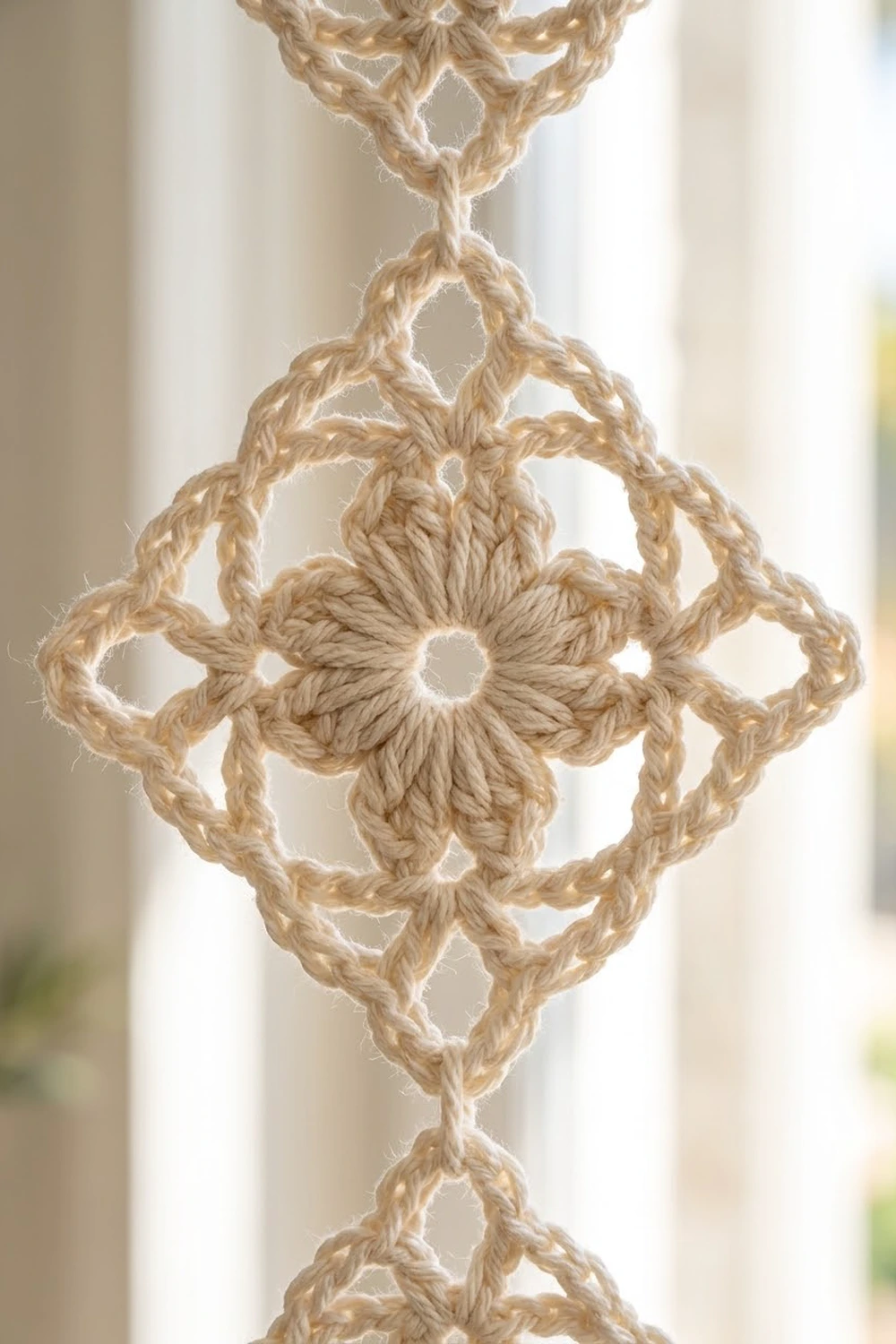
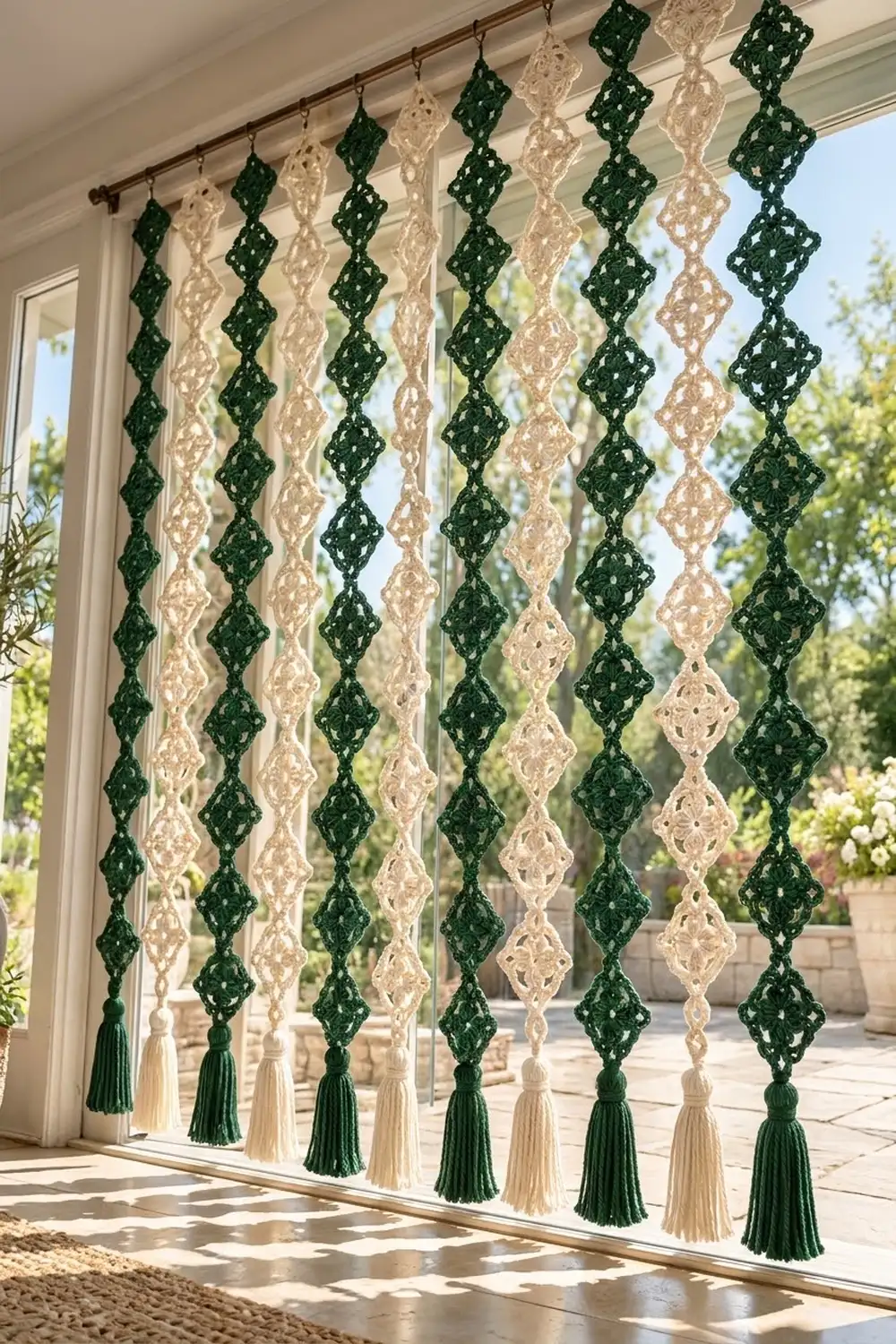
This curtain is made of hanging strands of lacy diamonds. Each strand is a column of small on-point motifs joined tip to tip. Every motif has a puff-petal flower in the center and an open chain lattice around it. A full yarn tassel finishes the bottom of each strand.
The colors are forest green and soft cream, alternating strand by strand. The finished look is airy and boho, a little like macramé. The curtain still lets light through, so it suits a patio door, a closet opening, or a window.
This pattern uses US crochet terms. The finished curtain is about 65 in (165.1 cm) wide and 67 in (170.2 cm) long, measured from the top of the hanging loops to the tassel tips.
You make one four-round diamond motif at a time. From the second motif on, each new motif joins to the one above it as you work its last round. When a strand has 12 motifs, you add a hanging loop at the top and a tassel at the bottom. You need 11 strands in total.
Finished Size and Construction
- Finished size: 65 in (165.1 cm) wide × 67 in (170.2 cm) long
- Skill level: Easy-intermediate
- Terminology: US crochet terms
- Yarn weight: Worsted (#4) cotton
- Hook: 4.5 mm (US 7)
- Number of pieces: 132 motifs, joined into 11 strands of 12 motifs each
- Layout: 11 strands hung side by side, spaced 6 in (15.2 cm) apart center to center
- Piece size: 3.5 in (8.9 cm) per side, 5 in (12.7 cm) tip to tip
- Strand length before finishing: 60 in (152.4 cm)
- Border depth: There is no perimeter border, because the strands hang free. The top finishing is a 2 in (5.1 cm) hanging loop, and the bottom finishing is a 5 in (12.7 cm) tassel.
Materials
Use a smooth, mercerized or combed worsted-weight cotton. Cotton keeps the lattice crisp and the puffs well defined. Avoid fuzzy or very stretchy yarns, because a long hanging strand can grow in length under its own weight.
The amounts below assume about 50 g = 85 m (93 yd) per ball:
- Forest green: 350 g / 595 m (651 yd), 7 balls. This covers 72 motifs, 6 tassels, and 6 hanging loops.
- Cream: 300 g / 510 m (558 yd), 6 balls. This covers 60 motifs, 5 tassels, and 5 hanging loops.
Both amounts include a margin of about 15% for gauge differences, weaving in ends, and tassel trimming.
Tools:
- 4.5 mm (US 7) crochet hook
- Tapestry needle
- Sharp scissors
- A stiff card 5 in (12.7 cm) tall, for tassels
- Tape measure
- Spray bottle and rust-proof pins
- A curtain rod at least 70 in (177.8 cm) long
Abbreviations (US Terms)
- ch: chain
- sl st: slip stitch
- sc: single crochet
- dc: double crochet
- sk: skip
- sp: space
- st(s): stitch(es)
- rep: repeat
- rnd: round
Special stitches:
- Puff: (Yo, insert hook in stitch, yo, pull up a loop to about 0.5 in) 3 times. You now have 7 loops on the hook. Yo and pull through all 7 loops.
- Beginning puff (beg puff): Ch 2. Then (yo, insert hook in same stitch, yo, pull up a loop) 2 times. Yo and pull through all 5 loops.
- Joining corner: This replaces a plain corner when you join a new motif to the one above it. Work sc in the corner sp, ch 2, sl st into the bottom corner ch-5 sp of the previous motif, ch 2, then sc in the same corner sp of the current motif.
Gauge and Checkpoints
Make one complete motif before you start a strand, and measure it at every round:
- After Rnd 1: 1.5 in (3.8 cm) across
- After Rnd 2: 2.25 in (5.7 cm) across, from puff to puff
- After Rnd 3: 2.75 in (7.0 cm) per side
- After Rnd 4: 3.5 in (8.9 cm) per side, 5 in (12.7 cm) tip to tip
If your motif is more than 1/4 in (0.6 cm) too big on the side, go down 0.5 mm in hook size. If it is more than 1/4 in (0.6 cm) too small, go up 0.5 mm.
Any change in motif size multiplies across a strand. A motif that is 1/4 in (0.6 cm) too long on the diagonal makes the strand 3 in (7.6 cm) too long over 12 motifs.
Strand checkpoint: 4 joined motifs should measure 20 in (50.8 cm) from top tip to bottom tip, laid flat without stretching.
Diamond Motif
Make every motif the same way, in either color. The four corners of Rnd 4 have names, worked in this order: A (top), B (side), C (bottom), D (side).
Rnd 1: Make a magic ring. Ch 3 (counts as dc), then work 15 dc in the ring. Pull the ring closed, leaving a small open center about 0.25 in (0.6 cm) wide. Join with a sl st to the top of the ch-3. (16 dc)
Rnd 2: Work a beg puff in the same stitch as the join, then ch 3. Sk next dc. Puff in next dc, ch 3, sk next dc. Rep from * 6 more times. Join with a sl st to the top of the beg puff. (8 puffs, 8 ch-3 sps)
This round gives you 8 petals: 8 puffs × 2 stitches used each = 16 stitches, which matches Rnd 1.
Rnd 3 (squaring round): Sl st into the first ch-3 sp, then ch 1. (Sc, ch 5, sc) in this ch-3 sp to make a corner. Ch 4, sc in next ch-3 sp, ch 4. Rep from * 3 more times. Join with a sl st to the first sc. (12 sc, 4 corner ch-5 sps, 8 ch-4 sps)
The 8 petal spaces become 4 corners and 4 side midpoints, which is what turns the round flower into a square. Each side now reads: corner, ch-4, sc, ch-4, corner.
Rnd 4 (lattice round): Sl st in the next 2 ch, then sl st into the corner ch-5 sp. This is corner A. Ch 1. (Sc, ch 5, sc) in the corner sp. Ch 5, sc in next ch-4 sp, ch 5, sc in next ch-4 sp, ch 5. Rep from * 3 more times, for corners A, B, C and D. Join with a sl st to the first sc. (16 sc, 4 corner ch-5 loops, 12 side ch-5 loops)
Per-side count for Rnd 4: 2 corner sc + 2 side sc = 4 sc, plus 3 side ch-5 loops. Across 4 sides that gives 16 sc and 12 side loops, which matches the round total. The corner ch-5 loops make the pointed tips you see in the photo.
For the first motif of each strand, fasten off and leave a 6 in (15.2 cm) tail. You will use this tail later to attach the hanging loop.
Make All Pieces
- Forest green: 72 motifs (6 strands × 12)
- Cream: 60 motifs (5 strands × 12)
- Total: 132 motifs, in 11 strands
You only make the first motif of each strand as a separate piece. The other 11 motifs in each strand join as you go.
Layout, left to right:
STRANDS: GREEN CREAM GREEN CREAM GREEN CREAM GREEN CREAM GREEN CREAM GREEN
Each strand, top to bottom:
LOOP – M1 – M2 – M3 – M4 – M5 – M6 – M7 – M8 – M9 – M10 – M11 – M12 – TASSEL
Joining
Method: Join as you go, tip to tip, on Rnd 4.
Work motifs 2 to 12 through Rnd 3 as usual. On Rnd 4, work corner A as a joining corner instead of a plain corner:
- Sc in the corner sp.
- Ch 2.
- Sl st into the corner C ch-5 sp of the motif above.
- Ch 2.
- Sc in the same corner sp of the current motif.
Then finish Rnd 4 as written.
Stitch logic: The joining corner replaces one ch-5 with ch 2 + sl st + ch 2. This keeps the same loop length and the same 16 sc, so the stitch count does not change. Only one corner of each motif touches the next one, which creates the short chain link between diamonds.
Tension: Keep the joining sl st snug, but don’t tighten it into a knot. If the link is too tight, the diamonds tilt. If it is too loose, the strand sags and grows longer.
Before you join, check that both motifs face right side up. Every strand should show the same face.
Size checkpoint: Each joined motif adds 5 in (12.7 cm). A finished 12-motif strand should measure 60 in (152.4 cm) laid flat.
Let a strand hang overnight. Up to 1 in (2.5 cm) of extra length is normal for cotton. If it stretches more than that, your joins or Rnd 4 chains are too loose.
Border
This curtain has no perimeter border, because the strands hang free and are never joined side to side. Each motif’s lattice round works as its own edge. So the “border” step here is the strand finishing: one hanging loop at the top of each strand, and one tassel at the bottom.
Edge count: Every motif edge has 4 sc and 3 ch-5 loops per side, including that side’s 2 corner sc. No stitches are added anywhere along the strand, so each edge stays identical from motif 1 to motif 12.
Hanging loop (top of M1):
- Join yarn with a sl st into the corner A ch-5 sp of M1.
- Ch 24, then sl st into the same corner sp.
- Work 30 sc over the ch-24 loop.
- Sl st into the corner sp and fasten off.
Loop gauge: 30 sc over 24 ch makes a firm loop about 4 in (10.2 cm) around. It hangs 2 in (5.1 cm) and fits a rod up to 1.25 in (3.2 cm) thick. The extra 6 sc keep the loop from stretching under the weight of 12 motifs.
Tassel (bottom of M12):
- Wrap yarn 40 times around the 5 in (12.7 cm) card.
- Slide a 12 in (30.5 cm) strand under the wraps at the top and tie it tightly.
- Cut the wraps open at the bottom.
- Wrap another strand 6 times around the tassel, 0.75 in (1.9 cm) below the top, to form the neck. Knot it and bury the ends inside the tassel.
- Thread the top tie ends through the corner C ch-5 sp of M12. Knot them securely and bury the ends inside the tassel.
- Trim the tassel to exactly 5 in (12.7 cm) below the neck.
Why the math works: 2 in (5.1 cm) loop + 60 in (152.4 cm) strand + 5 in (12.7 cm) tassel = 67 in (170.2 cm) total length.
For the width, the outer strands are 10 spacings apart: 10 × 6 in (15.2 cm) = 60 in (152.4 cm). Add half a motif width on each side, 2.5 in (6.4 cm) × 2 = 5 in (12.7 cm). That gives a total width of 65 in (165.1 cm).
Final Blocking
- Weave in all ends before blocking, and keep the weaving within each motif’s own color.
- Lay each strand flat on a blocking board or towel.
- Mist it lightly until damp. Don’t soak it, because heavy wet cotton stretches.
- Pin corners A and C on the vertical centerline, 5 in (12.7 cm) apart for each motif.
- Pin corners B and D so each motif is 3.5 in (8.9 cm) per side.
- Open each ch-5 loop with a pin so the lattice looks even.
- Fluff the puffs with your fingertip so all 8 petals are rounded.
- Let the strand dry completely, then unpin it.
- Steam the tassels lightly and comb them straight. Re-trim them to 5 in (12.7 cm) if needed.
- Hang the strands on the rod in the GREEN–CREAM order, spaced 6 in (15.2 cm) apart center to center.
Final Quality-Control Checklist
- Every motif has 16 dc, 8 puffs, 12 sc on Rnd 3, and 16 sc on Rnd 4.
- Every motif measures 3.5 in (8.9 cm) per side, within 1/8 in (0.3 cm).
- Each strand has exactly 12 motifs and measures 60 in (152.4 cm).
- All joins are at corners A and C only, and are centered on the strand.
- All strands show the same face.
- There are 6 green strands and 5 cream strands, alternating, with green at both outer edges.
- Hanging loops are all the same size and level on the rod.
- Tassels are tight at the neck, securely knotted, and all trimmed to 5 in (12.7 cm).
- All ends are woven in, with no tails poking through the lattice.
Troubleshooting
Center won’t close: Pull the magic ring tail firmly before you join Rnd 1. If the ring still slips, weave the tail around the ring once more.
Puffs look flat: Pull every loop up to the same height before you yo through them all. Pull the final loop tight.
Motif cups or ruffles: Your Rnd 3 or Rnd 4 chains are too long for your tension. Try ch 4 instead of ch 5 on the Rnd 4 side loops only, and check your gauge again.
Diamonds tilt on the strand: You joined at the wrong corner. Count the corners A, B, C, D on the previous motif and join only to C.
Strand is longer than its neighbors: Rehang it damp with a light weight on the tassel overnight, then compare. If it is still more than 1 in (2.5 cm) longer, remake the last motif with a 0.5 mm smaller hook.
Tassel sheds strands: The neck wrap is too loose. Rewrap it tighter and add a drop of fabric glue inside the neck.
Care
Hand wash in cool water with mild soap, press out the water in a towel, and dry the strands flat before rehanging. Don’t put the curtain in the dryer, because heat and tumbling stretch the strands and tangle the tassels.
Final Notes
The measurements build in a simple chain:
- Rnd 1: 1.5 in (3.8 cm) across
- Rnd 2: 2.25 in (5.7 cm) across
- Rnd 3: 2.75 in (7.0 cm) per side
- Rnd 4: 3.5 in (8.9 cm) per side, 5 in (12.7 cm) tip to tip
- 12 motifs: 60 in (152.4 cm)
- Plus the loop and tassel: 67 in (170.2 cm)
- 11 strands at 6 in (15.2 cm) spacing: 65 in (165.1 cm) wide
If the first motif matches the gauge, the rest of the curtain will measure up too. Make one motif, check it, and then build each strand one diamond at a time.
Happy crocheting!