

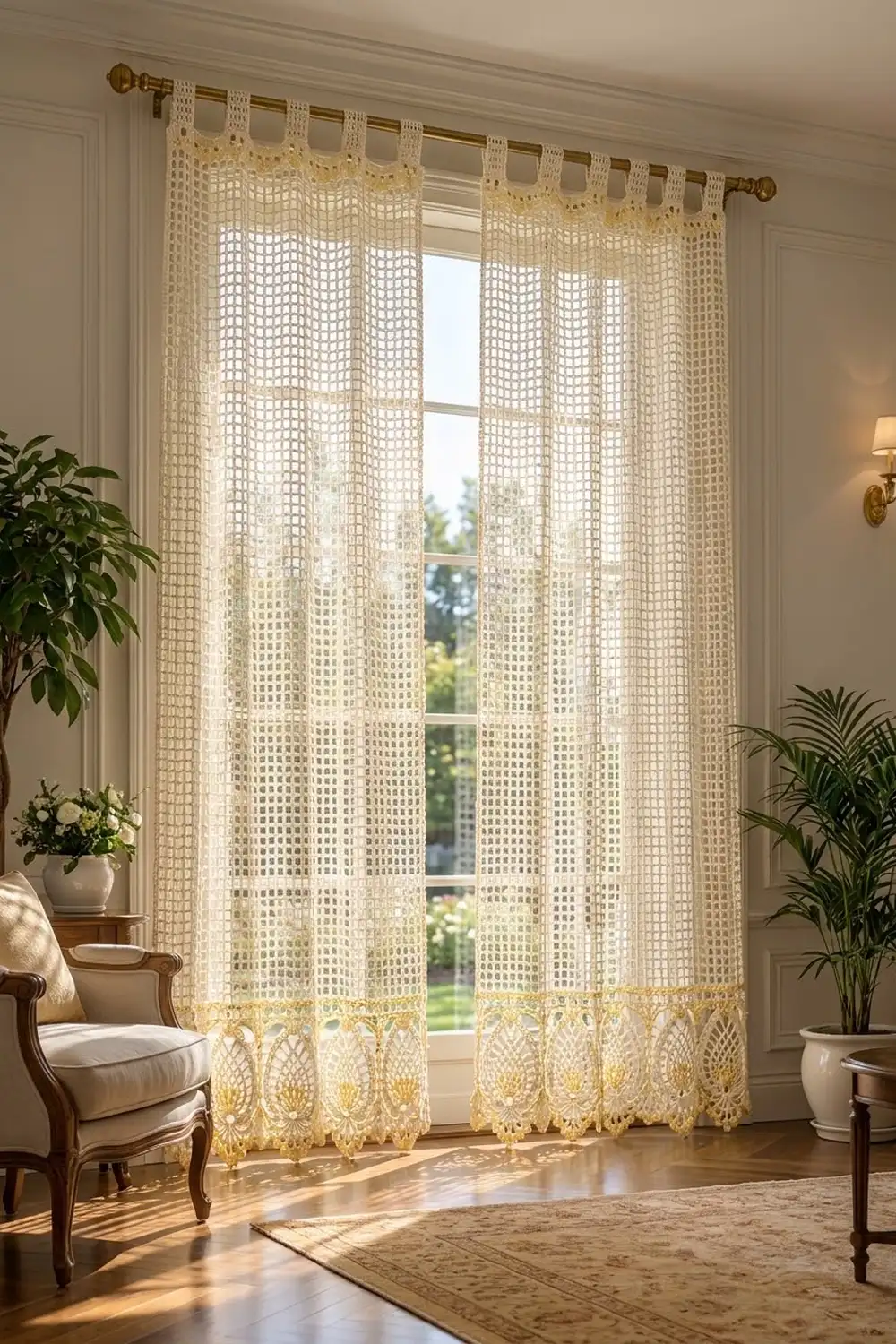
This curtain panel pairs an airy filet mesh body with a deep pineapple lace border. Light pours through the open grid, and the border adds weight and detail at the hem, so the panel hangs straight and drapes softly.
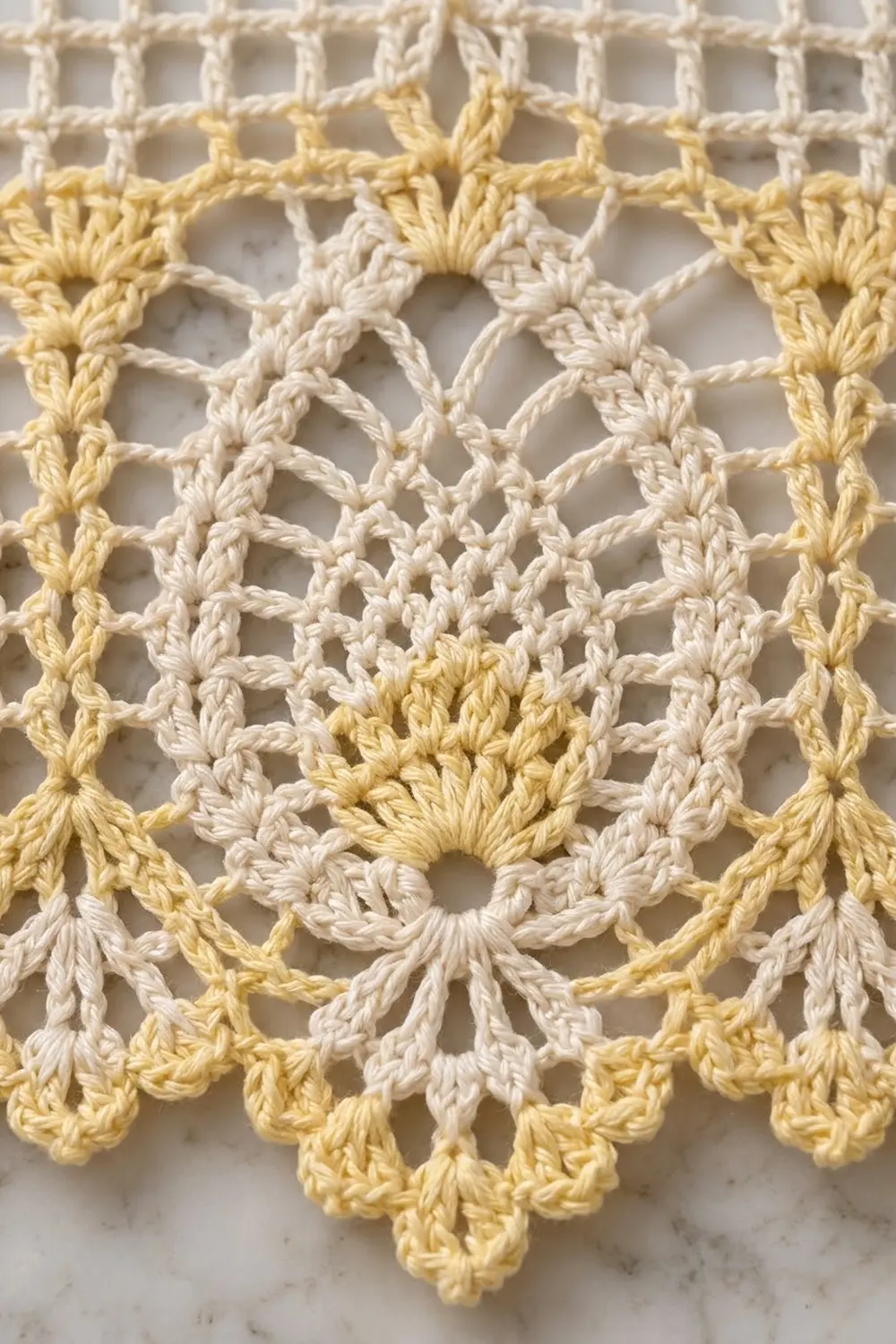
The palette is cream and pale butter yellow. Cream carries the mesh and the teardrop outlines. Yellow shows up in a solid band above the border, in a fan inside each teardrop, in the V-shaped columns between motifs, and in the scalloped picot hem. The look is vintage cottage lace that still feels fresh.
The pattern uses US crochet terms. One finished panel measures 40 in (101.6 cm) wide by 84 in (213.4 cm) long from the top edge to the picot tips, plus the tabs. Make two panels for a pair, as shown.
You work the panel in one piece from the top down. You start with 3 solid rows, work 190 mesh rows, then 11 border rows straight off the last mesh row. The tabs are added last, into the foundation chain.
Finished Size and Construction
- Finished size: 40 in (101.6 cm) wide × 84 in (213.4 cm) long, tabs not included
- Skill level: Intermediate
- Terminology: US
- Yarn weight: Sport (#2) mercerized cotton
- Hook: 3.0 mm (between US C/2 and D/3)
- Number of pieces: 1 per panel (the photo shows 2 separate panels)
- Layout: 3 solid header rows, 190 mesh rows, 11 border rows
- Piece size before border: 40 in × 77.2 in (101.6 cm × 196.1 cm)
- Border depth: 6.8 in (17.3 cm)
- Border repeat: 10 teardrops, each 4 in (10.2 cm) wide
Materials
Choose a smooth mercerized cotton or cotton blend. It shows lace clearly, resists stretching, and washes well. Avoid fuzzy or very stretchy fibers, because they blur the mesh and let a long panel sag.
Quantities per panel (based on 155 m per 50 g):
- Cream: 700 g (about 2,170 m)
- Pale yellow: 100 g (about 310 m)
For a pair, double these amounts. The quantities include a margin of about 10% for gauge differences and swatching.
Tools:
- 3.0 mm crochet hook
- Tapestry needle
- 12 locking stitch markers
- Tape measure
- Blocking mats or a clean sheet on a carpet, plus rust-proof pins
- Spray bottle
Abbreviations (US Terms)
- ch – chain
- sl st – slip stitch
- sc – single crochet
- hdc – half double crochet
- dc – double crochet
- sk – skip
- sp – space
- st(s) – stitch(es)
Special stitches:
- V-st: (dc, ch 2, dc) in the same st.
- Shell: (2 dc, ch 2, 2 dc) in the same sp.
- Double shell (DS): (2 dc, ch 2, 2 dc, ch 2, 2 dc) in the same sp.
- Picot: ch 3, sl st in the 3rd ch from the hook.
- Point: (2 dc, picot, 2 dc) in the same sp.
- Petal: (sc, hdc, dc, picot, dc, hdc, sc) in the same sp.
Gauge and Checkpoints
Body gauge: 30 dc = 4 in (10.2 cm). In mesh, 10 meshes and 10 rows = 4 in × 4 in (10.2 cm × 10.2 cm). One row is 0.4 in (1.0 cm) tall.
Test swatch first. Before starting the panel, make one small test piece:
- Ch 63 and work 1 row of dc: 61 dc.
- Work 10 mesh rows: 20 meshes.
- Work Border Rows 1–11 across it. 61 sts = 2 repeats + 1.
Block the swatch. It should measure 8 in (20.3 cm) wide. The mesh should be 4 in (10.2 cm) deep and the border 6.8 in (17.3 cm) deep.
If your swatch is too big, go down 0.25 mm. If it is too small, go up 0.25 mm. On a 40 in (101.6 cm) panel, a 2% gauge error adds up to almost 1 in (2.5 cm).
Checkpoints:
- After Row 3: width 40 in (101.6 cm)
- After Row 28: 11.2 in (28.4 cm) from the top edge
- After Row 193: 77.2 in (196.1 cm)
- After Border Row 11: 84 in (213.4 cm)
Panel Body
Header (Cream)
Ch 303.
Row 1: Dc in 4th ch from hook and in each ch across. Turn. (301 dc; the skipped ch-3 counts as a dc)
Rows 2–3: Ch 3 (counts as dc), dc in each dc across, ending with a dc in the top of the turning ch. Turn. (301 dc)
The header measures 1.2 in (3.0 cm) deep. Check the width now: 40 in (101.6 cm).
Mesh
Row 4: Ch 5 (counts as dc + ch 2), sk next 2 dc, dc in next dc. Ch 2, sk 2 dc, dc in next dc. Repeat from * across, working the last dc in the top of the turning ch. Turn. (100 meshes: 101 dc + 100 ch-2 sps)
Rows 5–193: Ch 5 (counts as dc + ch 2), dc in next dc. Ch 2, dc in next dc. Repeat from * across, working the last dc in the 3rd ch of the turning ch-5. Turn. (100 meshes)
That makes 190 mesh rows, 76 in (193.0 cm) deep. The body is now 77.2 in (196.1 cm) long. Keep the tension even: every square should be the same height as it is wide. Do not fasten off.
Bottom Border
Border gauge: one repeat = 30 sts = 4 in (10.2 cm) wide. The 11 border rows together are 6.8 in (17.3 cm) deep:
- Rows 1–2: 0.6 in (1.5 cm)
- Rows 3–10: 5.6 in (14.2 cm), about 0.7 in (1.8 cm) each
- Row 11: 0.6 in (1.5 cm)
The border is worked across the bottom edge only. The side edges stay as the turning-chain edges of the body.
Yellow Band
Row 1 (conversion): Join yellow. Ch 3 (counts as dc). Work 1 dc in each dc and 2 dc in each ch-2 sp. Turn. (101 dc worked into the dc + 200 dc worked into the spaces = 301 dc)
Row 2: Ch 1, sc in each dc across. Turn. (301 sc) Fasten off yellow.
Teardrops
Counts below are for the whole row. Each repeat between * and * is worked 10 times.
Row 3 (cream): Join cream in the first sc. Ch 5 (counts as dc + ch 2), dc in the same sc (edge V-st). Ch 4, sk 4 sc, sc in next sc, ch 4, sk 4 sc, sc in next sc, ch 7, sk 9 sc, sc in next sc, ch 4, sk 4 sc, sc in next sc, ch 4, sk 4 sc, V-st in next sc. Turn. (11 V-sts, 40 sc, 40 ch-4 loops, 10 ch-7 loops)
The ch-7 loop spans 10 sts and becomes the rounded arch at the top of each teardrop.
Row 4: Sl st into the first V-st sp, ch 3 (counts as dc), (dc, ch 2, 2 dc) in the same sp. Ch 2, sc in next ch-4 loop, ch 3, sc in next ch-4 loop, ch 2, (dc, ch 1) 6 times in the ch-7 loop, dc in the same loop, ch 2, sc in next ch-4 loop, ch 3, sc in next ch-4 loop, ch 2, shell in next V-st sp. Turn. (11 shells; 10 fans, each 7 dc with 6 ch-1 sps)
Row 5: Sl st in next dc and into the shell sp, ch 3, (dc, ch 2, 2 dc) in the same sp. Ch 5, sc in first ch-1 sp of the fan, (ch 3, sc in next ch-1 sp) 5 times, ch 5, shell in next shell sp. Turn. (11 shells, 50 ch-3 loops: 5 per teardrop)
Row 6: Sl st in next dc and into the shell sp, ch 3, (dc, ch 2, 2 dc, ch 2, 2 dc) in the same sp. Ch 5, sc in next ch-3 loop, (ch 3, sc in next ch-3 loop) 4 times, ch 5, DS in next shell sp. Turn. (11 DS, 40 ch-3 loops: 4 per teardrop) Fasten off cream.
Row 7 (yellow): Join yellow in the first ch-2 sp of the DS. Ch 3, (dc, ch 2, 2 dc) in the same sp, ch 2, shell in the next ch-2 sp of the same DS. Ch 4, (3 dc in next ch-3 loop, ch 1) 3 times, 3 dc in next ch-3 loop, ch 4, shell in first ch-2 sp of next DS, ch 2, shell in next ch-2 sp of the same DS. Turn. (22 shells in 11 pairs; 10 yellow fans, each 12 dc with 3 ch-1 sps) Fasten off yellow.
The DS splits into two shells here, which starts the V-shaped columns between the teardrops.
Row 8 (cream): Join cream in the first shell sp. Ch 3, (dc, ch 2, 2 dc) in the same sp, ch 3, shell in next shell sp. Ch 4, sc in first ch-1 sp of the fan, (ch 3, sc in next ch-1 sp) 2 times, ch 4, shell in next shell sp, ch 3, shell in next shell sp. Turn. (22 shells, 20 ch-3 loops)
Row 9: Sl st in next dc and into the shell sp, ch 3, (dc, ch 2, 2 dc) in the same sp, ch 4, shell in next shell sp. Ch 4, sc in next ch-3 loop, ch 3, sc in next ch-3 loop, ch 4, shell in next shell sp, ch 4, shell in next shell sp. Turn. (22 shells, 10 tip loops)
Row 10: Sl st in next dc and into the shell sp, ch 3, (dc, ch 2, 2 dc) in the same sp, ch 5, shell in next shell sp. Ch 4, (dc, ch 1) 4 times in the tip loop, dc in the same loop, ch 4, shell in next shell sp, ch 5, shell in next shell sp. Turn. (22 shells; 10 cream fans, each 5 dc with 4 ch-1 sps) Fasten off cream.
Picot Edge
Row 11 (yellow): Join yellow in the first shell sp. Ch 3 (counts as dc), (dc, picot, 2 dc) in the same sp, (3 sc, picot, 3 sc) in the ch-5 sp, point in next shell sp. 4 sc in next ch-4 sp, petal in each of the 4 ch-1 sps, 4 sc in next ch-4 sp, point in next shell sp, (3 sc, picot, 3 sc) in the ch-5 sp, point in next shell sp. Fasten off.
Row 11 totals: 22 points, 11 V-gap picots, 40 petals, 80 sc in the ch-4 sps.
Why the math works: each mesh row has 100 × 3 + 1 = 301 sts. Row 1 converts that to 301 dc. Since 301 = 10 × 30 + 1, there are 10 full 30-st repeats, and the extra st holds the final V-st. From there each separator carries one shell column (11 in total) and each repeat carries one teardrop (10 in total), so every row ends symmetrically.
Tabs
Turn the panel upside down and work into the unused loops of the foundation chain. Place markers on sts 1, 58, 115, 172, 229, and 286. Each tab is 16 sts wide, and the gaps between tabs are 41 sts.
Each tab: Join cream in a marked st. Ch 1, sc in the same st and next 15 sts. Turn. (16 sc) Then repeat: ch 1, sc in each sc, turn.
Stop when the tab measures 7 in (17.8 cm), about 35 rows. Fasten off, leaving a 12 in (30.5 cm) tail.
Fold each tab to the back and whipstitch its last row across the back of header Row 3. Each tab is about 2.1 in (5.3 cm) wide, and each gap is about 5.5 in (14.0 cm). Check that the six tab loops are the same length.
Final Blocking
- Weave in all ends along dc posts, never across mesh openings.
- Soak the panel in cool water for 15 minutes, then press out the water. Do not wring.
- Roll it in towels to remove excess moisture.
- Lay it flat on a clean sheet or blocking mats.
- Pin the top edge straight to 40 in (101.6 cm).
- Smooth the mesh downward and pin the sides to 77.2 in (196.1 cm) at the bottom of Row 193.
- Pin each border repeat to 4 in (10.2 cm) wide. Pin out every picot, petal tip, and point.
- Shape each teardrop so its arch is round and its tip lines up with the center of its petals.
- Let it dry completely, usually 24–48 hours.
- If any distortion remains, hang the panel and spray it lightly so gravity can straighten it.
Final Quality-Control Checklist
- Width is 40 in (101.6 cm) at the top, middle, and above the border.
- Length is 84 in (213.4 cm) to the picot tips.
- Every mesh row has 100 meshes.
- Border Row 1 has 301 dc.
- There are 10 teardrops and 11 shell columns.
- Each teardrop has a yellow fan and a cream bottom fan.
- Row 11 has 40 petals, 22 points, and 11 V-gap picots.
- All six tabs are 7 in (17.8 cm) before folding and sewn at the same height.
- No ends show through the mesh.
Troubleshooting
Mesh squares look tall and narrow. Your dc stitches are too loose in height. Pull each loop snug before the first yarn-over.
The panel narrows as you go. Check that every row starts with ch 5 and ends in the 3rd ch of the turning chain.
The border ruffles. Your shell chains are too loose, or your hook is too big. Rework with tighter chains.
The border cups or pulls up. The ch-4 and ch-5 sps are too tight. Work them more loosely, or go up 0.25 mm for the border only.
A teardrop is lopsided. Count the fan stitches: 7 dc in Row 4, 5 loops in Row 5, 4 loops in Row 6.
The repeat count is off at the end of a row. Recount Row 1. It must be exactly 301 dc.
The tabs differ in length. Re-measure them before sewing, and unpick or add rows as needed.
Care
Hand wash cool with a mild detergent, or machine wash on a delicate cycle in a mesh laundry bag. Reshape while damp and dry flat or hanging, out of direct heat.
Final Notes
Each measurement builds on the one before it:
- The 4 in (10.2 cm) swatch confirms a 40 in (101.6 cm) width.
- 3 header rows plus 190 mesh rows give 77.2 in (196.1 cm).
- 301 sts divide into 10 teardrop repeats of 4 in (10.2 cm) each.
- The 6.8 in (17.3 cm) border brings the panel to 84 in (213.4 cm).
If you check each stage before moving on, the pair will match and hang evenly.
Happy crocheting!