

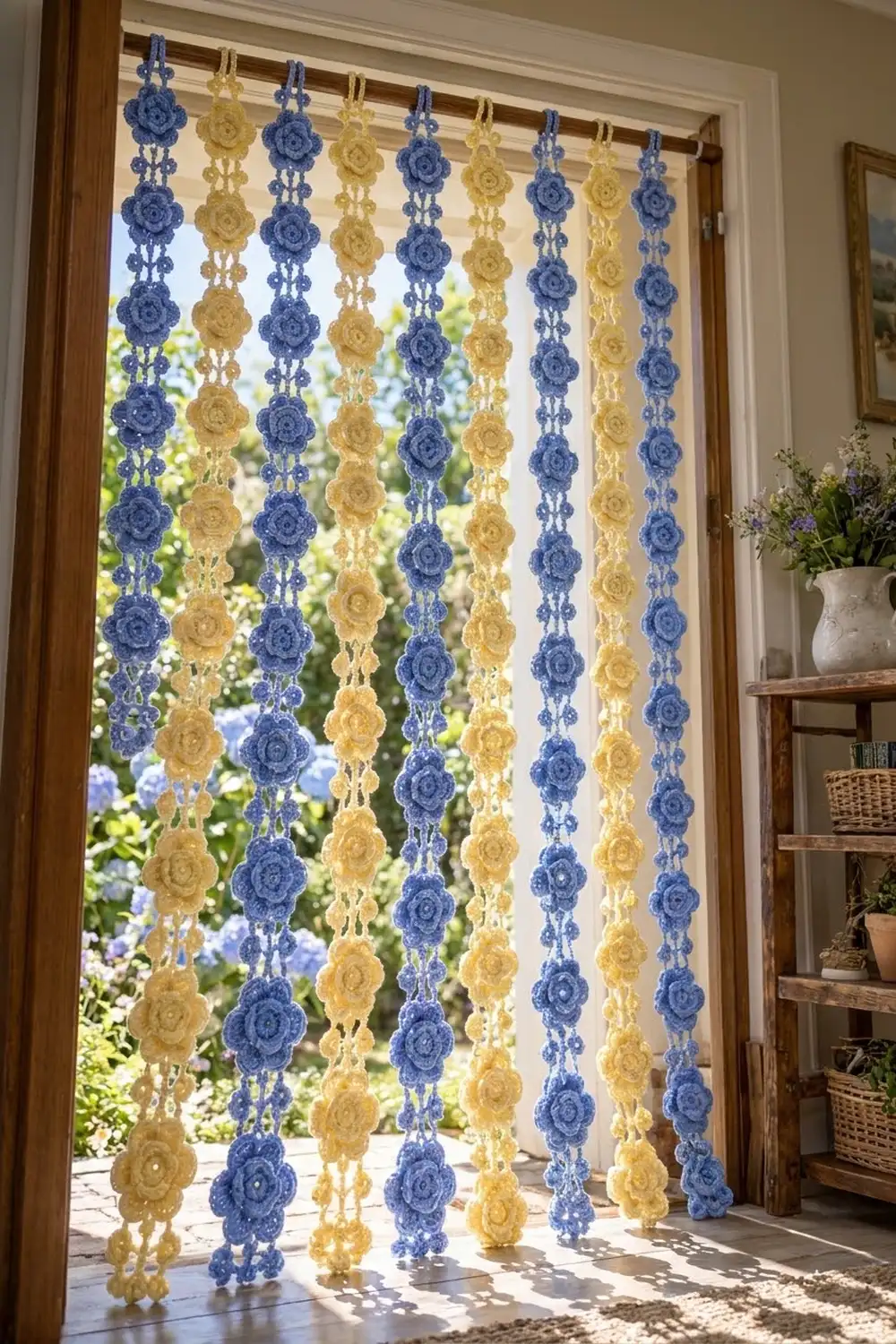
This door curtain is made of separate strands of layered roses that hang from a rod and move in the breeze. Strands of cornflower blue and butter yellow alternate across the doorway. Between the roses, open chain diamonds and small trefoils let light and air through.
The style is cottage-garden lace. Each rose has three tiers of rounded petals, so it looks full from both sides. The links between roses are kept light so the roses stand out. This pattern uses US crochet terms throughout.
The finished curtain measures about 38 in (96.5 cm) wide and 81 in (205.7 cm) long from the top of the rod loop to the bottom drop. Each strand is about 3 in (7.6 cm) wide.
You make the roses first. Then you link each strand together in two passes. Pass 1 goes down the left side of the roses and Pass 2 comes back up the right side, which creates the diamonds. Last, you edge the top loop and hang the strands on the rod.
Finished Size and Construction
- Finished size: 38 in (96.5 cm) wide × 81 in (205.7 cm) long
- Skill level: Intermediate
- Terminology: US crochet terms
- Yarn weight: DK (light #3) cotton
- Hook: 3.5 mm (E-4)
- Number of pieces: 11 strands (each built from 15 roses), 165 roses total
- Layout: 11 free-hanging strands, alternating colors, spaced 3.5 in (8.9 cm) apart center to center
- Piece size: rose 3 in (7.6 cm) across; one strand 3 in × 81 in (7.6 cm × 205.7 cm)
- Size before border: strand without the edged loop and drop, about 79 in (200.7 cm)
- Border depth: edged hanging loop about 3.5 in (8.9 cm) tall when folded; bottom drop 2 in (5.1 cm)
Materials
Use a smooth, mercerized DK cotton of about 225 m per 100 g. Cotton holds the petal shape, does not stretch much on long strands, and handles sunlight well.
- Cornflower blue: 350 g (about 790 m), for 6 strands
- Butter yellow: 300 g (about 675 m), for 5 strands
One strand uses about 46 g: about 37.5 g for 15 roses and about 8.5 g for the links and loop. These quantities include a margin of roughly 25% for gauge differences and test pieces.
Tools:
– 3.5 mm (E-4) crochet hook
– 4 locking stitch markers
– Tapestry needle
– Scissors
– Blocking mat, rustproof pins, spray bottle
– Measuring tape
– Wooden curtain rod up to 2 in (5.1 cm) in diameter and at least 40 in (101.6 cm) long
Abbreviations (US Terms)
- ch – chain
- sl st – slip stitch
- sc – single crochet
- hdc – half double crochet
- dc – double crochet
- BPsc – back post single crochet: insert the hook from back to front to back around the post of the stitch, then complete an sc
- MR – magic ring
- sp – space
- st(s) – stitch(es)
Special stitch – Trefoil (Tref): Ch 5, sl st in the 5th ch from the hook. The ch you slip-stitched into is the trefoil center. Then [ch 4, sl st in the trefoil center] twice. This makes 3 loops coming out of one point.
Petal tip: On the outer petals (11 sts each), the tip is the 6th st, which is the center dc.
Gauge and Checkpoints
Make one complete rose before anything else and block it lightly.
- After Rnd 3: 1.5 in (3.8 cm) across
- After Rnd 5: 2.25 in (5.7 cm) across
- After Rnd 7: 3 in (7.6 cm) across
- Chain gauge: 5 ch = 1 in (2.5 cm), so ch 11 = 2.2 in (5.6 cm)
If your rose is larger than 3 in (7.6 cm), go down to a 3.25 mm hook. If it is smaller than 2.75 in (7.0 cm), go up to a 3.75 mm hook. Check your chain gauge separately, because many people chain tighter than they stitch. The ch-11 links control the length of the strand, so they matter as much as the rose size.
Strand checkpoint: After linking the first 3 roses, measure from the top of Rose 1 to the bottom of Rose 3. It should be 13 in (33.0 cm): 3 roses × 3 in plus 2 gaps × 2 in.
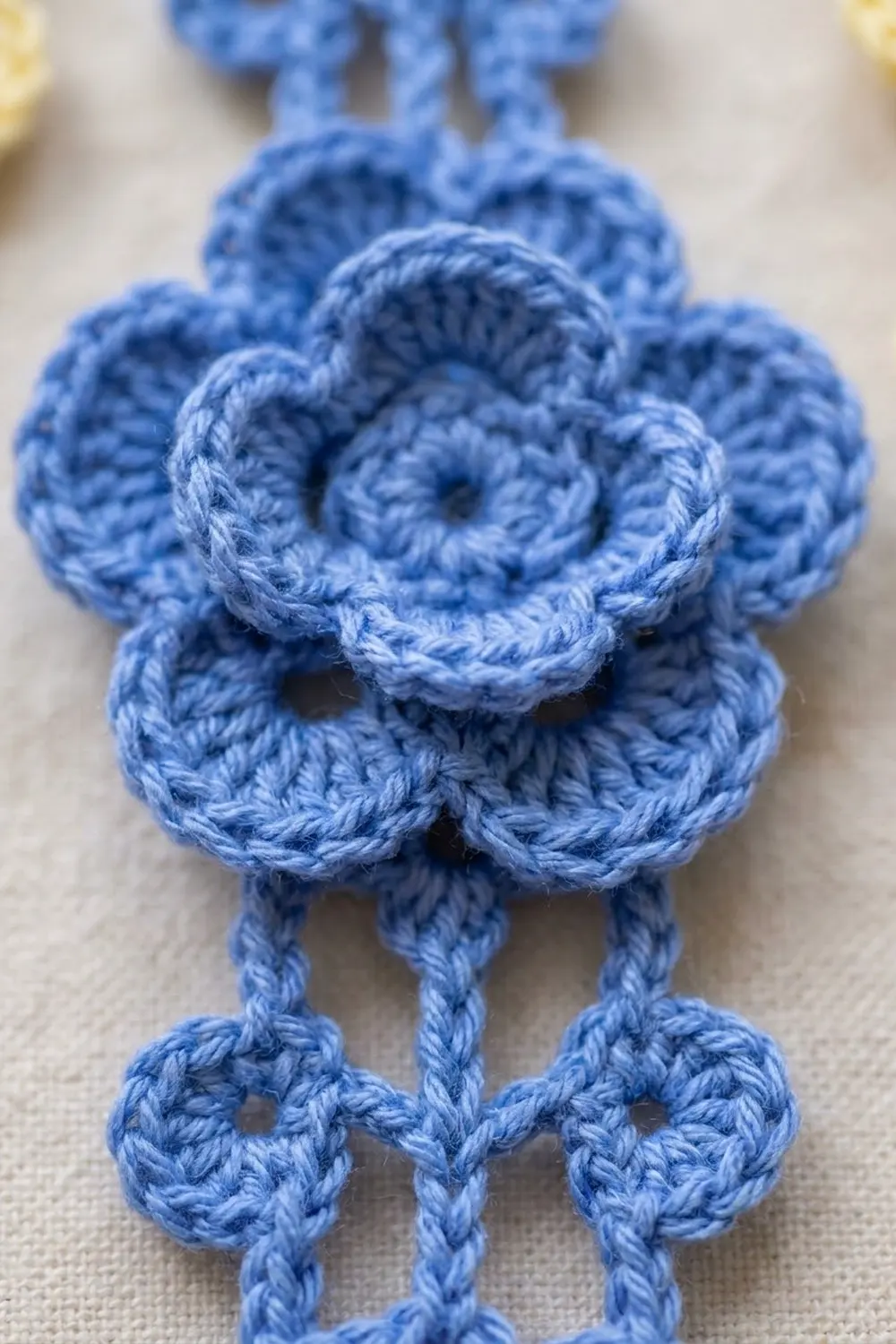
Rose (Make 165)
Each rose is worked in one piece. Fasten off with a 6 in (15.2 cm) tail and weave it in on the back.
Rnd 1: MR, ch 1, 12 sc in ring, sl st to first sc. (12 sc)
Rnd 2: Ch 1, sc in same st, ch 3, sk next st, sc in next st, ch 3, sk next st 5 times, sl st to first sc. (6 sc, 6 ch-3 sps)
Rnd 3 (inner petals): Sl st into first ch-3 sp. In each ch-3 sp work (sc, hdc, 3 dc, hdc, sc). Sl st to first sc. (6 petals of 7 sts = 42 sts)
Rnd 4: Fold the petals forward and work behind them. Ch 1, BPsc around the first sc of Rnd 2, ch 4, BPsc around the next Rnd 2 sc, ch 4 5 times, sl st to first BPsc. (6 BPsc, 6 ch-4 sps)
Rnd 5 (middle petals): In each ch-4 sp work (sc, hdc, 5 dc, hdc, sc). Sl st to first sc. (6 petals of 9 sts = 54 sts)
Rnd 6: Work behind again. Ch 1, BPsc around the first BPsc of Rnd 4, ch 5, BPsc around the next Rnd 4 BPsc, ch 5 5 times, sl st to first BPsc. (6 BPsc, 6 ch-5 sps)
Rnd 7 (outer petals): In each ch-5 sp work (sc, hdc, 7 dc, hdc, sc). Sl st to first sc. (6 petals of 11 sts = 66 sts) Fasten off.
The anchor sts move outward one tier at a time: Rnd 2 sc, then the Rnd 4 BPsc, then the Rnd 6 BPsc. This keeps the three petal tiers lined up and stacked.
Marking the rose: With the RS facing, label the outer petals clockwise A to F, with A at 12 o’clock. Then B is at 2, C at 4, D at 6, E at 8, and F at 10. Place markers in the tips of F, E, C, and B. These are your join points. Going along the edge from one tip to the next tip takes exactly 11 sts: 5 to finish one petal and 6 to reach the center of the next.
Make All Pieces
Each strand uses 15 roses of one color.
- Blue: 6 strands × 15 roses = 90 roses
- Yellow: 5 strands × 15 roses = 75 roses
- Total: 165 roses
Block all the roses before linking (see Final Blocking, Step 1). Stack them in sets of 15 so each strand’s roses are ready.
Layout grid (rod, left to right):
ROD: BLUE YELLOW BLUE YELLOW BLUE YELLOW BLUE YELLOW BLUE YELLOW BLUE
Joining: Linking Each Strand
Each strand is joined in two continuous passes using the color of its roses. Lay the 15 roses in a column with the RS facing up and petal A at the top.
Pass 1 (down the left side)
Hanging loop: Ch 36, sl st in the first ch to form a ring. Check that the ring is not twisted.
Stem: Ch 6, Tref. This is the top trefoil.
To Rose 1: Ch 11, sl st in the F tip of Rose 1. Sl st in each of the next 11 sts along the edge, ending in the E tip.
Link (repeat 14 times, for Roses 2 to 15): Ch 11, Tref, ch 11, sl st in the F tip of the next rose. Sl st in each of the next 11 sts, ending in the E tip.
Bottom: Ch 11, Tref. This is the bottom trefoil. For the drop, ch 5, Tref, then sl st in each of the 5 ch back up, ending in the bottom trefoil center.
Pass 2 (up the right side)
Do not fasten off. Ch 11, sl st in the C tip of Rose 15. Sl st in each of the next 11 sts, ending in the B tip.
Link (repeat 14 times): Ch 11, sl st in the center of the trefoil above. Ch 11, sl st in the C tip of the next rose up. Sl st in each of the next 11 sts, ending in the B tip.
Top: Ch 11, sl st in the top trefoil center. Sl st in each of the 6 stem ch, ending at the base of the hanging loop. Continue with the Border.
Stitch-to-stitch logic
Each link has two ch-11 legs. One leg runs from a rose’s lower tip (E or C) to a trefoil center, and the other runs from that trefoil center to the next rose’s upper tip (F or B). Pass 1 makes the left legs and Pass 2 makes the right legs. Both legs on each side meet at the same trefoil center, so you get one open diamond above the trefoil and one below it.
The E and C tips sit about 2.6 in (6.6 cm) apart. Each ch-11 leg is 2.2 in (5.6 cm) long and drops about 1.75 in (4.4 cm). As a result, one rose plus one link repeats every 5 in (12.7 cm), with a 2 in (5.1 cm) gap between roses.
Tension advice
Keep the ch-11 legs at the same tension as your gauge chain. Tight legs pull the diamonds flat and shorten the strand. Work the traveling sl sts loosely on top of the petal edge so the outer petals do not cup.
Size checkpoint: Lay the finished strand flat without stretching it. From the base of the hanging loop to the bottom of the drop, it should measure about 77.5 in (196.9 cm).
Border: Hanging Loop Edging and Drop
The strands hang freely and are never sewn together, so there is no border around a joined panel. The border on this piece is the edging on each strand’s hanging loop, plus the trefoil drop already made at the bottom.
Border gauge: 5 sc = 1 in (2.5 cm), the same as the chain gauge.
Loop edging round: You should be at the loop base. Ch 1, then work 1 sc in each of the 36 loop ch. Sl st to the first sc. (36 sc: 36 worked one per ch + 0 added) Fasten off and weave in the ends along the stem.
When the loop is folded over the rod, it has 18 sc on each side, and the two sides meet at the loop base.
Why the math works: 36 sc at 5 per inch makes a loop with a 7.2 in (18.3 cm) circumference. A 2 in (5.1 cm) rod is about 6.3 in (16.0 cm) around, so the loop slides easily but does not swing loose. When folded, the loop hangs about 3.5 in (8.9 cm) tall.
The full strand length breaks down like this:
– Top section (loop, stem, and top diamond): 6 in (15.2 cm)
– 15 roses × 3 in plus 14 gaps × 2 in: 73 in (185.4 cm)
– Bottom drop: 2 in (5.1 cm)
– Total: 81 in (205.7 cm)
Hanging: Slide the strands onto the rod in the layout order. Space them 3.5 in (8.9 cm) apart, center to center. Ten gaps × 3.5 in plus one rose width of 3 in gives 38 in (96.5 cm).
Final Blocking
- Roses: Pin each rose RS up. Place a pin in each outer petal tip at a 3 in (7.6 cm) circle, mist with water, and lift the inner tiers with your fingers. Let them dry fully.
- Strands: Lay each finished strand flat, in sections if needed. Pin the trefoil centers along a straight line.
- Diamonds: Pin each rose so that its F and B tips sit level. Open each diamond until the roses are 2 in (5.1 cm) apart.
- Trefoils: Pin out the three loops of each trefoil evenly, spaced about 120° apart.
- Mist and dry: Mist lightly and leave pinned until completely dry.
- Hang and settle: Hang the curtain for 24 hours. Check the lengths and even them out by easing the diamonds a little.
Final Quality-Control Checklist
- Every rose measures 3 in (7.6 cm) across and has 6 petals per tier
- The outer rounds count 66 sts, with 11 sts per petal
- All joins land exactly in the F, E, C, and B tips
- Every link has two ch-11 legs on each side meeting at one trefoil center
- Each strand has 15 roses, 14 link trefoils, a top trefoil, a bottom trefoil, and a drop
- Each hanging loop has 36 sc
- All strands measure 81 in (205.7 cm), within 1 in (2.5 cm) of each other
- The colors on the rod alternate, starting and ending with blue
- All ends are woven in on the WS
Troubleshooting
Petals cup or ruffle: Check that each petal has the right count (7, 9, or 11 sts). If the counts are right, go down a hook size for Rnds 5 and 7 only.
The middle tier hides the inner tier: Your Rnd 6 BPsc may be around Rnd 2 instead of Rnd 4. Rework that round so it anchors around the Rnd 4 BPsc.
Diamonds look flat: Your chains are too tight. Remake the legs a half size up, or add 1 ch to each leg and use the same count everywhere.
Strand is too long: Remove one rose and its link. That shortens the strand by 5 in (12.7 cm).
Strand twists when hanging: Mist it, then hang it with a light clip on the bottom drop until it dries.
Strands are different lengths: Measure every leg count. A single ch-12 leg repeated through a strand adds up quickly.
Care
Hand wash in cool water with mild soap, and roll each strand in a towel to remove the water. Dry flat, then rehang.
Final Notes
The measurements build on each other. Rnds 1–3 measure 1.5 in (3.8 cm), Rnd 5 measures 2.25 in (5.7 cm), and the finished rose measures 3 in (7.6 cm). With ch-11 legs, each rose plus link repeats every 5 in (12.7 cm). Fifteen roses give 73 in (185.4 cm). The 6 in (15.2 cm) top and the 2 in (5.1 cm) drop bring each strand to 81 in (205.7 cm). Eleven strands spaced 3.5 in (8.9 cm) apart fill 38 in (96.5 cm) of rod. If your rose and chain gauge match, every later measurement will match too.
Happy crocheting!