

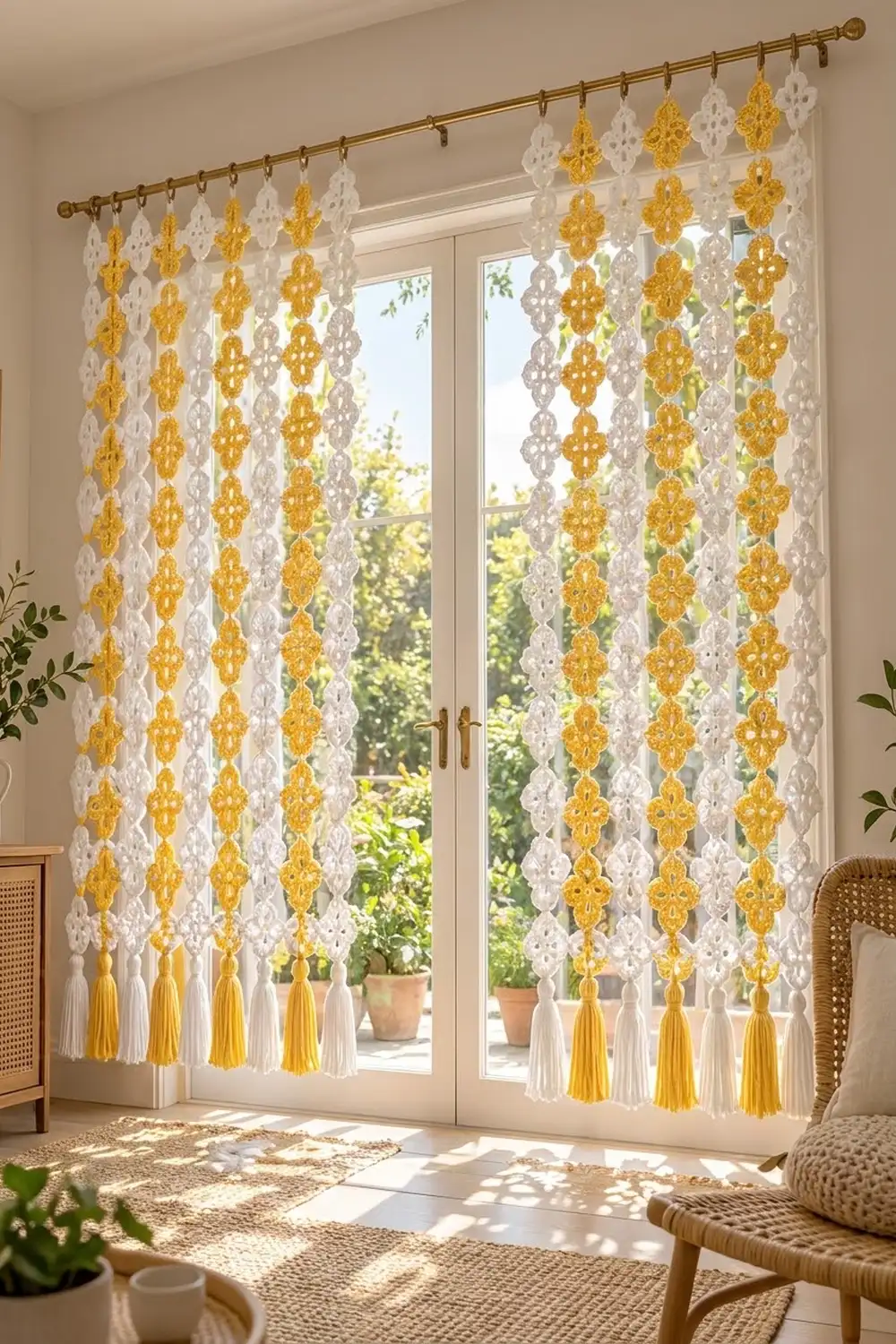
This curtain is built from one small motif: a four-petal quatrefoil with an oval eyelet in each petal and an open center. Repeated in alternating columns of sunflower yellow and bright white, the motifs make a light, airy screen that softens a doorway and still lets the sun through.
Each panel is a grid of motifs joined tip to tip while you work the last round. Every column hangs from its own loop at the top and ends in a full tassel at the bottom. The look is cheerful and a little boho, and it suits glass doors, kitchen windows or a room divider.
The pattern uses US crochet terms. Each panel is 28 in (71.1 cm) wide and 84 in (213.4 cm) long from the top of the hanging loops to the ends of the tassels. Both panels together cover 56 in (142.2 cm) of rod.
Construction is simple. You crochet a test motif, then build each panel row by row with join-as-you-go, add the hanging loops and tassels, and block.
Finished Size and Construction
- Finished size (one panel): 28 in (71.1 cm) wide × 84 in (213.4 cm) long
- Skill level: Intermediate (you need to be comfortable with join-as-you-go)
- Terminology: US crochet terms
- Yarn weight: Worsted (#4) cotton
- Hook: 4.0 mm (US G-6)
- Number of pieces: 352 motifs (176 per panel), plus 16 hanging loops and 16 tassels
- Layout: 2 panels, each 8 columns × 22 rows
- Piece size: 3.5 in (8.9 cm) across, measured petal tip to petal tip
- Size before edge finishing: 28 in × 77 in (71.1 cm × 195.6 cm) per panel
- Edge finishing depth: 2 in (5.1 cm) hanging loops at the top and 5 in (12.7 cm) tassels at the bottom
Materials
Use a smooth mercerized or combed worsted-weight cotton, about 190 m (208 yd) per 100 g. Cotton holds the petal shape, keeps the eyelets crisp and doesn’t stretch much when it hangs. Avoid fuzzy or very stretchy yarns, because a long hanging curtain made from them can grow several inches.
- Yellow (sunflower): 600 g / 1,140 m (1,247 yd), six 100 g skeins
- White (bright white): 600 g / 1,140 m (1,247 yd), six 100 g skeins
Each motif uses about 5 m (5.5 yd). Each tassel uses about 9 m (9.8 yd), and each hanging loop about 1 m (1.1 yd). One color needs about 960 m (1,050 yd) in total. The quantities above include a margin of about 19% for tails, swatching and dye-lot safety.
Tools:
- 4.0 mm (US G-6) crochet hook
- Tapestry needle
- Scissors
- Stitch markers
- Measuring tape
- A 5.5 in (14.0 cm) piece of stiff cardboard for the tassels
- Blocking mats, rust-proof pins and a spray bottle
- A curtain rod up to 1.25 in (3.2 cm) in diameter
Abbreviations (US Terms)
- ch: chain
- sl st: slip stitch
- sc: single crochet
- hdc: half double crochet
- dc: double crochet
- sp: space
- st(s): stitch(es)
- MR: magic ring
- rep: repeat
Special stitch – Drop-Loop Join (DLJ): Work the dc as normal. Take the hook out of the working loop. From the front, insert the hook into the matching stitch of the motif you are joining to, pick up the dropped loop and pull it through. Then carry on. A DLJ does not add a stitch, so it never changes the stitch count.
Gauge and Checkpoints
Make one complete test motif before anything else. The size of every part of the curtain depends on this one measurement.
- After Round 1: 1.5 in (3.8 cm) across
- After Round 3: 3.5 in (8.9 cm) from petal tip to opposite petal tip, measured flat without stretching
If your motif is bigger than 3.5 in (8.9 cm), go down half a hook size. If it’s smaller, go up half a hook size. A difference of just 0.25 in (0.6 cm) per motif adds up to 5.5 in (14.0 cm) over the 22-row length, so check gauge carefully.
Checkpoints later on:
- After Row 1 of a panel (8 motifs): 28 in (71.1 cm) wide
- After Row 11 (half of a panel): 38.5 in (97.8 cm) long
- After Row 22: 77 in (195.6 cm) long
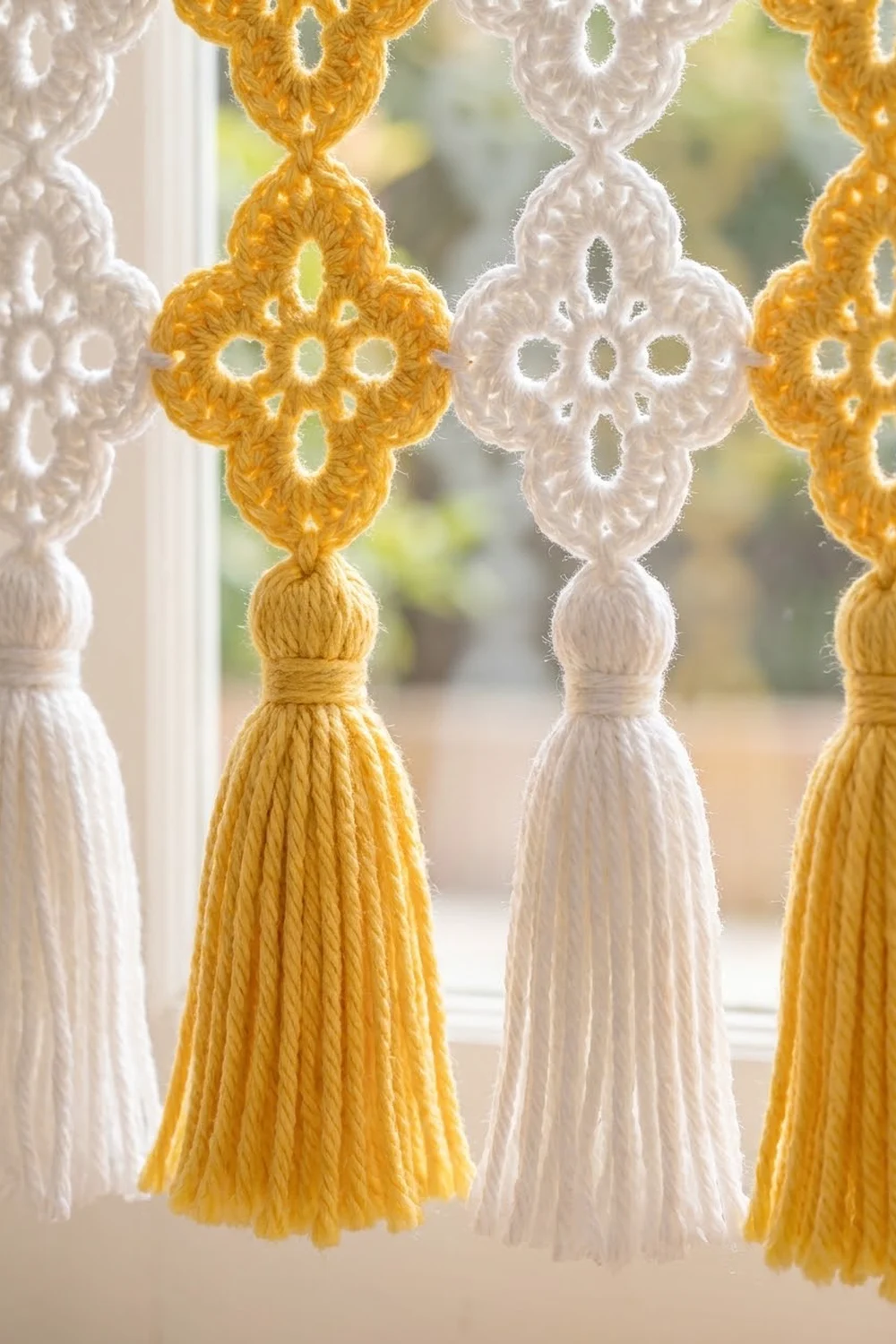
Quatrefoil Motif
Work in rounds with the right side facing you. Don’t turn.
Round 1: Make an MR. Ch 3 (counts as dc), 15 dc into the ring. Pull the ring closed, leaving a small center hole. Join with a sl st to the top of the ch-3. (16 dc)
Round 2: Ch 1. Sc in the same st as the join. Ch 7, skip 3 dc, sc in next dc. Rep from * 2 more times. Ch 7, skip the last 3 dc, then join with a sl st to the first sc. (4 sc and 4 ch-7 loops)
The four ch-7 loops become the oval eyelets in the petals. The 4 sc mark the dips between the petals.
Round 3: Sl st into the first ch-7 sp. Ch 1. In the same sp work (2 sc, 2 hdc, 7 dc, 2 hdc, 2 sc), then sc in the next sc. In the next ch-7 sp work (2 sc, 2 hdc, 7 dc, 2 hdc, 2 sc), sc in next sc. Rep from * 2 more times. The last sc goes into the sc at the base of the Round 2 join. Join with a sl st to the first sc and fasten off. (16 sts per petal, 64 sts total)
Each petal has 15 stitches in its loop plus 1 sc in the dip: 15 + 1 = 16. Four petals × 16 = 64 stitches.
Petal tips: The 4th dc of each 7-dc group is the petal tip. These four center dc are the only joining points. Name the petals in working order: Petal 1 is the top. If you crochet right-handed and work counter-clockwise, Petal 2 is on the left, Petal 3 is at the bottom and Petal 4 is on the right.
Left-handed crocheters work clockwise, so their Petal 2 sits on the right. Build each row from right to left and the joins will come out the same way.
Weave in the ends securely now. A hanging curtain shows every loose tail.
Make All Pieces
Each panel has 8 columns × 22 rows = 176 motifs.
- Per panel: 88 white motifs and 88 yellow motifs
- Both panels: 176 white and 176 yellow motifs
- Tassels: 4 white and 4 yellow per panel (8 of each color in total)
- Hanging loops: 4 white and 4 yellow per panel, matching the column colors
Every row in both panels uses the same color order:
ROW 1:  WHITE YELLOW WHITE YELLOW WHITE YELLOW WHITE YELLOW
ROW 2:  WHITE YELLOW WHITE YELLOW WHITE YELLOW WHITE YELLOW
...
ROW 22: WHITE YELLOW WHITE YELLOW WHITE YELLOW WHITE YELLOW
Because each column is a single color, each white column ends in a white tassel and each yellow column ends in a yellow tassel. Hang the second panel as a mirror image if you’d like the outer edges to match.
Joining
All the joins happen during Round 3 of each new motif. Make the first motif of a panel, the top-left one, completely, with no joins. Every motif after that is worked through Round 2 and then joined while you work Round 3.
Joining to the motif above: When you reach the 4th dc of Petal 1 on the new motif, work a DLJ into the center dc of Petal 3 (the bottom petal) of the motif above. Then finish the petal as normal.
Joining to the motif on the left: When you reach the 4th dc of Petal 2, work a DLJ into the center dc of Petal 4 (the right petal) of the motif on the left.
Which joins each motif needs:
- Row 1, motif 1: no joins
- Row 1, motifs 2–8: left join only
- Rows 2–22, motif 1: top join only
- Rows 2–22, motifs 2–8: top join and left join
Every join links one center dc to one center dc, so no stitches are added or skipped. Each motif keeps its 64 stitches. Each panel has 8 × 21 = 168 vertical joins and 7 × 22 = 154 horizontal joins.
Tension: Work the DLJ at your normal tension. If you pull too hard, the petal tips pucker and the grid bunches up. If you’re too loose, the motifs sag apart. The petals should just touch at their tips, leaving small diamond-shaped gaps between the motifs.
Size checkpoint: After Row 4, lay the panel flat. It should measure 28 in × 14 in (71.1 cm × 35.6 cm). Fix any size drift now, before it builds up.
Border: Hanging Loops and Tassels
This curtain doesn’t have a solid border. The side edges are left as scalloped petal edges. The top edge gets hanging loops and the bottom edge gets tassels, and each one attaches to the same center-dc tip used for joining.
Edge gauge: In the hanging loop, 22 sc fit snugly over a ch-16, about 5.5 sc per 1 in (2.5 cm) of chain.
Top edge – hanging loops (8 per panel): On each Row 1 motif, join yarn in the column color to the center dc of Petal 1. Ch 16. Sl st into the same dc to make a loop. Work 22 sc into the ch-16 loop, then sl st into the same dc again. Fasten off and weave in the ends.
That gives 8 loops along the top edge, 1 per column. Each finished loop stands about 2 in (5.1 cm) tall and fits a rod up to 1.25 in (3.2 cm) in diameter.
Bottom edge – tassels (8 per panel): Wrap yarn 30 times around the 5.5 in (14.0 cm) card. Slide a 12 in (30.5 cm) strand under the wraps at the top and tie it tightly. Cut the wraps at the bottom. Wrap another strand around the bundle 0.75 in (1.9 cm) below the top, knot it and hide the ends inside the tassel. Trim the tassel to 5 in (12.7 cm).
Thread the 12 in (30.5 cm) tie strand through the center dc of Petal 3 on the Row 22 motif in that column. Knot it securely and hide the ends inside the tassel.
Why the math works: 8 columns per panel gives 8 top tips and 8 bottom tips, so 8 loops and 8 tassels. Each loop and tassel sits right in line with the column of vertical joins underneath it. That means the curtain’s weight passes evenly down through every column, and no single motif takes extra strain. The total length is 2 in + 77 in + 5 in = 84 in (5.1 cm + 195.6 cm + 12.7 cm = 213.4 cm).
Final Blocking
- Lay one panel flat on blocking mats, with the hanging loops at the top.
- Spray it evenly until it’s damp but not soaking.
- Pin each column straight, pinning at the joined petal tips.
- Check that each motif measures 3.5 in (8.9 cm) and that each row of 8 measures 28 in (71.1 cm).
- Pin each petal into a rounded shape and open up each oval eyelet with a fingertip.
- Comb out the tassels and trim them evenly to 5 in (12.7 cm).
- Let the panel dry completely, then repeat with the second panel.
- Hang both panels for 24 hours, then check the length again.
Final Quality-Control Checklist
- Every motif has 64 stitches, with 4 clearly separated petals.
- All motifs measure 3.5 in (8.9 cm) tip to tip.
- Every join links a center dc to a center dc.
- The columns alternate white and yellow with no color errors.
- Each panel measures 28 in × 77 in (71.1 cm × 195.6 cm) before the loops and tassels.
- There are 8 hanging loops and 8 tassels per panel, each in its column’s color.
- All ends are woven in and none show from the back.
- The tassels are even at 5 in (12.7 cm).
Troubleshooting
The petals cup or ruffle: Your Round 1 is too tight. Go up half a hook size, or make sure you’ve pulled the magic ring closed only to a small hole.
The eyelets close up: Your chains are too tight. Chain a little more loosely in Round 2.
The panel is wider than 28 in (71.1 cm): Your motifs are too big. Check gauge again and go down half a hook size for the remaining motifs, then block the panel firmly.
The columns lean sideways: You may have joined a petal other than Petal 2 to the left neighbor. Check the petal order and undo the join if needed.
The curtain gets longer when hung: That’s normal settling for cotton. If it grows more than 1 in (2.5 cm), leave out one row or shorten the tassels.
The joins look loose: Snug the dropped loop through more firmly before carrying on.
Care
Hand wash in cool water with a mild detergent, press out the water in a towel, and dry flat, reshaping the motifs as needed. Don’t tumble dry, because the joins and tassels can tangle.
Final Notes
The measurement chain is short and reliable. Round 1 is 1.5 in (3.8 cm). One finished motif is 3.5 in (8.9 cm). One row of 8 motifs is 28 in (71.1 cm). Twenty-two rows make 77 in (195.6 cm). The 2 in (5.1 cm) loops and 5 in (12.7 cm) tassels bring each panel to 84 in (213.4 cm).
If your test motif matches gauge, every other measurement will follow. Enjoy watching the light come through your sunny quatrefoils.
Happy crocheting!