

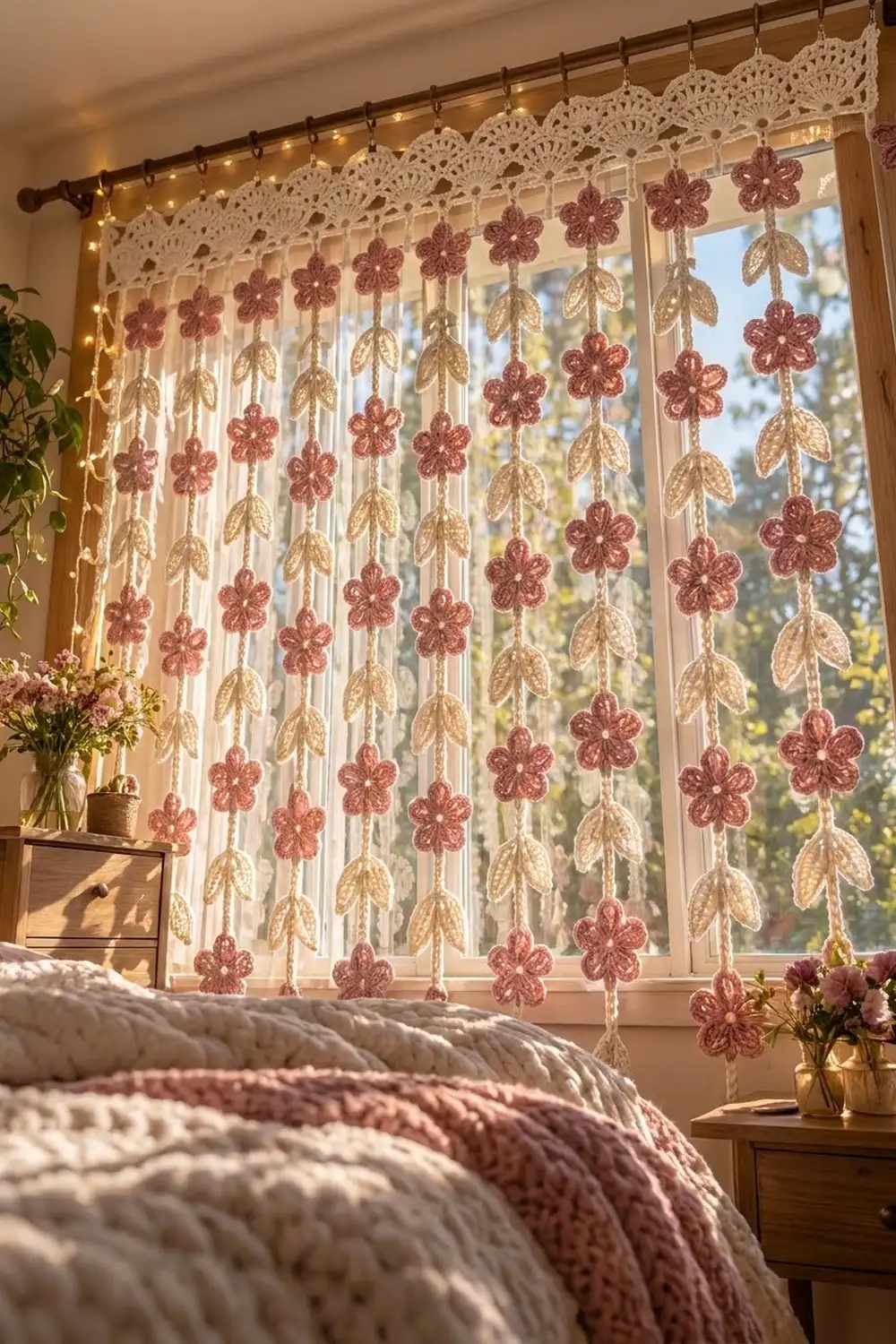
The Rosewood Lace Flower Curtain is a light, airy panel that filters sunlight through dozens of hanging strands. A cream lace header with a row of fan shells runs along the top. Below it hang 25 slender chain strands with dusty-rose flowers and pairs of cream leaves.
The palette is soft and romantic: warm cream for the structure and a muted rose pink for the flowers. Neighboring strands are offset, so flowers and leaves alternate across the curtain in a gentle checkerboard. It suits boho, cottage, and vintage rooms.
This pattern uses US crochet terms. The finished curtain measures 36¼ in (92.1 cm) wide and 58 in (147.3 cm) long from the top of the fans to the bottom motifs.
First you crochet all the flowers. Then you work the header flat in rows and add the fan border along its top edge. Finally, each strand is chained straight down from the header’s bottom edge, with the leaves made as you go and the flowers joined in.
Finished Size and Construction
- Finished size: 36¼ in (92.1 cm) wide × 58 in (147.3 cm) long
- Skill level: Intermediate (simple stitches, lots of repetition)
- Terminology: US crochet terms
- Yarn weight: DK (#3) cotton
- Hook: 4.0 mm (G-6)
- Number of pieces: 1 header, 25 strands, 175 flowers
- Layout: 25 strands spaced 1½ in (3.8 cm) apart, alternating Strand A and Strand B
- Piece size: each flower is 2 in (5.1 cm) across; each leaf is 2 in (5.1 cm) long × ¾ in (1.9 cm) wide
- Size before border: header body 36¼ in (92.1 cm) wide × 1 in (2.5 cm) tall
- Border depth: fan edging adds 1 in (2.5 cm), for a total header height of 2 in (5.1 cm)
Materials
Use a smooth mercerized or combed DK cotton. It shows the stitch detail, holds the leaf points crisply, and doesn’t stretch much when hung. The quantities below assume about 113 m per 50 g.
- Cream (header, strands, leaves): 400 g / 904 m
- Dusty rose (flowers): 250 g / 565 m
Both quantities include a safety margin of about 20%. Chain strands use more yarn than they appear to, so don’t cut the margin.
Tools:
– 4.0 mm (G-6) crochet hook
– Tapestry needle
– Scissors
– Stitch markers (at least 25)
– Measuring tape
– Spray bottle and rustproof pins
– 14 curtain clip rings, or a slim curtain rod
Abbreviations (US Terms)
- ch – chain
- sl st – slip stitch
- sc – single crochet
- hdc – half double crochet
- dc – double crochet
- sk – skip
- sp – space
- st(s) – stitch(es)
- RS / WS – right side / wrong side
Special stitches:
– Fan: (dc, ch 1) 6 times, then dc, all in the same stitch. That is 7 dc and 6 ch-1 sps, 13 sts in total.
– Surface sl st: with the yarn held behind the work, insert the hook from front to back through the fabric, pull up a loop, and pull it through the loop on the hook.
Gauge and Checkpoints
- Fabric gauge: 16 sc = 4 in (10.2 cm)
- Chain gauge: 8 ch = 2 in (5.1 cm), with the chain hanging relaxed
Test one of each piece first: make one flower, one leaf pair, and a 4 in (10.2 cm) chain. Check them against these measurements:
- Flower: 2 in (5.1 cm) across, measured petal tip to petal tip
- Leaf: 2 in (5.1 cm) long, ¾ in (1.9 cm) wide
- Header Row 1: 36¼ in (92.1 cm) wide
- Header after Row 3: 1 in (2.5 cm) tall
- One full strand repeat: 8 in (20.3 cm)
If your pieces are too big, go down one hook size, to 3.5 mm. If they are too small, go up to 4.5 mm. For chains specifically, loose chains are the most common problem. Chain gauge controls the curtain length, so measure a 16-ch test strand. It should hang at 4 in (10.2 cm).
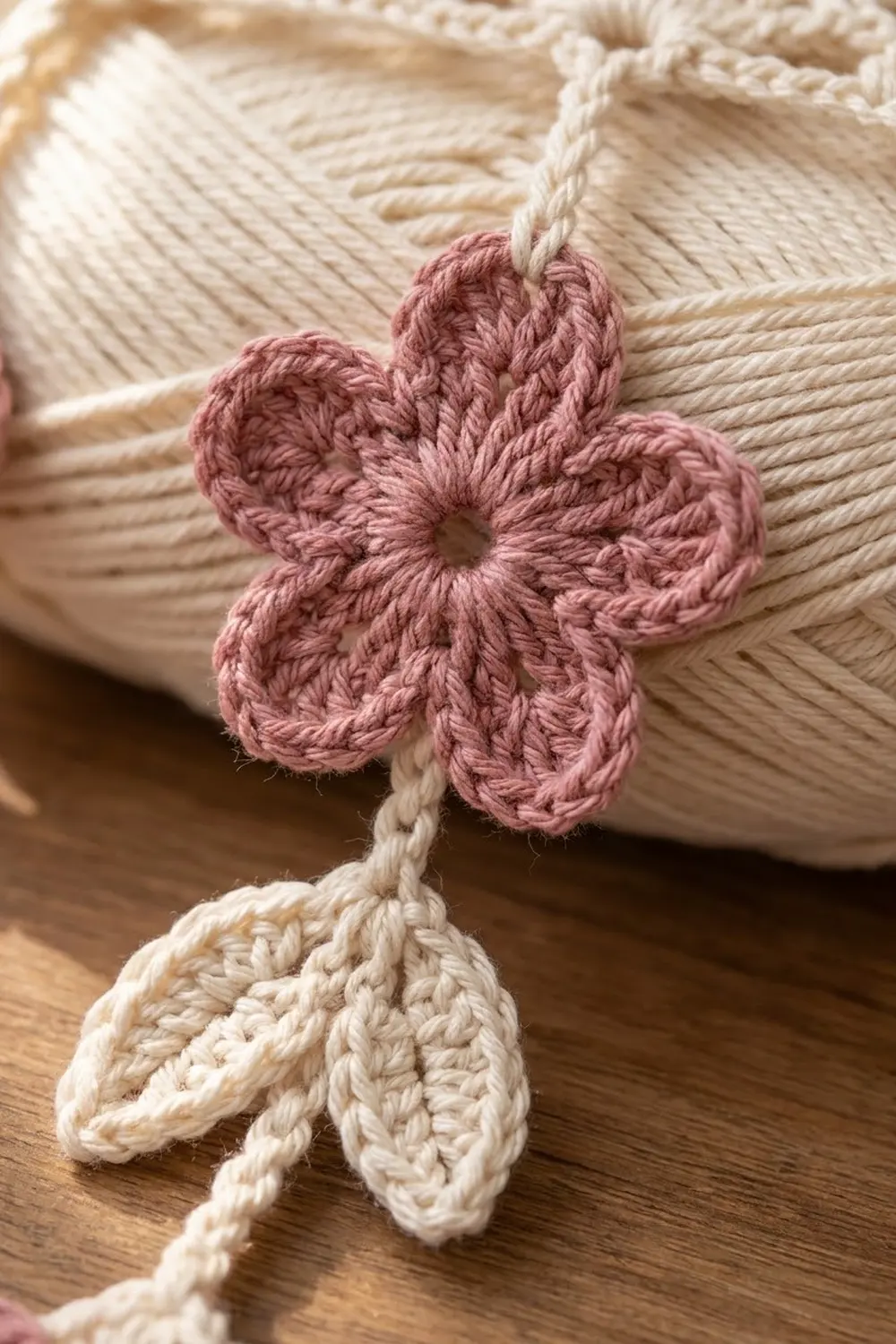
Flowers (Make 175, Dusty Rose)
Make all the flowers before you start the strands.
Ring: Ch 4, sl st to the first ch to form a ring.
Rnd 1: Ch 1, 10 sc in ring, sl st to the first sc. (10 sc)
Rnd 2: (sc, hdc, 2 dc) in next sc, (2 dc, hdc, sc) in next sc; repeat from * 4 more times, sl st to the first sc. (5 petals, 8 sts each, 40 sts)*
Fasten off and weave in the ends. Each petal spans 2 sc of Rnd 1, so the 10 sc make exactly 5 petals. The ch-4 ring leaves the open center you see in the photo.
Joining points: The valley is the first sc of any petal; call that petal “Petal 1.” The opposite tip is the point between the 4th and 5th sts of Petal 3, which lies directly across from the valley.
Header Body (Cream)
Row 1 (RS): Ch 146, sc in the 2nd ch from the hook and in each ch across. Turn. (145 sc)
Row 2: Ch 4 (counts as dc + ch 1), sk next sc, dc in next sc. Ch 1, sk next sc, dc in next sc; repeat from * across. Turn. (73 dc + 72 ch-1 sps = 145 sts)*
Row 3: Ch 1, sc in each dc and in each ch-1 sp across, working the last sc in the 3rd ch of the turning ch. Turn. (73 sc + 72 sc = 145 sc)
Checkpoint: 36¼ in (92.1 cm) × 1 in (2.5 cm).
Strands
There are 2 strand types. Each is built from 2 segments.
Leaf pair (worked from point P, the last ch made):
– Leaf 1: Ch 9. Sl st in the 2nd ch from the hook (the tip), then work sc, hdc, 2 dc, hdc, sc, sl st in the next 7 ch. That gives 8 sts, and you are now at the base.
– Ch 1 and rotate. Working into the free loops on the other side of the chain, work sl st, sc, hdc, 2 dc, hdc, sc, sl st. That gives another 8 sts, and you are now at the tip.
– Ch 2 and sl st into the tip ch to sharpen the point.
– Work 8 surface sl sts up the center of the leaf to point P. This forms the vein.
– Leaf 2: Repeat Leaf 1 from the same point P.
Both leaves hang downward from P and spread into a V.
Leaf segment (4 in / 10.2 cm): Ch 8, leaf pair, ch 8. The second ch 8 runs down between the two leaves.
Flower segment (4 in / 10.2 cm): Ch 8, then join a flower:
1. Hold the flower RS facing you and sl st into its valley.
2. Ch 7 behind the flower.
3. Sl st into the opposite tip.
The ch 7 lies flat behind the 2 in (5.1 cm) flower, so the flower counts as 2 in (5.1 cm) of strand length.
Strand A (leaf-first): [Leaf segment, flower segment] 7 times. Fasten off.
– Chains: 7 × 24 ch = 168 ch, plus 7 behind-flower ch-7s
– Length: 7 × 8 in = 56 in (142.2 cm)
Strand B (flower-first): [Flower segment, leaf segment] 6 times. Then flower segment, ch 8, leaf pair. Fasten off.
– The chain ends at 54 in (137.2 cm), but the 2 in (5.1 cm) leaves hang to 56 in (142.2 cm), level with Strand A.
Make All Pieces
Quantities per color:
– Dusty rose: 175 flowers (7 per strand × 25 strands)
– Cream: 1 header and 25 strands (13 Strand A + 12 Strand B), with 175 leaf pairs worked in
Layout grid, reading left to right across the curtain:
STRANDS:  A B A B A B A B A B A B A B A B A B A B A B A B A
LEVEL 1 (2–4 in / 5.1–10.2 cm):  LEAF FLOWER LEAF FLOWER … LEAF
LEVEL 2 (6–8 in / 15.2–20.3 cm): FLOWER LEAF FLOWER LEAF … FLOWER
(Levels alternate in this way down to 56 in / 142.2 cm.)
Joining
Method: Each strand is chained directly off the header. There is no sewing.
Stitch-to-stitch logic: Hold the header with Row 1 at the bottom and the RS facing you. Number the free loops of the foundation chain 1 to 145 from the right. Place a marker in every 6th loop: 1, 7, 13 … 145. That gives 25 markers, because 1 + (24 × 6) = 145.
- Odd-numbered markers sit at loops 1, 13, 25 … 145 (13 positions). They line up under the fan junctions. Work Strand A at these.
- Even-numbered markers sit at loops 7, 19 … 139 (12 positions). They line up under the fan centers. Work Strand B at these.
To start each strand, join cream with a sl st in the marked loop and begin chaining.
Each gap is 6 sts ÷ 4 sts per inch = 1½ in (3.8 cm). 24 gaps × 1½ in = 36 in (91.4 cm) from the first strand to the last.
Tension advice: Chain at an even, relaxed tension. Every 16 ch, let the strand hang and check that it measures 4 in (10.2 cm). Tight chains make the curtain shorter and pull the leaves out of line.
Size checkpoint: After the first 3 strands, hang the header. All 3 bottom motifs should reach 56 in (142.2 cm) below the header, give or take ½ in (1.3 cm).
Border: Fan Edging
Border gauge: each fan is 3 in (7.6 cm) wide (12 sts ÷ 4 sts per inch) and 1 in (2.5 cm) tall including Row 2.
The edging goes along the top edge only, which is the last row of the header (Row 3). The side edges are row ends and are left plain. The bottom edge carries the strands.
Border Row 1: With the RS facing, ch 1, sc in the first sc. Sk 5 sc, Fan in next sc, sk 5 sc, sc in next sc; repeat from * 11 more times. Turn.
– Count: 13 sc + 12 fans × 13 sts = 13 + 156 = 169 sts*
– Sc land on sts 1, 13 … 145; fans land on sts 7, 19 … 139
Border Row 2: Ch 1, sc in the first sc. *Ch 2, sk next dc, [sc in next ch-1 sp, ch 3] 5 times, sc in next ch-1 sp, ch 2, sk last dc, sc in next sc; repeat from * 11 more times. Fasten off.
– Count: 85 sc, 60 ch-3 loops, 24 ch-2 sps
– Per fan: 6 sc + 5 ch-3 loops + 2 ch-2 sps, plus the 13 junction sc
Why the math works: The fan repeat is 12 sts, so 12 repeats use 144 sts and the last sc uses the 145th. Fans sit directly above the Strand B loops (7, 19 … 139), and the junction sc sit above the Strand A loops (1, 13 … 145). The whole design lines up vertically: one fan and two strands for every 3 in (7.6 cm).
Hanging: Clip one ring to the center ch-3 loop of each fan (12 rings) and one to each top corner (2 rings), 14 rings in total. You can also thread a slim rod through the same loops.
Final Blocking
- Weave in all the ends before you block.
- Lay the header flat, RS up. Pin it to 36¼ in × 2 in (92.1 cm × 5.1 cm), opening each fan into an even half circle.
- Spray it until damp and leave it to dry completely.
- Hang the curtain on its clips or rod.
- Mist each strand lightly. Shape each flower flat with your fingers and point each pair of leaves outward in a V.
- Let the curtain dry while hanging. The weight of the motifs straightens the chains naturally.
- Measure the finished length: 58 in (147.3 cm).
Final Quality-Control Checklist
- [ ] 175 flowers, each with 5 petals and 2 in (5.1 cm) across
- [ ] Header Row 1 has 145 sc; Border Row 1 has 169 sts
- [ ] 12 fans, each sitting above a Strand B
- [ ] 25 strands at 1½ in (3.8 cm) spacing, alternating A and B
- [ ] Each strand has 7 flowers and 7 leaf pairs
- [ ] All bottom motifs end level at 56 in (142.2 cm) below the header
- [ ] Leaf veins show on the RS
- [ ] All ends woven in securely
Troubleshooting
- Strands are different lengths: chain tension varies. Count the ch in each segment, and redo any segment that is off by more than ½ in (1.3 cm).
- Flowers twist sideways: check that you joined at the valley and the opposite tip, not at neighboring petals.
- Leaves curl: the dc are too tight. Block them flat, or go up half a hook size for the leaves only.
- Header wider than 36¼ in (92.1 cm): redo the header with a smaller hook. Don’t adjust the stitch counts, because the strand positions depend on them.
- Fans ruffle: your dc are too loose. Work the fans with a tighter tension.
- Strands tangle while you work: wind each finished strand loosely and pin it out of the way.
Care
Hand wash in cool water with a mild detergent, roll it in a towel to remove water, and dry it hanging or flat. Don’t put it in the dryer: the chains can stretch and tangle.
Final Notes
Every measurement depends on the one before it:
– Gauge of 16 sc = 4 in (10.2 cm) gives a 145-st header 36¼ in (92.1 cm) wide.
– 12 fan repeats of 12 sts complete the 1 in (2.5 cm) border.
– Marking every 6th st places 25 strands 1½ in (3.8 cm) apart.
– 8-in (20.3 cm) strand repeats bring the motifs down to 56 in (142.2 cm).
– Total length: 58 in (147.3 cm).
Check each link of that chain and the curtain will hang straight and even.
Happy crocheting!