

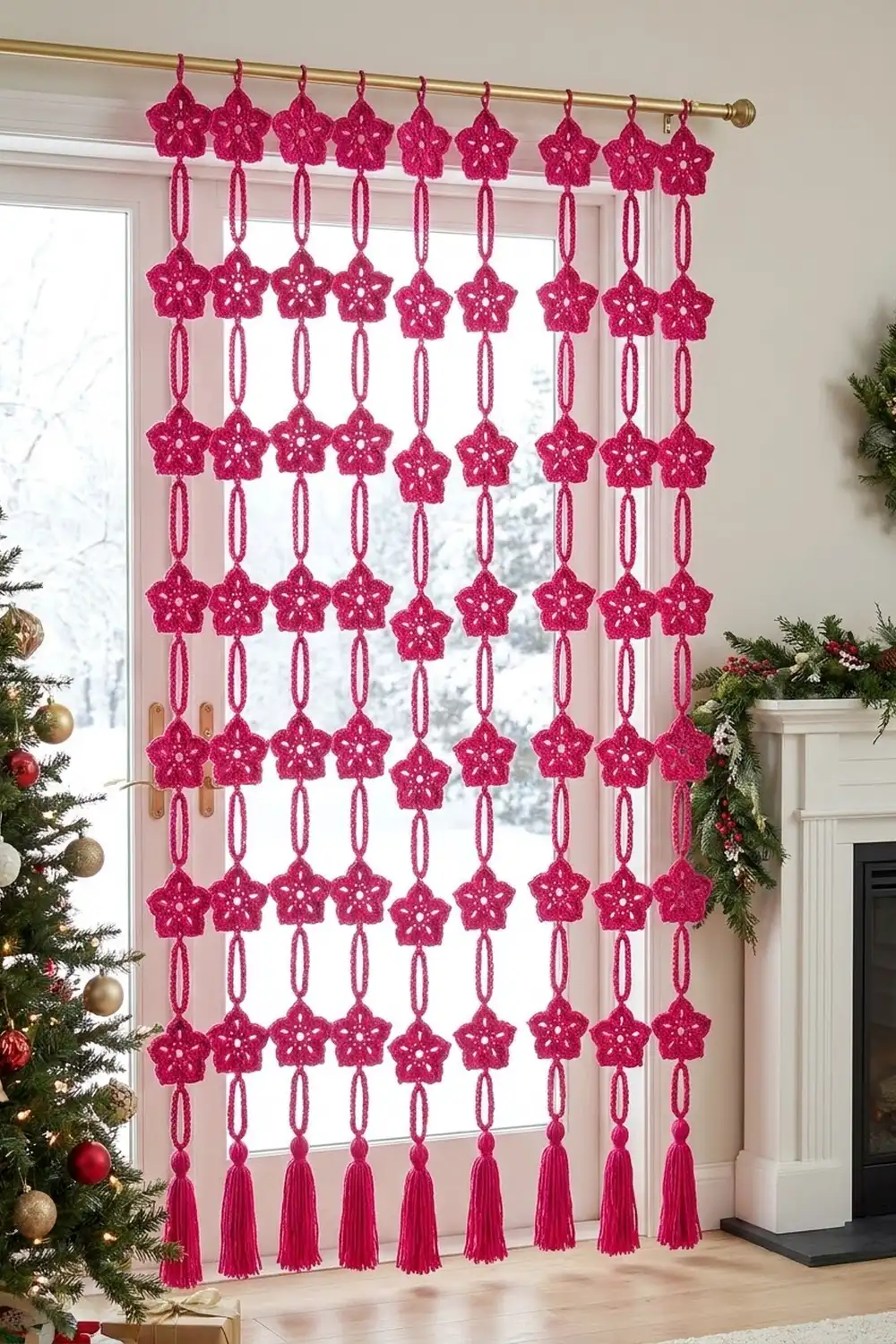
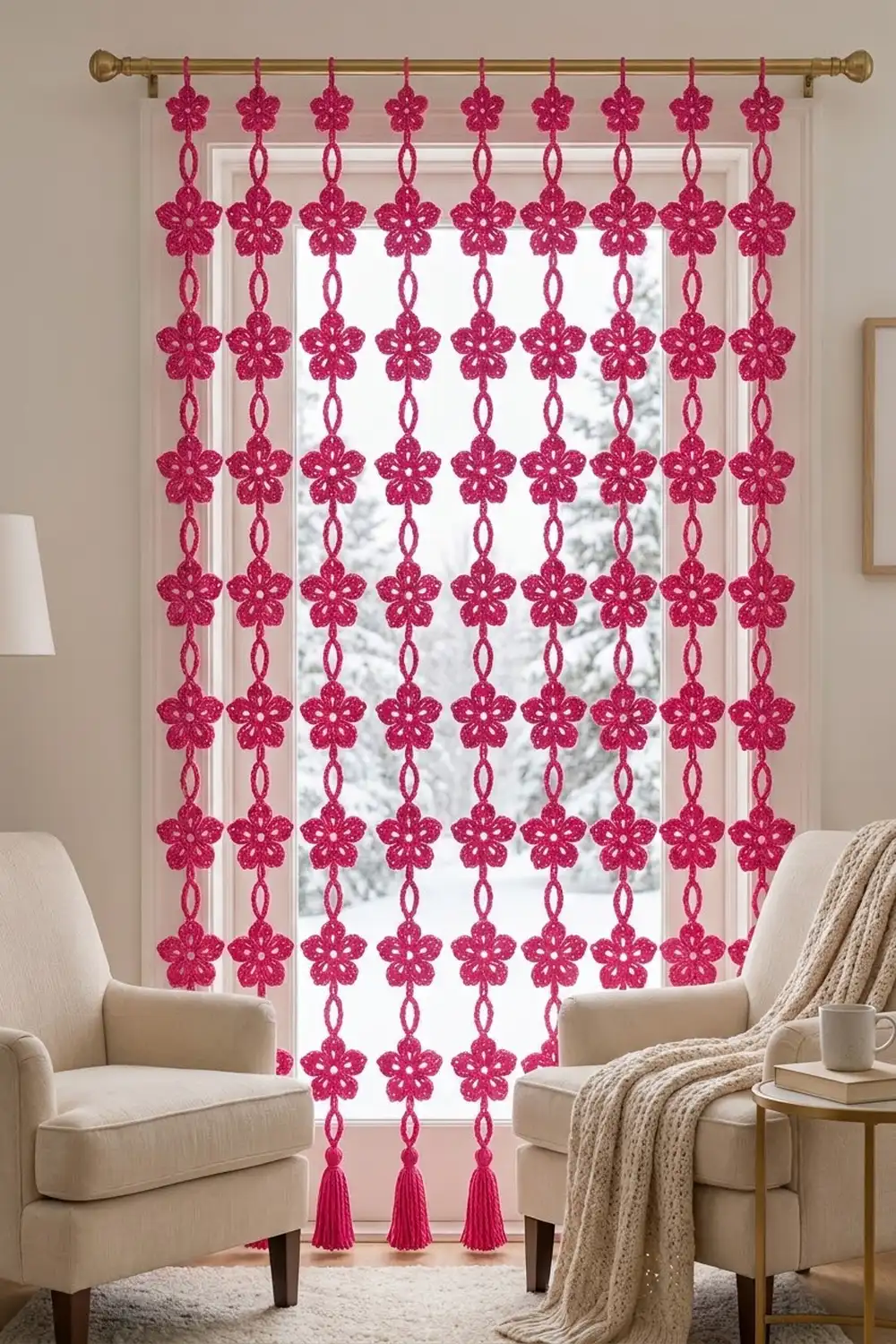
This curtain is made of twelve hanging strands of hot pink five-petal flowers. Oval chain links connect each flower to the next, and every strand ends in a full tassel. Hung on a rod, it looks light and lacy and still lets daylight through, which suits a doorway, window, or holiday backdrop.
The whole piece uses one bold fuchsia. Every flower has an open center ring, five pointed petals, and a small eyelet at the base of each petal, so the strands look delicate but hold their shape when they hang.
The pattern uses US crochet terms. The finished curtain is about 48 in (121.9 cm) wide on the rod and 84 in (213.4 cm) long, from the top of the hanging loops to the tips of the tassels.
Each strand is built from the top down. You make one flower, then work an oval link from its bottom valley. The next flower joins to that link with a slip stitch at its top petal tip. When all 13 flowers on a strand are done, you add a hanging loop at the top and a tassel at the bottom.
Finished Size and Construction
- Finished size: 48 in (121.9 cm) wide × 84 in (213.4 cm) long
- Skill level: Easy–Intermediate
- Terminology: US crochet terms
- Yarn weight: Worsted (#4), cotton or cotton blend
- Hook: 4.0 mm (G-6)
- Number of pieces: 12 strands. Each strand has 13 flowers, 13 oval links, 1 hanging loop and 1 tassel
- Layout: 12 strands side by side, spaced 4 in (10.2 cm) apart center to center
- Piece size: each flower is 3.5 in (8.9 cm) wide and 3 in (7.6 cm) tall from top tip to bottom valley. One flower plus one link is a 6 in (15.2 cm) repeat
- Size before border: each strand is 78 in (198.1 cm) long from the first top tip to the bottom of the final link
- Border depth: hanging loop 1.5 in (3.8 cm) at the top and tassel 4.5 in (11.4 cm) at the bottom
Materials
Yarn advice: Use a smooth, mercerized or combed worsted-weight cotton. Cotton hangs straight, shows the stitch definition, and doesn’t stretch much over time. Avoid fuzzy acrylics, because they tangle when strands brush against each other.
- Fuchsia / Hot Pink: 600 g, about 1,200 yd (1,097.3 m). This is six 100 g skeins of about 200 yd (182.9 m) each
One strand uses about 84 yd (76.8 m), roughly 42 g. Twelve strands use about 1,008 yd (921.7 m). The total above includes a margin of about 19% for gauge differences, tails and a test flower.
Tools:
– 4.0 mm (G-6) crochet hook
– Tapestry needle
– Scissors
– Stiff card 5 in (12.7 cm) tall, for the tassels
– Rust-proof pins and a blocking mat
– Spray bottle
– Measuring tape
– Curtain rod up to 1.25 in (3.2 cm) in diameter
Abbreviations (US Terms)
- ch – chain
- sl st – slip stitch
- sc – single crochet
- hdc – half double crochet
- dc – double crochet
- sk – skip
- st(s) – stitch(es)
- sp – space
Special stitch – Petal: work (sc, hdc, 3 dc, ch 2, 3 dc, hdc, sc) all into the same ch-5 loop. Each Petal is 10 stitches plus a ch-2 tip.
Special stitch – Joined Petal: work (sc, hdc, 3 dc, ch 1) into the ch-5 loop, sl st into the 10th ring ch at the bottom of the oval link above, ch 1, then work (3 dc, hdc, sc) into the same loop. This is still 10 stitches, and the tip is still 2 chains, with the join between them.
Gauge and Checkpoints
Make one test flower before you start a strand. Measure it lightly flattened, without stretching it.
- After Rnd 1: center ring is 1 in (2.5 cm) across
- After Rnd 2: 2 in (5.1 cm) across the loops
- After Rnd 3: 3.5 in (8.9 cm) wide and 3 in (7.6 cm) tall from top tip to bottom valley
- Oval link: 2.25 in (5.7 cm) long when hanging, plus a stem of 0.75 in (1.9 cm)
- Repeat: 6 in (15.2 cm) from the top tip of one flower to the top tip of the next
If the flower is too big, go down to a 3.75 mm hook. If it’s too small, go up to a 4.5 mm hook. If the flower is right but the links are too long or too short, keep the hook and change only how tightly you chain. The repeat has to stay at 6 in (15.2 cm) for the curtain to come out at the right length.
Flower with Link (make 13 per strand)
Every flower is worked the same way. Flower 1 on each strand uses a plain Petal at the top. Flowers 2–13 use a Joined Petal at the top so they attach to the link above.
Rnd 1: Ch 6, sl st in the first ch to form a ring. Ch 1, work 15 sc into the ring, sl st in the first sc. (15 sc)
Rnd 2: Ch 1, sc in the same st, ch 5, sk 2 sc. Sc in the next sc, ch 5, sk 2 sc; repeat from * 3 more times. Sl st in the first sc. (5 sc and 5 ch-5 loops)*
Check: 5 repeats × 3 sts (1 sc worked, 2 skipped) = 15, which uses all of Rnd 1 exactly.
Rnd 3 (petals and link): Sl st into the first ch-5 loop.
- Petal 1 (top): On Flower 1, work a Petal. On Flowers 2–13, work a Joined Petal. Then sl st in the next Rnd 2 sc.
- Petal 2: Petal in the next loop, then sl st in the next sc.
- Petal 3: Petal in the next loop, then sl st in the next sc. This sl st is the bottom valley.
- Link: Ch 21. Sl st in the 18th ch from the hook (ch 4 of the 21). This closes a ring of 18 chains, made of chs 4–21. Sl st back along chs 3, 2 and 1 to return to the valley. The 3-chain stem now hangs below the valley with the oval at its end.
- Petal 4: Petal in the next loop, then sl st in the next sc.
- Petal 5: Petal in the last loop, then sl st in the first sc of Rnd 2.
Fasten off and weave in the ends. (50 sts in 5 Petals, 5 ch-2 tips, 5 sl sts, 1 link)
Why the link sits at the bottom: With Petal 1 at the top, the five petals are spaced 72° apart. That puts the valley between Petals 3 and 4 directly opposite the top tip, at 180°, so the strand hangs straight.
The 10th ring ch: The ring runs from ch 4 to ch 21, and ch 4 is at the top. The chain directly opposite it is 9 chains along, at ch 13, which is the 10th ring chain. Joining there keeps the next flower centered.
Make All Pieces
All pieces are fuchsia.
- Flowers: 156 (13 per strand × 12 strands)
- Oval links: 156 (one is worked on every flower)
- Hanging loops: 12
- Tassels: 12
Each strand’s 13 links are the 12 that connect its flowers plus 1 final link under Flower 13 that holds the tassel.
Layout grid (front view, P = pink flower, o = oval link):
ROD:      S1 S2 S3 S4 S5 S6 S7 S8 S9 S10 S11 S12
LOOPS:    U  U  U  U  U  U  U  U  U  U   U   U
ROW 1:    P  P  P  P  P  P  P  P  P  P   P   P
          o  o  o  o  o  o  o  o  o  o   o   o
ROW 2:    P  P  P  P  P  P  P  P  P  P   P   P
...       (repeat flower + link down to ROW 13)
ROW 13:   P  P  P  P  P  P  P  P  P  P   P   P
          o  o  o  o  o  o  o  o  o  o   o   o
TASSELS:  T  T  T  T  T  T  T  T  T  T   T   T
Joining
Method: Flowers on a strand are joined as you go with a single slip stitch. The strands themselves are never joined to each other. Each one hangs on the rod by its own loop.
Stitch-to-stitch logic: Each join is 1 sl st, from the middle of a Joined Petal tip into the 10th ring chain of the oval above. One flower joins to one link, so each strand has 12 joins. No stitches are added or removed at a join, so every flower still has 50 stitches.
Tension advice: Make the joining sl st snug, but not tight. If it’s too tight, the top petal puckers. If it’s too loose, the flower twists sideways. Before you work the sl st, check that the flower faces the same way as the one above it, with the right side toward you and Petal 1 pointing up.
Size checkpoint: After 3 flowers, let the strand hang and measure from the top tip of Flower 1 to the top tip of Flower 3. It should be 12 in (30.5 cm), which is 2 repeats. On a finished strand, top tip of Flower 1 to top tip of Flower 13 should be 72 in (182.9 cm). Add Flower 13’s 3 in (7.6 cm) height and its final link’s 3 in (7.6 cm) to get the 78 in (198.1 cm) size before border.
Hanging: Space the strands 4 in (10.2 cm) apart, center to center. Twelve strands then take up about 48 in (121.9 cm) of rod.
Border: Top Hanging Loops and Tassel Edge
The strands hang free, so there’s no frame border around the curtain. The finishing edge is the 12 hanging loops along the top and the 12 tassels along the bottom.
Border gauge: 28 sc worked around a 20-chain ring cover 5 in (12.7 cm) of circumference, which is 5.6 sc per inch.
Top edge – Hanging Loop (one per strand):
- Join yarn with a sl st in the ch-2 tip of Petal 1 on Flower 1.
- Ch 20, then sl st in the same ch-2 tip to form the ring.
- Ch 1 and work 28 sc over the ring, working around the chains rather than into them. Sl st in the ch-2 tip.
- Fasten off. (28 sc per loop; 12 loops × 28 = 336 sc along the top edge)
Bottom edge – Tassel (one per strand):
- Wrap yarn 30 times around the 5 in (12.7 cm) card.
- Thread a 12 in (30.5 cm) tie through the top of the wraps. Pass it through the 10th ring ch of the final link and knot it tightly.
- Cut the wraps at the bottom. This gives 60 strands, each 5 in (12.7 cm) long from the fold.
- Wrap a separate piece of yarn 6 times around the tassel 0.75 in (1.9 cm) below the fold to form the head. Knot it and bury the ends inside the tassel.
- Trim the tassel evenly to 4.5 in (11.4 cm). (60 ends per tassel; 12 tassels × 60 = 720 ends along the bottom edge)
Why the math works: 28 sc over 20 chains is a ratio of 1.4. That’s enough stitches to cover the chain completely without ruffling it, and few enough that the loop doesn’t cup. A ring with a 5 in (12.7 cm) circumference has a diameter of about 1.6 in (4.1 cm). That slides easily over a rod up to 1.25 in (3.2 cm) across and leaves the loop hanging 1.5 in (3.8 cm). The total length then adds up: 1.5 + 78 + 4.5 = 84 in (213.4 cm).
Final Blocking
- Lay each strand flat on blocking mats in sections.
- Spray the flowers until they’re damp, not soaked.
- Pin each flower to 3.5 in (8.9 cm) wide, with one pin in each ch-2 tip so the points stay sharp.
- Pin the center ring open and round.
- Straighten each oval link to 2.25 in (5.7 cm) and its stem to 0.75 in (1.9 cm).
- Dampen the tassel, comb it straight, and let it dry hanging.
- Let everything dry completely before you unpin.
- Hang each strand for 24 hours so the links settle, then check that the length is 84 in (213.4 cm).
Final Quality-Control Checklist
- [ ] Every flower has 15 sc in Rnd 1, 5 loops in Rnd 2 and 5 Petals of 10 sts in Rnd 3
- [ ] Every flower is 3.5 in (8.9 cm) wide
- [ ] Each strand has 13 flowers and 13 links
- [ ] Every Petal 1 points straight up, and every link hangs from the Petal 3/4 valley
- [ ] All flowers face front
- [ ] The repeat is 6 in (15.2 cm), give or take 1/4 in (0.6 cm)
- [ ] Each hanging loop has 28 sc and fits the rod
- [ ] Each tassel has 60 ends, trimmed to 4.5 in (11.4 cm)
- [ ] All ends are woven in securely
- [ ] All 12 strands are the same length, 84 in (213.4 cm)
Troubleshooting
- Flowers twist on the strand: The link was worked from the wrong valley. Count again: it goes after Petal 3.
- Strands are different lengths: Your chain tension changed between sessions. Measure each strand against the 6 in (15.2 cm) repeat and redo any links that are off.
- Petals cup: Your dc are too tight for the ch-5 loop. Loosen up, or chain the loops slightly looser.
- Center hole closes up: Make the starting ch 6 looser, or chain with a hook one size up.
- Tassel looks thin: Increase to 35 wraps. Each extra wrap uses about 10 in (25.4 cm) of yarn.
- Hanging loop is too small for the rod: Work ch 24 with 34 sc, which keeps the 1.4 ratio within a stitch.
Care
Hand wash the curtain in cool water with mild soap, gently press the water out in a towel, and dry the strands hanging or flat. Re-block if the petals lose their shape.
Final Notes
Every measurement in this curtain comes from the flower. Rnd 3 gives a 3.5 in (8.9 cm) flower that’s 3 in (7.6 cm) tall. The flower plus a 3 in (7.6 cm) link makes the 6 in (15.2 cm) repeat. Twelve repeats plus the last flower and its final link make the 78 in (198.1 cm) strand. The 1.5 in (3.8 cm) loop and the 4.5 in (11.4 cm) tassel bring the full length to 84 in (213.4 cm). Twelve strands spaced 4 in (10.2 cm) apart fill 48 in (121.9 cm) of rod. If your test flower matches the checkpoints, the rest of the curtain will too.
Happy crocheting!