

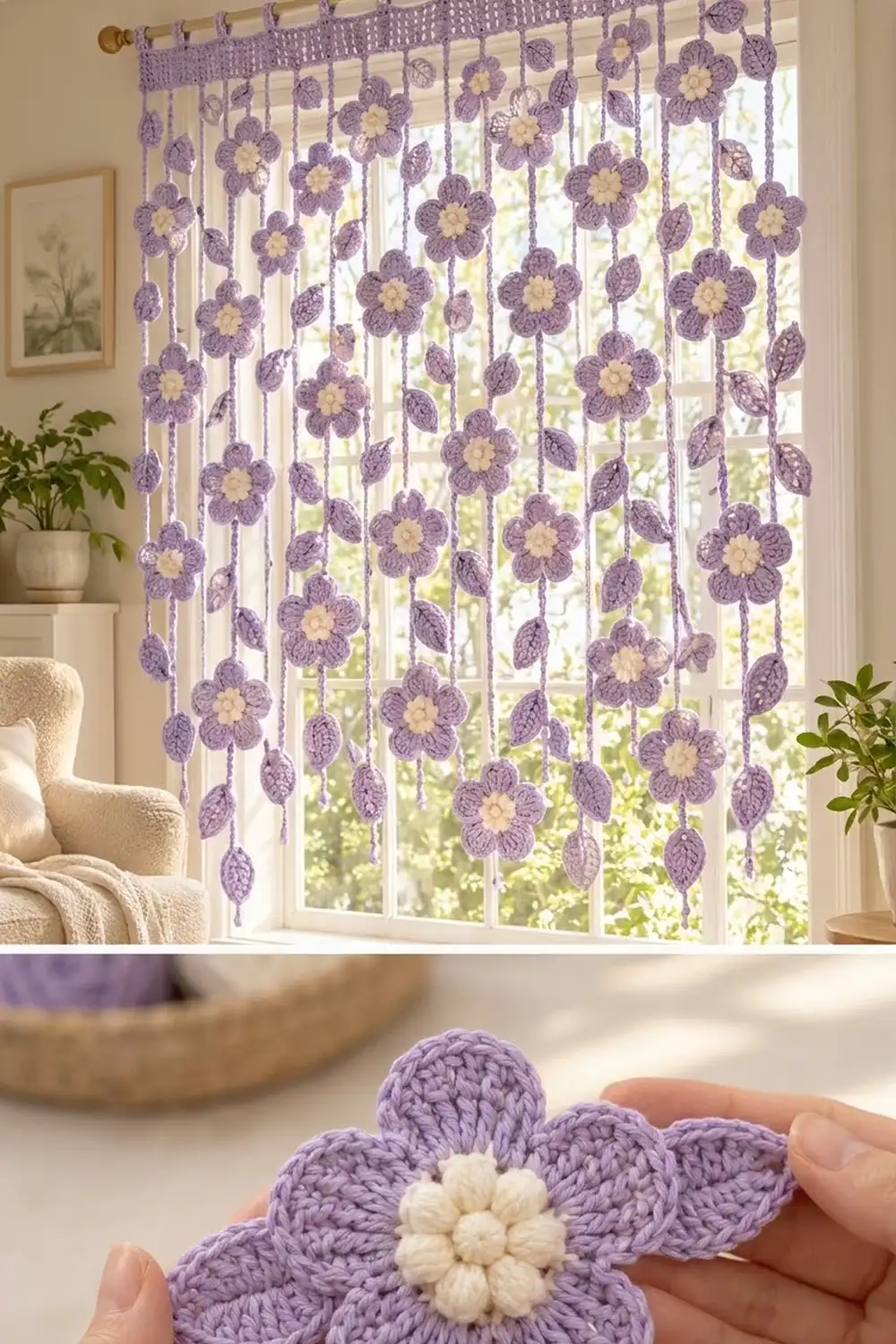
This curtain is made of lavender five-petal flowers with cream puff-stitch centers and small pointed leaves, all strung on vertical slip-stitch cords. The cords hang from a lacy mesh header band with chain-loop tabs that slide onto a curtain rod. Light passes between the strands, so it works well in a sunny window or a doorway.
Only two colors are used: lavender for the petals, leaves, cords, and header, and cream for the flower centers. The look is light, cottage-style, and a little romantic. The pattern uses US crochet terms throughout.
The finished curtain measures 37.6 in (95.5 cm) wide and about 57.5 in (146.1 cm) from the top of the header to the ends of the strands. The tab loops add about 2.5 in (6.4 cm) above the header.
You will crochet one header band, 14 cords, 56 flowers, and 56 leaves. Then you sew the flowers and leaves onto the cords in a staggered layout, and attach the cords to the header during the final border round.
Finished Size and Construction
- Finished size: 37.6 in (95.5 cm) wide x about 57.5 in (146.1 cm) long, plus tabs
- Skill level: Intermediate
- Terminology: US crochet terms
- Yarn weight: DK (3), cotton or cotton blend
- Hook: 3.5 mm (E-4)
- Number of pieces: 127 (1 header, 14 cords, 56 flowers, 56 leaves)
- Layout: 14 cords spaced 2.8 in (7.1 cm) apart, with flowers and leaves alternating and staggered between neighboring cords
- Piece sizes: flower 3 in (7.6 cm) across; leaf 2 in (5.1 cm) long x 1 in (2.5 cm) wide; cord 54 in (137.2 cm)
- Header size before border: 36.6 in x 2.5 in (93.0 cm x 6.4 cm)
- Border depth: 0.5 in (1.3 cm) on each edge of the header
Materials
Choose a smooth mercerized or matte cotton DK yarn of about 110 m per 50 g. Cotton holds the petal shapes crisply and doesn’t stretch much on long hanging cords. Avoid fuzzy yarns, which blur the puff stitches.
- Lavender: 380 g (836 m)
- Cream: 70 g (154 m)
These quantities include a margin of about 15% for test pieces and differences in tension.
Tools:
- 3.5 mm (E-4) crochet hook
- Tapestry needle
- Locking stitch markers (at least 14)
- Scissors
- Measuring tape
- Rustproof pins and a blocking mat or folded towel
- Spray bottle
- Curtain rod up to 1 in (2.5 cm) in diameter
Abbreviations (US Terms)
- ch – chain
- sl st – slip stitch
- sc – single crochet
- hdc – half double crochet
- dc – double crochet
- tr – treble crochet
- sk – skip
- sp – space
- st(s) – stitch(es)
- MR – magic ring
Puff stitch (puff): (Yarn over, insert hook in indicated st, yarn over and pull up a loop to the height of an hdc) 3 times, 7 loops on hook; yarn over and pull through all 7 loops.
Gauge and Checkpoints
Gauge: 20 dc and 8 rows = 4 in (10.2 cm) square. Sc and slip-stitch cord: 5 sts = 1 in (2.5 cm).
Make one complete flower and one leaf before anything else. These test pieces tell you more than a flat swatch, because the puff center and the petal rounds are the parts most affected by tension.
Checkpoints:
- Flower after Round 2: 1.25 in (3.2 cm) across
- Flower after Round 4: 2.5 in (6.4 cm) across
- Finished flower: 3 in (7.6 cm) across
- Leaf: 2 in (5.1 cm) long, 1 in (2.5 cm) wide
- Cord test: 25 ch with sl st back = 5 in (12.7 cm)
- Header after Row 1: 36.6 in (93.0 cm) wide
If your pieces come out too big, go down 0.25 mm in hook size. If they are too small, go up 0.25 mm. Recheck the flower and the cord test before you continue: with 56 flowers and 14 cords, every small error is multiplied.
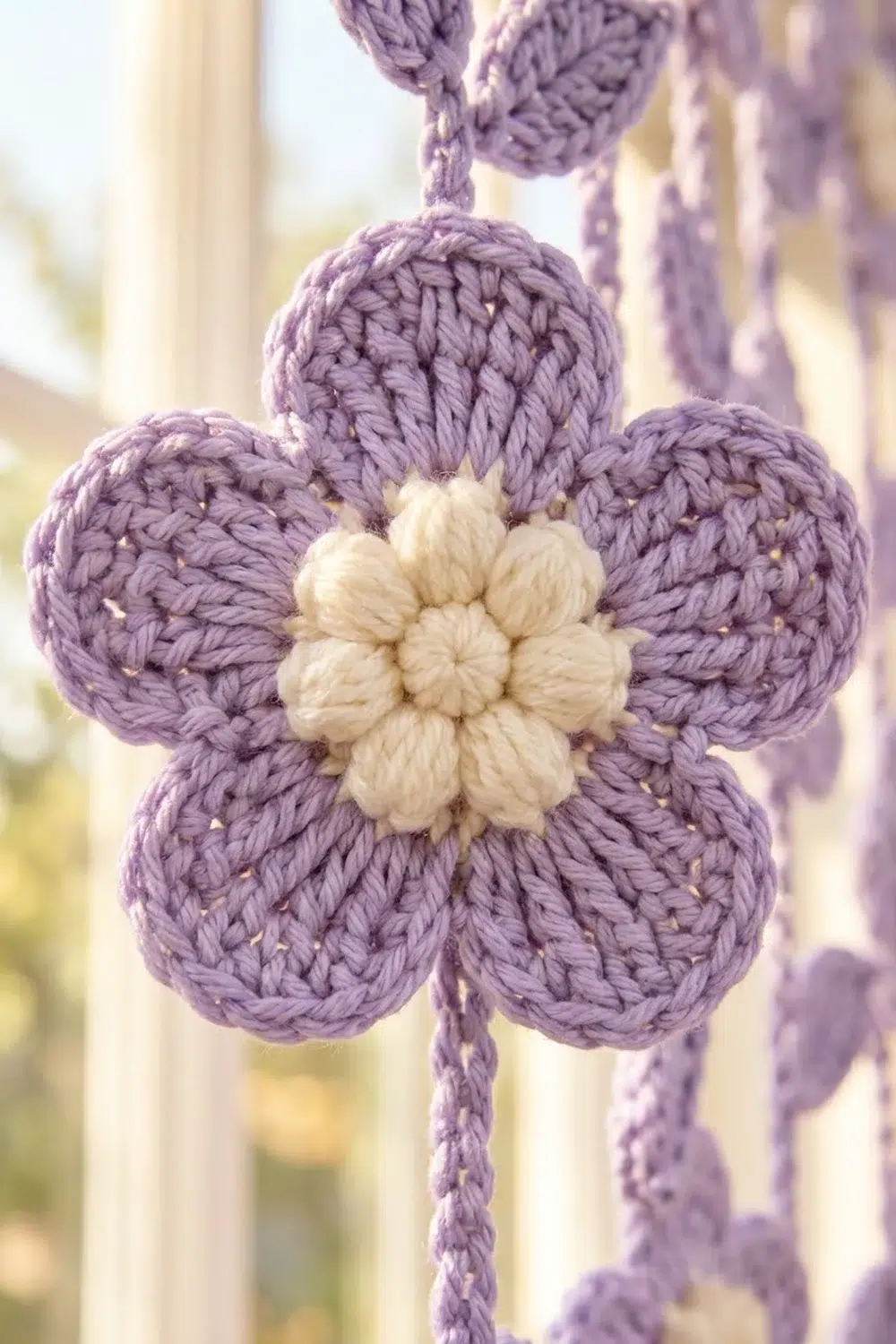
Flower (make 56)
The flower starts with a cream center of 10 puffs around a tight ring. Lavender then forms five chain loops, five rounded petals, and a shaping round that curves the petal edge.
Round 1 (cream): MR, ch 1, 10 sc in ring. Pull the ring tight and join with sl st to first sc. (10 sc)
Round 2 (cream): Ch 1, puff in same st, ch 1, puff in next sc, ch 1; repeat from * 8 more times. Join with sl st to top of first puff. (10 puffs + 10 ch-1 sps = 20 sts) Fasten off cream.
Check: 1.25 in (3.2 cm) across. The puffs crowd together into the raised, bumpy center.
Round 3 (lavender): Join lavender in any ch-1 sp. Ch 1, sc in same sp, ch 4, sk (puff, ch-1 sp, puff), sc in next ch-1 sp; repeat from * 3 more times, ch 4, join with sl st to first sc. (5 sc + 5 ch-4 loops = 25 sts)
Each ch-4 loop spans two puffs and becomes the base of one petal.
Round 4 (lavender): In next ch-4 loop work (sc, hdc, 5 dc, hdc, sc), sk next sc; repeat from * 4 more times. Join with sl st to first sc. (5 petals of 9 sts = 45 sts)
Check: 2.5 in (6.4 cm) across.
Round 5 (lavender, petal shaping): Sl st in first sc of petal, sc in hdc, hdc in first dc, 2 dc in each of next 3 dc, hdc in last dc, sc in hdc, sl st in last sc; repeat from * for each petal. Join to first sl st. (5 petals of 12 sts = 60 sts)
This conversion round works into each of the 9 petal sts and adds 3 extra dc at the top of each petal: (9 worked 1-per-st) + (3 added) = 12 per petal. The sl sts at each end pull in to form the notch between petals, which gives the rounded five-petal shape.
Fasten off, leaving a 12 in (30.5 cm) lavender tail for sewing. Weave in the cream tails.
Check: 3 in (7.6 cm) across.
Leaf (make 56)
The leaf is worked around both sides of a foundation chain. The unworked center of the chain shows as a neat vein.
Foundation: With lavender, ch 10.
Side 1: Starting in 2nd ch from hook: sl st, sc, hdc, dc, tr, tr, dc, hdc, sc in the last ch. (9 sts)
Base: Ch 2, then rotate to work along the opposite side of the foundation chain.
Side 2: In the same 9 chains, working back toward the tip: sc, hdc, dc, tr, tr, dc, hdc, sc, sl st. (9 sts)
Tip: Ch 2, sl st in first sl st of Side 1 to close the point. (18 sts + base ch-2 + tip ch-2)
Fasten off, leaving a 10 in (25.4 cm) tail. Check: 2 in (5.1 cm) long and 1 in (2.5 cm) wide at the tr sts.
Cord (make 14)
Foundation: With lavender, ch 271.
Row 1: Sl st in back bump of 2nd ch from hook and in back bump of each ch across. (270 sl sts)
Fasten off, leaving a 10 in (25.4 cm) tail at the top end. Lay the cord flat without stretching it; it should measure 54 in (137.2 cm). The slip-stitch layer firms up the chain so it doesn’t keep growing once flowers hang from it.
Header Band (make 1)
The header alternates solid dc rows with open mesh rows.
Row 1: With lavender, ch 185. Dc in 4th ch from hook and in each ch across. Turn. (183 sts; the skipped 3 ch count as 1 dc)
Check: 36.6 in (93.0 cm) wide.
Row 2 (mesh): Ch 4 (counts as dc + ch 1), sk next st, dc in next st, ch 1, sk next st, dc in next st; repeat from * across, working last dc in top of turning ch. Turn. (92 dc + 91 ch-1 sps = 183 sts)
Row 3: Ch 3 (counts as dc), dc in next ch-1 sp, dc in next dc; repeat from * across, ending in 3rd ch of turning ch-4. Turn. (183 dc)
Row 4 (mesh): Repeat Row 2. (183 sts)
Row 5: Repeat Row 3. (183 dc) Do not fasten off.
Check: 36.6 in x 2.5 in (93.0 cm x 6.4 cm).
Make All Pieces
Totals for the full curtain:
- Flowers: 56 (cream Rounds 1–2, lavender Rounds 3–5)
- Leaves: 56 lavender
- Cords: 14 lavender
- Header: 1 lavender
Number the cords 1 to 14 from left to right. Odd cords use Layout A and even cords use Layout B, so the flowers and leaves stagger across the curtain. Distances are measured from the top of the cord to the center of each piece.
Distance   Layout A (cords 1,3,5...13)   Layout B (cords 2,4,6...14)
 4 in      Flower                        Leaf
11 in      Leaf                          Flower
18 in      Flower                        Leaf
25 in      Leaf                          Flower
32 in      Flower                        Leaf
39 in      Leaf                          Flower
46 in      Flower                        Leaf
52 in      Leaf                          Flower
In cm: 4 in (10.2 cm), 11 in (27.9 cm), 18 in (45.7 cm), 25 in (63.5 cm), 32 in (81.3 cm), 39 in (99.1 cm), 46 in (116.8 cm), 52 in (132.1 cm). Pieces on one cord are 7 in (17.8 cm) apart, except the last pair, which is 6 in (15.2 cm) apart.
Each cord carries 4 flowers and 4 leaves: 14 x 4 = 56 flowers and 56 leaves.
Joining
Method: Whipstitch each flower and leaf to its cord using the piece’s own tail.
- Lay a cord flat and place locking markers at each distance in the grid.
- Flowers: center the flower on the cord, right side facing you, with the cord running behind it. Whipstitch through the back of the Round 2 puffs and around the cord, catching the cord at the top and bottom of the center. Two points of contact keep the flower from spinning.
- Leaves: place the base ch-2 of the leaf against the cord so the leaf angles slightly outward. Sew 3–4 stitches through the base and the cord.
- Work each stitch through one cord sl st at a time, so that one sl st on the cord meets one stitch on the piece. Do not skip or bunch cord stitches.
Tension: Sew snugly but don’t cinch. If the cord puckers or gets shorter, your stitches are too tight.
Checkpoint: Every finished cord should still measure 54 in (137.2 cm) laid flat, with the center of the lowest piece 2 in (5.1 cm) above the cord end.
Border
The border edges the header, adds the tab loops, and attaches the cords. Border gauge: 5 sc = 1 in (2.5 cm), 4 rounds = 1 in (2.5 cm).
Round 1: Continuing from Row 5, ch 1 and work around the header.
- Short sides: 2 sc in each row-end. (10 sc per side)
- Long sides: 1 sc in each st along the top and in each foundation ch along the bottom. (183 sc per side)
- Each corner: ch 1 (not counted as a st).
Join with sl st to first sc. (183 + 10 + 183 + 10 = 386 sc, plus 4 corner ch-1 sps)
Round 2: Ch 1. Sc in each sc around. In each corner ch-1 sp, work (sc, ch 1, sc).
Each side now has its Round 1 sts plus its own two corner sc: long sides 183 + 2 = 185 sc, short sides 10 + 2 = 12 sc. Total 185 + 12 + 185 + 12 = 394 sc, plus 4 corner ch-1 sps. Each corner sc belongs to one side only, so nothing is counted twice.
As you work Round 2:
- Top edge, tab loops: The 183 sts between the corner sc are the anchor row. At anchor sts 1, 15, 29, 43, 57, 71, 85, 99, 113, 127, 141, 155, 169, and 183, work the sc, then ch 25 and sl st into that same sc. The loop chains are not counted. (14 loops)
- Bottom edge, cords: At the same 14 anchor positions, insert the hook through the sc and through the top sl st of a cord, then complete the sc through both. Attach cords 1–14 in order.
Join with sl st to first sc and fasten off.
Tab reinforcement: Join lavender at the base of each loop, work 35 sc into the ch-25 loop, sl st to the base, and fasten off. (35 sc per tab)
Why the math works: 183 = (13 x 14) + 1, so anchors placed every 14 sts start on the first st and land exactly on the last. That gives 14 anchors, 2.8 in (7.1 cm) apart at 5 sts per inch. Every anchor falls on an odd position, which was a dc in the mesh rows, so each tab and cord hangs from a solid post. The two sc rounds add 0.5 in (1.3 cm) to each edge, so the header finishes at 37.6 in x 3.5 in (95.5 cm x 8.9 cm). With the 54 in (137.2 cm) cords, the curtain is about 57.5 in (146.1 cm) long.
Final Blocking
- Weave in all remaining ends, running each one back through its own color.
- Pin the header flat to 37.6 in x 3.5 in (95.5 cm x 8.9 cm), easing the mesh rows straight.
- Mist the header until it is damp but not soaked.
- Pin each flower to 3 in (7.6 cm) across, with a pin at the top of each petal and one at each notch. Lift the puffs gently with a fingertip; never pin through them.
- Pin each leaf to 2 in x 1 in (5.1 cm x 2.5 cm), pinning the tip into a point.
- Mist the flowers and leaves and let everything dry completely.
- Hang the curtain for 24 hours so gravity can relax the cords evenly before you judge the final length.
Final Quality-Control Checklist
- Every flower has 10 puffs and 5 even petals, and measures 3 in (7.6 cm).
- Every leaf has a visible center vein and a sharp tip.
- All 14 cords measure 54 in (137.2 cm) and hang straight.
- Flowers and leaves follow the A/B grid, staggered across the curtain.
- The header is 37.6 in (95.5 cm) wide, with 14 tabs and 14 cords on matching anchors.
- No loose ends show from the front.
- Flowers face forward and don’t spin on the cords.
Troubleshooting
Puffs look flat: Pull up taller loops before closing each puff, or use a slightly larger hook for Round 2 only.
Petals cup or ruffle: Round 5 is too tight or too loose. Check your hook size against the 3 in (7.6 cm) flower checkpoint.
Center hole is open: Pull the magic ring tighter and weave the tail across the back of the ring.
Cords stretch too long: Work the slip stitches a little tighter, or take 5 ch off the foundation for every 1 in (2.5 cm) of extra length.
Header slants or waves: Count each row. Mesh rows must start with ch 4 and end in the turning chain.
Flowers twist: Add a second tacking stitch at the top and bottom of the center.
Care
Hand wash in cool water with mild soap, roll in a towel to remove moisture, and dry flat or hanging. Lightly reblock the flowers if they lose their shape.
Final Notes
The measurement chain is simple. A 3 in (7.6 cm) flower and a 2 in (5.1 cm) leaf confirm your tension. Each 54 in (137.2 cm) cord carries 4 flowers and 4 leaves spaced 7 in (17.8 cm) apart, with 6 in (15.2 cm) between the last two. A 183-st header at 5 sts per inch gives 36.6 in (93.0 cm), with 14 anchors 2.8 in (7.1 cm) apart, and two border rounds finish it at 37.6 in x 3.5 in (95.5 cm x 8.9 cm). Measure at every checkpoint and the curtain will hang straight and even.
Happy crocheting!