

The Meadow Chevron Leaf Valance is a light, boho-style window curtain. A solid chevron header holds a row of beaded strands, and each strand carries two lacy leaf motifs and ends in a full tassel. Sunlight passes between the strands, so the window stays bright while the glass is softly screened.
The sample uses one color, a warm chartreuse cotton. Using a single color keeps the focus on texture: the nested V-rows in each leaf, the round bobble beads, and the zigzag lower edge of the header.
This pattern uses US crochet terms. The finished valance measures about 35 in (88.9 cm) wide. The longer strands measure 28 in (71.1 cm) from the top of the header to the tip of the tassel, and the shorter strands measure 26.25 in (66.7 cm).
Construction is modular. You make 22 leaves, 11 tassels and one header band. Then you build each strand by working chain-and-bead cords that link the header, the leaves and the tassel. A short border finishes the header and adds hanging loops.
Finished Size and Construction
- Finished size: 35 in (88.9 cm) wide × 28 in (71.1 cm) at the longest strand
- Skill level: Intermediate
- Terminology: US
- Yarn weight: DK (3) cotton
- Hook: 4.0 mm (G-6)
- Number of pieces: 1 header, 22 leaves, 11 tassels
- Layout: 11 strands, alternating A and B (6 A, 5 B)
- Leaf size: 3 in (7.6 cm) wide × 4 in (10.2 cm) tall, not counting the loops
- Header before border: 34.5 in (87.6 cm) × 3.25 in (8.3 cm)
- Border depth: 0.25 in (0.6 cm), plus 1.25 in (3.2 cm) hanging loops
Materials
Choose a smooth, mercerized or combed DK cotton. Cotton holds the leaf points crisp and hangs straight without stretching. Avoid fuzzy or very stretchy acrylics, because the strands would lengthen over time.
Chartreuse, 250 g / 575 m total (for example, 5 balls of 50 g / 115 m). Estimated use:
– Header with border: 60 g / 138 m
– 22 leaves: 80 g / 184 m
– Cords and beads: 15 g / 35 m
– 11 tassels: 35 g / 80 m
The estimated total is 190 g / 437 m. The amount to buy includes a margin of about 25% for gauge differences and test pieces.
Tools:
– 4.0 mm (G-6) crochet hook
– Tapestry needle
– Scissors
– Stiff card, 4.5 in (11.4 cm) tall, for tassels
– Stitch markers
– Blocking mat and rust-proof pins
– Spray bottle
– Curtain rod and 12 rings or clips
Abbreviations (US Terms)
- ch: chain
- sl st: slip stitch
- sc: single crochet
- hdc: half double crochet
- dc: double crochet
- tr: treble crochet
- dc3tog: double crochet 3 together
- sp: space
- st(s): stitch(es)
- RS: right side
Shell: (2 dc, ch 2, 2 dc) in the indicated ch-2 sp.
Picot: ch 3, sl st in 3rd ch from hook.
Bead: Ch 3. Work a 5-dc bobble in the 3rd ch from hook: [yo, insert hook, yo, pull up a loop, yo, draw through 2 loops] 5 times, then yo and draw through all 6 loops on the hook. Ch 1 to lock. The bead measures about 0.5 in (1.3 cm).
Gauge and Checkpoints
Gauge: 18 dc and 9 rows = 4 in (10.2 cm) in plain rows of dc.
Make one test leaf before anything else. It uses every main stitch in the pattern and gives a quick check of your tension.
Checkpoints:
– Leaf after Row 3: about 2.75 in (7.0 cm) across the widest point
– Leaf after Row 7: about 3.5 in (8.9 cm) tall
– Leaf after edging: 3 in (7.6 cm) × 4 in (10.2 cm)
– Header after Row 1: about 34.5 in (87.6 cm) wide
– Header after Row 7: 3.25 in (8.3 cm) deep at the side edges
If your leaf comes out bigger, go down one hook size. If it comes out smaller, go up one hook size. A difference of 0.25 in (0.6 cm) per leaf is fine. Larger differences add up across the strand, and a wrong header gauge changes the overall width.
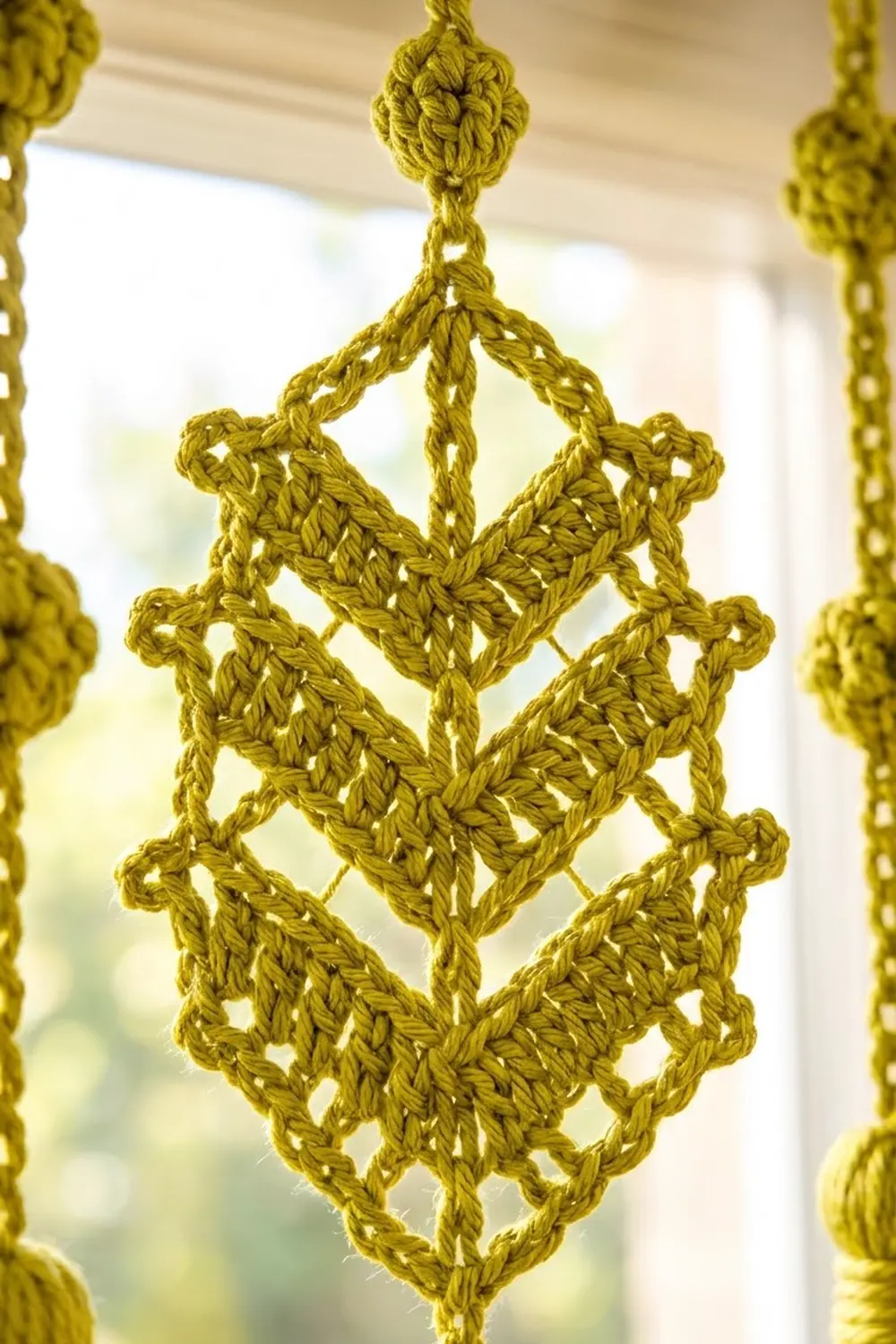
Leaf Motif (Make 22)
The leaf is worked in turned rows from the bottom tip upward. The shell at the center creates the V-shaped chevron and leaves an open spine of ch-2 spaces. Rows 2-3 widen the leaf, Rows 4-6 step the edges inward, and Row 7 fills the top notch to make a point.
The counts below give stitches per side, meaning the dc on each side of the center ch-2 sp. The beginning ch-3 always counts as a dc.
Row 1: Ch 4. Work (dc, ch 2, 2 dc) in the 4th ch from hook.
(2 sts per side, 4 dc total + ch-2 sp)
Row 2 (growth): Ch 3, turn. Dc in the same st, dc in next st, shell in ch-2 sp, dc in next st, 2 dc in top of the turning ch.
(5 sts per side, 10 dc total)
Row 3 (growth): Ch 3, turn. Dc in the same st, dc in next 4 sts, shell in ch-2 sp, dc in next 4 sts, 2 dc in top of the turning ch.
(8 sts per side, 16 dc total)
Row 4 (step in): Turn. Sl st in the first 4 sts, ch 3 (counts as dc), dc in next 4 sts, shell, dc in next 5 sts. Leave the last 3 sts unworked.
(7 sts per side, 14 dc total)
Row 5 (step in): Turn. Sl st in the first 4 sts, ch 3, dc in next 3 sts, shell, dc in next 4 sts. Leave 3 sts unworked.
(6 sts per side, 12 dc total)
Row 6 (step in): Turn. Sl st in the first 4 sts, ch 3, dc in next 2 sts, shell, dc in next 3 sts. Leave 3 sts unworked.
(5 sts per side, 10 dc total)
Row 7 (peak/conversion): Ch 1 (does not count), turn. Sc in the first st, hdc in next st, dc in next st, tr in next 2 sts, (tr, ch 3, tr) in ch-2 sp, tr in next 2 sts, dc in next st, hdc in next st, sc in top of the turning ch.
(10 sts worked 1 per existing st + 2 tr added in the sp = 12 sts, plus the ch-3 point)
The graded heights, from sc at the edges to tr at the center, lift the middle and turn the top notch into a point.
Edging Round: Do not turn. Each long side gives exactly 28 places to work:
– Row-ends of Rows 1-3: 2 sc each = 6
– Rows 4-6: 3 exposed sts from the row below + 2 sc in the row-end = 5 each = 15
– Row-end of Row 7: 1
– Top of Row 7 on that side: 6
Total per side: 6 + 15 + 1 + 6 = 28.
Ch 1. Work (sc, ch 5, sc) in the bottom tip, at the base of Row 1. Working up the first side, [sc in the next 4 places, picot] 7 times. Work (sc, ch 5, sc) in the ch-3 point. Down the second side, [sc in the next 4 places, picot] 7 times. Sl st to the first sc and fasten off.
(60 sc, 14 picots, 2 ch-5 loops)
Weave in the ends along the edge, not across the open spine.
Tassels (Make 11)
Wrap the yarn 30 times around the 4.5 in (11.4 cm) card. Slide a 10 in (25.4 cm) tie strand under the wraps at the top and knot it tightly. Cut the wraps at the bottom and remove the card. Wrap a second strand around the bundle 8 times, 0.75 in (1.9 cm) below the top, to form the neck. Knot it and bury the tails inside the tassel. Trim the bottom evenly to 4 in (10.2 cm).
Header Band (Make 1)
The header is worked bottom-up. Rows 1-4 form a ripple with 11 dc3tog valleys, and each valley becomes a downward point on the lower edge. Row 5 levels the zigzag and Row 7 adds the open mesh.
Row 1: Ch 158. Dc in the 4th ch from hook; the skipped 3 ch count as a dc, and together they form the half-peak. [Dc in next 5 ch, dc3tog over next 3 ch, dc in next 5 ch, 3 dc in next ch] 10 times. Dc in next 5 ch, dc3tog, dc in next 5 ch, 2 dc in the last ch.
(155 sts)*
Check: The row uses 1 + (10 × 14) + 13 + 1 = 155 ch after the 3 skipped ch, and it makes 2 + (10 × 14) + 13 = 155 sts.
Rows 2-4: Ch 3, turn. Dc in the first st. Repeat from * of Row 1, working into sts instead of ch, so each dc3tog sits on a dc3tog and each 3-dc group sits in the center dc of the 3-dc group below. End with 2 dc in top of the turning ch.
(155 sts each row)
Row 5 (leveling/conversion): Ch 1, turn. Sc in the first 2 sts. [Hdc in next 2 sts, dc in next 2 sts, tr in next 3 sts (the center tr sits on the valley), dc in next 2 sts, hdc in next 2 sts, sc in next 3 sts] 10 times. Hdc in next 2, dc in next 2, tr in next 3, dc in next 2, hdc in next 2, sc in the last 2.
(155 sts worked 1 per existing st + 0 added = 155)*
Row 6: Ch 3 (counts as dc), turn. Dc in each st across.
(155 dc)
Row 7 (mesh): Ch 4 (counts as dc + ch 1), turn. Skip the next st. [Dc in next st, ch 1, skip next st] across, ending with dc in the last st.
(78 dc, 77 ch-1 sps)
Make All Pieces
All pieces use the single Chartreuse color:
– 22 leaves, 2 per strand: 80 g
– 11 tassels: 35 g
– 1 header: 60 g with border
Strand types:
– Strand A (make 6): Cord 1 is 3 in (7.6 cm), then leaf, then Cord 2 at 4.75 in (12.1 cm), then leaf, then Cord 3 at 3 in (7.6 cm), then tassel.
– Strand B (make 5): Same as A, except Cord 1 is 4.75 in (12.1 cm).
Layout (valley positions from left to right):
Valley:  1  2  3  4  5  6  7  8  9  10  11
Strand:  A  B  A  B  A  B  A  B  A  B   A
Strand B is 1.75 in (4.4 cm) longer than Strand A. That difference creates the staggered leaves and tassels.
Joining
Each cord is a separate chain that links two pieces. Every ch-6 measures 1.25 in (3.2 cm) and every bead measures 0.5 in (1.3 cm):
– Short cord, about 3 in (7.6 cm): ch 6, bead, ch 6
– Long cord, about 4.75 in (12.1 cm): ch 6, bead, ch 6, bead, ch 6
Cord 1: With RS facing, join the yarn with sc around the foundation ch at a valley point, directly under the Row 1 dc3tog. Work a short cord for A or a long cord for B. Sc into the top ch-5 loop of a leaf and fasten off.
Cord 2: Join with sc in the bottom ch-5 loop of that leaf. Work a long cord, sc into the top loop of the second leaf and fasten off.
Cord 3: Join with sc in the bottom loop of the second leaf. Work a short cord, then ch 1 and fasten off, leaving a 6 in (15.2 cm) tail. Thread the tail through the tassel’s top tie, knot it securely and bury it inside the tassel.
The stitch-to-stitch logic is that each valley gives exactly one anchor point. The 11 valleys sit 14 sts apart, so the strands hang about 3.1 in (7.9 cm) apart.
Tension: Chain at a steady, medium tension. Count the chains rather than measuring them, so all cords of the same type match. Pull each bead firmly closed before continuing.
Size checkpoint: Hang the header. Strand A should measure 22.75 in (57.8 cm) below the header and Strand B 24.5 in (62.2 cm).
Border
The border uses sc at the main gauge: 18 sc = 4 in (10.2 cm).
Border Row 1: With RS facing, join the yarn at the bottom right corner of the header.
– Right side edge: 13 sc. That is 2 sc in each dc row-end (Rows 1-4, 6 and 7 = 12) plus 1 sc in the Row 5 row-end.
– Corner: ch 1. This is a turning space, not a stitch.
– Top: 155 sc, 1 in each dc and 1 in each ch-1 sp.
– Corner: ch 1.
– Left side edge: 13 sc.
Fasten off.
(181 sc: 13 + 155 + 13; the top is 155 worked 1 per existing st + 0 added)
Border Row 2 (hanging loops, top only): Join the yarn in the first top sc. Ch 1, (sc, ch 8, sc) in the same sc. [Sc in next 13 sc, (sc, ch 8, sc) in next sc] 11 times. Fasten off.
(155 sc worked 1 per existing st + 12 extra sc = 167 sc, plus 12 ch-8 loops)
Why the math works: 155 = 1 + (11 × 14), so the 12 loops land exactly on the first st, the last st and every 14th st between them. Because 14 sts is one chevron repeat, the loops line up evenly with the peaks. Side rows add about 0.25 in (0.6 cm) to each end, which brings the width from 34.5 in (87.6 cm) to 35 in (88.9 cm).
Final Blocking
- Weave in all remaining ends.
- Lay the header RS up on a blocking mat. Pin it to 35 in (88.9 cm) × 3.5 in (8.9 cm), with each valley pinned into a sharp point.
- Pin each leaf to 3 in (7.6 cm) × 4 in (10.2 cm). Open the center spine and pin the top and bottom points.
- Lay the strands straight, without stretching the cords.
- Mist everything until damp, not soaked.
- Let it dry completely, at least 12 hours.
- Comb and re-trim the tassels to 4 in (10.2 cm).
Final Quality-Control Checklist
- Header is 35 in (88.9 cm) wide with 11 crisp valley points
- 12 hanging loops are evenly spaced
- Each leaf has 60 sc, 14 picots and both loops intact
- Strand pattern reads A-B-A-B across, with 6 A and 5 B
- A strands measure 22.75 in (57.8 cm) and B strands 24.5 in (62.2 cm)
- Beads are round and evenly spaced
- Tassels are even, firmly tied and trimmed to the same length
- No visible tails
Troubleshooting
- Leaf top stays notched: Make sure Row 7 uses tr at the center. Tighten your sc at the edges.
- Leaf leans to one side: You skipped an uneven number of sts. Recount each side against the per-side totals.
- Header ripples or flares: Check the stitch counts in Rows 2-4. Every dc3tog must sit over a dc3tog.
- Header comes out too narrow: Chain the foundation more loosely, or use a larger hook for the chain only.
- Beads look flat: Pull the closing yo snug and push the bobble out to the RS.
- Strands twist: Block them flat, and let the curtain hang for a day.
Care
Hand wash in cool water with a mild soap and press out the water in a towel. Lay flat to dry, reshape the leaves and comb the tassels.
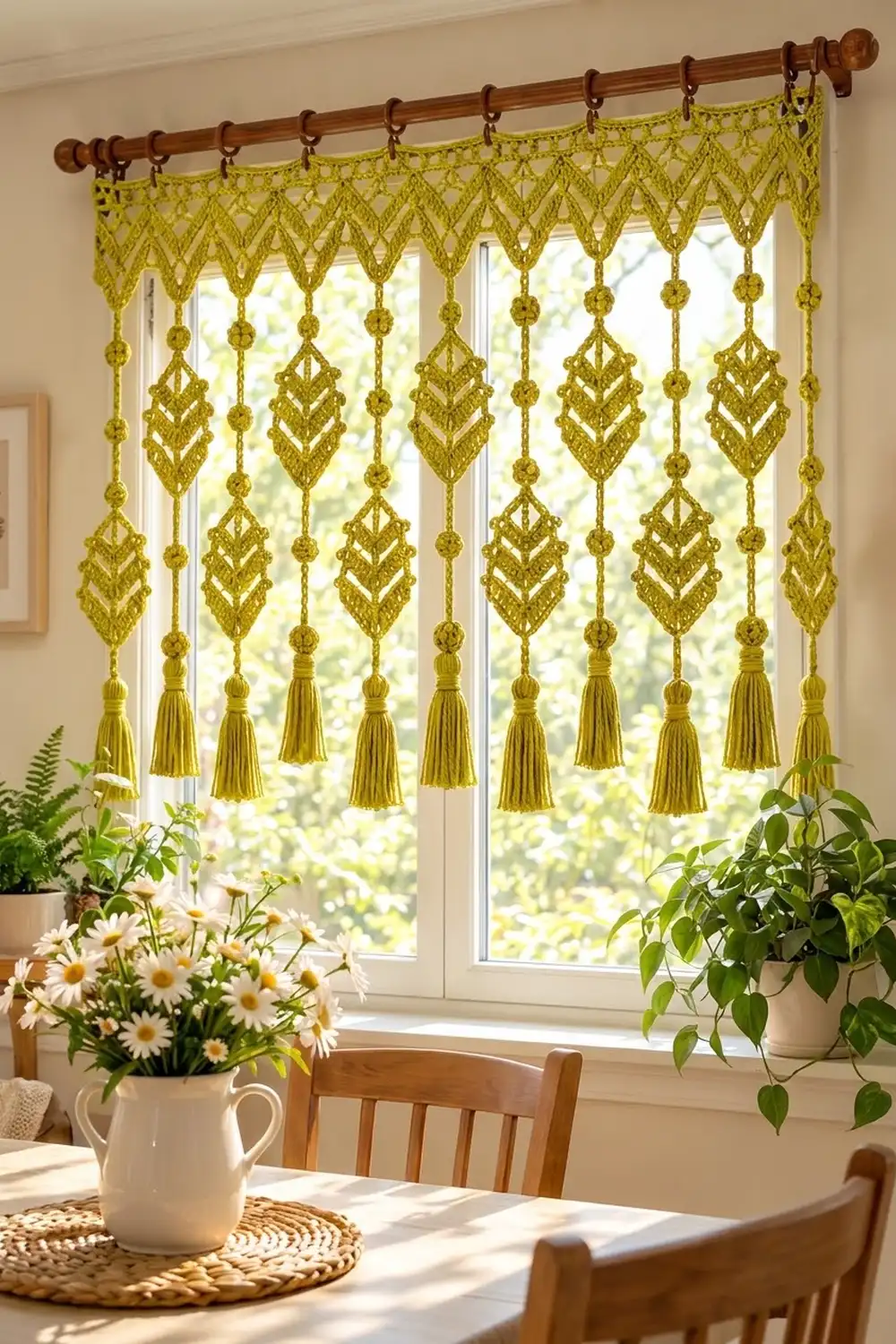
Final Notes
The measurement chain is simple. A gauge of 18 dc × 9 rows = 4 in (10.2 cm) gives leaves of 3 in × 4 in (7.6 cm × 10.2 cm) and a 155-stitch header that is 34.5 in (87.6 cm) wide. The border brings the width to 35 in (88.9 cm). Counted ch-6 cords produce strands of 22.75 in (57.8 cm) and 24.5 in (62.2 cm). Check your test leaf first, and the rest of the curtain should come out on size.
Happy crocheting!