

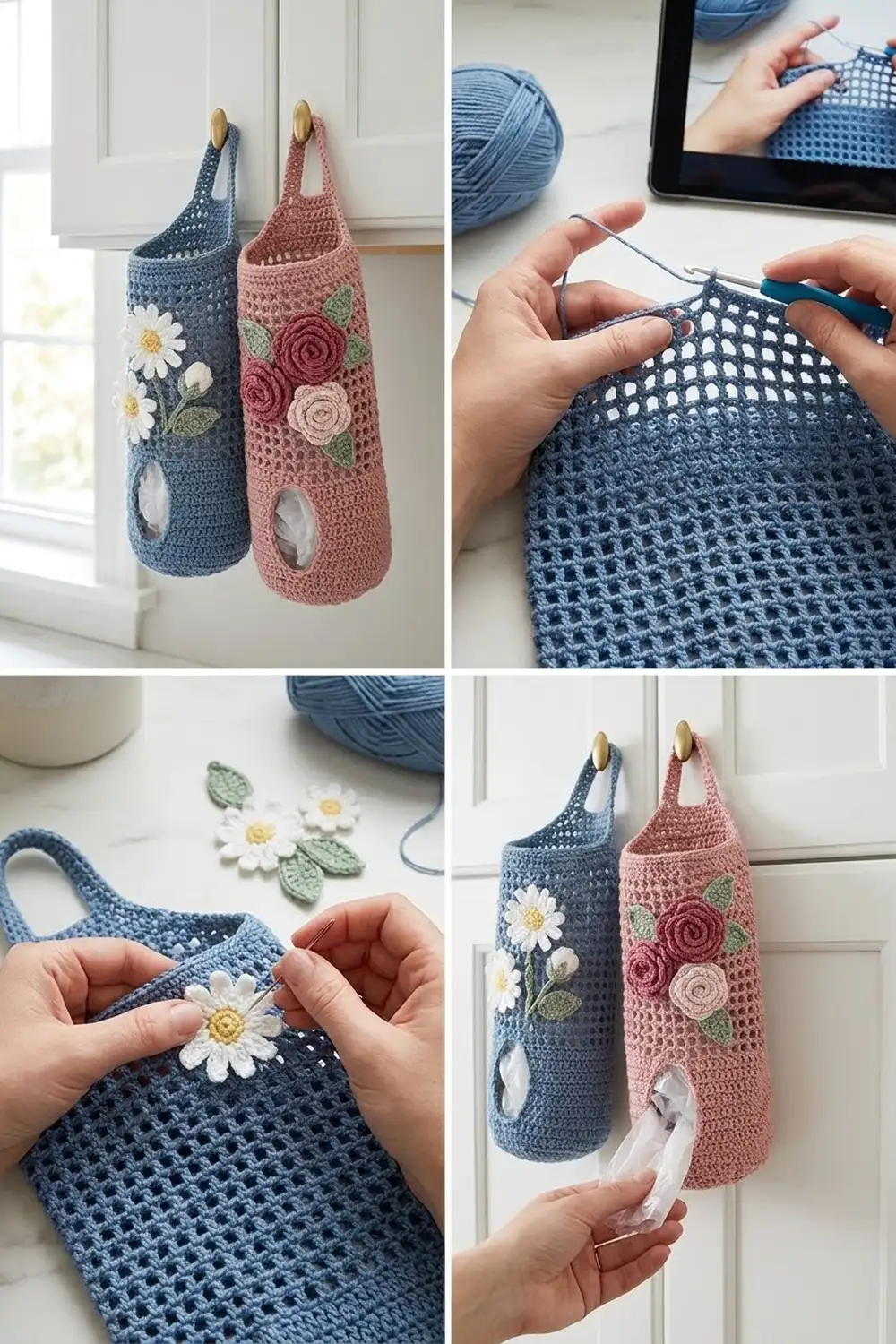
The Cottage Bloom Plastic Bag Holder is a tall, airy mesh tube that keeps grocery bags tidy and looks good doing it. A solid cream band frames the bottom and top, an open square mesh fills the middle, and a tapered strap hangs from a smooth wooden ring.
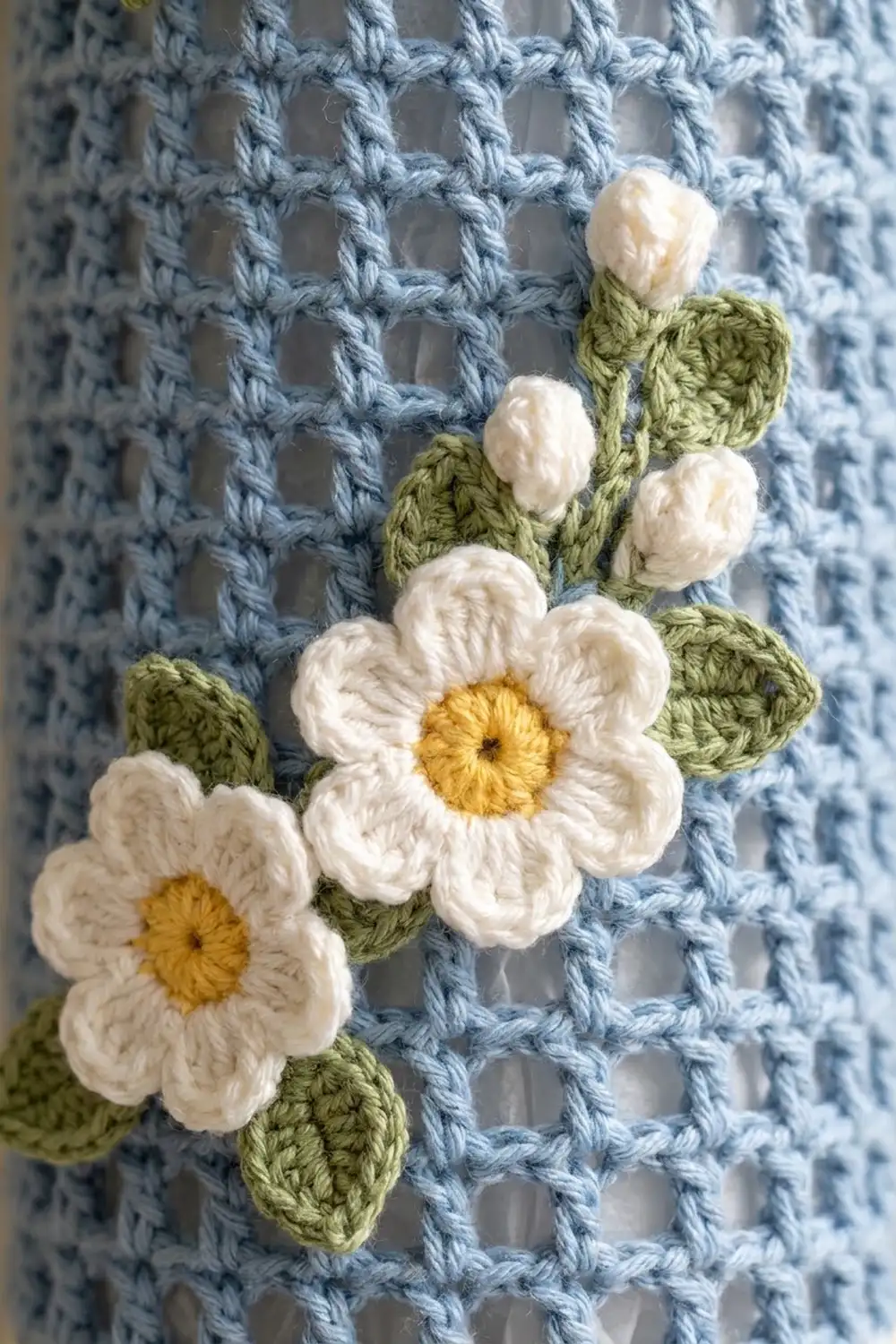
This pattern covers two colorways. The Blue Daisy version has two clusters of white daisies, round buds, and sage leaves, and you fill and empty it from the top. The Pink Rose version has one cluster of rolled roses in two shades plus an oval dispensing opening near the base, so you can pull bags out one at a time.
The pattern uses US crochet terms. The finished body is 4.2 in (10.7 cm) in diameter and 15.6 in (39.6 cm) tall. Hanging length, including the strap and ring, is about 20.6 in (52.3 cm).
You work the holder bottom-up in one piece: a flat single-crochet base, a cream bottom band, the mesh body, a cream top band, then a strap worked in rows. The flowers and leaves are made separately and sewn on.
Finished Size and Construction
- Finished size: 4.2 in (10.7 cm) diameter × 15.6 in (39.6 cm) tall body; 6.7 in (17.0 cm) wide when flattened
- Skill level: Easy-intermediate
- Terminology: US
- Yarn weight: DK / light worsted (#3) cotton
- Hook: 4.0 mm (G-6)
- Number of pieces: 1 body, plus sewn appliqués
- Layout: Single tube worked in the round
- Circumference: 60 stitches = 13.3 in (33.8 cm)
- Size before border: Base, bottom band, and mesh measure 13.6 in (34.5 cm) tall
- Border depth: Top band 2.0 in (5.1 cm); strap rises 2.0 in (5.1 cm) above the rim
Materials
Use a smooth, mercerized or combed cotton, about 120 m (131 yd) per 50 g. Cotton holds its shape under the weight of bags and shows the mesh crisply.
Per holder:
- Main color (MC): dusty blue or dusty pink, 70 g (170 m)
- Color A (cream): bands, 40 g (100 m)
Blue Daisy appliqués:
- White, 10 g (25 m)
- Yellow, 3 g (8 m)
- Sage green, 8 g (20 m)
Pink Rose appliqués:
- Deep rose, 8 g (20 m)
- Pale blush, 8 g (20 m)
- Sage green, 6 g (15 m)
Tools:
- 4.0 mm (G-6) hook
- Wooden ring, 3 in (7.6 cm) outer diameter
- Tapestry needle
- Stitch markers
- Measuring tape
- Pins
All quantities include a margin of about 15%.
Abbreviations (US Terms)
- ch: chain
- sl st: slip stitch
- sc: single crochet
- hdc: half double crochet
- dc: double crochet
- tr: treble crochet
- MR: magic ring
- inc: 2 sc in the same stitch
- sc2tog: single crochet 2 together
- sp: space
- st(s): stitch(es)
- rnd: round
- RS: right side
Mesh unit: 1 dc + ch 1 (2 sts). Each mesh round has 30 units, which is 60 sts. A ch-4 at the start of a round counts as the first dc plus ch 1.
Gauge and Checkpoints
- Single crochet: 18 sc × 20 rnds = 4 in (10.2 cm)
- Mesh: 9 mesh units (18 sts) × 9 rnds = 4 in (10.2 cm)
The holder itself works as a swatch. Make the base, then measure before going on.
- Checkpoint 1 (after Rnd 10): The base measures 4.2 in (10.7 cm) across.
- Checkpoint 2 (after Rnd 18): The side band is 1.6 in (4.1 cm) tall. Flattened, the tube is 6.7 in (17.0 cm) wide.
- Checkpoint 3 (after Rnd 27): The mesh is 4.0 in (10.2 cm) tall and still 6.7 in (17.0 cm) wide flat.
- Checkpoint 4 (after Rnd 45): The mesh is 12.0 in (30.5 cm) tall.
If your piece is too big, go down 0.5 mm. If it is too small, go up 0.5 mm. If only the mesh is off, change hooks for the mesh rounds only, so the width matches the cream bands.
Base (Color A)
Work in continuous joined rounds: join each round with a sl st to the first st, then ch 1. The ch 1 does not count as a stitch.
- Rnd 1: 6 sc in MR. (6)
- Rnd 2: inc in each st. (12)
- Rnd 3: (sc 1, inc) × 6. (18)
- Rnd 4: (sc 2, inc) × 6. (24)
- Rnd 5: (sc 3, inc) × 6. (30)
- Rnd 6: (sc 4, inc) × 6. (36)
- Rnd 7: (sc 5, inc) × 6. (42)
- Rnd 8: (sc 6, inc) × 6. (48)
- Rnd 9: (sc 7, inc) × 6. (54)
- Rnd 10: (sc 8, inc) × 6. (60)
Place a marker in the first st of the round and move it up as you go. It keeps your stitch numbering lined up for the strap later.
Bottom Band (Color A)
- Rnds 11–18: sc in each st. (60)
On Rnd 18, change to MC on the last yarn-over of the joining sl st. The band is 1.6 in (4.1 cm) tall, and the base curves gently into it, giving the rounded bottom.
Mesh Body (MC)
- Rnd 19: ch 4 (counts as dc + ch 1), sk next st, dc in next st, ch 1, sk next st; repeat from * 28 more times. Sl st to the 3rd ch of the beginning ch-4. (30 dc + 30 ch-1 sps = 60 sts)
The 30 dc posts are P1–P30, and S1–S30 are the ch-1 spaces after each post.
Blue Daisy Version (no opening)
- Rnds 20–45: ch 4, dc in next dc, ch 1; repeat from * around. Sl st to the 3rd ch of the beginning ch-4. (60 sts each round)
Go to the Top Band.
Pink Rose Version (dispensing opening)
Rows 20–24 are worked back and forth to leave a gap of 13 sts (S24 through S30).
- Row 20 (RS): ch 4, dc in next dc, [ch 1, dc in next dc] 22 times. This ends at P24. (24 dc + 23 ch-1 sps = 47 sts) Turn.
- Rows 21–24: ch 4, dc in next dc, [ch 1, dc in next dc] 21 times, ch 1, dc in 3rd ch of turning ch. (47 sts) Turn at the end of Rows 21–23.
At the end of Row 24 you are back at P24, beside the gap.
- Close the gap: ch 13, then sl st to the 3rd ch of Row 24’s beginning ch-4. (47 sts + 13 ch = 60)
- Rnd 25: ch 4, dc in next dc, [ch 1, dc in next dc] across to P24. Then work across the chain: ch 1, sk 1 ch, dc in next ch 6 times, ch 1, sk last ch. Sl st to the 3rd ch of the beginning ch-4. (6 posts + 7 spaces over the chain; 30 dc + 30 ch-1 sps = 60 sts)
- Rnds 26–45: Work as Blue Rnds 20–45. (60 sts each round)
The opening is 2.9 in (7.4 cm) wide and 2.2 in (5.6 cm) tall before edging. Rnd 19 plus Rows 20–24 give the same mesh height as six rounds, so both versions have 27 mesh rows in total.
Border: Top Band, Opening Edging, and Strap
Border gauge: same as the base, 18 sc = 4 in (10.2 cm).
A tube has no corners. For counting, think of it as two flattened sides of 30 sts each: front and back.
Top Band (Color A)
- Rnd 46 (conversion): Join Color A at the beginning of the round. sc in each dc and each ch-1 sp. (30 sc in dc + 30 sc in ch-1 sps = 60; 30 per side)
- Rnds 47–55: sc in each st. (60; 30 per side)
The band is 10 rnds, or 2.0 in (5.1 cm). Fasten off.
Why the math works: Each mesh unit is 2 sts wide and becomes exactly 2 sc, so 30 units become 60 sc. That matches the 60 sc of the bottom band, so the band neither flares nor pulls in. 60 ÷ 4.5 sts per in = 13.3 in (33.8 cm) around, which is 6.7 in (17.0 cm) flat.
Opening Edging (Pink Rose only, MC)
- Rnd 1: Join MC at the bottom right corner of the opening. Work sc evenly around:
- 13 sc across the bottom edge (1 in each st)
- 10 sc up the left side (2 around each dc row end)
- 13 sc across the top edge (1 in each free loop of the ch-13)
- 10 sc down the right side
- Total: 46. Do not add corner stitches. Leaving them out rounds the corners into an oval.
- Rnd 2: sl st in each st around. (46)
Fasten off and weave in the ends.
Strap (MC)
The strap is centered opposite the opening. With the marker at st 1 of Rnd 55, count to st 17.
- Row 1: Join MC in st 17, sc in sts 17–32. (16) Turn.
- Row 2: ch 1, sc2tog, sc 12, sc2tog. (14)
- Row 3: ch 1, sc across. (14)
- Row 4: ch 1, sc2tog, sc 10, sc2tog. (12)
- Row 5: ch 1, sc across. (12)
- Row 6: ch 1, sc2tog, sc 8, sc2tog. (10)
- Row 7: ch 1, sc across. (10)
- Row 8: ch 1, sc2tog, sc 6, sc2tog. (8)
- Rows 9–16: ch 1, sc across. (8)
Fasten off and leave a 12 in (30.5 cm) tail. Slide the ring onto the strap. Fold Rows 11–16 over the ring to the inside and whipstitch Row 16 to Row 10. The visible strap is 2.0 in (5.1 cm) tall and tapers from 3.6 in (9.1 cm) to 1.8 in (4.6 cm) wide.
Appliqués
Daisy (make 4: Blue)
- Rnd 1 (yellow): 10 sc in MR, join. (10) Fasten off.
- Rnd 2 (white): Join in any st. sl st in next st, (hdc, 3 dc, hdc) in next st; repeat 4 more times. Join. (5 petals)
Each daisy is 1.75 in (4.4 cm) across.
Bud (make 4: Blue, white)
- Rnd 1: 6 sc in MR. (6)
- Rnd 2: sc in each st. (6)
Stuff the tails inside, then gather the round closed. Each bud is 0.5 in (1.3 cm).
Large Leaf (sage; make 4 Blue, 5 Pink)
ch 7. Starting in the 2nd ch from the hook: sl st, sc, hdc, dc, hdc, (sc, ch 1, sc) in last ch. Working along the other side of the chain: hdc, dc, hdc, sc, sl st. The leaf is 1.25 in (3.2 cm) long.
Small Leaf (sage; make 6: Blue)
ch 5. Starting in the 2nd ch from the hook: sl st, hdc, dc, (sc, ch 1, sc) in last ch. Working along the other side: dc, hdc, sl st. The leaf is 0.9 in (2.3 cm) long.
Rolled Rose (make 2 deep rose, 2 blush: Pink)
- Row 1: ch 25. (dc, ch 1, dc) in the 5th ch from the hook, sk 1 ch, (dc, ch 1, dc) in next ch; repeat 9 more times. (11 V-sts)
- Row 2: ch 3, turn, 5 dc in each ch-1 sp. (11 shells)
Roll the strip from the starting end and stitch through the base to hold it. Each rose is 1.75 in (4.4 cm) across.
Placement
Blue:
- Upper cluster: 1 in (2.5 cm) below the top band, left of center, with 2 daisies, 1 bud, 2 large leaves, and 3 small leaves.
- Lower cluster: 1 in (2.5 cm) above the bottom band, right of center, with 2 daisies placed on a diagonal, 3 buds, 2 large leaves, and 3 small leaves.
Pink: Place all 4 roses just below the top band, left of center, alternating the two shades, and tuck 5 leaves around them. The cluster sits above the opening.
Sew each appliqué through the mesh posts, not the spaces, so it stays flat.
Final Blocking
- Roll a hand towel into a tube about 4.2 in (10.7 cm) thick and slide it inside the holder.
- Mist the holder evenly with water.
- Measure 15.6 in (39.6 cm) from the base edge to the rim, and 6.7 in (17.0 cm) flattened width. Adjust by hand until the mesh squares sit square.
- Pat the petals and leaves flat. Open the rose petals slightly.
- Let it dry completely, then remove the towel.
Final Quality-Control Checklist
- Base is 4.2 in (10.7 cm) across and the rounded bottom has no ripples.
- Every mesh round has 30 dc and 30 ch-1 sps.
- Bottom and top bands both have 60 sts.
- Body is 15.6 in (39.6 cm) tall.
- Pink only: the opening is centered opposite the strap, and the edging has 46 sts that lie flat.
- Strap is folded and secure, and the ring turns freely.
- Appliqués are firmly stitched and all ends are woven in.
Troubleshooting
- Mesh is wider than the bands: Use a hook 0.5 mm smaller for the mesh rounds.
- Base cups or ruffles: Recount Rnds 8–10. There should be exactly 6 increases per round.
- Opening edging puckers: Work 2 sc per dc row end, never 3. Do not add corner stitches.
- Strap leans to one side: Check that it starts at st 17 and that the decreases are mirrored at both ends.
- Rose looks flat: Roll it more tightly at the start and anchor it every half turn.
- Mesh squares are slanted: Block over the towel roll and straighten the posts by hand.
Care
Hand wash in cool water with mild soap, press out the water in a towel, and dry flat with a towel roll inside. Do not tumble dry.
Final Notes
The size depends on one chain of measurements. A 60-stitch base is 4.2 in (10.7 cm) across. The 1.6 in (4.1 cm) band keeps that width, 27 mesh rows add 12.0 in (30.5 cm), and a 2.0 in (5.1 cm) top band brings the body to 15.6 in (39.6 cm). The strap and ring add about 5.0 in (12.7 cm), for a hanging length of about 20.6 in (52.3 cm). Check each measurement before you move on, and the holder will come out right.
Happy crocheting!