

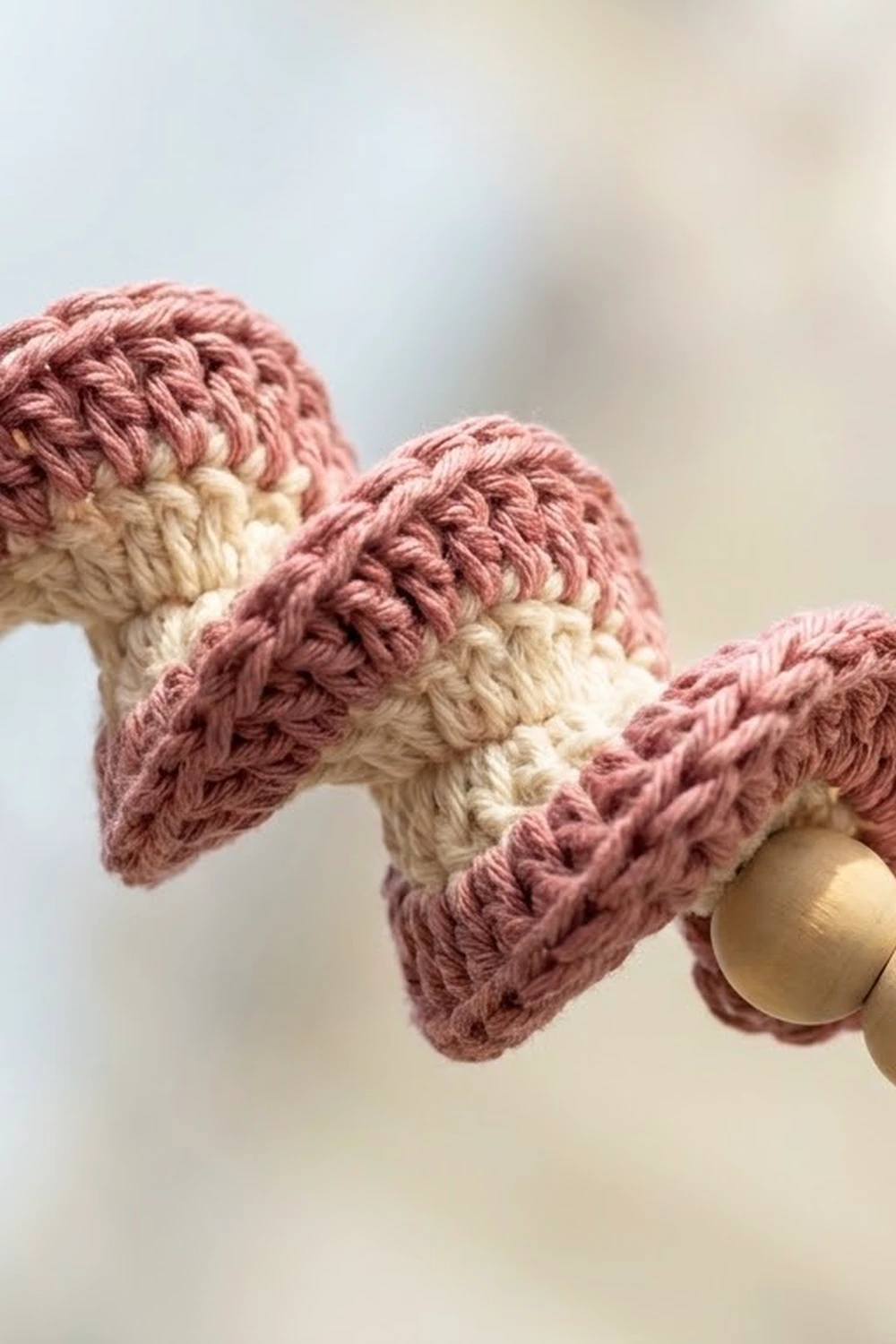
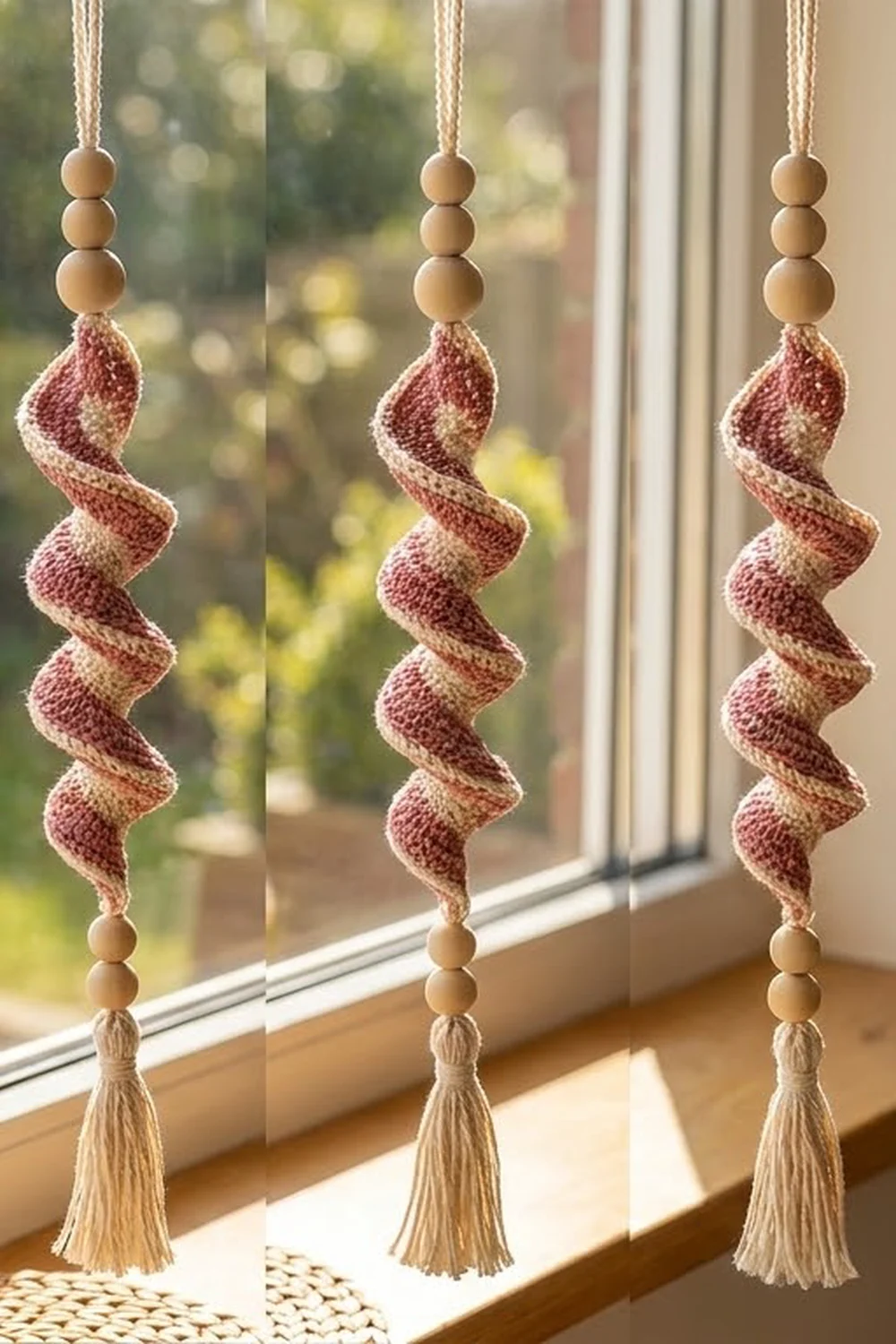
The Rosewood Twist Spiral Hanger is a single crocheted spiral, about 6.5 in (16.5 cm) long, that turns like a ribbon caught in a breeze. One long half is dusty rose and the other is cream, so as the spiral turns you see the two colors take turns: rose, cream, rose, cream, all the way down.
The spiral hangs from a cream twisted cord. Three natural wooden beads sit above it, and two more beads plus a full cream tassel hang below. It looks lovely in a sunny window, on a cabinet knob, or hung in a row of several.
This pattern uses US crochet terms. The finished spiral is about 6.5 in (16.5 cm) long and about 1.75 in (4.4 cm) wide once twisted. Including the beads and tassel, the hanger measures about 12.5 in (31.8 cm) from the top of the bead stack to the tip of the tassel, plus the hanging loop.
The construction is simple. You crochet one foundation chain that becomes the spine of the spiral. You work rose rows along one side of that chain and cream rows along the other side. Doubling the stitches in the second row makes the outer edges much longer than the spine, and that extra length forces the strip to twist into a helix by itself. A sc edging firms up both edges, and then you thread the spiral onto the cord with the beads and tassel.
Finished Size and Construction
- Finished spiral: about 6.5 in (16.5 cm) long x 1.75 in (4.4 cm) wide, twisted
- Full hanger: about 12.5 in (31.8 cm) from top bead to tassel tip, plus the loop
- Skill level: Easy
- Terminology: US crochet terms
- Yarn weight: DK (light #3) cotton
- Hook: 3.5 mm (E-4)
- Number of pieces: 1 crocheted spiral, plus 1 tassel and 1 twisted cord
- Layout: 1 spiral threaded vertically on a cord, 3 beads above, 2 beads and a tassel below
- Piece size (flat, before twisting sets in): about 9 in (22.9 cm) long along the spine
- Size before edging: about 2 in (5.1 cm) wide at the center, measured flat
- Edging depth: about 0.25 in (0.6 cm) on each long edge, bringing the flat center width to about 2.5 in (6.4 cm)
Materials
Choose a smooth, firm cotton or cotton blend in DK weight. Cotton holds the spiral shape well and shows the stitches clearly. Very soft acrylic will still twist, but the spiral may droop.
- Color A, dusty rose: about 8 g / 18 m
- Color B, cream: about 22 g / 50 m (about 7 g for the spiral, 12 g for the tassel, 3 g for the cord)
Tools and notions:
- 3.5 mm (E-4) crochet hook
- Tapestry needle with a large eye
- 5 natural wooden beads: one 12 mm and four 16 mm, each with a hole of at least 4 mm
- Stiff card about 3.5 in (8.9 cm) tall, for the tassel
- Scissors
- Spray bottle and a pencil or 0.5 in (1.3 cm) dowel, for blocking
- Stitch marker (optional)
All yarn quantities include a margin of about 15 percent for your gauge swatch and weaving in ends.
Abbreviations (US Terms)
- ch – chain
- sl st – slip stitch
- sc – single crochet
- hdc – half double crochet
- dc – double crochet
- st(s) – stitch(es)
- free loop – the single strand of the foundation chain left unworked on the opposite side after Row 1
- [ ] – repeat the instructions inside the brackets the number of times stated
Special stitch – 2 dc increase: Work 2 dc into the same stitch. This is the only increase in the pattern, and it is what makes the spiral twist.
Gauge and Checkpoints
Gauge: 18 sc = 4 in (10.2 cm) with a 3.5 mm hook. A dc row should stand about 0.5 in (1.3 cm) tall.
Gauge is not critical for a hanger, but it controls length and twist. Make the full spiral first, check it against the checkpoints below, and only then cut the cord and make the tassel.
- After Row 1 in Color A: strip about 9 in (22.9 cm) long and 0.5 in (1.3 cm) tall at the center.
- After Row 1 in Color B: strip about 1 in (2.5 cm) wide at the center, still mostly flat.
- After Row 2 on both sides: about 2 in (5.1 cm) wide at the center measured flat. The strip already twists, and its relaxed length is about 7 in (17.8 cm).
- After the edging: about 2.5 in (6.4 cm) wide at the center measured flat; about 6.5 in (16.5 cm) long and 1.75 in (4.4 cm) wide when twisted.
If your strip is more than 0.5 in (1.3 cm) longer than 9 in (22.9 cm) after Row 1, go down to a 3.25 mm hook. If it is more than 0.5 in (1.3 cm) shorter, go up to a 3.75 mm hook. Do not change the stitch counts. The twist depends on the ratio of 40 spine stitches to 64 edge stitches, not on the hook.
Spiral Pattern
Foundation and Rose Half (Color A)
With Color A, ch 41.
Row 1 (Color A): Sl st in 2nd ch from hook, sc in next 3 ch, hdc in next 4 ch, dc in next 24 ch, hdc in next 4 ch, sc in next 3 ch, sl st in last ch. (40 sts: 1 sl st, 3 sc, 4 hdc, 24 dc, 4 hdc, 3 sc, 1 sl st)
The stepped stitch heights give the strip pointed, tapered tips at both ends.
Row 2 (Color A, growth row): Ch 1, turn. Sl st in first 4 sts, sc in next 4 sts, [2 dc in next st] 24 times, sc in next 4 sts, sl st in last 4 sts. (64 sts: 4 sl st, 4 sc, 48 dc, 4 sc, 4 sl st)
The 24 center dc become 48 dc, so the outer edge is now much longer than the spine. The strip will start to ruffle and turn, which is correct. Don’t fasten off. Either put a stitch marker in the loop to hold Color A, or fasten off with a 6 in (15.2 cm) tail if you prefer.
Cream Half (Color B)
Turn the piece so the unworked free loops of the foundation chain face up. There are 40 free loops, one under each stitch of Row 1.
Row 1 (Color B): Join Color B with a sl st in the first free loop at the end where Color A finished Row 1 (this sl st counts as the first st). Sc in next 3 loops, hdc in next 4 loops, dc in next 24 loops, hdc in next 4 loops, sc in next 3 loops, sl st in last loop. (40 sts: 1 sl st, 3 sc, 4 hdc, 24 dc, 4 hdc, 3 sc, 1 sl st)
Check that each tall section sits opposite the matching tall section on the rose side. The foundation chain is now centered between the two colors and forms the spine.
Row 2 (Color B, growth row): Ch 1, turn. Sl st in first 4 sts, sc in next 4 sts, [2 dc in next st] 24 times, sc in next 4 sts, sl st in last 4 sts. (64 sts: 4 sl st, 4 sc, 48 dc, 4 sc, 4 sl st)
Both outer edges are now 64 sts long while the spine stays 40 sts long. The strip turns into a full spiral. Check the third checkpoint: about 2 in (5.1 cm) wide at the center measured flat.
Edging
The edging is one row of sc along each outer edge, in the matching color. It firms the edges so they roll neatly, as in the finished piece.
Edging gauge: same as the body, 18 sc = 4 in (10.2 cm). The edging adds about 0.25 in (0.6 cm) of depth per side.
Edging Row, Color B side: Ch 1, turn. Sc in each st across. (64 sc) Fasten off, leaving a 6 in (15.2 cm) tail.
Edging Row, Color A side: Pick up the held Color A loop (or rejoin Color A in the first st of its Row 2). Ch 1, turn. Sc in each st across. (64 sc) Fasten off, leaving a 6 in (15.2 cm) tail.
Why the math works: Each edging row is worked 1 sc in each of the 64 existing sts, with nothing added and nothing skipped. The edge length stays exactly the same as Row 2, so the 40-to-64 ratio between spine and edge is unchanged and the twist is not flattened or tightened. Adding increases here would over-ruffle the edge into waves. Skipping stitches would pull the spiral straight.
Weave in all ends along the spine, where they are hidden between the two colors.
Tassel and Cord
Tassel: Wrap Color B around the 3.5 in (8.9 cm) card 30 times. Slide a 12 in (30.5 cm) strand under the wraps at the top, and tie it tightly. Leave both ends of this strand long, because they will join the tassel to the hanger. Cut the wraps at the bottom. Wrap a separate 12 in (30.5 cm) strand tightly around the tassel, about 0.5 in (1.3 cm) below the top, 6 times. Knot it, and bury the ends inside the tassel. Trim the bottom evenly to 3 in (7.6 cm).
Twisted cord: Cut 2 strands of Color B, each 40 in (101.6 cm). Hold them together, knot both ends, and twist until the strands kink back on themselves. Fold the cord in half and let it twist together. Knot the open end. The cord will be about 18 in (45.7 cm) long.
Assembly:
- Thread both long tassel strands onto the tapestry needle. Pass them up through two 16 mm beads.
- Push the needle up through the spine of the spiral, entering the bottom tip and coming out the top tip, so it travels along the foundation chain.
- Pass the strands up through one 16 mm bead, then another 16 mm bead, then the 12 mm bead.
- Tie the strands securely around the knotted end of the twisted cord, just above the 12 mm bead. Trim the ends, and hide them inside the top bead.
- Tie the other end of the cord into a loop at the length you want for hanging.
Final Blocking
- Mist the spiral lightly with water until it is damp but not wet.
- Wrap it loosely around a pencil or 0.5 in (1.3 cm) dowel, following its natural twist. Do not force extra turns.
- Check that rose and cream alternate evenly down the length, with each color showing about three times.
- Let it dry completely on the dowel, about 4 to 6 hours.
- Slide it off and measure. The twisted spiral should be about 6.5 in (16.5 cm) long and 1.75 in (4.4 cm) wide.
- Steam the tassel lightly, then comb the strands straight with your fingers. Retrim to 3 in (7.6 cm) if needed.
If possible, block the spiral before you add the beads. It is easier to wrap around the dowel without them.
Final Quality-Control Checklist
- Foundation chain has 41 ch; each Row 1 has 40 sts.
- Each Row 2 has 64 sts, with 48 dc in the center.
- Each edging row has 64 sc.
- Both tips are pointed and tapered, matching each other.
- Rose and cream alternate cleanly as the spiral turns.
- Twisted spiral is about 6.5 in (16.5 cm) long and 1.75 in (4.4 cm) wide.
- Three beads sit above the spiral and two below it.
- Tassel is 3 in (7.6 cm) long, with a neat wrap at the top.
- All ends are hidden in the spine or inside the beads.
Troubleshooting
The strip will not twist. Check Row 2 on both sides. The center must have 48 dc. If you worked 1 dc per st, the edge is too short to force a turn.
The edges ripple like a ruffle instead of spiraling. Your tension on Row 2 may be very loose. Redo Row 2 with a hook 0.25 mm smaller, keeping the same counts.
One color shows much more than the other. The two Row 1 sections are probably out of line. Make sure the dc sections on both sides sit opposite each other along the same 24 chains.
The tips curl or flare. Pull the end sl sts snug, and re-block the tips around the dowel.
The spiral slides down the cord. Choose a top bead with a smaller hole, or tie a knot in the strands just above the spiral’s top tip.
Care
Hand wash in cool water with mild soap, press out the water in a towel, and re-block around a dowel. Keep the hanger out of strong direct sun for long periods so the rose yarn doesn’t fade.
Final Notes
The measurement chain is short and easy to follow. Your 41-ch foundation gives 40 spine sts, about 9 in (22.9 cm) long. Row 1 adds 0.5 in (1.3 cm) per side for a 1 in (2.5 cm) strip. Row 2 doubles the center to 64 edge sts and brings the flat width to 2 in (5.1 cm). The edging adds 0.25 in (0.6 cm) per side for 2.5 in (6.4 cm), and twisting draws it all into a 6.5 in (16.5 cm) by 1.75 in (4.4 cm) spiral. Add the beads and a 3 in (7.6 cm) tassel, and the hanger measures about 12.5 in (31.8 cm). Make one for a window, or make a few in the same colors to hang in a row.
Happy crocheting!