

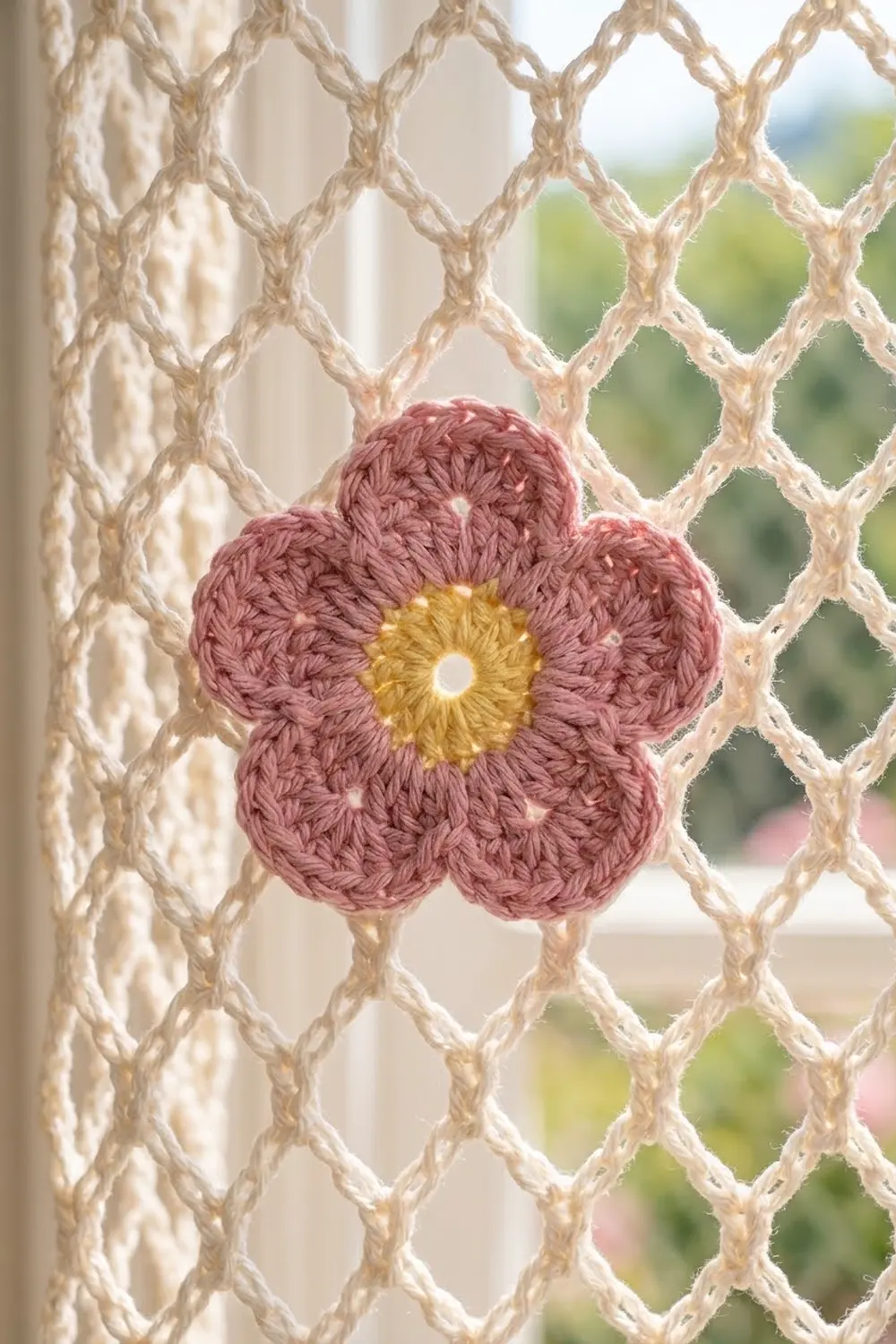
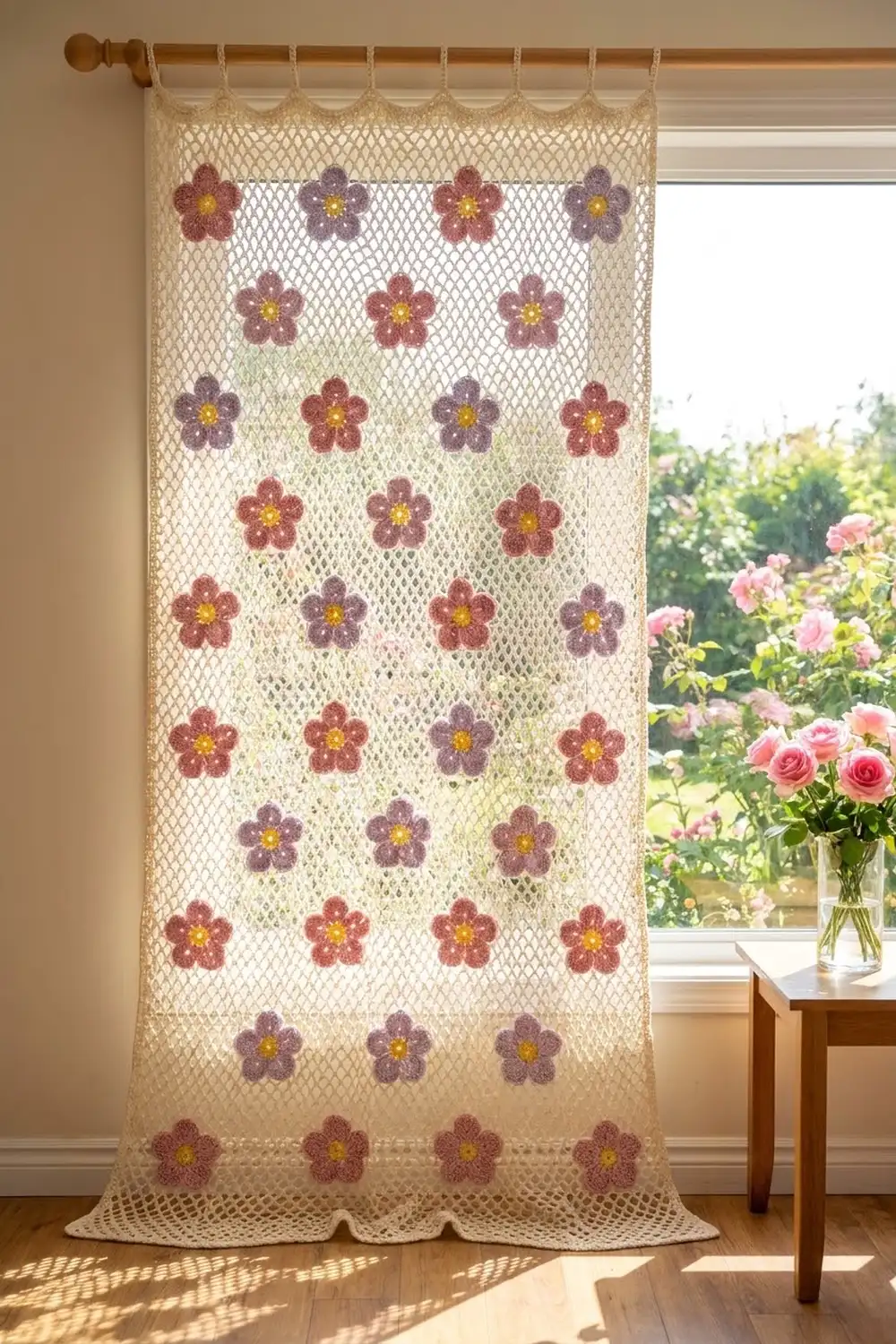
The Petal Breeze curtain is a light, airy cream mesh panel scattered with small five-petal flowers. The open diamond net lets daylight through, and the pink and lilac flowers with yellow centers sit across it in a staggered pattern. It hangs from a curtain rod by a row of crocheted tabs.
The style is soft cottage-garden: one neutral background color and three gentle accents. The mesh is a classic ch-5 net, so the body works up quickly. The flowers are small motifs you can make in batches.
This pattern uses US crochet terms. The finished panel measures 40 in wide x 80 in long (101.6 cm x 203.2 cm). The hanging tabs add about 2 in (5.1 cm) above the top edge.
You work one rectangular mesh panel in rows, add a two-round single crochet border all around, then add hanging tabs along the top. Finally, you make 42 separate flowers and sew them onto the mesh using a placement grid.
Finished Size and Construction
- Finished size: 40 in x 80 in (101.6 cm x 203.2 cm), plus 2 in (5.1 cm) tabs
- Skill level: Easy / advanced beginner
- Terminology: US crochet terms
- Yarn weight: Worsted (#4) cotton or cotton blend
- Hooks: 5.0 mm (H-8) for mesh and border, 4.0 mm (G-6) for flowers
- Number of pieces: 1 mesh panel + 42 appliqué flowers
- Layout: 12 staggered flower rows, alternating 4 and 3 flowers
- Flower size: 3 in (7.6 cm) across, petal tip to petal tip
- Size before border: 39 in x 79 in (99.1 cm x 200.7 cm), blocked
- Border depth: 0.5 in (1.3 cm) on every side
Materials
Choose a smooth mercerized or combed worsted cotton. Cotton holds the mesh shape, resists stretching on the rod, and washes well. Avoid fuzzy yarns, which blur the open diamonds. The quantities below assume about 190 m per 100 g.
- Cream (mesh, border, tabs): 450 g / 855 m
- Pink (petals): 80 g / 152 m
- Lilac (petals): 50 g / 95 m
- Yellow (centers): 40 g / 76 m
All quantities include a margin of about 25% for gauge differences and swatching.
Tools:
- 5.0 mm (H-8) and 4.0 mm (G-6) crochet hooks
- Tapestry needle with a large eye
- 12 locking stitch markers
- Measuring tape
- Rust-proof pins, towels, and a large flat surface for blocking
- Spray bottle and scissors
Abbreviations (US Terms)
- ch – chain
- sl st – slip stitch
- sc – single crochet
- hdc – half double crochet
- dc – double crochet
- sk – skip
- sp – space
- st(s) – stitch(es)
- RS – right side
- ch-5 loop – the arch of 5 chains between two sc in the mesh
Special technique – Magic ring: Wrap the yarn around two fingers to form a loop. Insert the hook, pull up a loop, and ch 1 to secure. Work the first round into the ring, then pull the tail to close the center.
Gauge and Checkpoints
Mesh gauge (5.0 mm hook, blocked): 4 ch-5 loops wide x 4 rows tall = 4 in x 4 in (10.2 cm x 10.2 cm). Each loop is 1 in (2.5 cm) wide, and each row is 1 in (2.5 cm) tall.
Border gauge (5.0 mm hook): 16 sc = 4 in (10.2 cm). 2 rounds of sc = 0.5 in (1.3 cm).
Flower gauge (4.0 mm hook): 1 flower = 3 in (7.6 cm) across.
Test first. Make one flower and a mesh swatch before you start the panel. For the swatch, ch 22 and work Row 1 below with 5 repeats (5 loops). Then work Rows 2–3 until you have 7 rows. Pin, mist, and let dry. Measure 4 loops across and 4 rows up in the center.
Checkpoints:
- Flower after Rnd 1: 1.25 in (3.2 cm)
- Flower after Rnd 2: 1.75 in (4.4 cm)
- Flower after Rnd 3: 3 in (7.6 cm)
- Foundation chain (158 ch): about 39 in (99.1 cm) relaxed
- Mesh after 20 rows: 20 in (50.8 cm) tall, gently stretched
If your gauge is too big, go down one hook size. If it is too small, go up one hook size. Blocking opens the mesh vertically, but the width should be within 1 in (2.5 cm) of the target.
Pattern: Mesh Panel
Use cream and the 5.0 mm hook. Work from the bottom edge upward. The layout is symmetrical, so you can count loops from either side.
Foundation: Ch 158.
Row 1: Sc in 2nd ch from hook, ch 5, sk 3 ch, sc in next ch; repeat from * 38 more times (39 repeats total), turn. (40 sc, 39 ch-5 loops)*
Check: 1 skipped ch + 1 sc + (39 x 4 chains used) = 158 chains.
Row 2: Ch 5 (counts as dc + ch 2), sc in first ch-5 loop, ch 5, sc in next ch-5 loop; repeat from * 37 more times (38 repeats total), ch 2, dc in last sc, turn. (39 sc, 38 full ch-5 loops, 2 half loops at the edges)*
Row 3: Ch 1, sc in first dc, ch 5, sc in next ch-5 loop; repeat from * 37 more times (38 repeats total), ch 5, sc in 3rd ch of turning ch-5, turn. (40 sc, 39 ch-5 loops)*
Row 3 gives you the same count as Row 1, with sc at both edges for a straight side.
Rows 4–79: Repeat Rows 2–3 thirty-eight more times. You finish on Row 79, an odd row with 40 sc and 39 ch-5 loops. Fasten off and weave in.
Size checkpoint: The panel should measure 39 in x 79 in (99.1 cm x 200.7 cm) when gently stretched. Count rows instead of measuring length, because unblocked mesh hangs long and narrow.
Mark the flower rows. Place a marker at the edge of Rows 7, 13, 19, 25, 31, 37, 43, 49, 55, 61, 67, and 73. These are the 12 flower rows. They are 6 rows (6 in / 15.2 cm) apart, with 6 rows of plain mesh above and below.
Pattern: Flower
Use the 4.0 mm hook. Each flower has a yellow center and pink or lilac petals.
Rnd 1 (yellow): Make a magic ring, ch 3 (counts as dc), 9 dc in ring, sl st to top of ch-3. Pull the ring closed but leave a small open center. Fasten off. (10 dc)
Rnd 2 (petal color): Join pink or lilac in any st, ch 1, 2 sc in each st around, sl st to first sc. (20 sc: 10 sts worked + 10 sts added)
Rnd 3 (petal color): Sl st in next st, (hdc, 3 dc) in next st, (3 dc, hdc) in next st, sl st in next st; repeat from * 4 more times, joining with the last sl st. (5 petals, 50 sts total: 20 sts worked + 30 added, because each group of 4 base sts becomes 2 sl st + 8 petal sts)*
The sl sts sink between the petals and form the notches between the five rounded petals. Fasten off and leave a 16 in (40.6 cm) tail for sewing.
Make All Pieces
Make 42 flowers in total:
- Pink petals: 27 flowers
- Lilac petals: 15 flowers
- Yellow centers: all 42 flowers
Before sewing, pin each flower to 3 in (7.6 cm), mist it, and let it dry.
Placement grid. Each flower is centered over one ch-5 loop on a flower row. Wide rows (A) use loops 5, 15, 25, and 35. Narrow rows (B) use loops 10, 20, and 30, which creates the staggered diagonal look. P = pink, L = lilac, . = empty. Rows are listed from the bottom up.
Loop:          5  10  15  20  25  30  35
Row 7  (A):    P   .   L   .   P   .   P
Row 13 (B):    .   P   .   L   .   P   .
Row 19 (A):    L   .   P   .   P   .   L
Row 25 (B):    .   P   .   P   .   L   .
Row 31 (A):    P   .   L   .   P   .   P
Row 37 (B):    .   P   .   L   .   P   .
Row 43 (A):    L   .   P   .   P   .   L
Row 49 (B):    .   P   .   P   .   L   .
Row 55 (A):    P   .   L   .   P   .   P
Row 61 (B):    .   P   .   L   .   P   .
Row 67 (A):    L   .   P   .   P   .   L
Row 73 (B):    .   P   .   P   .   L   .
Each block of 4 flower rows holds 9 pink and 5 lilac flowers. Three blocks give 27 + 15 = 42 flowers.
Attaching the Flowers
Sew the flowers on after you block the panel, so the mesh is at its true size.
Method: Center each flower over its loop with one petal pointing straight up, and pin through the center. Thread the petal-color tail and work from the back. Sew a running stitch around the Rnd 2 ring, catching every mesh strand underneath. Then take 2 small tacking stitches at each petal tip. Knot on the back and weave the end into the flower.
Tension: Keep your stitches snug but not tight. The diamonds under each flower should look like the ones beside it. Pulling hard puckers the mesh.
Logic check: Columns are 5 loops (5 in / 12.7 cm) apart. Flowers in the same row are 10 in (25.4 cm) apart, and flower rows are 6 in (15.2 cm) apart. At 3 in (7.6 cm) wide, the flowers never touch.
Size checkpoint: After sewing, the panel should still measure 39 in x 79 in (99.1 cm x 200.7 cm). If it doesn’t, loosen the tightest flowers.
Border
Use cream and the 5.0 mm hook. The corners are ch-2 spaces. The side counts below are the sts between the corner ch-2 spaces and do not include them.
Rnd 1: With RS facing, join cream in the first sc of Row 79.
- Top edge: Sc in first sc, 3 sc in next ch-5 loop, sc in next sc; repeat from * 38 more times. (157 sc: 40 sc worked 1-per-sc + 117 sc in the 39 loops)*
- Ch 2 for the corner.
- Side edge: Work 4 sc in each row end. On even rows, work around the dc or turning ch. On odd rows, work around the edge sc. (79 rows x 4 = 316 sc)
- Ch 2 for the corner.
- Bottom edge: Working in the free loops of the foundation chain, sc in each ch from the first sc to the last sc of Row 1. (157 sc: chains 2 through 158)
- Ch 2 for the corner.
- Second side edge: Work as for the first side. (316 sc)
- Ch 2, sl st to first sc. (946 sc + 4 corner ch-2 sps)
Rnd 2: Ch 1, sc in each sc to first corner, (sc, ch 2, sc) in corner ch-2 sp, sc in each sc to next corner; repeat from * around, ending with (sc, ch 2, sc) in the last corner, sl st to first sc. (Top and bottom: 157 worked + 2 added = 159 sc each. Sides: 316 worked + 2 added = 318 sc each. Total: 946 + 8 = 954 sc + 4 corner ch-2 sps)*
Fasten off and weave in.
Why the math works: At 16 sc per 4 in (10.2 cm), 159 sc measure 39.75 in (101.0 cm), and the corners bring the width to 40 in (101.6 cm). The 318 sc on each side measure 79.5 in (201.9 cm), and the corners bring the length to 80 in (203.2 cm). You work 4 sc for every 1 in (2.5 cm) of mesh, which matches the border gauge, so the border lies flat.
Hanging Tabs (top edge only):
Tab Row 1: With RS facing, join cream in the first sc after the top-right corner ch-2 sp. Sc in same st and next 14 sts, ch 15, sk 3 sts, sc in next 15 sts; repeat from * 7 more times, turn. (8 tabs: 9 groups of 15 sc + 8 skipped groups of 3 = 159 sts)*
Tab Row 2: Ch 1, sl st in each sc and work 18 sc in each ch-15 loop across. Fasten off.
Each tab is a sturdy loop about 2 in (5.1 cm) tall. The tabs are 18 sts, or 4.5 in (11.4 cm), apart from center to center.
Final Blocking
- Weave in all remaining ends.
- Lay towels over a 40 in x 80 in (101.6 cm x 203.2 cm) area.
- Lay the curtain RS up and mist it until damp, not soaked.
- Pin the four corners to the final size.
- Pin along each edge every 4 in (10.2 cm), keeping the border straight.
- Open the mesh so each diamond is about 1 in (2.5 cm) wide and tall.
- Press each flower flat with your palm.
- Let it dry completely, for at least 24 hours, then unpin.
Final Quality-Control Checklist
- The panel measures 40 in x 80 in (101.6 cm x 203.2 cm) without tabs.
- Rows 1 and 79 each have 40 sc and 39 loops.
- 42 flowers are attached (27 pink, 15 lilac), each with an open center and 5 even petals.
- The flowers sit on Rows 7 through 73 in the correct columns, with no puckering.
- Border Rnd 2 has 159 sc on the top and bottom and 318 sc on each side.
- All 8 tabs are evenly spaced and fit your rod.
- All ends are woven in securely.
Troubleshooting
The panel is narrower than 39 in (99.1 cm). Your chains are tight. Use a larger hook for the foundation chain, or block firmly in width.
The side edges dip. Check that Row 2 ends with ch 2 and dc, and that Row 3 starts with sc in that dc.
The loop count drifts. Count every 10 rows. Odd rows have 39 loops. Even rows have 38 full loops plus 2 half loops.
The flowers cup. Re-block them, or work Rnd 3 with a 4.5 mm (7) hook.
The petals don’t separate. The sl sts go in the first and fourth st of every group of 4 sts.
The border ruffles or pulls. Recount: 4 sc per row end and 3 sc per loop.
The tabs stretch. Work Tab Row 2 more firmly.
Care
Hand wash, or machine wash on a cold gentle cycle in a mesh laundry bag. Lay it flat to dry. Never hang it wet, because the weight stretches the mesh.
Final Notes
Each mesh loop and each row is 1 in (2.5 cm), so 39 loops and 79 rows give 39 in x 79 in (99.1 cm x 200.7 cm). The border adds 0.5 in (1.3 cm) on each side, for 40 in x 80 in (101.6 cm x 203.2 cm). The 42 flowers are 3 in (7.6 cm) each and sit on a grid of columns 5 loops apart, with flower rows every 6 rows. 8 tabs hold the panel on the rod.
Check your swatch and count your loops, and the rest will follow. Happy crocheting!