

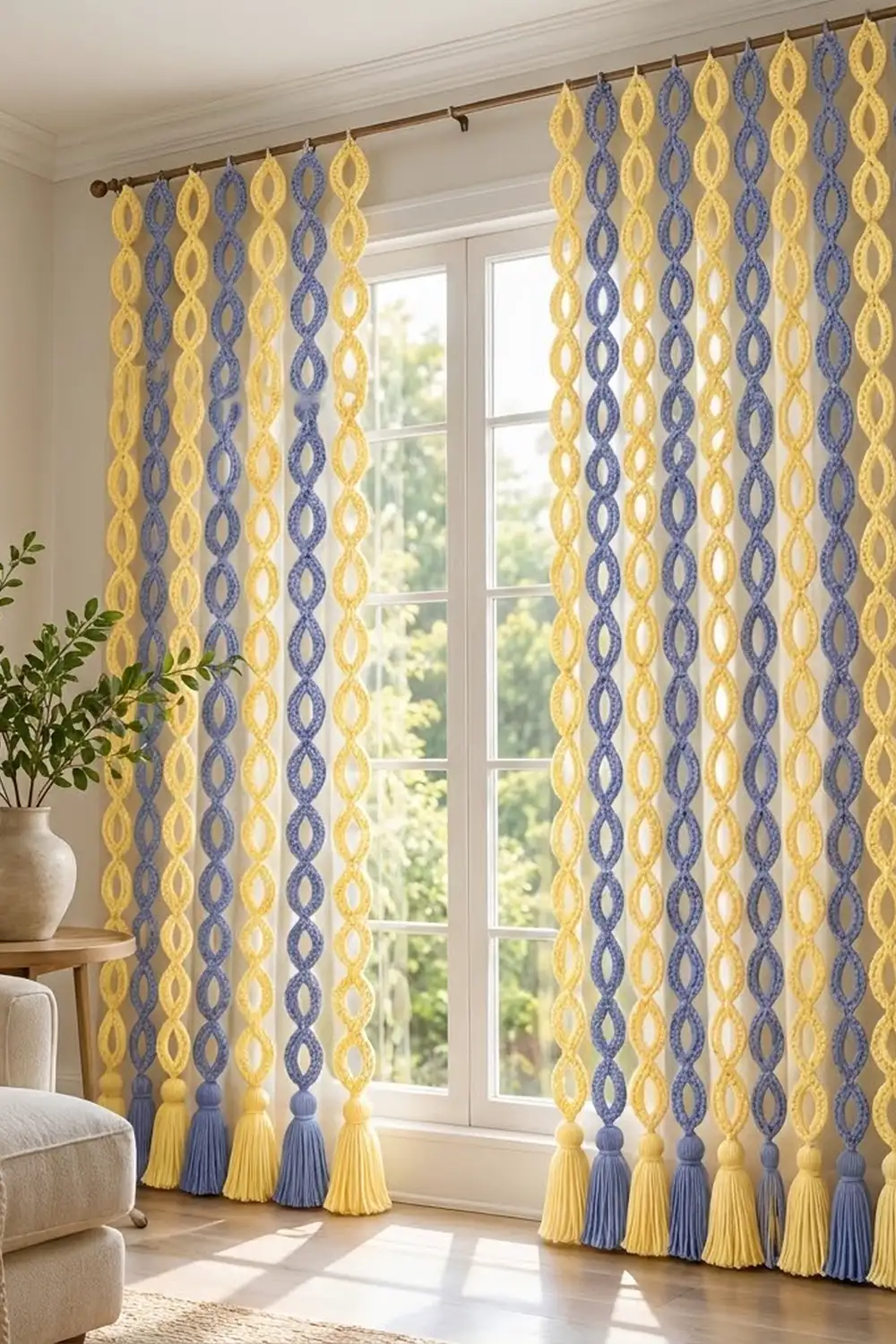
This strand curtain is made from long, separate crocheted strands. Each one is a chain of almond-shaped eyelets linked tip to tip and finished with a full tassel. When the strands hang side by side from a rod, the open eyelets let light and air through while still softening the window.
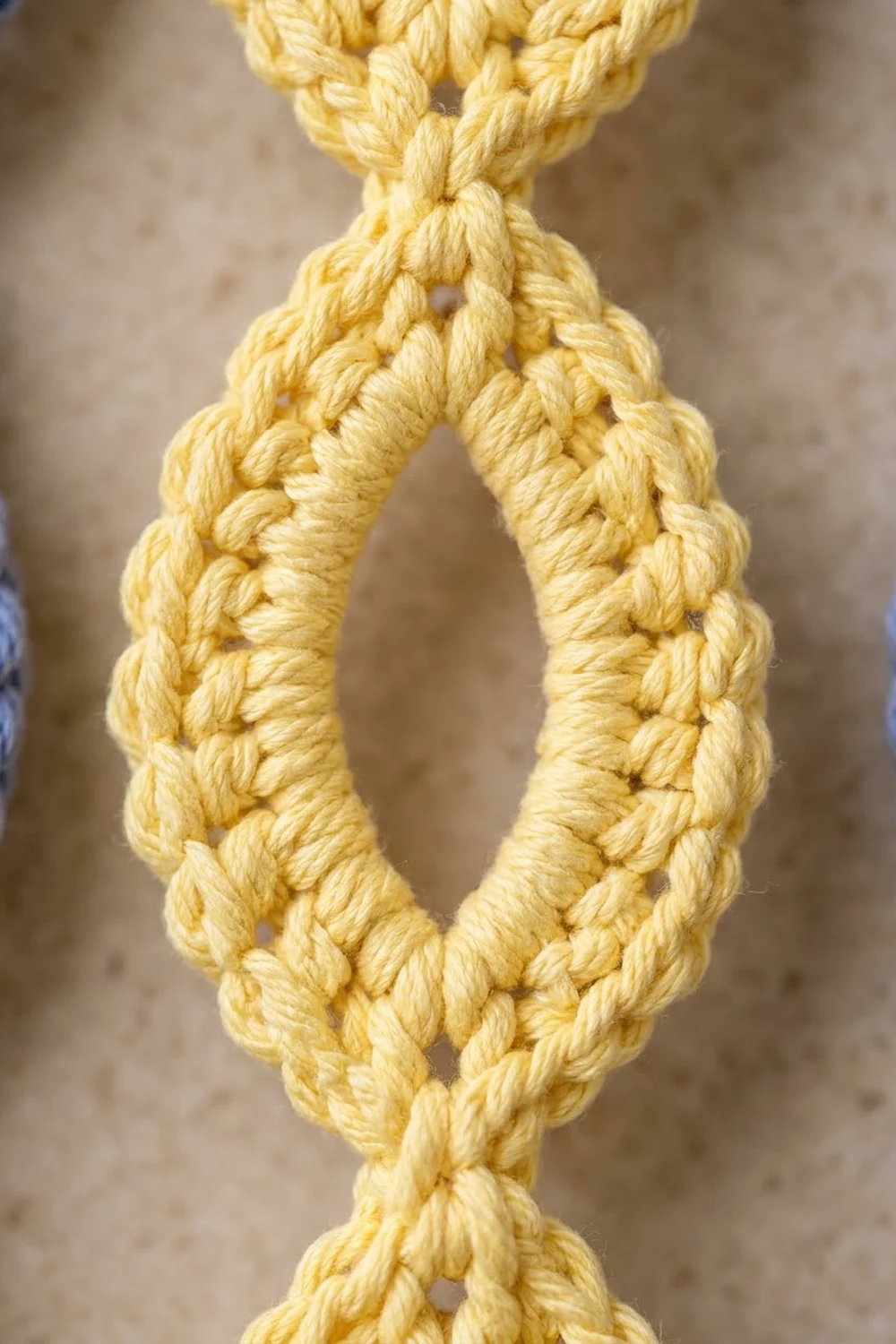
The palette is butter yellow and soft periwinkle blue, set out in alternating strands. Each eyelet has a dense ring of upright stitches. They are short at the two tips and tall at the widest point, which gives the almond shape and a rounded, sculpted edge. Each strand ends in a tassel in the same color, with a crocheted cap over a round head.
The pattern uses US crochet terms. One finished strand measures 1.5 in (3.8 cm) wide and 72.5 in (184.2 cm) long from the top of the hanging loop to the tip of the tassel. Each panel has 12 strands spaced 2 in (5.1 cm) apart, giving a panel width of 23.5 in (59.7 cm). The set has two panels.
Each strand is worked in two passes from one continuous chain. Going down, you chain a loop for each eyelet and cover its left half with stitches. Coming back up, you cover the right halves. A covered hanging loop at the top and a capped tassel at the bottom finish the strand.
Finished Size and Construction
- Finished strand size: 1.5 in (3.8 cm) wide x 72.5 in (184.2 cm) long, including tassel
- Skill level: Easy
- Terminology: US crochet terms
- Yarn weight: Worsted (#4), cotton or cotton blend
- Hook: 5.0 mm (H-8)
- Number of pieces: 24 strands (12 per panel), plus 24 tassels and 24 tassel caps
- Layout: 2 panels; each panel alternates yellow and blue, starting with yellow
- Piece size: each eyelet is 2.75 in (7.0 cm) tall x 1.5 in (3.8 cm) wide; one eyelet plus one waist is 3.25 in (8.3 cm)
- Size before finishing: the eyelet section is 64.5 in (163.8 cm) for 20 eyelets
- Finishing depth: hanging loop plus stem adds 2 in (5.1 cm) at the top; the tassel adds 6 in (15.2 cm) at the bottom
Materials
A smooth mercerized or combed cotton in worsted weight gives the clearest stitch definition and stays in shape on a sunny window. Acrylic will stretch more as it hangs, so if you use it, check your length after a day of hanging before you add tassels.
- Butter Yellow: 400 g / 720 m (12 strands and tassels)
- Periwinkle Blue: 400 g / 720 m (12 strands and tassels)
One complete strand, tassel included, uses about 25 g / 45 m. The quantities above allow a margin of about 30% for your gauge swatch, gauge differences, and tassel trimming.
Tools:
– 5.0 mm (H-8) crochet hook
– Tapestry needle
– Scissors
– Stiff card cut to 6.5 in (16.5 cm) wide, for tassels
– Tape measure
– Locking stitch markers
– Spray bottle and a few clothespins for blocking
– Curtain rod up to 1 in (2.5 cm) in diameter, or curtain clip rings
Abbreviations (US Terms)
- ch – chain
- sl st – slip stitch
- sc – single crochet
- hdc – half double crochet
- dc – double crochet
- st(s) – stitch(es)
- sp – space
- MR – magic ring
Special stitch: Eyelet Half (EH). Working into the ch-16 ring (around the chain, not into individual chains): 2 sc, 2 hdc, 5 dc, 2 hdc, 2 sc. (13 sts)
Because the stitch heights step up from sc to dc and back down again, the middle of each half bulges out and the tips stay narrow. That is what makes the almond shape.
Gauge and Checkpoints
Make one test strand of 3 eyelets before you start the full set. Follow the pattern below, but chain only 3 eyelets in Pass 1, then complete Pass 2. You can leave out the tassel on the test.
- Eyelet gauge: one finished eyelet = 2.75 in (7.0 cm) tall x 1.5 in (3.8 cm) wide, measured flat without stretching.
- Waist: the ch-2 waist between eyelets = 0.5 in (1.3 cm).
- Checkpoint A (3 eyelets): 3 eyelets plus 2 waists = 9.25 in (23.5 cm).
- Checkpoint B (10 eyelets, on your first real strand): 32 in (81.3 cm).
- Checkpoint C (20 eyelets): 64.5 in (163.8 cm).
If your eyelets are too big: go down to a 4.5 mm (US 7) hook. If eyelets are tall but the width is correct, your ch-16 rings are loose, so chain more firmly.
If your eyelets are too small: go up to a 5.5 mm (I-9) hook. If they look crowded and cupped, check that you work around the chain and not into individual chains.
A difference of 0.25 in (0.6 cm) per eyelet adds up to about 5 in (12.7 cm) over 20 eyelets. Fix gauge before going further.
Strand Pattern (Make 24: 12 Yellow, 12 Blue)
Pass 1: Down the Left Side
Hanging loop: Ch 14, sl st in the first ch made to form a ring. This loop is covered at the end of the strand.
Stem: Ch 3.
Eyelet 1: Ch 16, sl st in the 16th ch from hook (the first of these 16 ch) to form a ring. Work 1 EH into the ring. (13 sts)
You started at the top of the ring and worked down its left side, so your hook is now at the bottom tip.
Waist: Ch 2.
Eyelets 2–20: Ch 16, sl st in the 16th ch from hook to form a ring, work 1 EH into the ring, ch 2 (waist); repeat 18 more times, but do not ch 2 after Eyelet 20.
Pass 1 count check: 20 ch-16 rings, each with 13 sts on the left half; 19 waists of 2 ch; 3 stem ch; 1 ch-14 loop. Place a marker in the last st of Eyelet 20.
Checkpoint: lay the strand flat. Each half-covered ring looks like a lopsided teardrop, all with the stitches on the same side. If any eyelet’s stitches sit on the opposite side, the ring got twisted. Undo back to that ring.
Pass 2: Up the Right Side
Do not turn. Keep working in the same direction around the ring, so the right side faces you the whole time.
Eyelet 20: Work 1 EH into the remaining (right) half of the same ring, working up from the bottom tip to the top. (13 sts; Eyelet 20 now has 26 sts)
Climb the waist: Sl st in each of the 2 waist ch above, working into the back bump of the chains. (2 sl st)
Eyelets 19–1: Work 1 EH into the remaining half of the next ring up (13 sts; eyelet total 26 sts), sl st in each of the 2 waist ch above; repeat for each eyelet. After Eyelet 1, there is no waist. Sl st in each of the 3 stem ch instead. (3 sl st)
Pass 2 count check: every eyelet has 26 sts (13 per half). That makes 520 sts in the eyelets, plus 38 sl st on the waists and 3 sl st on the stem.
Push the stitches gently along each ring so the two halves meet neatly at the top and bottom tips without gaps.
Tassel Cap (Make 24: 12 Yellow, 12 Blue)
Rnd 1: Work 6 sc in MR, sl st in first sc. (6 sts)
Rnd 2: Ch 1, 2 sc in each st around, sl st in first sc. (12 sts)
Rnds 3–5: Ch 1, sc in each st around, sl st in first sc. (12 sts)
Fasten off, leaving a 6 in (15.2 cm) tail. The cap measures 1.25 in (3.2 cm) tall and 1 in (2.5 cm) wide.
Tassel (Make 24: 12 Yellow, 12 Blue)
- Cut a 12 in (30.5 cm) tie strand and set it aside.
- Wrap yarn 30 times around the 6.5 in (16.5 cm) card.
- Slide the tie strand under the wraps at one edge and knot tightly. Cut the wraps along the opposite edge.
- Thread both ends of the tie up through the center of the cap, from the inside out, and push the folded head into the cap.
- Wrap yarn 6 times tightly around the tassel just below the cap, knot, and bury the ends inside the tassel.
- Trim the tassel so it measures 6 in (15.2 cm) from the top of the cap to the tip.
Thread the two tie ends through the bottom tip of Eyelet 20, where the two halves meet. Knot them so the cap sits snugly against the tip, and bury the ends in the tassel. Use the cap tail to sew the cap rim to the tassel neck with 4 small stitches.
Make All Pieces
- Butter Yellow: 12 strands, 12 caps, 12 tassels
- Periwinkle Blue: 12 strands, 12 caps, 12 tassels
Layout (Y = yellow, B = blue), viewed from inside the room, left to right:
Panel 1:  Y  B  Y  B  Y  B  Y  B  Y  B  Y  B
Panel 2:  Y  B  Y  B  Y  B  Y  B  Y  B  Y  B
Each column is one strand, with 2 in (5.1 cm) between centers.
Joining (Hanging the Strands)
The strands are not joined to each other. Each one hangs on its own from the rod, so they move freely and can be removed for washing one at a time.
Method: Slide each covered hanging loop onto the rod in layout order. If your rod has fixed finials, attach each loop to a curtain clip ring instead.
Spacing logic: The strands are 1.5 in (3.8 cm) wide and are spaced 2 in (5.1 cm) center to center. That leaves a 0.5 in (1.3 cm) gap between neighboring strands. One panel spans 11 gaps between centers (11 x 2 in = 22 in) plus half a strand at each end (0.75 in + 0.75 in = 1.5 in), for 23.5 in (59.7 cm).
Tension advice: Hang every strand before you trim or adjust anything. Cotton relaxes by up to 0.5 in (1.3 cm) in the first day. Do not pull the strands to make them match. Let them hang overnight, then compare.
Size checkpoint: each panel is 23.5 in (59.7 cm) wide. All tassel tips should line up within 0.5 in (1.3 cm) of each other, 72.5 in (184.2 cm) below the top of the loops.
Border (Hanging Loop Finish)
This curtain has no traditional border. Instead, the edge finish is the covered hanging loop, worked as the last step of each strand.
Border gauge: 1.5 sc per chain of the loop. Working into a ring space packs the stitches against the inside of the curve, so the outside needs extra stitches to lie flat.
Loop round: After the 3 stem sl sts, your hook is at the base of the ch-14 loop. Work 21 sc into the loop sp, sl st in the first sc. Fasten off and weave in the ends. (21 sts)
Per-side count: When the loop is flattened, each side has 10 sc. The 1 remaining sc sits at the top of the curve, so 10 + 10 + 1 = 21.
Why the math works: 14 ch x 1.5 = 21 sc, which covers the chain without ruffling or cinching. The finished loop is 1.5 in (3.8 cm) tall and fits over a rod up to 1 in (2.5 cm) thick. Together with the 0.5 in (1.3 cm) stem, it adds the 2 in (5.1 cm) top section to the strand.
Full length check: 2 in (top) + 64.5 in (eyelets) + 6 in (tassel) = 72.5 in (184.2 cm).
Final Blocking
- Weave in all remaining ends before blocking.
- Hang each strand from a hook or the rod.
- Mist the strand evenly until it is damp, not dripping.
- Pinch each eyelet so its two tips are centered on the strand and the opening is a clear almond shape.
- Clip a clothespin to the tassel neck to add light weight, and let it dry fully.
- Comb the tassel strands with your fingers, steam lightly, and re-trim any uneven ends level at 6 in (15.2 cm).
Final Quality-Control Checklist
- Every eyelet has 26 sts: 13 on each half.
- Stitches step up from sc to hdc to dc and back down, so each eyelet has two pointed tips.
- No eyelet is twisted; all of them face the same way.
- Waists are 0.5 in (1.3 cm), and each one is covered with 2 sl st.
- The hanging loop has 21 sc and is 1.5 in (3.8 cm) tall.
- Tassel caps sit snugly against the bottom tip of the last eyelet.
- Each strand is 72.5 in (184.2 cm) long after hanging overnight.
- Each panel is 23.5 in (59.7 cm) wide, with colors alternating Y, B from the left.
Troubleshooting
Eyelets look round, not almond-shaped: You may have worked dc too early. Check that each half follows 2 sc, 2 hdc, 5 dc, 2 hdc, 2 sc, and that the tips are pinched during blocking.
Gaps at the eyelet tips: Work the first and last sc of each half snugly, and push them toward the tip.
Strand twists when hanging: A ring was twisted in Pass 1. Rip back to it, or steam the strand while it hangs with a weight on the tassel.
Strands differ in length: Count the eyelets on each strand. If all strands have 20, block the short ones a second time with a little more weight.
Tassel looks thin: Wrap 35 times instead of 30, using about 1 g more yarn per tassel.
Cap slips down: Tighten the neck wraps and add 2 more stitches between the cap rim and the neck.
Care
Remove the strands from the rod, hand wash in cool water with mild soap, and roll them in a towel. Rehang the strands to dry so they keep their length and shape.
Final Notes
Your measurements build on each other. The eyelet gauge is 2.75 in (7.0 cm) per eyelet, so one eyelet plus one waist is 3.25 in (8.3 cm). Twenty eyelets make 64.5 in (163.8 cm). Add the 2 in (5.1 cm) top section and the 6 in (15.2 cm) tassel, and each strand is 72.5 in (184.2 cm). Twelve strands at 2 in (5.1 cm) spacing give a 23.5 in (59.7 cm) panel.
To change the length, add or remove eyelets; each one changes the strand by 3.25 in (8.3 cm). Check your test strand first, and the rest of the set will follow.
Happy crocheting!